
by Christie Purifoy | Mar 6, 2017 | Art, Church, Gardening, Home, Homebound, Lent, Seasons, Spring, Uncategorized, Waiting
Elizabeth and I are homebound. She, a writer of poetry and prose, is bound to Mersea, a 1904 white Victorian nestled in the historic district of a South Carolina shrimping village. I am bound to Maplehurst, a red-brick farmhouse built by Pennsylvania Quakers in 1880. We are both writers, wives, and mothers, but nearly twenty years and hundreds of miles lie between us. This season, as winter turns toward spring and Lent leans toward Easter, Elizabeth and I are writing letters, she beneath the pines and pecans, I beneath the hemlocks and maples. We will reflect together on our homebound journeys. We will explore the bonds of love and faithfulness that tie us, and not always easily, to these particular places and to the people sheltered within them. Please join us for an epistolary exploration of love, loss, and restoration.

Read Elizabeth’s letter of March 3 here. My response is below.
March 6, 2017
In my third-floor office, tucked up in an armchair near the window
Dear Elizabeth,
You write of pansies and roses and blooming cherry trees, and I imagine a scented floral carpet working its way across our country, south to north. I know a new season is on its way, but it is difficult to believe in spring while this bitter wind whips across my attic window. The temperature here at Maplehurst is predicted to fall to thirteen tonight. I am afraid that the swollen buds on my peach and apricot trees will not survive to bloom. Seasons do collide, as you say, and there are casualties. I am grieving the fruit we likely will not pick this July.
To invest in a garden is to have your heart broken on a regular basis. The more you pour in, the more you receive, but the more you also have to lose. In the past year or two, I have focused my gardening efforts on “extending the season of interest,” as it says in one of my gardening books. This means planting the earliest blooming snowdrops and daffodils and the latest flowering dahlias and windflowers. This week has shown me that in addition to the great joy of more flowers I now also have an extended season for potential heartbreak. My early “February Gold” daffodils were a lovely winter surprise, but now they look, from my window, like a child’s toys left out to be ruined in the weather. I should have gathered them all up, but I couldn’t bear to erase every last bit of golden yellow from beneath the hawthorn trees.
I had forgotten how slow the shift from winter to spring can be (two steps forward, one step back). Home restoration is the same. I sometimes think that every project we complete merely highlights the decay that remains in new ways. If I paint a wall, the ceiling suddenly looks dingy. If I paint one radiator, the peeling paint on the others stands out more than ever. I recently painted the trim down our back stairs, but now the cracks in the plaster wall are all I can see (two steps forward, one step back). If I struggle to know where to begin, I also struggle to decide when, and where, to stop.
You write that the slow process of transformation shapes you, that it is formative. I agree, and yet I resent the slowness. If I could, I would snap my fingers – ta da! – and Maplehurst would be fixed, repaired, spruced up. This place, and everyone in it, would be healed. Made whole. But if I lost the process, what else would I lose? I know I would lose a great deal, though I am loathe to admit it.
Lent is indeed a sacred time. It is a season for active waiting. It is the season when I try to turn, deliberately, toward the source, like a daffodil turning its face toward the sun.
…
I set this letter aside when it came time to make dinner. Now a night and a day have passed. The cold did come. The daffodils no longer look like toys, but like debris that has been trampled underfoot. They are utterly wilted.
The bitter cold arrived with the first Sunday of Lent. In the morning, I read the Sunday paper and shook my head. I could not finish a single story because every one was breaking my heart. At church, we began our service, as we do every year during Lent, with a recitation of the ten commandments and a prayer of confession.
Now I recall what it is I hear when you say the name of your home Mersea.
Mercy. I hear mercy.
It is both prayer (Lord, have mercy) and statement (Lord, you are merciful indeed).
with love,
Christie
Maplehurst

by Christie Purifoy | Mar 1, 2017 | Art, Home, Homebound, Lent, Spring, Uncategorized
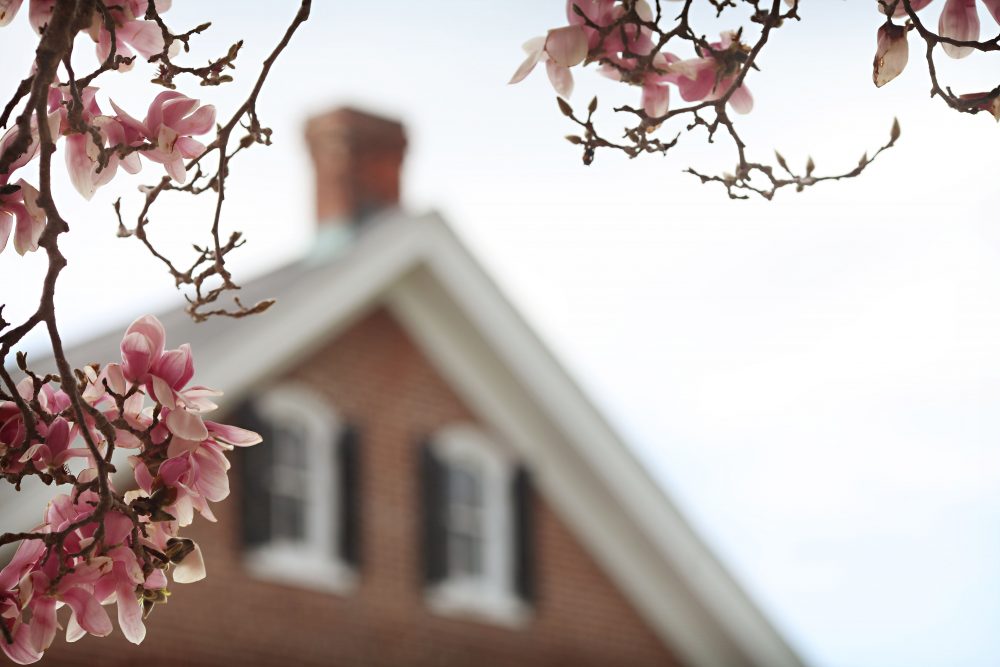
Elizabeth and I are homebound. She, a writer of poetry and prose, is bound to Mersea, a 1904 white Victorian nestled in the historic district of a South Carolina shrimping village. I am bound to Maplehurst, a red-brick farmhouse built by Pennsylvania Quakers in 1880. We are both writers, wives, and mothers, but nearly twenty years and hundreds of miles lie between us. This season, as winter turns toward spring and Lent leans toward Easter, Elizabeth and I are writing letters, she beneath the pines and pecans, I beneath the hemlocks and maples. We will reflect together on our homebound journeys. We will explore the bonds of love and faithfulness that tie us, and not always easily, to these particular places and to the people sheltered within them. Please join us for an epistolary exploration of love, loss, and restoration.
Find Elizabeth’s first letter here. My response is below.
March 1, 2017
From the kitchen table at Maplehurst, where a peacock blue, block-printed tablecloth is scattered with the crumbs of last night’s pancake supper
My friend,
As I write, Dr. B is smoothing down our old oak floors with an electric sander. It sounds as if an airplane has flown in through an open window by mistake, a mechanical bird looking for escape. Once the old finish is removed, he will soak the wood in a mixture of tung and orange oils. The dull, dry floorboards will absorb their own luster until they can absorb no more. Then the floors will shine for the first time in many decades, and my children will no longer gather splinters with their bare toes. He says the finish will take a month or so to cure. While we wait, the rugs will lie rolled up in the basement, and the house will smell like a grove of Florida citrus.
Dr. B is our doctor of old houses, and he does indeed have the healer’s gift. He came to us a year ago when Jonathan and I found that we had fallen into a silence more sinister than the usual quiet lull between house projects. This was the silence of rotted wood beyond our ability to repair and crumbling limestone mortar whose nineteenth-century recipe was a puzzle we could not hope to solve.
The first time I met him he showed me photographs of his intricate, swirling plaster work. I admired them like I admire sculpture in a museum. It did not matter that our plain, Quaker-built farmhouse has no decorative plasterwork. The second time I met him he told me he’d been praying for one more old house to restore. Maplehurst was the answer to his prayer, but he is the answer to ours.
Here in Pennsylvania, a mild winter appears to be coming to an early end. I have seen the very first of the bright yellow daffodils called “February Gold.” Despite their name, they have never bloomed for me in February, until this year.
Soon, then, he and I will turn our attention outdoors. He to the red bricks in need of fresh mortar on the west side of the house, and me to the garden. Before I plant out sweet peas and dig in bareroot roses, however, I need to finish wallpapering and painting “Julie’s room.” For two years, our friend Julie lived in this room, but last month she moved out to a place of her own. I have chosen a pale, not-too-pink shade of pink for the sloped attic ceiling and walls, and a bold pink-and-blue floral wallpaper for the window wall at the far end of the room. Quite likely, we will call this bedroom “Julie’s room” forever, but I intend it to be a bedroom my two nieces can call their own each time they visit.
Perhaps I plant baby trees so enthusiastically because I, like you, live in fear that one of our ancient pines will one day topple down, taking our front porch with it. Restoration that peels back the ravages of time like layers of old paint is such a hopeful thing. But the restoration required of us in the wake of disaster, even a disaster as small as a broken pane of glass or the deep scratch my boys left on the banister, is a more daunting cross to carry. In my weariness, I opt for bandages that hide but do not heal. Months ago, I taped a square of cardboard across the missing pane of glass in the door to my potting shed. Now I can see that cardboard flapping in the breeze.
Restoration is beautiful to contemplate, wonderful when finished, but often difficult to live. In this season at Maplehurst, restoration is the bone-rattling sound of renewed floors. It is the rosy-pink glow of a bedroom decorated for young girls. It is also the note on my calendar reminding me that my husband will soon travel to escort our nieces to their Daddy-Daughter Dance.
To commit oneself to restoration, we must be willing to draw near to brokenness. Broken floors. Broken hearts.
Today is Ash Wednesday. Tonight, I will make the drive to church with my children. I will allow four soft, small foreheads to be smudged with a mark of sin and death. We are turning toward spring, toward resurrection, yet I worry: is restoration second-best? Is it always not-quite-as-good-as new? When I study these many broken things, I know I want better-than-new.
The broken walls, of which Scripture speaks so often, are only partially rebuilt. The ruins have only begun to be repaired.
But the work has begun, and this gives me hope.
With gratitude for your listening ear,
Christie
at Maplehurst
*
You can find Elizabeth Marshall’s letters and more of her beautiful words here.


by Christie Purifoy | Feb 7, 2017 | children, guest post, Jesus, motherhood, Uncategorized, Waiting
I still remember when I discovered Hilary Yancey’s writing online. She writes the kind of sweet-sharp prose that I love. Hers is the beautifully precise storytelling that hurts a little to read but always in the best possible way. I remember thinking, “I hope she writes a book one day.”
I am so pleased to share the following guest post from Hilary with you. She writes for those who are waiting for help or good news but worry time is running out. She writes for those who wonder why there seems to be no miracle for them.
Hilary reminds me that good news unfolds in time. Rarely can we receive it in an instant. Instead, it is, like grace, something that reveals itself slowly. But given time, it will sink its roots down deep into our lives changing, not only our present and our future, but our past as well.
I was all grace-less worry the first six weeks of my son’s life. He was born into the bright steadying lights of the NICU. He was born into weeks of poking, prodding, scoped up and down. His first pictures besides our Instagram snapshots were the flickery black and white of heart and head and kidney ultrasounds.
Two by two, we would go into that ark, my husband and I. Two by two, and no more than that at a time. In the mornings the attending physicians and residents would form a crescent moon standing around his bassinet, and the real moon would take the night watch alongside us.
We are all born into motherhood. The labor is from us, and for us, and so I too was welcomed by bright lights and pulsing blue and red monitors. I too was born into an endless click, click of blood pressure cuffs and kinked IV needles and blanket forts to hide us while we slept.
This birthing birthed in me a worry of keeping it together, of keeping on for him, a worry of being enough. I have known this worry before, but it has a different shape in the helpless hallways of a hospital. I was told by every sign and monitor and nurse who ran past me for the red or yellow alarm that I – the mother, the one they say is everything and has been everything – was not the only person my son needed. I was reminded of this when I had to leave Jack’s bedside or faint from not eating. I was reminded when I tossed and turned in the hotel bed that felt suddenly empty.
It ripped me wide, this birth into hand sanitizer rituals and the required removal of wedding rings, these quiet conference rooms where the patient in bed 34 was the topic of conversation, where my son was the patient in bed 34. In all this worry I lost the thread that binds us back together. I lost the thread of the hem of the robe of Jesus.
I think of the woman and her hemorrhages. I think of myself and the way I seemed to hemorrhage confidence and trust as I walked the same dreaded hallways. Is that how she felt, finally seeing his feet passing her by, walking somewhere else? Why didn’t he stop for me – I’ve been here for years – what other house must he go to? What other miracle is more worthy than mine?
I became, this past year, the woman suffering from hemhorrages. I sat down on the side of the road and day after day I thought Jesus would never walk by, that I would never get the chance to reach out for his robe. I wondered if there was any strength left to do even that. When I was pregnant with my son I used to read him the Jesus Storybook Bible. “‘We don’t have time!’ Jesus’ friends said. But Jesus always had time. He reached out his hands and gently lifted her head. He looked into her eyes and smiled. ‘You believed,’ he said, wiping a tear from her eye, ‘and now you are well.’
Just then, Jairus’ servant rushed up to Jairus. ‘It’s too late,’ he said breathlessly. ‘Your daughter is dead.’ Jesus turned to Jairus. ‘It’s not too late,’ Jesus said. ‘Trust me.’”
There is the place where Jesus is going. And then there is the woman I believe he always waited for along the road. I believe that road wanders through the bright hallways of the hospital, past me, that he always has enough time for me to reach out for his robe.
And now, one year later, I open the book to this page, to this story. I am the woman with her fingers grasping the edge of Jesus and I am the woman receiving grace from him, a grace that pours back over the worrying, the disbelieving, the many days when I walked the hallways in quiet desperation. Even when I thought there was no time – Jesus has always had more than enough. Jesus was waiting, maybe even trusting, that we will stop him and touch the hem of his robe.

Hilary Yancey is mama to Jack, wife to Preston and in the midst of getting a PhD in philosophy from Baylor University. When she isn’t chasing an idea, a busy toddler, or learning the first few steps in her adult beginner ballet class, you can find her writing at her blog the wild love or on Instagram at @hilaryyancey.

by Christie Purifoy | Feb 2, 2017 | Books, Roots and Sky, Seasons, Summer, Uncategorized, Winter
(the following post contains affiliate links)
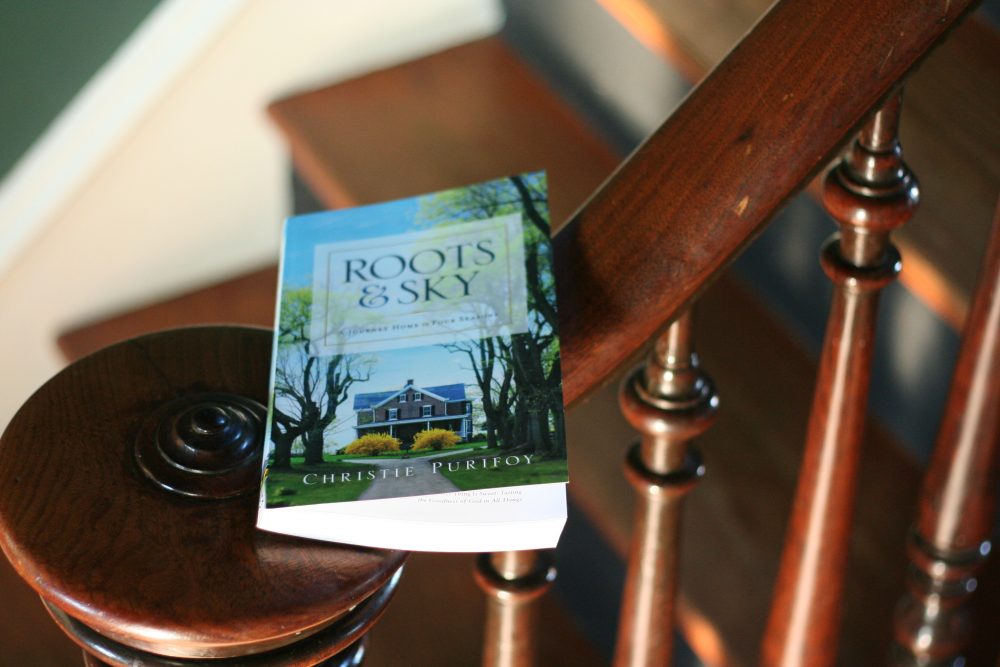
Today, this little book of mine turns one. Alas, I did not bake a cake, but I might have to do something about that later today.
For those of you who haven’t yet picked up a copy of Roots and Sky: A Journey Home in Four Seasons, it’s a love letter to an old farmhouse called Maplehurst and an invitation to discover the wonder of a God who would choose to make his home with us. You can read all about the book right here.
If you are a regular reader of this blog, you know that “These Farmhouse Bookshelves” is my occasional series of book recommendations. In honor of my own book’s first birthday, I thought I’d tell you about a few just-released books as well as some old favorites of mine.


In Dangerous Territory: My Misguided Quest to Save the World, Amy Peterson has written a different kind of missionary memoir. This isn’t a triumphant tale of changing the world, rather it is honest, thoughtful writing about a missionary learning to rest in her own belovedness. A great book for world-changers as well as the ones who feel a little more ordinary than that.


In Katharina & Martin Luther: The Radical Marriage of a Runaway Nun and a Renegade Monk, Michelle DeRusha has written a biography of one of the most influential marriages in history. Compulsively readable and thoroughly researched, here is a book for those interested in history and theology as well as for those who simply love a good story, well told.


The Way of the Dragon or the Way of the Lamb: Searching for Jesus’ Path of Power in a Church That Has Abandoned It is a timely new release from Jamin Goggin and Kyle Strobel. Having suffered from their own misplaced desires for relevance and influence, Goggin and Strobel go in search of a better way. A mix of storytelling, theology, and personal interviews, here is wisdom for these days from J.I. Packer, Dallas Willard, Marva Dawn, John Perkins, Jean Vanier, James Houston, and Eugene Peterson.
Finally, I have two more seasonally appropriate suggestions.


Though I rarely reread fiction, I have read and reread The Long Winter by Laura Ingalls Wilder many times since I discovered it as a child. This true tale of how Laura and her pioneer family survived the historic winter of 1880-81 is the most exciting of the Little House books. I am about to begin reading this one aloud to my own kids.
The writer Laura Brown has organized an online book discussion for The Long Winter on her website MakesYouMom.com. I may even contribute an audio file of me reading aloud from the book (then you’ll know just what my children have to put up with! Wink, wink). All the information on the book club is right here.


And if reading about winter is too much for you during winter, or if you live in Texas or Australia where it’s either summer or feeling like summer, I suggest one of my favorite novels: The Greengage Summer by Rumer Godden. This coming-of-age story set in the post-war French countryside is as delicious as the ripe plums that give the book its title. Tense, atmospheric, exciting, and intelligent, I love this story in any season. You can read my full review on Goodreads.
I love the book so much I ordered a Greengage plum tree for my own backyard. It should arrive for planting in March.
Tell me, what are you reading these days?
by Christie Purifoy | Jan 25, 2017 | God's Love, Politics, Scripture, Uncategorized

Image credit: Chelsea Hudson
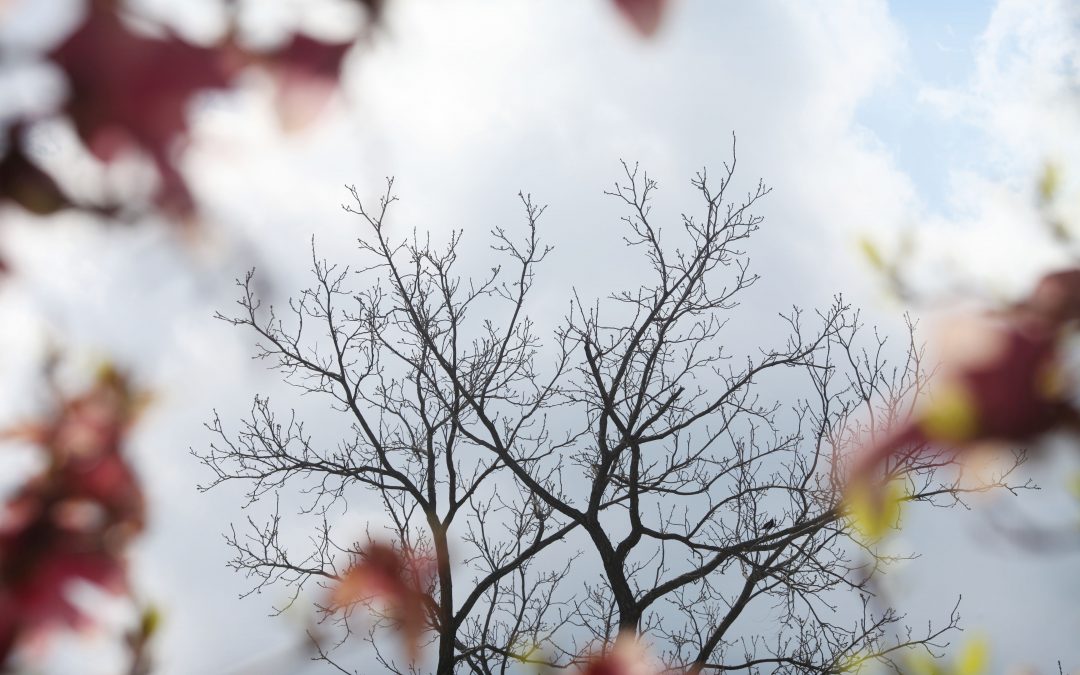
There is a white oak tree near my house that is older than these United States.
Much older.
Lately, I have needed the long perspective this tree provides. I have needed to remember that there are still living witnesses to years far beyond every one of our forty five presidents.
This one tree has outlived all the great divisions that have plagued our national community. It has outlasted the rebels and the loyalists, those who fought duels, and those who took up arms against their brothers.
But political division is much older than our country.
Even much older than this tree.
*
Did you know that Jesus called a traitor and a terrorist to be among his first followers? Of course, even those words are contentious. You could call Simon a freedom fighter. You could say Matthew was a law-and-order guy.
Simon was a Zealot. Matthew was a tax collector for the Empire. Politically, the space between these two makes the different between an American Democrat and an American Republican look as insignificant as the tiny bird’s nest I once saw tucked into a branch of the old oak tree.
Jesus ate with them both. Walked with them both. And while we might imagine that each man tossed his political opinions out like garbage when he chose to follow a carpenter from Nazareth, we have no evidence of that. It seems far more likely to me that they went on disagreeing about many things. Only now, they disagreed as they ate together, prayed together, and became servants of men together.
Each man saw some things clearly and was blind to others, and Jesus wanted them both on his team.
*
I know. I don’t like it any more than you do.
Perhaps you cannot imagine worshiping alongside someone who thinks abortion should remain legal. Perhaps you cannot imagine worshiping alongside someone who thinks abortion should be made illegal.
Feel free to insert any one of the many political issues that divide us.
For me, it is deeply painful to know that I love the same Jesus as some who favor closing our borders to Muslim refugees fleeing war. Perhaps you find it painful to realize that’s my view.
This is not easy. It will make us cry.
The only thing that will help is if we name one another rightly. Not pro or against. Not right or left. Not terrorist or traitor. But Beloved.
We who seek to follow do it well and we do it badly, often all on the same day, but always we are Beloved.
You and your neighbor both:
Beloved.
You and your enemy both:
Beloved.
*
I worry that the old oak tree down the hill from my house will not survive much longer.
The average lifespan of a white oak tree is three-hundred years, but this tree has already lived long beyond that. I believe the oldest white oak tree lived to see six hundred, but I doubt that it sat, as mine does, on the edge of a possibly over-watered and over-fertilized golf course.
Not even the grandest tree is immune to the decisions of men and women. Shall we tend forest, pasture cows, or build a golf course? Even these seemingly non-political decisions have something to say about our political commitments, and even the most personal experience can become political.
Politics matter. After all, justice, as Cornel West has said, is what love looks like in public.
I can almost guarantee that you know a woman who sees the face of the man who groped her in the face of our new President.
And I am sure most of us know someone who remembers when their public school teacher began the day with prayer and worries that the faith of his grandchildren is at risk in our now much more secular culture.
Politics is personal. And, yes, lives are at stake.
*
I will go on choosing silence. I will go on choosing speech. I encourage you to do the same.
Lord, help us to know when to choose the one and when the other.
And let your banner over us be Love.

by Christie Purifoy | Jan 13, 2017 | Family, grief, Hope, Jesus, river, Stories, Uncategorized
“Precious in the sight of the Lord is the death of his faithful servants” (Psalm 116:15).
It is precious as a rainbow above green velvet cliffs.
It is precious as the full moon on that warm night when we gathered to cry for him and laughed remembering him.
It is as precious as a Hawaiian lei. We cut the thread, we scattered the flowers, and the thunder waves of the North Shore sent them back to us, pink petals on our toes.
But they did not send Shawn back. He was not theirs to return.
He is his Maker’s.
He is not ours, though we can still recall the exact sound of his laugh and the precise tone of his voice, as if he had only just called out to us from the other room.

*
Last January, I stood on a moonlit shore listening to a legendary Hawaiian surfer tell me what he had seen and heard from his beach-front house on January 14. The hem of my turquoise sundress trailed in the water like a mermaid’s bedraggled tail.
I am no mermaid. I know maple trees, and I love the green hills of Chester County, Pennsylvania. The water that tugged at my dress frightened me. But this man had known waves for decades, and he loved the wild waters of Oahu’s North Shore. He told story after story, while I began to see rightly and truly the place where I stood. I began to see these dangerous waters through the lens of this man’s great love for them.
He spoke of fire and a noise like thunder and of waves so high it was as if the ocean understood. The ocean offered up its own anguish before we knew to offer ours. Shawn and the eleven men flying with him that night did not die unseen in a swirl of chaos. They died in a known place, in a much-loved place; a door opened for them, and arms of welcome enfolded them, in one of the most astonishingly beautiful places on earth.
“If I could choose the spot where I would die and be buried, I would choose these waves right here,” the man told me.
I have thought many times since our conversation of an Old Testament tale:
“As they were walking along and talking together, suddenly a chariot of fire and horses of fire appeared and separated the two of them, and Elijah went up to heaven in a whirlwind” (2 Kings 2:11).
And Elisha, who loved him, went on walking, alone, as the reflection of heavenly fire faded from his eyes, and the skies returned to their ordinary, silent gray.
There was no door in the sky for Elisha, and there is no door for us, as yet.
*
The fire has faded, and the wind has stilled. One year later, rainbows are harder to come by.
And yet, when I slow my usual busyness, when I pause and reflect, I realize that the hems of our clothing still trail through salty water. The turtle-dotted waves of the North Shore offered a kind of baptism, and we have not shaken that water off yet.
God willing, we never will.
This is living water. It poured from the cross when an innocent man, and the maker of us all, died to set things right. Shawn chose every day to hide his life in the life of the innocent One who defeated death, and so his death shares in the power of Christ’s own. Losing Shawn has left us shocked and grieving, yes, but the loss has also unleashed rivers of living water.
And even when we cry we trail streams of rainbow glory.
Shawn Campbell’s legacy.


