by Christie Purifoy | May 10, 2017 | children, Family, grief, guest post, Joy, motherhood, Uncategorized
I look forward to Mother’s Day. My life brims with beautiful mothers: my own, my mother-in-law, my two sisters, and my sister-in-law. Though my four children never have managed to plan a breakfast in bed, they are not stingy with homemade cards and hugs. When I stirred my youngest awake this morning, she said, before even opening her eyes, “Is today Mother’s Day?” That’s how eager she is to watch me open the brown paper-wrapped craft she brought home yesterday from preschool.
But I remember other Mother’s Days. I remember Sundays when the annual recognition of all the moms in the church congregation brought me nothing but pain. I wanted what they had. Desperately.
Having a mother and being a mother are blessings, which means they open us right up to both great joy and great pain. It seems a fitting thing to remember this week.
I am grateful to my friend and fellow writer Sharon McKeeman for sharing her story of grief and Joy with us.

When I was young, I tucked my dolls into bed safely each night. When I was young, I drew haphazard flowers on construction paper for my mom on Mother’s Day. Life was simple and sweet, and I trusted that it would always remain so.
I didn’t know then that I would hold a son stillborn on his due-date. I didn’t know I would caress his perfect but lifeless body before the nurses took him from me. In those moments, life shattered desolate. I returned home from the hospital to my two young sons, and somehow, we celebrated Thanksgiving a few weeks later. My heart had stopped right in its tracks, but the North Carolina sun kept shining, and the rhythm of ordinary and holidays continued. I offered thanks around our turkey-laden dinner table, and I wrapped presents for my children at Christmas. Grief is a long road, but as the chill of the winter months turned to warm spring, I felt my soul begin to revive. Then one day I woke up, and it was Mother’s Day. How could I survive this?
I was afraid I would come untethered, scared that I might just float away. Shame, despair, and heartache were so very close that day, but miraculously Christ was closer. The One who made me and holds my son, wrapped His arms tight around me and carried me through that day. This didn’t numb the pain, but as my two living children kissed my tear streaked cheeks, I lived the truth that, “Blessed are those who mourn, for they will be comforted. (Matthew 5:4 NIV) A mother just barely healing from sprinkling her son’s ashes in the sea, I was comforted. I can’t explain it other than I called out to Christ because I didn’t know how else to survive, and He surrounded me. He held me and didn’t let go.
I wish I could say that since then I have tucked my children into bed safe each night. Thankfully a healthy pregnancy followed the loss of my son on his due-date, but I lost another child when his heart stopped beating at sixteen weeks and another when her heart never began to beat. Even though I held three living children, Mother’s Day become a joke, a time to endure. Even as I collected hand drawn cards and red roses, my soul sank. While around me spring was bursting with life, my heart began to feel as dead as my womb. Despair and distrust of my heavenly Father grew until a friend reminded me that a weeping Jesus is always near.
Jesus entered this mess with us. He suffered and wept; He weeps with us still.
I came to rest in that truth.
I held three children, and I mourned three children. My arms were full, and my arms were empty. Through it all my Maker held me. When I was too weak, too consumed by grief, to hold on, God surrounded and carried me.
This spring an unexpected bloom has unfurled. After I held death within my body three times, a pregnancy blossomed into a healthy daughter who is filling my arms and heart. After all these years of mourning, we have named her Joy. Our family holds her close and breathes thanksgiving, but I know this happiness is just a step in our journey. There will be more storms, more barren months. The greatest gift comes in knowing that joy was not found alone in this precious little one, but in discovering that Christ weeps with me, and my Maker holds me so carefully that no tragedy can tear me from His embrace.
For every woman with empty arms and an aching heart in this season, I pray that she will feel a weeping Jesus near and comforting her. I pray that a miraculous joy will well up within, defy earthly pain, and speak heaven straight to her soul.
There is an everlasting spring yet to come, and even as these bodies of dust often fail us, its whispers take root in our hearts.

Sharon is a homeschooling mama to three sons and a daughter. She is a Midwestern girl at heart who now lives with her family on the sunny beaches of Southern California, where they enjoy reading together and playing in the surf. She is an author, educator, speaker, and photographer who shares more of her story as @sharonmckeeman on Instagram and at www.sharonmckeeman.com where you will find her blog, Writing in the Dust, as well as her newsletter, Mourning into Joy, which is filled with encouragement and resources for grieving mamas.

by Christie Purifoy | Apr 20, 2017 | Easter, Home, Homebound, hospitality, Lent, Pennsylvania, Spring, Uncategorized
Elizabeth and I are homebound. She, a writer of poetry and prose, is bound to Mersea, a 1904 white Victorian nestled in the historic district of a South Carolina shrimping village. I am bound to Maplehurst, a red-brick farmhouse built by Pennsylvania Quakers in 1880. We are both writers, wives, and mothers, but nearly twenty years and hundreds of miles lie between us.
Elizabeth and I exchanged a few “homebound” letters over Lent. The nature of a letter is to communicate over a distance, but the season of Lent introduces other distances – there is the space between winter and spring, the break between longing and fulfillment, and the chasm, so like a tomb, between death and new life. But what is Lent, after all, but a kind of long homecoming? It is a practice of return and a way of erasing distance.
Those who go out weeping, carrying seed to sow, will return with songs of joy, carrying sheaves with them (Psalm 126:6).
This is the meaning of Easter.
Easter is watching all that miserable distance shrink, almost to nothing. Easter is no more letter-writing but a face-to-face encounter. Elizabeth and I haven’t yet achieved that, it remains our not-quite-yet, but here is our literary equivalent. Here, for you Elizabeth, and for each one of you reading along: your very own tour of Maplehurst at Easter time. I am so glad you’ve come to visit.

The first thing I say to almost every guest arriving at my front door for the first time is: You found us! It always seems slightly miraculous to me. These narrow, winding Pennsylvania roads twist and curl in a way that confounds even Google and every form of GPS.
But, Elizabeth, you found us!
Even after you discovered my road (a road once traveled by George Washington and Abraham Lincoln on journeys between Philadelphia and Baltimore), even after you crawled, slowly, down our long driveway, craning your neck to see the faraway tops of the maple trees meeting in a green cathedral ceiling overhead, even then there was the matter of our front door.
Where is it?
The apparent front of the house, facing the street, has no door, only a wide front porch and two tall windows. You followed the sign with its pointing arrow, glued to a rock at the place where the driveway splits, to the right. Here is a lamppost, here is a door painted the light green color of old copper, but is this the front door? The driveway curves on around the house, there is nowhere to park, and you were unsure. This is why you found me waiting and waving right there, half in and half out of the door.
You found us! You are here!
If this were your second visit, you would continue on the driveway’s curve around to the western side of the house. You would park your car next to my pickup truck near the old, red barn, and you would enter through the back door on that side of the porch. But this is your first visit, and I will open the front door, with its many glass panes, wide.
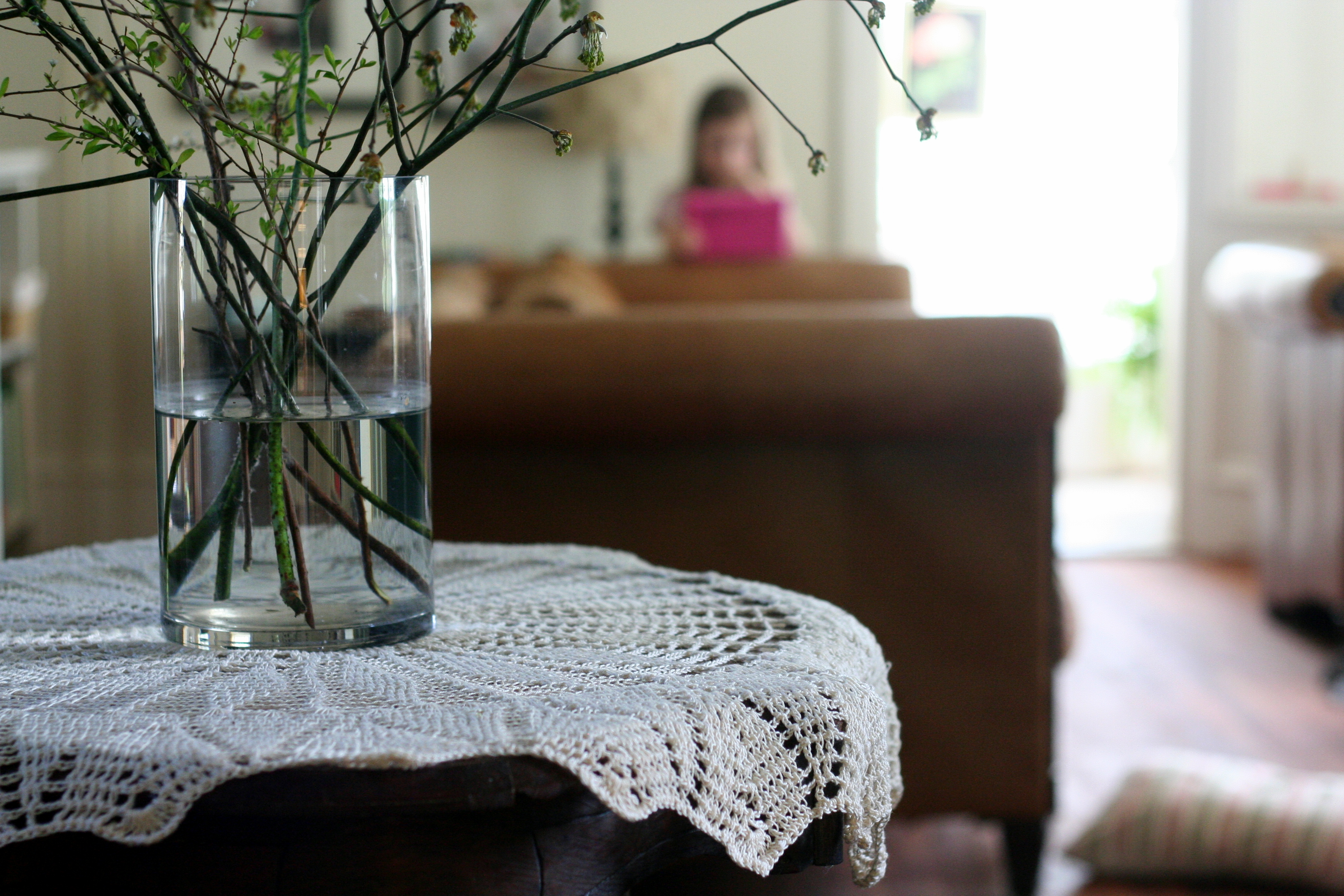
Here is the space we grandly call “the front hall,” but it isn’t so very big. A small, oval table sits in the center of an old red rug. The table once belonged to my husband’s great-grandparents in Mexico. I don’t know exactly why, but it looks right at home here at Maplehurst. On top is a glass vase I have filled with branches: the electric green of sassafrass buds and the starry white of spirea. The staircase with its scarred wooden banister moves up toward a tall window before turning out of sight.


Not only is it Easter now, but it is April, and the air is sweet in that way some people name warm and some people name cool. There is no need to pause at the coat closet. Instead, I place your bag on the table, take your hand, gesture to our left, and say,
“Here is the parlor. This is my quiet room. Unless the children are practicing their piano.”
I turn and indicate the room on our right,
“We call this larger room the family room, though I sometimes wonder what the Hughes family, who first built this house, would have called it.”
You see that a round, oak pedestal table sits in the curve of a bow window. The cloth is dark, dusty pink and covered in cabbage roses. I explain that it was once our kitchen table, but we, along with our guests, have outgrown it. Now it sits here for board games and library books and cups of tea with a view of the flower garden.
“Look,” I say pointing toward the garden just beyond the window, “Lent was for planting tiny shriveled pea seeds only to watch them be buried by snow. Easter is for that shower of wild violets. It has flooded the garden. Purple, lavender, white, and green everywhere you look. And there, in the middle of a purple sea, is my youngest. She is a hunter stalking dandelions. When she finds one, she will shout with pleasure before wishing, yet one more time, for a dog of her own.
Bless her heart. I’ve always insisted that Jonathan and I are not dog people, but maybe those dandelion wishes are more powerful than I know.
Would you like to step through to the kitchen?”
To be continued …


Elizabeth is giving me and my readers a personal tour of her home, Mersea. Will you join us?

by Christie Purifoy | Apr 4, 2017 | Books, These Farmhouse Bookshelves, Uncategorized
You probably know that I love to share about the books I’m reading just as often as I can, but it’s a rare day when I can tell you about a wonderful new book on friendship written by one of my oldest and dearest, real-life friends.


Never Unfriended: The Secret to Finding and Keeping Lasting Friendships by Lisa-Jo Baker
I want to tell you that Lisa-Jo was the perfect person to write this book because she is a perfect friend. I want to say this because she has always been such a very good friend to me. When we said goodbye many years ago, just before she and her husband left Chicago for Ukraine, I assumed our friendship would fade. But Lisa-Jo held on. And I will forever be grateful to her for that.
But I will not in fact tell you that Lisa-Jo wrote this book out of a place of perfection. I will not even tell you that she wrote it out of a place of personal strength. I know her well enough to know that she feels her own failures as a friend keenly, and that she has also felt the deep wounds only a friend can inflict.
Like most precious things, this book is the fruit of suffering and struggle. When Lisa-Jo reminds me that I am free to become a friend to others because I have found the most perfect friendship in Jesus, I listen.
I listen, because she knows this for herself, and because she tells the story so persuasively and so well.


One: Unity in a Divided World is the just-released book by Deidra Riggs. I don’t know Deidra nearly as well as I know Lisa-Jo (we are facebook friends who have never met in person), and yet, I know enough of Deidra, and of her wisdom and experience and passion, to know that this timely book should be embraced and widely read.
If you are troubled by the rancor and divisions that seem so prevalent today, here is a book to inspire you and challenge you to pursue the reconciling way of Jesus.


Whether you’ve never heard of the Enneagram or have read every book about it you can get your hands on, I highly recommend this new book by Ian Morgan Cron (the author of one of my favorite memoirs!) and Suzanne Stabile.
The Road Back to You: An Enneagram Journey to Self-Discovery is probably the most user-friendly introduction to the Enneagram I have read. Not only that, it is wonderfully written (in fact, this book is proof that instructive nonfiction can feature insanely good writing).
The Enneagram is an ancient personality typing system with roots in Christian monasticism. I have personally found it to be a powerful tool for gaining self understanding and, perhaps most importantly, compassion and even gratitude for those who are very different from me.


I am slowly reading my way through Anne Fadiman’s book At Large and At Small: Familiar Essays. I am reading slowly only because I am making myself read slowly. I want to devour these delightful, witty, intelligent essays like a bowl of ice cream (and Fadiman even has an essay on ice cream!), but I also want this treat to last as long as possible.
Tell me, do you read nonfiction?

by Christie Purifoy | Mar 31, 2017 | Easter, Family, grief, Jesus, Lent, Spring, trees, Uncategorized

For weeks now my children have not been able to stop themselves from singing April showers bring May flowers. Even the four-year-old, she who serenades her dinner companions every evening with the months-of-the-year ditty she learned in preschool, knows that this song is not yet quite appropriate. But each one of them also knows that it is raining, again, and something new is just there on the far side of the horizon.
And so they sing.
*
Today is the last day of March, and it is raining cats and dogs. It is raining puddles and mud. It is gushing, washing, rinsing, quenching. I planned to visit the library, but this rain is too much even for the tall, waterproof boots I wear in the garden. It is too much even for my one remaining unbroken umbrella. I am drinking tea and typing these words instead.
*
Someone sent me a message. You know about trees. Tell me, why is my river birch dripping water? Why is it trickling, oozing, seeping, leaking? Is something wrong?
Nothing is wrong, I told her. All trees know how to sing, but some trees also know how to cry.
When the weather turns from warm to wet, a birch tree will drip, drip, drip.
*
Last year in Hawaii, I saw trees sheathed in rainbows.
The rainbow eucalyptus thrives in tropical climates. It is happiest in rain-washed places. It sheds its bark, and what remains are long, vertical strips of color: red, orange, green, blue, gray. Rainbows trickle, ooze, seep, and leak their colors down the length of each trunk.
I saw those colors from the car window as we drove toward the North Shore. We had flowery leis in our laps. Later, we tore the string and tossed the flowers and said one more goodbye to the man who died just there, above those waters. Somewhere just to the right of the rainbow and to the left of the singing whale, he went where we cannot yet follow.
*
I visited my friend this week and saw a rough wooden cross in the corner of her small sitting room. It was our Christmas tree, she told me. Now it is our Easter cross.
I’m sure her tree was beautiful. I have forgotten the name, but she said it was some rare variety: silvery and soft. That beauty is lost. What remains is harsh and looked out of place propped in the corner of the room. It can’t be easy, I thought, to live with this cross.
*
Some legends say that Jesus’s cross was made from the wood of an aspen tree. Apparently, these trees do grow in that region of the world. No matter where they grow, aspen leaves startle and stir in even a slight breeze. It is said the tree trembles for what it has seen and how it was used.
I read somewhere that in Hebrew the name of this tree is baca. This is also the name of the “Valley of Weeping” mentioned in Psalm 84. When I go to check my memory against the knowledge of the internet, I find that baca might mean balsam-tree. It might mean mulberry.
It seems there are many trees associated with weeping.
*
In Psalm 84, the Valley of Weeping changes as we walk through it. By the touch of our feet, it becomes a place of springs. Then the early rains come, but they do not bring puddles or mud. They bring blessing.
I do not want to walk through the valley. I am tired of tears (drip, drip, drip). I do not want to trip over the ugly, bare cross in the corner of the room, and I certainly do not want to carry it on my back.
Today, I do not even want the rain.
But I want the rainbows. I want the May flowers. I want, yes I admit, I want the blessing.
I want to know what the trees have always known.
I want to know what it is to be planted, planted so deep and so well, that not even death can pull up these roots.
Oh, death. Where is your sting? You grab at us. You scratch and claw. And what is revealed?
Only rainbows.
Only water.
Only blessing.
Only Jesus.
by Christie Purifoy | Mar 21, 2017 | Dreams, Home, Homebound, Hope, Lent, Scripture, Seasons, Spring, Uncategorized, Waiting
Elizabeth and I are homebound. She, a writer of poetry and prose, is bound to Mersea, a 1904 white Victorian nestled in the historic district of a South Carolina shrimping village. I am bound to Maplehurst, a red-brick farmhouse built by Pennsylvania Quakers in 1880. We are both writers, wives, and mothers, but nearly twenty years and hundreds of miles lie between us. This season, as winter turns toward spring and Lent leans toward Easter, Elizabeth and I are writing letters, she beneath the pines and pecans, I beneath the hemlocks and maples. We will reflect together on our homebound journeys. We will explore the bonds of love and faithfulness that tie us, and not always easily, to these particular places and to the people sheltered within them. Please join us for an epistolary exploration of love, loss, and restoration.

Read Elizabeth’s letter of March 9 here. My response is below.
March 21, 2017
from my armchair near the window, with its view of soggy earth and snow
Dear Elizabeth,
I, too, have been traveling, though I have not left this place.
My feet were firmly planted in spring. The early daffodils were up and nodding their heads, and the giant magnolia tree was a haze of pink. The two forsythia shrubs in our front lawn were beginning to pop, like yellow corn kernels tossed in a hot pan. But last Tuesday the wind picked up and hurled snow, then ice, at our window glass. It’s so loud, the kids said. And just like that I found myself in a winter world. And not winter’s last gasp, either, but winter as dark and ice-locked as any day in January.
Today, the calendar says spring, but the snow is retreating slowly, and the growing tips of the daffodils look bruised. They remind me of that proverb once bitten, twice shy. They look as hesitant as I feel. A few new projects beckon, and I have felt some old dreams stirring, as if their time draws near, but can I trust the weather?
You write of seeds. You say they are worth the wait. Yet even the seeds I planted in those warmer February days now trouble me. I have a long row of sweetpea seedlings on my kitchen windowsill. They are overgrown. White roots are beginning to worm their way out of the bottoms of the tall peat pots. Yet I cannot plant them out while snow is on the ground. I worry they will end up feeding the compost heap rather than scrambling up the lattice prepared for them in the garden.
Because it is Lent, I have been pausing throughout each day with a prayer book. Recently, my prayer book reminded me that March 25 will mark nine months before Christmas. On this day, the church celebrates the message the angel Gabriel brought to Mary. We remember how she said yes though she did not understand how such an impossible thing could come to be. How right it seems to recall, in these dark and muddy days of earliest spring, the seed that was planted within one young woman. The refrain for this week’s prayers is this: “On this day the Lord has acted; we will rejoice and be glad in it.”
I can remember a spring morning five years ago. I woke with those same words already dancing through my head: “This is the day … let us rejoice and be glad in it.” The words startled me. I was living then in a wilderness place, desperate for hope, desperate for newness, and praying for a home, yet it seemed, if the words in my head could be trusted, that something had shifted.
The following day, Jonathan returned from a business trip. He told me he had been offered a job in Pennsylvania. We could move as soon as we found a home, and the home we found not long after was Maplehurst.
First, there is the seed, planted in darkness. Only later, new life, miraculous, impossible.
Sorrow and joy do co-exist, as you wrote to me, and that is never more true than while we walk this sharp edge between winter and spring.
When I began this letter, the sky was low and gray. Now it is striped with blue, and I can see the shadows of the maple trees. Perhaps hope is not such a foolhardy thing. The sun seems to say, This. This is the day.
with grace, peace, and, yes, hope,
Christie
Maplehurst


by Christie Purifoy | Mar 15, 2017 | Books, Gardening, Grace Table, These Farmhouse Bookshelves, Uncategorized, Winter
The view from my window is more January than March, thanks to a late-season blizzard.
The worst of the storm hit north and west of us, but we still have more snow, and colder temperatures, than we’ve seen all winter. Yet more snow is driving hard past my window, but the wind is scouring our driveway clean. I am glad since Tuesday’s heavy, wet snowfall damaged the snowplow we attach to our tractor mower. Of course, I write “we” in the most generous sense because my contribution to clearing snow is keeping the children out of their father’s way.
It’s a strange day to browse my favorite gardening books, but this is the middle of March, and I must keep faith with the angle of the sun, no matter the peculiarities of the weather.

The literary letters Elizabeth and I have recently exchanged here on the blog have had me giving a great deal of thought to the epistolary genre. As a form of artistic creation, it is centuries old, though today’s epistolary novels are perhaps more likely to include email transcripts than handwritten letters.
It is not a form you tend to see in garden writing, but exploring the form these past few weeks has reminded me of the quality I most appreciate in my favorite gardening books: that is, the singular human voice writing from a particular time and place.
My preferred gardening books are written by gardeners who love their own plot of earth and know it well. It is tempting to think their advice might be of only local importance. The needs of my own garden will be very different from a garden with rocky New England soil near the salt-air of the ocean. Yet I find precisely the opposite to be true. This may be one more case of greater love leading to greater wisdom.
Here are a few of my favorite garden books, just in time for spring. These are not exhaustive and impersonal garden reference books. These are more like letters from a gardener, or better yet, missives from a particular plot of cultivated earth. I hope they inspire you to better love the ground beneath your own feet.
- Henry Mitchell is one of my favorite garden writers. Usually he makes me laugh out loud, but he often surprises me with eloquence and emotional insight. For many years he wrote a garden column for The Washington Post, and it is these columns that make up collections like The Essential Earthman and One Man’s Garden. His style, geared toward local Washington D.C. newspaper readers, probably comes the closest to the intimacy of the epistolary form.


- Tara Austen Weaver’s memoir Orchard House is a perfect example of why I prefer the personal rather than the encyclopedic approach to garden reading. I am easily overwhelmed by lists of plant varieties, but when Weaver praises a particular variety of homegrown strawberry, I find that I want to plant and taste nothing else. This is a lovely memoir of growing a garden and healing a family.


- If you enjoy Michael Pollan’s approach to food writing, you will love his gardening book: Second Nature: A Gardener’s Education. It is another well-researched book filtered through Pollan’s everyman voice and his particular gardening adventures. Flipping through my tattered old copy, I’ve decided it’s time for me to reread it.


- I do not recommend Katharine S. White’s book Onward and Upward in the Garden to many people. If yours is only a casual interest in garden writing, this may not be the book for you. However, if you are at all intrigued by the idea of an experienced gardener and knowledgeable writer examining seed and plant catalogs as a reviewer would study a just-released novel, then you might enjoy this book as much as I do. Here is another enticement: Katharine was the wife of E.B. White, and her descriptions of their Maine garden helped me to see Charlotte’s Web and The Trumpet of the Swan in a fresh light.


- The Living Landscape by Rick Darke and Doug Tallamy leans more toward the encyclopedic, but this astonishing account of the importance of native landscaping for our own wellbeing and the wellbeing of our planet is told through from the perspectives of scientists making important observations in their very own gardens. I used to think that native plants were a nice extra, but Darke and Tallamy have transformed my thinking. This may be one of the most important garden books you read.


- If you love keeping fresh flowers in your home, I highly recommend the beautiful just-released book Floret Farm’s Cut Flower Garden by Erin Benzakein. This book is practical, gorgeous, and inspiring.


I’d love to know: do you read garden books?
And if you’d like to read a little more from me, here is my latest post for Grace Table: “Sunlight, Shadows, and a Supper Club.”