Like many of you, I turn the radio off when my children stumble, sleepy-eyed, into the kitchen. In an hour, they will sit in their own elementary school classrooms, and I don’t have answers for the questions they will ask.
I pack lunches, and my own head pounds with questions. Old, old questions.
Could not he who opened the eyes of the blind man have kept this man from dying?
We are not the first to ask these questions, but they have grown more insistent over the years, not less. At one time, God walked among us. But we have seen so much trouble since those days. We have cried rivers of tears.
I sometimes think I have the answers. When Jesus, speaking of resurrection, says, “Do you believe?” I say, yes. I believe.
But belief is not the same thing as answers. Not, really. Belief cannot silence questions like Why and Where were you?
When Mary reached the place where Jesus was and saw him, she fell at his feet and said, “Lord, if you had been here, my brother would not have died.”
Because I believe, I reach too quickly for answers. Because I write stories, I move too soon to imagine happy endings.
In other words, I do not follow the example of the One I profess to follow. It seems too hard to do what he did: to let myself be moved. To let myself be troubled.
To let the tears fall.
When Jesus saw her weeping, and the Jews who had come along with her also weeping, he was deeply moved in spirit and troubled. “Where have you laid him?” he asked. “Come and see, Lord,” they replied.
Jesus wept.
I don’t have answers for a day like this. How does anyone keep going after a two-mile-wide nightmare overtakes them?
I don’t know.
I hope – I can only hope – that when the time comes to stand up again and move, I will be there, cross in hand, following.
Following the suffering King.
The man of sorrows.
The one who stays and weeps and is moved by our questions.
One name for so many seasons: magnolia season, daffodil season, tulip season, and, now, dogwood season.
Each day, something is lost and some new beauty is born.
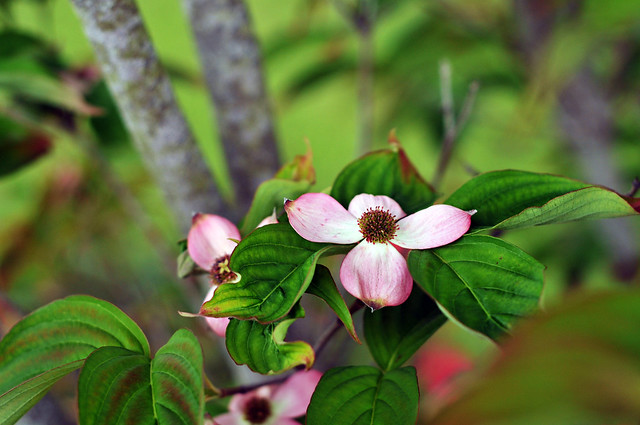
I could never pick a favorite spring season (and I haven’t even mentioned the lilacs), but I do know what it is I love about the dogwoods: they light up the shadows.
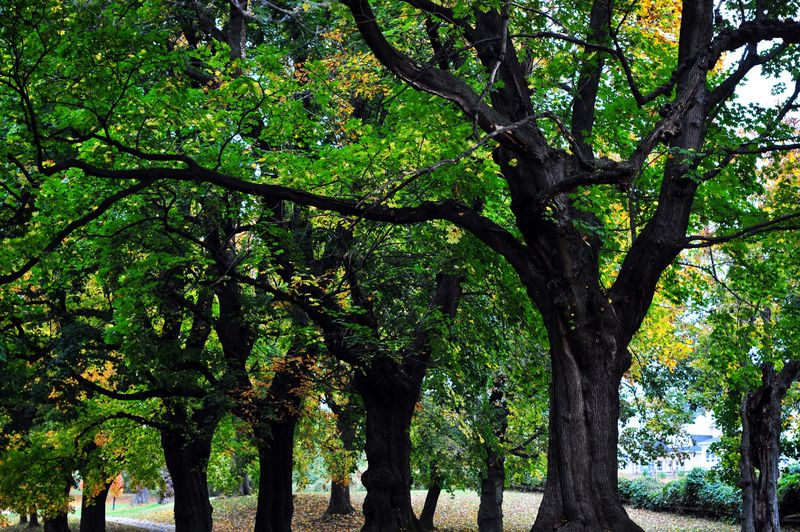
Here, from where I sit at my desk, I can see a thick, dark line of trees along the fence. It might look foreboding except that there is a lacy pink-and-white dogwood dancing on the edge of the darkness.
It is so pretty I have wasted more than a bit of my writing time googling hammock.
On Mother’s Day, I went for a drive. Alone. Because the irony of Mother’s Day is that I lose all patience for even the usual tasks of motherhood. Like wrangling four kids into carseats and listening to them bicker.
Just down the street from our house is a church like something from a child’s picture book. It is almost perfectly square and has a tall white steeple.
Of course, the child’s picture book never shows the tacky roadside notice board. This one said: We know life is hard. You are not alone.
I don’t think I’ve ever appreciated anything spelled out on one of those yellow plastic signs. Even the sentiments with which I agree bother me with their cheesy puns or too-cute rhymes.
But this one … Well, honesty is eloquent. Love sings.
I have nothing against John 3:16, but these may be the very best words for a churchyard sign.
I’m tempted to write them on my hand. Life is hard, but I am not alone. I think these words, and remembering that they apply to me and to everyone I meet, might help me respond to life with more gentleness. More compassion.
Life can be hard. It can be hard even on the good days, the days we feel at home, the days in which thank you, thank you tumbles easily from our lips.
Our lives are edged with shadow.
I write my own thank yous out in this space. Thank you for my family. Thank you for my home. Thank you for bringing me out of the wilderness and into this good, green land.
But we all live with shadows, whether we are walking through a wilderness or not.
Here is where you might expect me to point to those dogwoods and say something about silver linings or unexpected blessings.
I refuse to do that.
I think we sometimes act as if truth isn’t worthwhile unless it can be summed up in one sentence or organized into five lessons or bound up with bullet points.
I am a writer, I love words, but I know that words – more often than not – fail us.
Sometimes the only true thing is to say as little as possible. Perhaps, to say only this:
“Look! Do you see? A dogwood tree like pale pink lace dancing at the edge of darkness.”
Here is one thing I know: the world will keep on falling apart.
Sometimes it’s terrible, and you think you can’t go on. Bombs explode and guns are aimed at children, and the unimagined thing becomes our new reality.
Sometimes it’s a pebble in your shoe, a child apparently born without an indoor voice, and the discovery that you can, in fact, ruin brown rice even when you make it with an automatic rice cooker.
Sometimes it’s a Friday night thunderstorm that sounds terrible but lasts only fifteen minutes. You wake the next morning to blue skies and sunshine and the sight of a once-beautiful and massive maple tree lying stricken across your lawn.
The gloomy face of your chain-saw wielding husband annoys you. The tears of your firstborn both sadden and exasperate.
You move swiftly to combat both gloom and grief.
The tree was already at the end of its life! It was only a matter of time! It’s the circle of life! Nothing to cry about!
But you are wrong.
It is worth the gloom. It is even worth the grief.
The young girl is right, and you consider that even flowers were not created to fade. Life was never intended for death.
If we numb ourselves to the loss of one great tree, do we lose our capacity to grieve the harsher pain? The less explainable calamities?
Can our optimism become a kind of blindness? A refusal to see and acknowledge that all is not as it should be?
You are grateful your Saturday story does not end here. You consider that pain rarely seems to signal The End. In your (admittedly) limited experience, there is always something more.
Joy does come in the morning.
On this morning it appears in the form of a half-dozen teenagers. Needing to earn money for summer camp, you had agreed weeks ago (and quickly second-guessed your agreement) to give them odd jobs. You’d spent too much of the previous week worrying about the tall ladders involved in window washing and the poison ivy involved in brush clearing.
But here they are, and there, you have only just discovered, is the tree, and for that entire Saturday morning and the next Sunday afternoon, they will haul and carry and load. They will be your very own, unasked-for, tree-clearing work team, and your children will only occasionally slow their progress by treating the log pile like a jungle gym.
Brown leaves are everywhere like an ugly, soggy blanket, and I want snow so badly I ache.
I want to be tucked in beneath that still, beautiful whiteness. I want to sleep on and on and forget how ugly this world is. How broken.
I pray for snow, and I tell God I don’t want to live in this world anymore. I don’t want to wake up day after day in a world where children die such violent deaths (whether it’s one young man with a gun or a government with a bomb). Enough.
I tell God how screwed up everything is, and I’m not praying to an infant in a manger, I’m praying to one whose “… eyes were like blazing fire … [whose] feet were like bronze glowing in a furnace, and [whose] voice was like the sound of rushing waters” (Revelation 1:14-15).
Snow refuses to fall, the world stays stubbornly brown, and I begin to wonder what that voice like rushing water is saying.
I can speak so quickly, so effortlessly of hope and heaven. Of no more tears and all made right.
I am quick to talk but oh, so slow to listen.
What message blazes in the eyes of the one who kicked over those tables at the temple?
I want to sing of snow and silent nights, but I’ve been walking this Advent road, and I can’t easily forget that Mary sang of justice not silence.
Could it be that I am not grieved enough? Could it be that I am not angry enough?
Because, looking at him, I know what love looks like: giving small children the welcome of my arms and kicking those tables with fire in my eyes.
But this is no Jesus with guns blazing, like a video-game hero out for revenge. That’s the world’s way. The old way. What I see in his fiery eyes is a peacemaker’s fire. A turn-the-other-cheek fire. A fire that brings food to the hungry. A fire that will not let the world forget what children suffer.
This is a radically upside down kind of love. It lays down its rights (to safety, to comfort, to not be inconvenienced) in order to care for the weakest, the smallest, the most despised.
I no longer want the oblivion of snow.
I want a torch. I want a bonfire. I want to shine the light of The Ancient of Days into every despicable, dark corner until, yes, I’ll say it, until all is made right.
I reserve Mondays for poetry, but, truthfully, I keep opening books and closing them again. The loss of so many children and their teachers is too heavy, and I have no poem for you today.
My head is bursting with words I want to share: words of anger, words of lament. But I think it better to follow the example of Job’s companions: “they sat on the ground with him for seven days and seven nights. No one said a word to him because they saw how great his suffering was” (Job 2:13).
Instead of writing, I’ve been listening. Mostly to this song. It asks a question I can’t get out of my head: is love alive? Some part of my mind is sure of the answer, but most of me is anything but sure.
We are approaching the longest night of the year. We’ve known it was coming, but we didn’t know how dark it would be.
The pace of advent requires that we walk through the darkness. There can be no Christmas without this long, long night. For me, it means sitting with my questions and my tears, without reaching for answers too soon.