by Christie Purifoy | Nov 3, 2016 | Autumn, Family, grief, healing, Jesus, Uncategorized

We planted a tree on Friday.
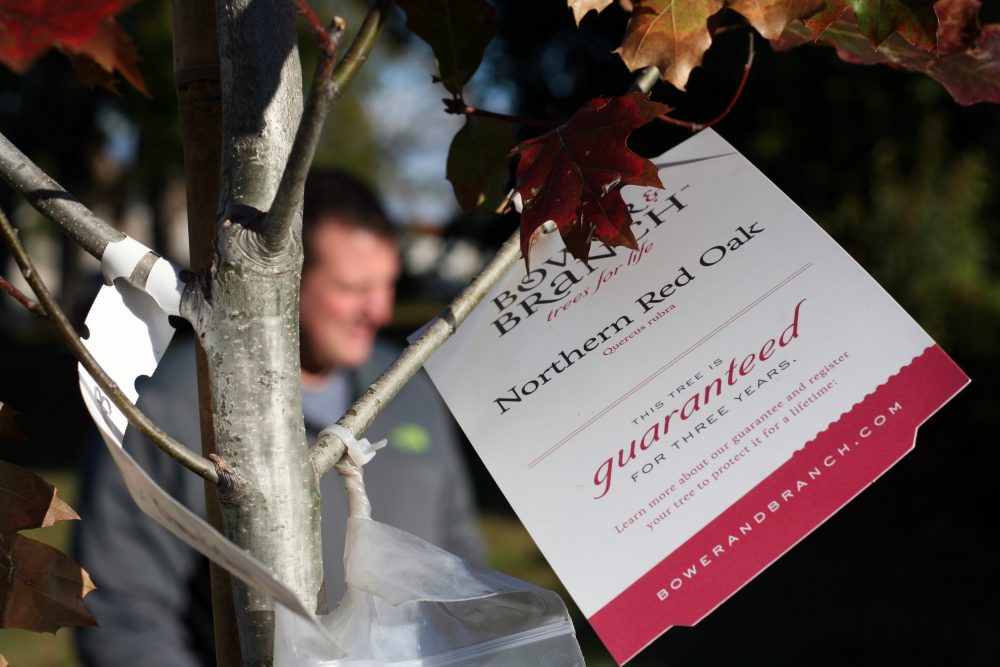
It is a red oak tree, and we planted it for Shawn.
I’d ordered it in June for fall planting. It arrived at the nursery weeks ago, but somehow I never received the message. I found out it was ready only a few days before my family, the family I so rarely see, came to stay.
We have two shovels. My husband, brother, brother-in-law, and nephew took turns digging. My brother’s wife held the baby who was born the day of Shawn’s memorial service. The baby who shares his name.
The wind was a little too blustery for a nine-month-old more accustomed to Texas heat, but instead of carrying him back inside, I tried to block the wind with my body. I thought of how the tree will grow as he grows.
We tipped the tree out of its container and watered it well. I suppose its leaves were green when it was first set aside for us at the nursery, but now they are mottled with dark red like dried blood and bright red like the berries on our winterberry shrubs.
This tree is young, but it already knows what every tree knows: there is a space between life and death, and it has its own particular beauty.
The story of our world is a story of three trees.
In the beginning there was a tree of life, but we fell from that flourishing green perfection and went on falling until it seemed that death and evil and suffering would always have the last word.
Until Jesus.
He was like us, yet he did not fall. On a cross fashioned from a broken tree, he submitted to death and suffering, and so defeated them.
Now the power that carried him from death to life is transforming us from the inside out. And it is transforming our world from the inside out. One day that transformation will be complete, the distance between the way things are and the way they were always meant to be will be erased, and we will live in the green shade of another tree of life.
The leaves of that third tree, we are told, “are for the healing of the nations” (Rev. 22:2).

I can think of few things I want more.
I can think of few things we need more because words wound as well as sticks and stones and bombs.
Is it only a far-off dream? A happily-ever-after story we pull like wool over our eyes during days of trouble?
The radiant leaves of Shawn’s tree say otherwise. When the wind picks up, I hear them whisper, “The fruit of the righteous is a tree of life” (Proverbs 11:30).
Because of Shawn, a tree of life has spread its roots through our family and among many friends. It is as real as this red oak tree. Things that were broken in our hearts or our relationships or our ways of living in the world are being made right. Healing we did not even know we needed has begun.
Our world is caught somewhere between death and life. It is like a tree glowing with autumn color. It breaks our hearts even as it dazzles our eyes.
But the seeds for that third tree have already been sown.
In us.
*
Controversies may swirl and bullets may fly (both metaphorical and all too real), but we are not afraid. We are not dismayed.
We are too busy planting and tending trees.
And that will make all the difference in the world.
by Christie Purifoy | Oct 3, 2016 | Books, Family, Food, Grace Table, Simplicity, These Farmhouse Bookshelves, Uncategorized

(this post contains affiliate links)
September began with a back-to-school, double-birthday, two-nights-in-hospital swirl.
Our only option, once we had emerged on the other side of all that, was to slow time down. Way down.
How does one do that, you ask?
By wasting it, of course.
Stop rushing. Sit still. Stare out of a nearby window.
Take a nap. Putter in the kitchen. Read a book. And then another one.
Procrastinate. Yes, even that.
I am not suggesting you ignore your deadlines and abandon your obligations. But if a task might take two days, and you have three, then wait.
Delay is risky. You may find you don’t have quite as much time for work as you’d like. But there is risk in productivity, too. You might discover you have accomplished so much in a day that the day has gone by in a blur.
I can think of few things more tragic than a lifetime of blurry days.
For the past two weeks, I have wasted time like a professional. I have even broken my unspoken rule and actually read a novel in the morning. Shocking, I know. But when the novel is by Barbara Pym I can hardly help myself.
Pym was a twentieth-century Jane Austen. There is less conventional romance in her novels of a post-war Britain, there is certainly more melancholy, but there is the same keenly observant eye and witty sense of humor. So far I have read Excellent Women (1952) and Quartet in Autumn (1977), and I highly recommend them both. The first is more humorous, the second more preoccupied with sorrow, but both are quietly subversive and fiercely intelligent.
When not reading, I have been cooking. I’m not baking bread or making party appetizers, I am only making dinner. These quieter, slower days have reminded me that family dinner is not the onerous obligation I have sometimes believed it to be. Instead, it is a delicious, daily treat.
Of course, if I wait until five pm to give it my attention, then it can be stressful. But why should I wait? Why not sip my morning coffee while asking what’s for dinner? Surely there are few questions so full with pleasurable possibility.
This is especially true if you own one of my favorite family cookbooks Dinner: A Love Story. Jenny Rosenstrach’s recipes are straightforward, wholesome, and tasty, and her celebration of the family dinner hour (written from the perspective of a busy, full-time working mother, no less) has been just the inspiration I needed to try new recipes.
And, I can’t wait to try her just-released cookbook How To Celebrate Everything.
I recently finished Katherine Willis Pershey’s wonderful new book Very Married: Field Notes on Love and Fidelity. You can find my full review on Goodreads, but here is the condensed version: Very Married is my favorite book on marriage. The personal storytelling is funny and friendly, but it is also inspiring and wise.
This book (with a foreword by Eugene Peterson!) is also that incredibly rare thing in Christian publishing: a book for all of us. No matter how your own views line up with Christian teaching on marriage, Pershey’s book is for you. Whether you consider yourself liberal or conservative, Very Married is for you. Pershey doesn’t ignore controversial or complex topics, and she doesn’t hesitate to state her own positions, but she writes with such grace and compassion. Her book reminded me not only how beautiful fidelity can be, but how beautiful Christian unity can be.
If slowing down holds appeal for you, I have one more recommendation. My dear friend Summer Gross, an ordained minister and spiritual director, has recently inaugurated a “Slow Word Movement.”
Summer offers guided Scripture meditations, or Lectio Divina, via video through her website. You can sign up to receive each new “Slow Word” in your email inbox. Summer has made it so easy for us to hit pause in order to find that still point in our spinning world. I hope you’ll visit her website to find out more and subscribe.
Finally, here is my latest post for Grace Table. It includes a recipe for our new favorite cake.
What are you reading and cooking these days?

by Christie Purifoy | Sep 15, 2016 | children, Family, healing, motherhood, Scripture, Uncategorized

We’ve been here before: waiting for that callback from the on-call nurse, waiting to find out if we’re headed to the emergency room with this child.
But it never has been this child.
Her older brothers, yes. From staples in the scalp to midnight croup, from epi-pen jabs to that one nightmarish choking incident. We’ve called 911. We’ve opened the door for paramedics. We’ve carried little boys out to the car in the cold and dark of the night.
After thirteen years of parenting, we aren’t frightened by much. After nearly twenty years of marriage, we’ve reached a state of calm. It takes a lot to rattle us.
When Jonathan carried Elsa to the car on Labor Day and headed for the emergency room, I wasn’t afraid. When he called to say they were admitting her to the children’s hospital, I wasn’t afraid. When they told me the next day that she needed to stay for a second night, I wasn’t afraid. Asthma is our family inheritance, after all. From grandmother to mother to daughter and son. It is familiar to us.
When we brought Elsa home again, her virus-weakened lungs having been strengthened by inhalers, and fluids, and oxygen in a snaking tube, we remarked on how capable we had felt through the entire ordeal. Maybe after four children we had learned a thing or two? We know when to call the doctor’s office. We know how to trust (in doctors, in nurses, in God above).
We know how to stay calm.
We know how to move on.
***
A week has gone by, and it occurs to me there is something I don’t know. I don’t know how to stop seeing it. I don’t know how to forget.
When I lie in bed at night, my mind replays one moment over and over: Elsa, lying in our bed and working so very, very hard to breathe. The muscle at the base of her throat flutters with each quick and shallow breath.
It looks like a small butterfly trapped just beneath her skin.
***
On Monday, one week after she went into the hospital, we celebrated Elsa’s fourth birthday. She opened presents in the morning, and we ate pink birthday cake in the afternoon, but her favorite thing was the iridescent butterfly balloon.
She carried it around the house. She played with it outside in the yard. She lay down in the grass and held it over her head. All the better to see those butterfly colors against the deep blue of the September sky. All the better to carry on a laughing conversation with a soaring balloon.
The weather lately has fluctuated between just right and still too hot. We’ve spent a lot of time outside in it regardless. Elsa hunts for caterpillars in the herb garden that grows just outside the kitchen door. These particular green caterpillars seem very fond of Italian flat-leaf parsley.
I found one perfect, orange butterfly wing fluttering in the grass. I thought at first it was a butterfly, and I wondered why it didn’t fly away as I approached. Leaning down, I saw that it was only the one wing, caught on a blade of grass, moving back and forth in that day’s hot, dry wind.
Lord have mercy, I thought, this child I love is as fragile and vulnerable as a butterfly.
I am, too, I suppose, no matter how solid my own body feels when I plant my feet on the ground of my garden.
We are gossamer.
We are tissue-thin.
Liable to be whipped about in the slightest wind.
What is it Scripture says?
“The life of mortals is like grass, they flourish like a flower of the field; the wind blows over it and it is gone, and its place remembers it no more” (Psalm 103:15-16).
Those words have always made me feel sad. And afraid.
But I have learned how to be unafraid. I have learned that. There is sadness, yes, but there is beauty, too. We are like flowers. We are like butterflies. We are jewel-colored. We fly swiftly. We dance in the wind.
I want to forget, but these are precious things. God, I pray, make me strong enough to remember all of it.
The broken wing.
The brilliant orange.
The broken lungs, and the small, laughing voice.
Give my own weak lungs breath to sing the whole Psalm, all the way through:
“The life of mortals is like grass,
they flourish like a flower of the field;
the wind blows over it and it is gone,
and its place remembers it no more.
But from everlasting to everlasting
the Lord’s love is with those who fear him,
and his righteousness with their children’s children …
Praise the Lord, you his angels …
Praise the Lord, all his heavenly hosts, …
Praise the Lord, all his works everywhere in his dominion.
Praise the Lord, my soul.”
(Psalm 103:15-22)

by Christie Purifoy | Aug 30, 2016 | children, Family, God's promises, grief, Hope, motherhood, Uncategorized, Vacation

There are days that plod, one after the other, days of sameness and stasis.
Summer days are often like that. Sometimes it is a hard thing, and sometimes it is a gift. Our recent vacation days in the Adirondacks were a gift, but remembering them now is like remembering one long day, so slow and similar were they.
Then there are days when you can feel the planet tilting and swirling beneath you. These are days when change rushes toward you like the wind, and you are flung toward new horizons as if shot from a circus cannon.
All four of my children went to school on Monday.
It was only four years ago that we came to Maplehurst. Only four years ago that my firstborn walked all the way down our long driveway toward third grade, her first-grade brother trailing behind. My little boy stayed home for games of Candy Land, and our baby girl would be born in only a week.
Four years sounds like nothing at all, but it is nearly an eternity in the life of a child. This week, my firstborn walked all the way down our long driveway toward seventh grade, her fifth and second-grade brothers trailing behind.
And Elsa Spring started preschool.
*

*
Our little sorrows seem as nothing, especially when they are sorrows of abundance. How silly is it to cry for our lost babies when our arms are filled with growing children?
I too would laugh, I too would call this folly, except that I have seen how easy it is for me to discount every form of grief. Like so many, I privilege “closure” and “recovery.” Like a foolish accountant, I weigh the world’s sorrows on a scale. The loss of a child weighs the most. The loss of a spouse a little less, the loss of a sibling or a favorite aunt still less. The ordinary grief a mother feels watching her children grow and leave her behind counts not at all.
Why is it so hard to acknowledge that we all walk through life with grief for which there is, today, no compensation?
We grieve the baby we wanted but could never have, the baby who died too soon, the baby who lived but grew up to leave us.
We grieve, we grieve, we grieve.
In Housekeeping, her perfect poem of a novel, Marilynne Robinson writes: “The force behind the movement of time is a mourning that will not be comforted. That is why the first event is known to have been an expulsion, and the last is hoped to be a reconciliation and return.”
If we pretend that this life gives enough comfort and consolation to erase our griefs is it because we fear we can hope for nothing better?
If we assume that what is lost is lost forever, then why not take what little comfort we can, wherever we can?
But if we persist in the wild belief that the world will be made new and whole, that everything lost will be found again, then we must go on grieving.
To turn our back on sorrow is to turn our back on hope.
*

*
These are the things I tell myself, seven months after Shawn’s death. Twenty years after Michelle’s death. Twenty-four years after Sissie’s death. And four years after I birthed a baby girl who would not long remain a baby.
Time is cruel because it carries us so far from the people and places and things we have loved and lost.
Time is sweet grace because it propels us, ready or not, like it or not, toward a hoped-for day. A day when all the fragments of our lives, all the broken bits and pieces, will be gathered up.
On that day, the promise inherent in our precious memories will be fulfilled. The half-forgotten and the dimly-recalled will take on flesh, and greet us by name, and together we will go home.
*


by Christie Purifoy | Aug 16, 2016 | Books, Food, Gardening, God's Love, Religion, These Farmhouse Bookshelves, Uncategorized
(this post contains affiliate links)
I moved to this old farmhouse with dreams of a garden, but it wasn’t a flower garden. What an extravagant dream that would have been. I was a garden do-gooder. If you had asked me to place a spiritual value on a box of seed packets, tomatoes for canning and cucumbers for pickling would have risen right to the top. Morning glories were an indulgence.
Extravagance is something I have had to learn.
Jesus told us he came to give us life. But not just enough life to scrape by. Not a pinched and narrow life. Life to the full. Abundant life. Life like a cup overflowing.
Life like a garden bursting with flowers.
There is a ministry of flowers. I don’t think I can yet claim it as my own. If I practice it, it is only in small ways. A bouquet for a neighbor here. A flower photo on instagram there.
These days, the ministry of flowers is God’s ministry to me. The flowers that grow here at Maplehurst have become an emblem of God’s wild love and evidence of his generative presence on this earth. They are extravagant. Foolish in their ephemeral beauty. Profuse and profligate and anything but practical.
But this is a post about books.
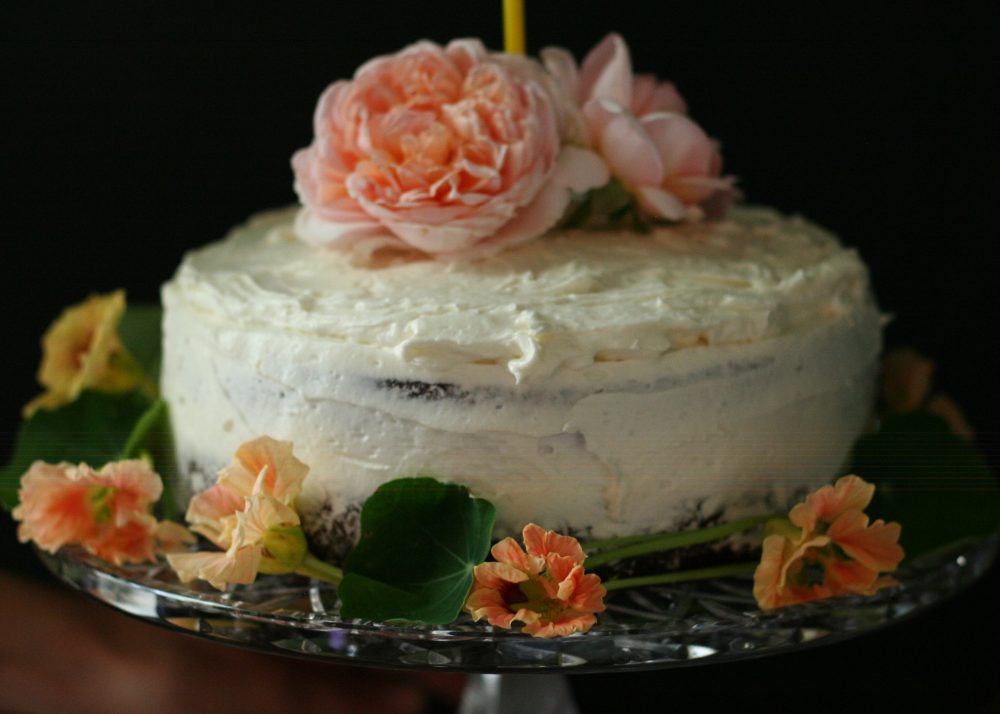
And it is a post about the ministry of cake.
D. L. Mayfield is one of my favorite online writers. Her first book comes out today, and it is a gorgeous, heartbreaking, and wise collection of personal essays.


Assimilate Or Go Home shows us how Mayfield’s own do-gooder dream deflated, not in the garden but on the mission field. In her own words:
The more I failed to communicate the love of God to my refugee friends, the more I experienced it for myself. The more overwhelmed I felt as I became involved in the myriads of problems facing my friends who experience poverty in America, the less pressure I felt to attain success or wealth or prestige. And the more my world started to expand at the edges of my periphery, the more it became clear that life was more beautiful and more terrible than I had been told.
There are so many reasons to read this book, but I especially recommend it for Mayfield’s final reflections on the ministry of cake. Cake, like flowers, seems like a nonessential. In a world rocked by wars and rumors of wars, in a world of unbearable sorrows and grief, a world where too many people lack even basic necessities, what is the point of cake? I am reminded of Marie Antoinette. If we celebrate flowers or cake, if we celebrate at all, are we hopelessly out of touch? Extravagant to the point of selfishness?
Sometimes we must receive something in order to understand that it is worth giving. Because God gave me flowers, I tend those flowers and I give them away knowing that they matter. Mayfield wanted to give her refugee friends everything: answers, solutions, even the love of God, but they gave her cake and that changed everything.
Her most of all.
Here are two more book recommendations (one for cake and one for flowers). Perhaps they might help you to receive the love of God in more beautiful and more delicious ways.


This is my new favorite cookbook. It’s a book of seasonal desserts inspired by homegrown produce and farmer’s market bounty. As soon as I opened it, I wanted to bake my way from first page to last.
The banana and summer squash cake is my children’s new favorite cake. Seriously. Also, there is a cake recipe inspired by those apple cider doughnuts so beloved at Amish farmstands and pick-your-own apple orchards. Need I say more?


This beautiful book was a birthday gift to me from my sister Kelli. It is pretty and inspiring, but it’s also informative and practical. I still have so much to learn about floral design (okay, I still have everything to learn), but I’ve already implemented a few good tips and ideas from this book. Because the bouquet we take to a neighbor, and the flowers we arrange for our own bedside table, matter more than we know.
Tell me, what books are on your nightstand?

by Christie Purifoy | Aug 9, 2016 | children, Dreams, Family, God, grief, Joy, Life Right Now, Roots and Sky, Uncategorized

*
I always know just how long it’s been since we moved to this old farmhouse called Maplehurst. I can judge it by the length of her curls and the stoutness of her legs.
I was eight-months pregnant when I watched the London Olympics surrounded by teetering piles of unpacked cardboard boxes. Elsa Spring was born six weeks after we moved in. This week she and I watched Olympic “gymtastics” while I held her on the sofa in the family room.
*
I wrote about our first year in this place in a book called Roots and Sky: A Journey Home in Four Seasons. I wrote about how small and slow this new beginning was for us. We had such big dreams. I wanted to see them realized immediately, but before we’d even unpacked all of the boxes, I had a baby daughter in my arms. Not long after that, winter settled in. Ice on the windowpanes. Ice in my veins.
That first year was a year for slow and small. Those first four seasons were all about be still.
And since then? The days have continued to feel slow and small and ordinary. It is only when I look back, only when I take in the full sweep of four years all at once, do I feel that explosion of new life.
Nothing has been small. Nothing has been slow. Nothing has been ordinary.
All along, God has been doing a new thing. And I am a witness.
*


*
What has happened in four years? We welcomed a daughter, we watched four children grow, I wrote a book, we built gardens, and we have almost filled our guestbook with names. I wrote about that, the guests and the flowers, in a recent piece for Art House America. You can read my quiet manifesto here.
We continue to dream new dreams for this place and for those who join us here, which means we continue to wade through the small, and the slow, and the ordinary.
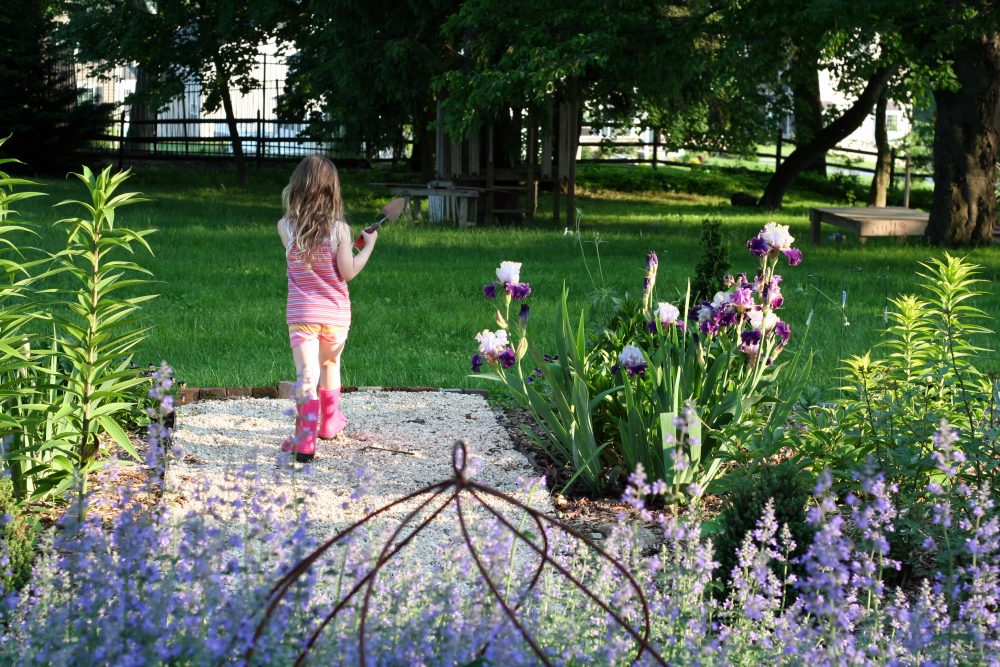
The house is wrapped in scaffolding, but thanks to the care of two men, the one-hundred-and-thirty-year-old bricks haven’t looked this solid since the year they were laid. The worn, black shutters have been removed, and the day when we will reinstall them, either repaired or remade, feels impossibly far away. One by one, a local craftsman is restoring our windows, but it could be years before every window in this house is repaired. Yet once stripped and repaired, these old windows with their wavy glass will welcome cool breezes for another hundred years.
It feels, four years on, as if we are still in the messy middle. Those words I wrote in Roots and Sky have lately come floating back into my mind:
We love beginnings, and we privilege endings, but we live most of our lives in some sort of middle. Life is perpetually unfinished. That is its nature. – Roots and Sky, p 122
Unfinished it may be, but I can say with confidence that here at Maplehurst I have seen the goodness of the Lord in the land of the living. And that is enough for me.
*
God’s goodness and the world’s grief are not as irreconcilable as I sometimes think. Four years ago, I could not have anticipated the sorrows that would visit us in this place. I wrote about the grief of that first, hard winter in Roots and Sky. I have written about other sorrows here on this blog.
Four years ago, I could not have anticipated how much would be given and just how much would be taken away. It is good that I did not know. It is good because I would have weighed it all in some balance. I would have asked if the gains compensated for the losses. Would there be more laughter than tears? More happiness than grief?
But I have learned that joy spreads its roots through laughter and tears. I have learned that sometimes we receive the most when something precious has been lost. Abundant life is mystery, not mathematics. Or perhaps, mathematics, which I’ve been told is the language of the universe, is more mysterious than I knew.
There is a wise woman in Proverbs. She is one who “can laugh at the days to come.” What will the next four years bring? I feel too sobered by the recent past to laugh. Considering time, I cannot help but tremble. It is so clearly held in hands that are not mine.
I may not be laughing, but I do feel very small and very still. Four years on, I am no longer fighting the wisdom of this place. So much has grown here in these four years: a baby girl, a book, a ring of apple trees. The soil here was always fertile, but we have watered it faithfully with our tears. I cannot say with certainty what we will harvest next, but I think the harvest will be a good one. Perhaps our best yet.
Perhaps our next harvest will be laughter.
*