by Christie Purifoy | Mar 18, 2014 | Art, Faith, God, Jesus, Lent, Stories, Uncategorized, Winter
“His soul swooned slowly as he heard the snow falling faintly through the universe and faintly falling, like the descent of their last end, upon all the living and the dead.”
– James Joyce, “The Dead”
***
***
I want to write spring stories. I want to write glorious endings.
And why not? I am the storyteller. I am the one tap, tapping at this keyboard.
I know that others in this world are observing spring’s first blooms and taking walks on balmy nights. My snow-covered world is not the world in which everyone is living. I am winter-weary, and I want to move on to other themes.
But I have ceded control over my own stories. I have made a promise (to myself? To God?) to write stories rooted in my own particular place and this particular time.
And this place is snow-covered.
And Easter is still a long way off.
***
On Saturday I walked the halls of a large art museum. I listened to echoes. I stared into the deep brown eyes of a woman who died in Egypt thousands of years ago. Her funeral portrait is lifelike. It hangs at eye level. She looked about my age. We might have been neighbors, I thought.
After that, each work of art seemed connected to some soul. The silversmith who worked the bracelet. The painter who held the brush. The model who sat for hours. The dancers portrayed in silk. The anonymous ones who wove the tapestry.
Each room revealed more of the vastness of our world. So many people live on planet earth today, I cannot even conceive of them all. But add in every life in every place and each time for all of history? My small mind struggles to believe there is a God who has known and loved each one.
***
The end of the story is always the best part. It is the place where the messiness of the middle is resolved. The point where pain is redeemed and suffering fades into something beautiful. It is the place where I want to pitch my tent.
But I do not think we are always given that choice.
I keep seeing one particular crucifix. I encountered it in one of the museum’s rooms of medieval art. It was carved out of wood and out of anguish. The Christ figure was elongated and emaciated. Reaching tendrils of warm wooden hair seemed to say that this is pain without end.
This is suffering unfinished.
I drove long miles between the art museum and my house, and I thought about the crucifix. The carving was small enough to hold with one hand, but I wanted it to be bigger. I felt the heaviness of all those lives, like shades in every corner of the galleries. I wanted Christ crucified to be big enough to heal every soul for all time.
And I wanted it finished.
As I drove, snow began to tumble through the air. I could see it churning in the light of streetlamps and headlights. As it dusted rooftops and cornfields, I could feel winter settling back in for a longer stay.
***
We privilege endings, but we live in the middle.
This place is snow-covered.
And Easter is still a long way off.
by Christie Purifoy | Mar 11, 2014 | Desire, Dreams, Lent, rest, Seasons, Spring, Uncategorized, Winter
From my kitchen window I can see a blue plastic sled stranded at the top of a small hill.
Last year, our first spring at Maplehurst, we edged the hill on one side with blueberry bushes. We shored up the other side with an asparagus patch. We planted a peach tree and a cold-hardy fig like two flags at the top, but the kids have carved a downward path that manages, usually, to carry their sleds around their mother’s precious plants.
The snowcover on the hill is shrinking, and the sled is marooned. I can imagine it still sitting there in July, nearly forgotten in the weeds.
The sled I see clearly, but it is much harder for me to imagine July’s green abundance. Here, in early March, there are no signs of new life. Instead, the snow seems to be coughing up rusted buckets and wilted kickballs.
These hinge weeks between winter and spring are always ugly, but, thanks to February’s ice storm, this one is particularly awful. Brown grass and mud are mixed with splintered wood; our world looks as if it has only just survived some disaster.
From my kitchen window, I see a waste land.
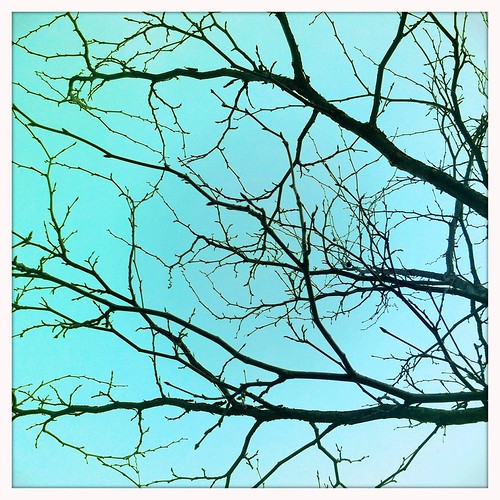
The trees, still bare, no longer remind me of elegant bones against the sky. Instead, they look naked, and I am ashamed for them.
***
***
At church, it is the first Sunday of Lent. The cross carried in procession is veiled in purple, as if we cannot yet bear the sight of our redemption. Easter, like spring, is still too good to be true.
The reading from the Old Testament this day is from Genesis. Adam and Eve discover their nakedness, and they are ashamed.
This season I am following my friend Sue’s example and praying daily one simple prayer: Search me, God, and know my heart.
This prayer is simple and brief, but it isn’t easy to pray. It feels like a deliberate stepping out into the open with no clothes. Not even a fig leaf.
***
I thought this prayer would open my eyes to some sin. Instead, my eyes have been opened to something much more complicated.
T. S. Eliot describes it in his own meditation on a wasted, blasted land:
April is the cruelest month, breeding
Lilacs out of the dead land, mixing
Memory and desire, stirring
Dull roots with spring rain.
Winter kept us warm, covering
Earth in forgetful snow …
Winter’s rest is melting away, and I am waking up to a great desire. And I find this terrifying. Exhilarating, too.
Spring won’t truly arrive until I have dreamed and ached to pick asparagus, blueberries, peaches and figs. First, the longing. Then, the feast.
And the new plans God has for my life can’t be realized unless I first recognize the desire planted in my heart. Certain dreams will never come true unless I first wake up and remember them. But to remember them enough to pray for them is to stand naked before God. There is no more hiding the depth of my desire. There is no shrinking from the fear that he will say no or not yet. Sometimes spring is interrupted by a killing freeze.
God is tugging me – and you – towards resurrection.
But the road is a cruel one.
***
by Christie Purifoy | Feb 25, 2014 | Dreams, God, Home, Uncategorized, wilderness, Winter
You were a child, and they wanted only the best for you. So they told you your heart was deceitful. They told you that every desire was only a misplaced desire for Him.
They spoke the (partial) truth in love, and you took their words to heart. Those words kept you safe. They kept you on a narrow way, and you will always be grateful for that.
But Jesus never promised safety; He promised abundance. The abundant life is a wide-awake life, and it is anything but safe.
*
Infertility was unexpected. It was a hammer blow to your heart, and when your heart cracked open something precious and dangerous slipped out.
Desire.
First one and then one more. And just when you thought that was all, convinced you’d closed the box up tight, even more would come leaking out. We were made to be deep water, but you were terrified when you first glimpsed the depths of your desiring self.
You wanted, and you wanted fiercely. You wanted a baby of your own. And when that miracle baby was born you asked for more.
There are three things that are never satisfied, / four that never say, ‘Enough!’: / the grave, the barren womb, / land, which is never satisfied with water, / and fire, which never says, ‘Enough!’ (Proverbs 30:16).
Babies were only the beginning. You wanted to earn that PhD. You wanted to live in the big city. You wanted to read poetry on green Irish cliffs.
You wanted to live a life that mattered. You wanted to create. You wanted to be loved.
Fiery desire had been unleashed. You held your hands to the flames, and you were consumed.
*
God gave you the babies. God gave you the degree. God gave you poetry in Ireland, and God gave you love.
But God wanted to give you more. So He took you to the wilderness.
You cried every day for two years, Lord I want to go home. Lord I have no home. Lord I want to go home. Please, oh please, take me home.
When God led you through the desert to the farmhouse on the hill, you heard again the message given by those well-meaning Christians all those years ago.
It is true that all desire is misleading.
Desire isn’t necessarily wrong (though it might be). It isn’t necessarily sinful (though it might be). Desire is misleading because, if God-given, it leads you somewhere unexpected.
The babies bring joy, but they grow so quickly and every day they slip just a little further from your arms. The PhD sharpened you, but it didn’t provide the career you imagined. The house is a dream-come-true, the garden is your canvas, but the work is relentless and you do not have what it takes.
Those things do not satisfy completely but wanting them was never wrong. Those dreams were planted in you by God himself and in reaching for them you found something better – someone better – than any dream-come-true.
*
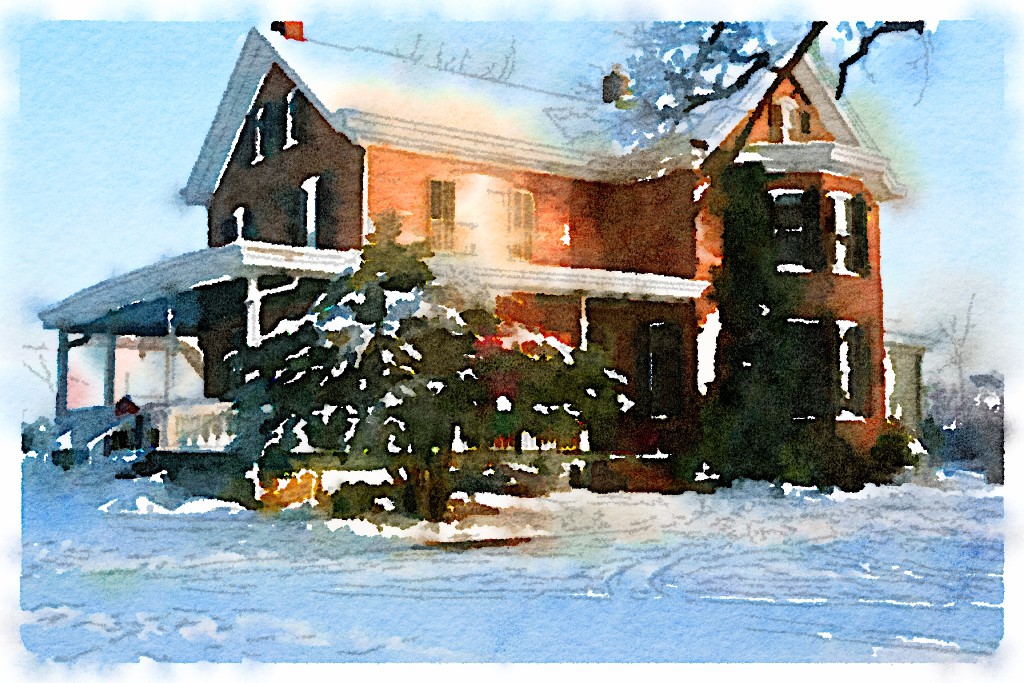
Sitting in the deep recess of the old parlor window, you notice the snow beginning to dust your hilltop. Stepping outside, snowflakes tap-dancing on your cheeks, you feel a great longing well up in your heart.
This is a familiar feeling. For years, you could see some clear thing whenever you felt it. A child. Or an accomplishment. Or a garden of your own. But you have come home and what is there left to want? What is the object of this longing and where will it lead?
Perhaps the snowflakes blur your vision just enough to help you see. Because it is here – in the snow on the hilltop – that you finally glimpse the truth. Yes, the farmhouse on the hill is a gift, God-given, but it is only the shadow of your true home.
Now you understand that God is, that he has always been, leading you home to himself.
Welcome home.
*
*
by Christie Purifoy | Feb 19, 2014 | Home, motherhood, Pennsylvania, river, Uncategorized, Winter
Last week, it snowed here at Maplehurst. Even after ten years lived in Chicago, I don’t think I have ever seen so much snow fall all at once. Granted, I left Chicago for Florida the winter before the once-in-a-decade, cars-stranded-on-Lakeshore Drive monster storm.
I remember that winter well. It was my first in Florida. Everyone I knew – neighbors at the bus stop, new friends at church – kept saying the same thing. Aren’t you glad you don’t live there anymore?
Which only made me want to cry. Because, no. The answer was no. I did wish I was there. In the snow. With my friends. In a place that felt like home.
*

*
But now I feel at home again, although in a new place, and there is snow, and I am grateful. Crazy-eyed from the pileup of canceled-school days and disruptions to my cherished daily routines, but still grateful.
The evening after our Pennsylvania nor’easter, I looked out the window just after sunset. I saw what looked like a deep and rising sea of snow. I could even point out small windblown waves. As darkness blurred the edges of everything, those waves began to rise and fall. And creep higher. Deeper. Or, they seemed to. I felt the irrational worry that seawater would soon be seeping in around the window frames.
It was strange and startling. It was also beautiful.
Twenty-four hours later, our long driveway had finally been cleared. I walked the length of it, from front porch to mailbox, and decided the scene looked just like a wedding cake. Thick white frosting smoothed to perfection, and a driveway sliced cleanly away.
*
I tend to see the world in layered images like these. The result of a lifetime of reading, I suppose. The trick, I’m discovering, is holding on to both. Acknowledging the truth of both.
Snow-covered field and rising floodwaters. A freshly-plowed driveway and a slice of wedding cake.
Maplehurst is like this, too. It is an old, gracious, crumbling-a-bit-around-the-edges house. It is the scene of our daily happiness and daily headaches. The place where children laugh, and I yell at them to take their fun outside. Outside! I say. You can scream at your brother all you like just please don’t do it under my feet while I’m cooking dinner!
Yes, I’m afraid you’ll hear exactly that every day at 5 pm.
Maplehurst is also our dream-come-true. In spiritual terms, it is a fountain. A blessing. The one place on earth that, for me, is nearest to the throneroom of God. There is a river and it flows straight through an avenue of old maple trees.
It is both, and I must see both.
The spiritual reality is likely the most important, the most real, but I can’t let it crowd out the rest. If I’m going to write honestly and live honestly, I can’t forget the ground beneath my feet. I can’t forget what 5 pm feels like.
And it isn’t only honesty at stake. It is also love. If I am going to love my neighbor well, I can’t stop seeing the dirtiness of my own patch of dirt. I can’t forget that we are all together in this land of muddy snow and headaches and 5 pm yelling.
*
5 pm is still quite a few hours away. In the freshness of a quiet morning (the children have finally returned to school, the baby is happy and miraculously occupied with toys too big to be a choking hazard), something new occurs to me. Maybe, the trick is not learning to hold on to two true things. Maybe, there aren’t two realities: one spiritual, the other temporal. Maybe there is only the one. Maybe I must learn to see without splitting everything in two.
Maybe, there is glory in the dirt.
*
“I am mountain, I am dust
Constellations made of us
There’s glory in the dirt
A universe within the sand
Eternity within a man
We are ocean, we are mist
Brilliant fools who wound and kiss
There’s beauty in the dirt
Wandering in skin and soul
Searching, longing for a home.”
– from “I am Mountain,” by Michael Gungor and Lisa Gungor
*

*
by Christie Purifoy | Feb 11, 2014 | Grateful, Home, Pennsylvania, rest, Uncategorized, Winter
Last week, I wrote a few words in praise of The Slow Life. And you responded.
So many of you said you live in just the same way. Or try to. Or want to. And I was pleased. Maybe even a little smug in my self-satisfaction.
And then ice blew in on the wind, and I learned something: my vision of the good, slow life is highly dependent on hot coffee in the morning. And hot tea in the afternoon. And cozy heat in the radiators and running water in the tub. And, well, creature comforts of every kind.
But there are days when the carpet of your usual choices does not roll out at your feet. Days that do not begin with hot coffee and do not end on the sofa watching PBS with your husband.
What does this slow life look like when we are not comfortable? On those days, is the slow life we crave even possible?

On our first day without power, I spent many hours reading on my old pink settee by the light from my bedroom windows. It was cozy under a blanket, and the baby took a good nap. The cold hadn’t yet settled into our bones the way it would on day two.
But I wasn’t comfortable. I was on edge. Every few minutes I would hear a rending, cracking sound, and I would sit up looking left to right, left to right, trying to see which tree was losing its battle with the ice this time. When a 120-year-old maple tree loses a limb, that limb is still the size of a large tree. And those large trees fall with a grinding sound of splintered wood, and a crashing sound of falling limbs, and the shattering sound of a shower of ice.
When I lived in Chicago, I would often come across a sweep of broken windshield glass glittering on the sidewalk. Sometimes, I would find more and more of it leading from car to car and on to my own car parked on the street with a startled look where the front windshield once was.
Late in the day, I took a short walk, and I remembered all that broken glass. By then the temperature had warmed to the low 30s and a lot of the ice had dropped its hold on the trees and scattered in the wind. You could see it everywhere, great sweeps of it sprinkled on top of the frozen snow.
I stepped carefully, shielding my eyes against the glittery light, and realized that the whole sky must be made of glass, like the windshield of a car.
And someone had taken a hammer to it.
There are quiet days and there are days we are convinced someone, somewhere is wielding a hammer.
And, honestly, I’m still waiting for whoever’s in charge to put down the hammer because the suitcases we packed when we decamped to a hotel have disgorged their contents in every room like last night’s dinner, and I’m sick with a cold and a pounding headache, and they say another big storm is headed our way.
And yet, I still want to say this: there’s a still point in this turning world. On the quiet days it grows in us, we welcome it into our hearts with coffee cups and dinners together and hours with a book and bedtime stories read by the fireplace and candlelight at breakfast just because.
And when the hammer falls, and the sky does come falling, that still point doesn’t leave us as we duck and take cover. It’s still there in our hearts and still out there in the world. Leaning over, catching our breath, we might spot it.
To me, this day, it looks like one splintered tree fallen just to the right of my car and one splintered tree fallen just to the left. It looks like another tree lying broken just beside the kids’ playset and another huge limb right beside the henhouse.
Looking around, I would swear that no trees fell on this hill.
They were placed.
(Also, my husband says he’ll slice the old maple wood into pretty round platters for serving bread and cheese, so there’s that.)
by Christie Purifoy | Jan 29, 2014 | children, Home, Pennsylvania, Uncategorized, Winter
I grew up without winter. For the most part, at least.
Winters in central Texas were brown and chilly, but you never knew when it might hit eighty degrees. In December, we never bothered to ask for a white Christmas. Instead, I would secretly pray that it wouldn’t be so warm we’d need the air conditioner. Even at eight years old, I found air conditioning very depressing.
As a young girl I read every one of Laura Ingalls Wilder’s books repeatedly. But I read The Long Winter more than any other. It isn’t a pretty story, far from it, but something about the extreme cold and snow fed my soul. Even then.
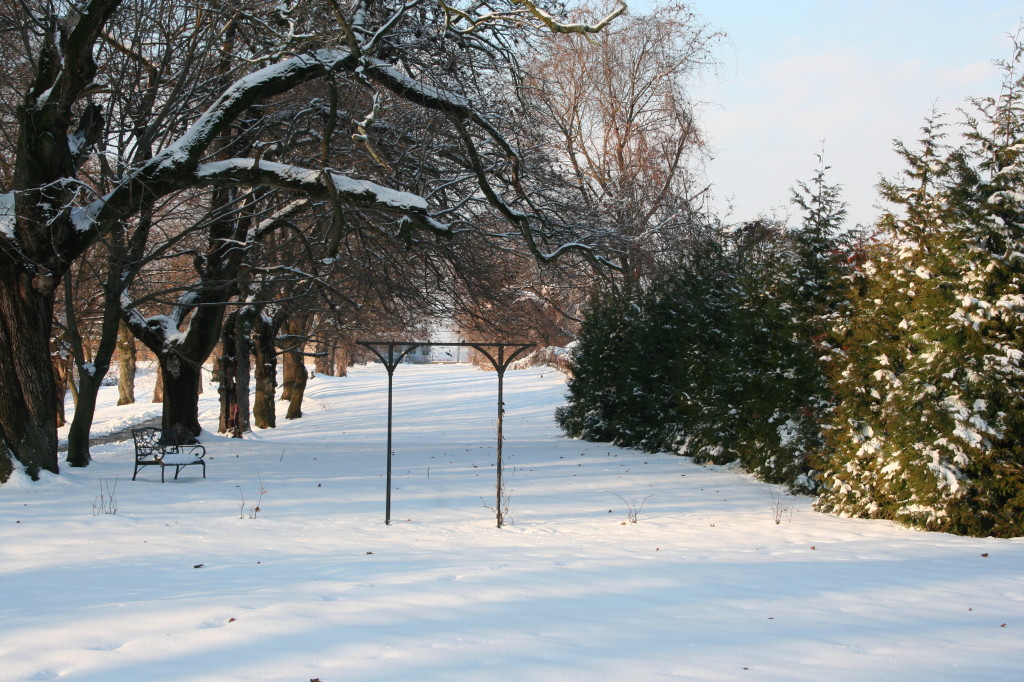
It’s a truism that home is where you come from. Home is where you began.
I disagree. I think home is the place we’re headed. Home is the destination.
Here in my little southern corner of Pennsylvania, winter’s grip is fierce. Not Midwestern or New England fierce, to be sure, but strong enough to leave me feeling more than a little battered. More than a little caged-in.
Replacing the chickens’ frozen water with fresh, I feel like Laura Ingalls herself, but by the fourth trip out to the henhouse the literary novelty has quite worn off.
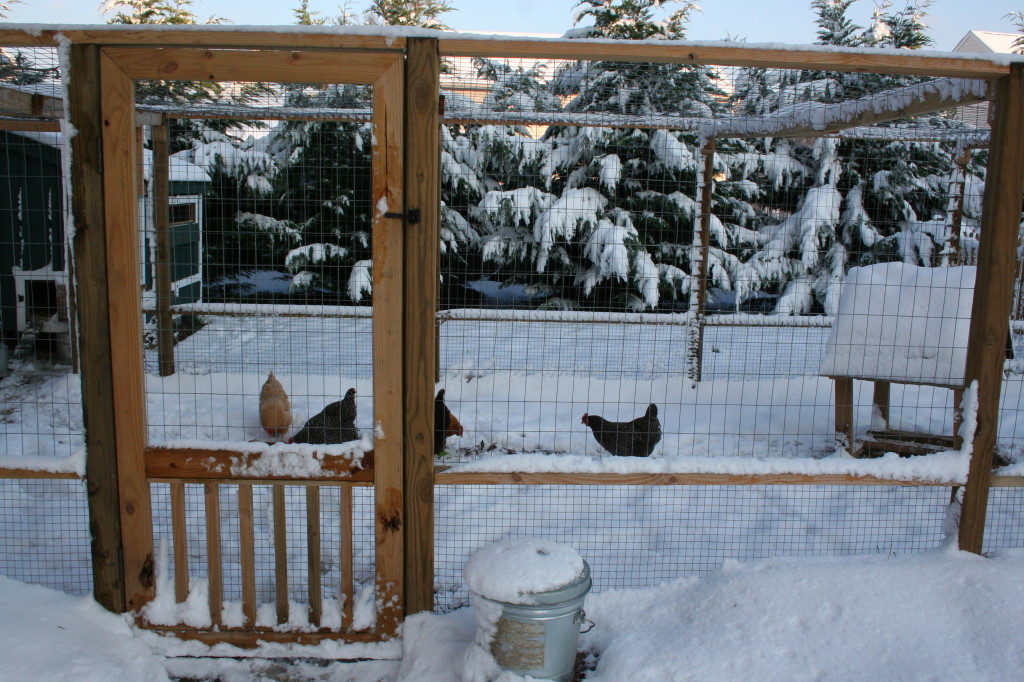
And yet I love winter.
Recently, I dropped the baby in her father’s arms and escaped out the front door with my other daughter, my firstborn. I don’t have ice skates of my own, but I carried hers. We opened the gate in the split-rail fence and we half-slid, half-stumbled down the sledding hill until we could cross the street to the frozen pond.
I stood in the snow, my toes slowly going numb, and I watched my daughter slice one foot and then the other across the ice. I said to myself, “This is Pennsylvania. This is our home.” The word Pennsylvania felt awkward. Perhaps I should blame my frozen lips. Or perhaps not. We are still learning the contours of this place and these people.
She circled the perimeter three times before I made her come in. I might lose my toes, I shouted.

My poor toes. They really did hurt, buried in snow like that, but it was a good kind of pain. Like the sharp, stinging realization that comes at the end of a very long walk. You know you’ve gone farther than you can handle, but it will be worth it. You are so close.
Three times around may have been too much. My daughter fell to her knees only part-way through our climb back up the sledding hill.
You’ll make it, I said. We’re nearly there.
Look! I can see our home from here.
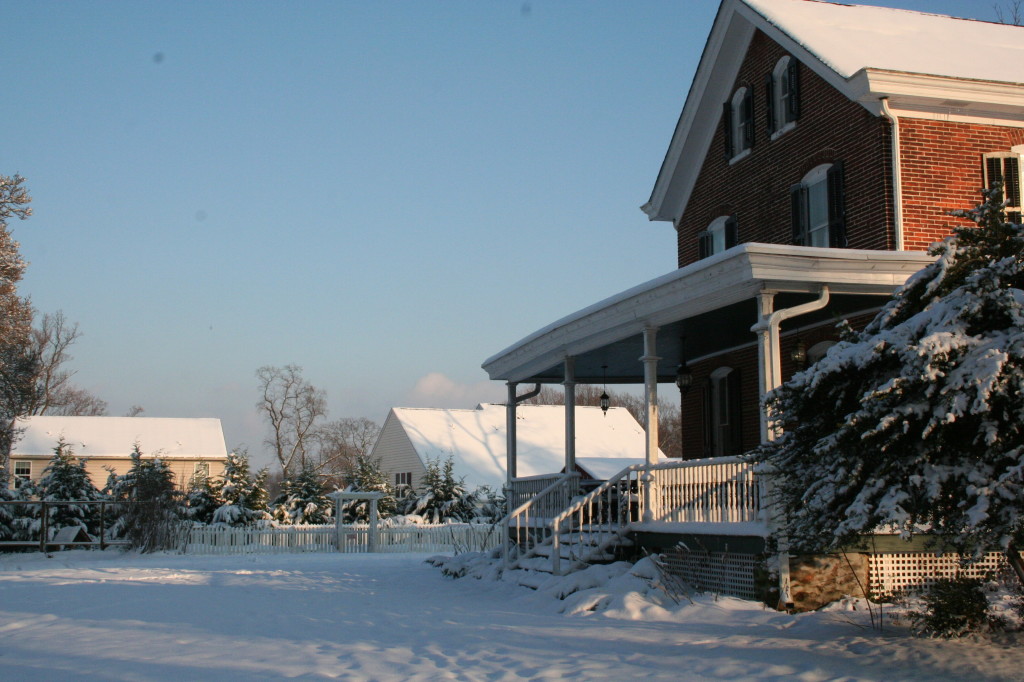
*all photos taken by yours truly (with apologies to our talented, much beloved Photographer)


