by Christie Purifoy | Dec 3, 2012 | Advent, Poetry, Pregnancy, Uncategorized
For a while now, I’ve reserved Mondays for poetry. If nothing else, poetry slows us down, and I usually need that on Mondays.
Here is a poem for the first Monday of Advent.
No doubt you can find many English-language versions of Rilke’s poem “Magnificat.” I’m afraid I couldn’t say which is best, whatever “best” means when we are speaking of poetry in translation. Most accurate? Most beautiful? As much as possible of both?
I chose this translation because of the words which begin the final stanza: “That he found me!”
Despite the trouble that sent Mary to seek refuge in the home of her cousin, she praises God because he saw her. He noticed her. He found her.
He is God-who-sees-us.
He is God-who-knows-us.
We are all of us lost, we are all of us found. Some of us don’t yet know that we’ve been found. Some of us just have a hard time remembering.
Rilke’s version of Mary’s song reminds me that even in the midst of trouble, even when I feel most lost, I have been noticed. I have been found.
Magnificat
Already gravid, she ascended, nearly
bereft of any solace, faith, or hope.
The pregnant matron, proudly and austerely
knowing, met her on the slope,
aware of all that Mary need not share.
Since she was resting on her suddenly,
the heavy frau embraced with patient care,
and waited till the younger spoke: “You see,
I feel as if I were to live forever.
God fills the rich with vanities, dear friend,
almost not even looking at their clever
glitter; choosing maidens, though, He’s never
rash, but fills them with life without end.
That he found me! Consider, that on my
account His fiats moved the stars. Oh, raise
Him up, my soul. Exalt the Lord on high,
for all that you can praise.”
– Rainer Maria Rilke, translated from the German by Len Krisak
by Christie Purifoy | Nov 26, 2012 | Advent, Family, God's Love, Grateful, motherhood, Pennsylvania, Poetry, Pregnancy, Uncategorized, Waiting

One year ago, I was waiting, holding on to these words from Psalm 81: “I am the Lord your God, who brought you up out of Egypt. Open wide your mouth, and I will fill it.”
The date inked in beside those words in my Bible is August 23, 2011. By the time Advent began, I’d spent three months wringing out every drop of hope they had to give.
I did not know when (or even if) we would be moving on from Florida, but I longed to leave the desert behind. I was not yet pregnant, but I had a daughter who prayed every night for a sister. I had only imprecise dreams of what the future might hold, but I kept my mouth open and imagined a cup running over.
I wrote every day that Advent, and I shared it all with you here.
Before I’d even packed away the Christmas tree, I was pregnant, and the events which would bring us to Pennsylvania had been set in motion. I celebrated the new year with anticipation, though I still knew nothing of a baby girl or a red brick farmhouse.
Such a year it has been. Such a year.
And now – now, it is a season for singing. And, so, like last year, I will have something for you here each day of Advent.
We will wait and sing, together.
Magnificat
I am singing my Advent anthem to you, God: How all year
I’ve felt your thrusts, every sound and sight stabbing
like a little blade – the creak of gulls, the racket
as waves jostle pebbles, the road after rain, shining
like a river, the scrub of wind on the cheek, a flute
trilling – clean as a knife, the immeasurable chants of green,
of sky: messages, announcements. But of what? Who?
Then last Tuesday, a peacock feather (surprise!)
spoke from the grass; Flannery calls hers “a genuine
word of the Lord.” And I – as startled as Mary, nearly,
at your arrival in her chamber (the invisible
suddenly seen, urgent, iridescent, having put on light
for her regard) – I brim over like her, quickening. I can’t
stop singing, thoroughly pregnant with Word!
– Luci Shaw
by Christie Purifoy | Nov 19, 2012 | Family, motherhood, Poetry, Seasons, Uncategorized

My firstborn holds my fourth and all I can think is how much time gives us and how much it takes away.
I looked forward to autumn for ages, it seems, and now, suddenly, we have tipped over into frosts and bare trees. Is it any wonder, holding this tiny baby and reading this book to the nine-year-old, that I want to slow everything down? Time, itself, included?
Later, arms emptied by bedtime, I read “In Season.” Now I wonder, would I really see these two daughters, and in seeing, love them, if I weren’t prompted by the shifting season?
If the season were as endless as this poem’s tea-cup climate would I be content, like the tea-cup couple, to hold my family at arm’s length? To love them, but only in convenient ways?
In Season
The man and woman on the blue and white
mug we have owned for so long
we can hardly remember
where we got it
or how
are not young. They are out walking in
a cobalt dusk under the odd azure of
apple blossom,
going towards each other with hands outstretched.
Suddenly this evening, for the first time,
I wondered how will they find each other?
For so long they have been circling the small circumference
of an ironstone cup that they have forgotten,
if they ever really knew it, earth itself.
This top to bottom endlessly turning world
in which they only meet
each other meeting
each other
has no seasons, no intermission; and if
they do not know when light is rearranged
according to the usual celestial ordinance –
tides, stars, a less and later dusk –
and if they never noticed
the cotton edge of the curtains brightening earlier
on a spring morning after the clocks have changed
and changed again, it can only be
they have their own reasons, since
they have their own weather (a sudden fog,
tinted rain) which they have settled into
so that the kettle steam, the splash of new tea are
a sought-after climate endlessly folded
into a rinsed horizon.
– Eavan Boland

by Christie Purifoy | Nov 5, 2012 | Art, Books, Faith, Pennsylvania, Poetry, Uncategorized
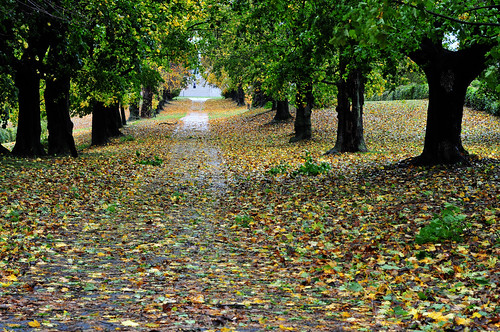
I watched these old, old maples bend in the wind of that hurricane. Because they yielded, they are still standing.
That is how I want to live. I am more and more sure that art and beauty and love grow best not by raging against the wind (or the storm, the dark day, the hard, unasked-for circumstance). They come through yielding.
To yield is not to give up. It is not throwing up my hands in defeat. This yielding is more like being carried. It is moving with what moves and watching – always watching – for the One who does the moving.
And then singing of what I see.
Vow
The need to work this land to fit my wants
I yield. I vow no more to walk with plans
like gossip falling from my mouth. I choose
to go in silence, learning, in my sure
refusal, the truth that yields to yielding.
At Equinox, before the flood of light
sets water loose, I covenant to give
the downward rush beneath the grass its head.
I’ll dam no stream. I’ll dig no pond. Nor will
I plant willows to suck the wet spots dry.
My work shall be to say the nature
of Creation’s slow unfolding, to name what
becoming new has always been, to praise
what lives without my praise unto itself.
– John Leax
by Christie Purifoy | Oct 22, 2012 | Books, Food, Poetry, Scripture, Uncategorized
Once upon a time, Mondays on this website were devoted to poetry. Because the small bites of poetry are about the only literary food I have time for these days, I’m reviving the tradition. Please tell me what you think. Would you like a poem each week?
To help you make up your mind, here’s one from a favorite poet, Luci Shaw.
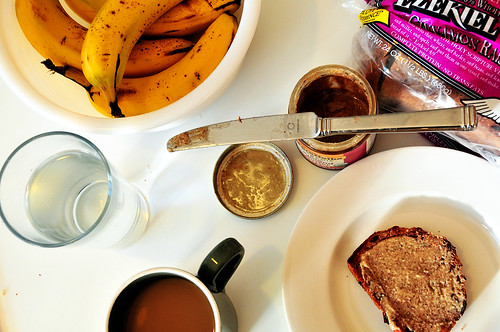
It reminds me that my own “quotidian wilderness” (a land of baby bottles and cinnamon toast, children with sniffles and autumn leaves) is saturated with glory.
Manna
They asked, and he brought quails,
and gave them food from heaven. Psalms 105:40
I’m not asking for quails for dinner
and, if they flew in my window, at mealtime,
in a torrent of wind, I would think
aggravation, not miracle.
Time is so multiple and fluid. If I lose a day
flying the Pacific and gain it back
returning, perhaps the prayer I offered
this morning at first light
was known and answered last week.
You never know what a simple request
will get you. So, no plea for birds
from heaven. Rather, I will commit myself
to this quotidian wilderness, watching for what
the wind may bring me next –
perhaps a minor wafer tasting like honey
that I can pick up with my fingers
and lay on my tongue to ease, for this day,
my hunger to know.
– Luci Shaw
