by Christie Purifoy | Aug 5, 2013 | allergies, Family, Food, Grateful, Uncategorized
A week ago Friday, Maplehurst’s kitchen was the scene of a pizza party.
Rice flour crusts turned crisp in the oven while puffy dough rested on the counters. Oregano snipped from the pot on the steps turned tomatoes, garlic, and oil into more than the sum of their parts. We sliced fresh mozzarella on one board. We scattered dairy-free cheese substitute on another. We browned sausage from Axel, our local farmer, in the cast-iron skillet.
We baked and sliced and baked again as seven children held out their hands for more.
The pizzas were delicious, but that doesn’t explain the looks on the faces of two mothers who hovered near the table.
“He’s never shared pizza with a friend,” she whispered.
“Never,” I said.
//
//
The kitchen table.
It’s a symbol of hospitality. Of togetherness and community. Except, for us, it’s the place where fear draws up a seat. The table doesn’t bridge the divide. It reinforces it.
We say no to potlucks. We decline the invitation to someone else’s Thanksgiving dinner. If we say yes to the birthday party, I bake our own pizza and cupcakes ahead of time.
We don’t often say yes.
A young girl in California is given three injections with the epi-pen but dies anyway. Fear scores one more point.
Always there is another reason to be afraid.
In the daily sifting of life (this is good, this is bad), life-threatening food allergies are our constant Bad Thing.
//
//
The pizza party came during the week we hosted good friends, a mother with two daughters and a son. Our big girls were once babies together in Chicago. Their family left the city soon after that, but our lives have run on parallel tracks ever since. Epi pens and questions. Fear and hives. Uncertain blood tests and frighteningly close calls.
Most importantly, we share little boys. One has a grin slightly wider than the other, but they both carry medicines and their own packed food wherever they go.
This shared Bad Thing brought us together for a week, but it turns out Good and Bad can’t be sifted so neatly.
Our week together was perfect summer weather and long drives over green hills past storybook farms. Our week was three little girls laughing and noisy, nightly sleepovers. It was a week of good conversations. Of childish voices singing together during our own at-home Sunday morning service. We swam in the creek. We visited a new Amish farmstand every day.
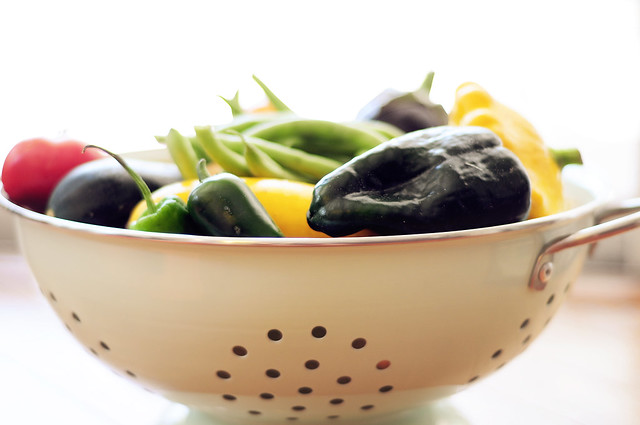
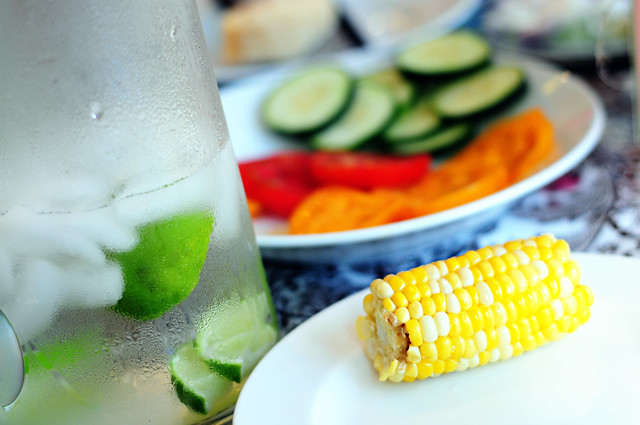
And the food! Two ears of corn for each person at the table. Watermelon for breakfast, afternoon snack, and dessert. Garden squash even the children enjoyed (the secret? Julienne into matchsticks and cook it up in a pancake).
We ate Japanese fried chicken and ribs cooked on the grill. We dipped spring rolls fried in coconut oil into a no-sugar-needed apricot sauce. We licked our fingers over garlicky green beans, and we smiled over a rainbow of tomatoes dusted with salt and cracked pepper.
//
//
I don’t think a week like this would be possible if we handled our fears well. I don’t think it would happen if we tucked them neatly out of sight.
I think we arrived at this week because we felt the full weight of fear on our backs, but we kept on walking. We acknowledged our fear but asked, “Isn’t there more?”
It turns out there is more. Much more.
I’m no longer so confident about naming the good and the bad in my life. What do I know, really? I know that food allergies are terrifying but pizza shared with a friend is the most delicious pizza around, whether or not the cheese is real.
I think even a life lived in the valley of the shadow of death can be beautiful. I don’t fully understand this. I may never be able to explain it or account for it. But I am grateful.
“… the rising sun will come to us from heaven / to shine on those living in darkness / and in the shadow of death, to guide our feet into the path of peace.”
Luke 1:78-79
by Christie Purifoy | Apr 24, 2013 | children, Grateful, Pennsylvania, Uncategorized
Here is one thing I know: the world will keep on falling apart.
Sometimes it’s terrible, and you think you can’t go on. Bombs explode and guns are aimed at children, and the unimagined thing becomes our new reality.
Sometimes it’s a pebble in your shoe, a child apparently born without an indoor voice, and the discovery that you can, in fact, ruin brown rice even when you make it with an automatic rice cooker.
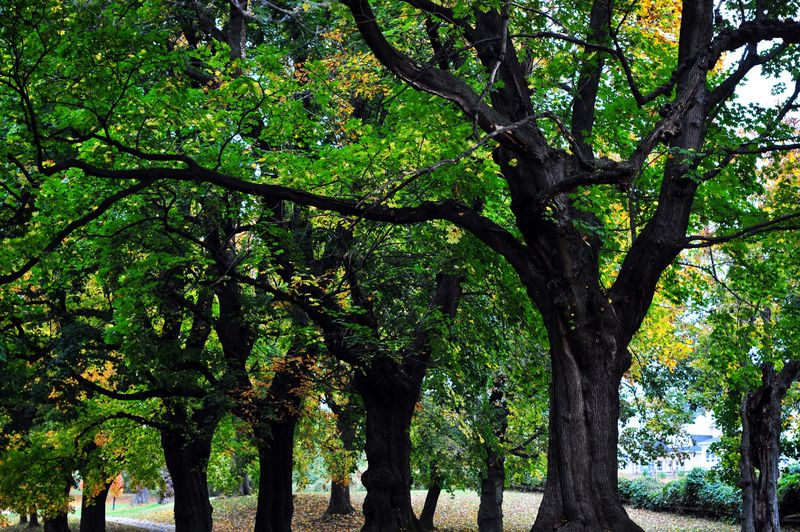
Sometimes it’s a Friday night thunderstorm that sounds terrible but lasts only fifteen minutes. You wake the next morning to blue skies and sunshine and the sight of a once-beautiful and massive maple tree lying stricken across your lawn.
The gloomy face of your chain-saw wielding husband annoys you. The tears of your firstborn both sadden and exasperate.
You move swiftly to combat both gloom and grief.
The tree was already at the end of its life! It was only a matter of time! It’s the circle of life! Nothing to cry about!
But you are wrong.
It is worth the gloom. It is even worth the grief.
The young girl is right, and you consider that even flowers were not created to fade. Life was never intended for death.
If we numb ourselves to the loss of one great tree, do we lose our capacity to grieve the harsher pain? The less explainable calamities?
Can our optimism become a kind of blindness? A refusal to see and acknowledge that all is not as it should be?

You are grateful your Saturday story does not end here. You consider that pain rarely seems to signal The End. In your (admittedly) limited experience, there is always something more.
Joy does come in the morning.
On this morning it appears in the form of a half-dozen teenagers. Needing to earn money for summer camp, you had agreed weeks ago (and quickly second-guessed your agreement) to give them odd jobs. You’d spent too much of the previous week worrying about the tall ladders involved in window washing and the poison ivy involved in brush clearing.
But here they are, and there, you have only just discovered, is the tree, and for that entire Saturday morning and the next Sunday afternoon, they will haul and carry and load. They will be your very own, unasked-for, tree-clearing work team, and your children will only occasionally slow their progress by treating the log pile like a jungle gym.
The tree is lost, and that is a terrible thing.
But it is not the only thing.
by Christie Purifoy | Apr 17, 2013 | Florida, Gardening, God's promises, Grateful, Home, Joy, Pennsylvania, Seasons, Spring, Uncategorized, Waiting
Spring has finally come to Maplehurst, and we are living in a watercolor world. Trees are smudged with the almost-neon green of new buds. The ground is blurred by the purple and white of wild violets. Move your head too quickly, and the brilliant yellow of the dandelions might just look like a lightning strike.
For several days, I have noticed a spot of garish orangey-red near the laundry room steps. I assumed it was a child’s toy. Something awful and plastic. Today, I realized it was a patch of tulips striped orange and yellow. They have large, black polka-dots in their middles. They are the tackiest flowers I have ever seen, more like circus clowns than plants. These tulips, bursting out near the propane tank, prove spring does, in fact, have a sense of humor.

I was twenty-one before I witnessed a real spring, the kind that only comes after a long, cold winter. We were living near Washington D.C.. I had never seen redbuds and forsythia, cherry blossoms and tulips. And the dogwoods. Oh, the dogwoods.
I’d been raised by a farmer-turned-gardener, but I’d never paid much attention to plants. That first spring, something woke up in my twenty-one-year-old soul, and I’ve been paying attention to plants ever since.
On a walk to see the cherry blossoms near the Jefferson Memorial that spring, I noticed a spectacular flowering tree. It looked as if a hundred thousand delicate, pink-winged birds had come to rest on its branches. I took a closer look at the flowers, and I knew they resembled magnolia blooms.
I may not have paid much attention to Texas flora beyond the justifiably famous bluebonnets, but I, like any southern girl, knew that magnolias never lost their dark, glossy green leaves. I also knew that magnolia blooms are pure white, as big (or bigger) than a baby’s head, and they merely dot the tree, like ornaments placed just so.
In other words, this brilliant pink explosion of a tree could not be a magnolia.
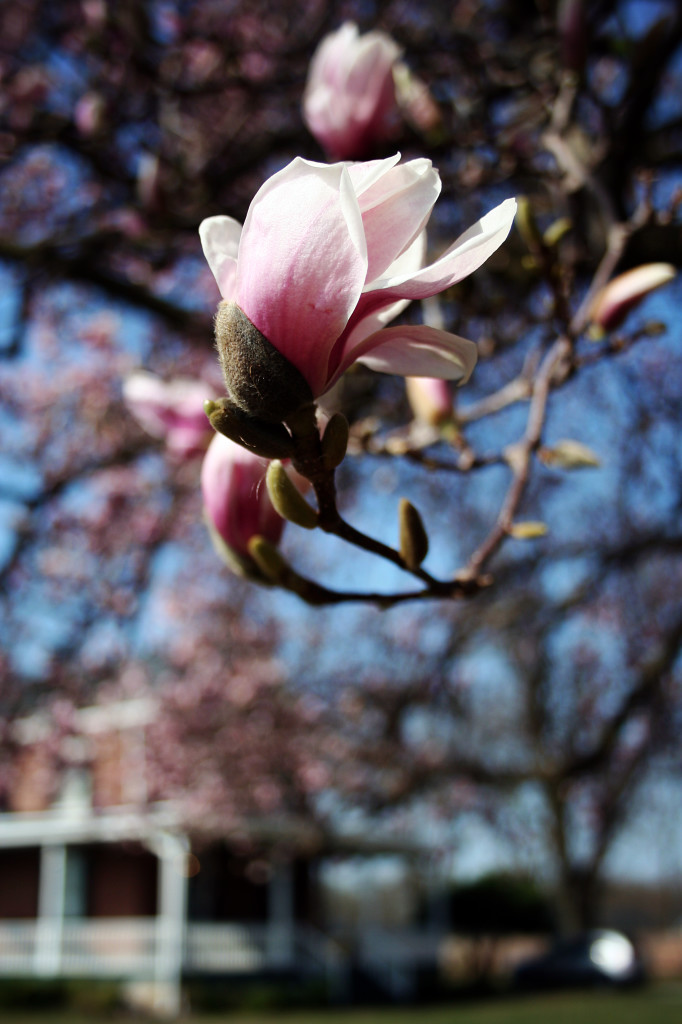
But it was. That year, that first spring, I learned the difference between the south’s evergreen magnolias and the deciduous varieties grown farther north. I learned the difference, and I chased it.
After two years in Virginia, it was time to choose a graduate school. I took one look at the blooming pink magnolias lined up against the gothic grey of quadrangle walls and knew I’d be moving to Chicago.
After Chicago, I lived for two years in a Florida house with an evergreen magnolia centered proudly in the front yard. It was lovely, yes, but it reminded me that I was living in an eddy. My life had turned backwards and sideways. For two years, I had no spring.
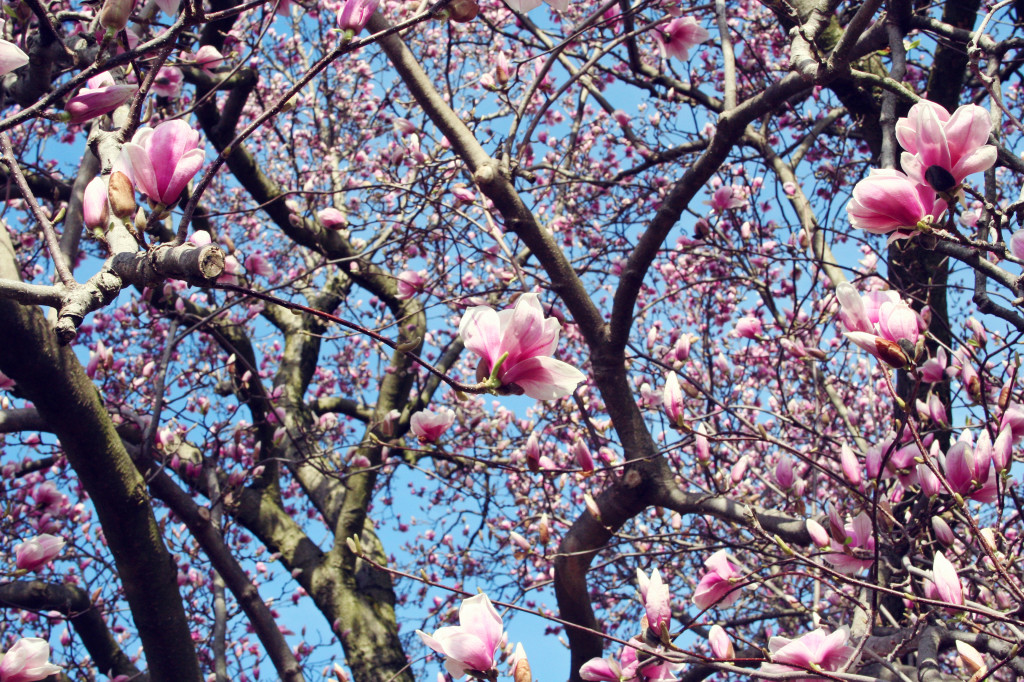
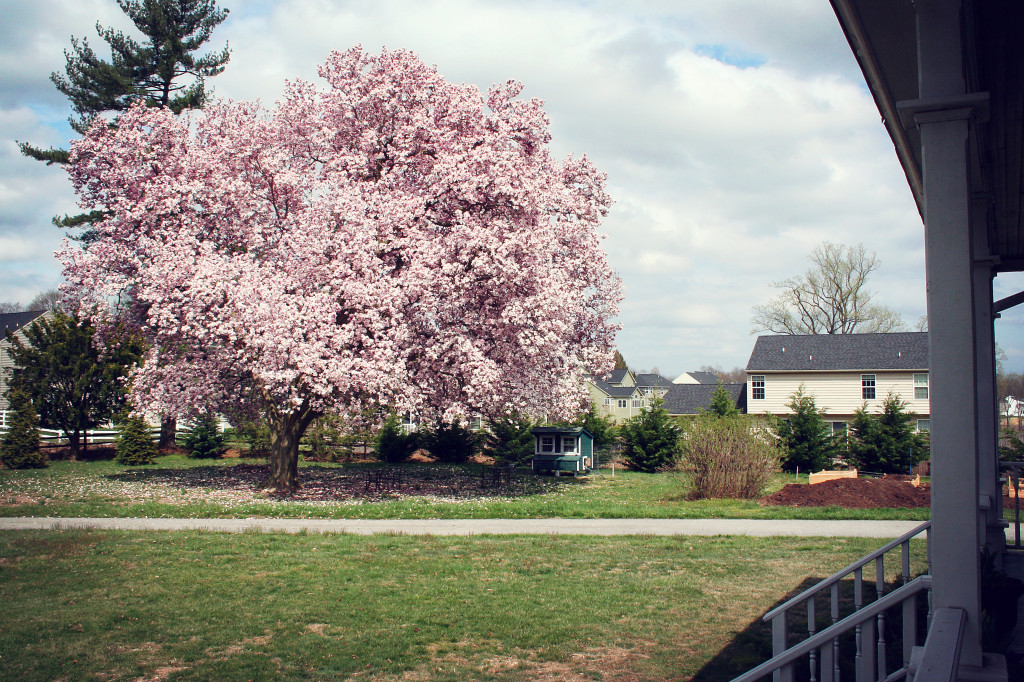
Nine months ago, we moved to Pennsylvania, to this Victorian farmhouse called Maplehurst. I knew the old tree planted north of our front porch (a tree that must be as old as the house itself) was a magnolia. A deciduous magnolia. The largest I have ever seen.
And I’ve been waiting.
Waiting for God to keep his promises, waiting for life to get a little easier, waiting for spring – spring like we haven’t seen for three years – to come.
This was waiting as it is meant to be. Waiting with hope. Waiting with full expectation. This, not because I’ve finally mastered the spiritual discipline of waiting, but only because I have lived through a few winters, and I have seen them all end.
I have been waiting with eyes wide open because I could see the tree always outside my window. I knew what it had in store for me because I’ve seen it before.
But never this big.
Never this beautiful.
Never this good.
“Flowers appear on the earth; the season of singing has come.”
Song of Songs 2: 12

by Christie Purifoy | Apr 9, 2013 | children, Grateful, guest post, poverty, Uncategorized
Are you visiting from J.R.’s Love is What You Do? Welcome.
I write about the kingdom of God. About motherhood. About books.
I pray that the kingdom comes down to my own bit of Pennsylvania countryside.
I try to pay attention when it does.
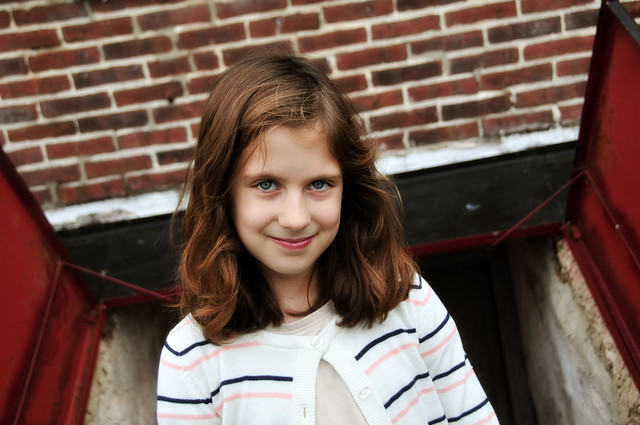
J. R. Goudeau is a PhD candidate in English literature. When I was a PhD candidate in English literature, I used my spare time to lounge senseless on the sofa while my husband bathed and bedtimed our young kids. J.R. also has young kids, but she has used her spare time to found and direct Hill Country Hill Tribers, a nonprofit helping to support the skilled artisans of refugee communities in Austin, Texas.
Yes, she’s amazing. I’m blessed to call her a friend. I’m blessed to be sharing this story at her place today.
Blessed
Our refrigerator is a typical mess of grocery lists, crayon drawings, and expired coupons. In the middle of the mess is something more precious: the photographed faces of three young children. They are not family, not even friends, exactly. They live on three different continents, and we do not speak their languages. They are our sponsored children.
My daughter is writing a letter to the oldest girl. They share a birthday. This child has written to us that she loves to play ball. Also, the rains have been plentiful.
My daughter stops writing, looks up at me, and I see something like guilt in her eyes. “I’m glad we’re not poor,” she says.
//
I believe in the work of this sponsorship program. I believe in holding wealth with open hands. I believe in giving it away. But I worry about the unintended message these three photographs may be sending to my children, children who know their own faces appear on no one’s refrigerator but Grandma’s.
I wonder if these images in our kitchen are bridging a wall or building it up.
A wall distinguishing us from the poor.
A wall separating us from the poor.
A wall we only cross with dollars, cents, and the occasional letter.
Because we, thank you Jesus, are not poor.
…
You can find the rest of my story here.
by Christie Purifoy | Jan 23, 2013 | children, Family, Grateful, motherhood, Seasons, Uncategorized

(photo by yours truly)
One of my favorite comedians has a bit about life with four young children. “Bedtime is a crisis!” he says.
I can relate. In our house breakfast is a crisis (the three-year-old is NOT a morning person), homework after school is a crisis (I’ve forgotten 9 times 7, and I can’t find a calculator), dinner is a crisis (food allergies + general pickiness = misery for mama the cook), and bathtime is always a crisis.
Not long ago, a friend (and father of one small child) stood in my kitchen as I prepared and served a quick lunch for the kids. I take it for granted that feeding so many small children can feel like wrestling a tornado, but my friend had, apparently, never seen anything like it. “Is it always like that? How do you do it?”
Most days I wake up feeling as if waves are crashing just at my heels, and I must rush, rush, rush to keep my head above the water.
Except I know it doesn’t have to be this way. I know this. I’ve felt it.
Sometimes I remember these words of Laura Ingalls Wilder: “She was glad that the cozy house, and Pa and Ma and the firelight and the music, were now. They could not be forgotten, she thought, because now is now. It can never be a long time ago.”
When the waves threaten to overwhelm me, I stand very still and tell myself, “Now is now.” The beautiful thing about my life in this season is that my now is almost always good. When I let go of the ten next steps, when I give up trying to manage the crisis, I can recognize just how good and just how magical my life is.
When I feed the baby in the rocking chair, I tell myself “This is now.” Suddenly, I notice those big blue eyes, and I give up deciding which job I’ll tackle next.
When the firstborn shrieks about the blood and why oh why did her brother have to lose his tooth while sitting on her white quilt, I hold that baby tooth in my hand and say “This is now.” I remember the moment I first felt its sharpness in his baby gums. Like Laura says, it cannot be forgotten. It can never be a long time ago.
And when the quilt is washed, and the tooth placed beneath his pillow, I go back into their bedrooms. I whisper, “Come and see.”
While we ate dinner, and found lost pajamas, and yelled, and wiped up blood, the world outside was transformed.
We never saw the snow clouds that came and went, but this is now: the whole world washed clean and sparkling. The whole world shining in moonlight.
This is now, and it can never be a long time ago.

(photo by yours truly)
by Christie Purifoy | Dec 28, 2012 | Community, Family, God's Love, Grateful, Home, Pennsylvania, Uncategorized
Their minivan is stuffed with children and luggage, all the paraphernalia of a Christmas well celebrated. The late December sun is too weak to soften the wind’s bite so we rush inside to wave goodbye from the window.
The kids and I wave frantically, and it is as if we are saying goodbye to good friends, to Christmas, to this entire year.
In a few more days I will look ahead, but now is the time for saying goodbye. For looking back. For remembering.
In one year everything has changed.
One year ago, I had three children and little hope of more.
One year ago, I lived in the south and grieved the loss of northern winters.
One year ago, I dreamed of a farmhouse with room for chickens and vegetables while my single, potted tomato withered in the Florida sun.
On year ago, we spent the holidays alone and wondered if we’d ever again spread a feast across the length of our dining table for a crowd of friends and family.
This year is dying, but it has left me with these gifts: four children, an old farmhouse, a large garden, and the perfect spot for a chicken coop.
And this: hospitality, community. We now live within driving distance of our dearest friends. Hardly a week goes by that we don’t hear from someone we love: “We’ll be in Pennsylvania. Can we come and see you?”
I live in a Victorian farmhouse with several acres of land, but the fields all around have been parceled into home sites. Now that the leaves have fallen I can look out of my windows and see houses. I don’t yet know who lives in them, but one day I will. One day, their children will run up the hill and through the break in the fence to play with mine. One day, I will wave hello through the line of trees with an invitation to help pick blueberries. Or apples. Or tomatoes.
One day, one day, one day …
This is the greatest gift of this year: I have been brought to a place with a future.
In other words, I have been given a home.
“I will make an everlasting covenant with them: I will never stop doing good to them, and I will inspire them to fear me, so that they will never turn away from me. I will rejoice in doing them good and will assuredly plant them in this land with all my heart and soul.”
Jeremiah 32: 40-41


