by Christie Purifoy | Sep 1, 2011 | Family, motherhood, Seasons, Vacation
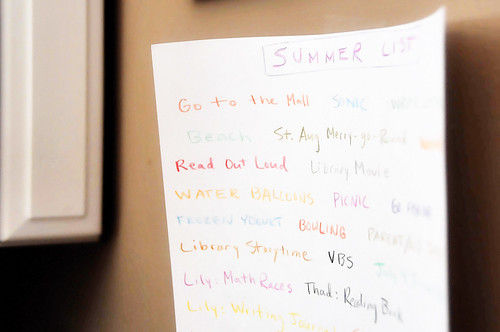
Our Summer List is nearly illegible. Most of the items are crossed through. I might have drawn a neat pencil line through each activity (trying to check it off but not erase it). My young daughter, who has not yet learned to grasp desperately at passing time, obliterated most of the list with a thick, black marker.
On the record, I’d say that our list helped shape an enjoyable summer. Though, the perfectionist zeal of my first-born did lead to a difficult argument on one of the final days of summer vacation. No, I had to tell her, we cannot visit the carousel, go on a picnic, keep a writing journal, and make playdough all in a single day just because they are still on the list. The compromise was a half-hour drive to the carousel. And a few more memories for our piggy banks.
The Summer List did not completely silence the eternal summer cries of “Mom, I’m bored!” Nor should it have.
I tend to think that boredom is good for children, like green beans and sharing a bedroom. I tell them as much, though they remain unconvinced.
I thought I believed my own preaching, but I began to doubt that over the summer. I too have been bored. Very bored. I discovered that, for me at least, green beans and sharing a bedroom are much, much better than being bored.
Of course, boredom is a privilege. If I had to walk miles in fear to collect water for my family, I would not be bored.
I wonder, is boredom merely a lesser evil, or might it have some good to offer?
I know that I don’t like it, I know that I don’t want it, and yet I write out here a few of the gifts boredom has recently given me:
To be bored is to be unhurried.
When my toddler throws a screaming fit, I let him scream. But, I also sit down close by because nothing else is screaming for my attention. When he’s ready to climb into my lap, I’m right there.
To be bored is to be waiting.
I have been thinking (and, let’s face it, hoping) that boredom might be one of the final stages of resting. When we first rest from work, we are content to simply be. After a while, our minds, our hearts, our bodies are ready, once again, to do.
To be bored is to be listening.
God is always talking. Sometimes He has a lot to say, and He says it in some big way, but, more often, He is whispering. When I am bored out of my mind, my ears are searching for any sound from Him, so eager am I to hear the extraordinary break into my ordinary.
by Christie Purifoy | Aug 23, 2011 | Books, Family, guest post, healing, motherhood, Uncategorized

My love for books is well known. However, books haven’t always come through for me. They haven’t always given me the answers I’m looking for.
In my house, there is a particular shelf of books that have failed me utterly.
I’m honored to be writing over at Lisa-Jo’s place today. Won’t you join me there for the rest of the story?
by Christie Purifoy | Aug 18, 2011 | Family, God's promises

(photo by yours truly)
We recently returned from our week in the mountains. The luggage is still unopened, the mail stacked perilously high, and the backyard pool is green with neglect. At breakfast, the middle child sighed and said, “I miss the waterfalls.” We answered him with our own sighs.
A great vacation is a rare and wonderful thing, but it exacts a high price: the unhappy return to everyday life.
Still, we remember the mountaintop views and know that it was worthwhile. We have seen something precious.
There is a mountain in North Carolina called Pisgah. It is named for the mountaintop on which Moses first saw the Promised Land, a fact which surprises me not at all. Hazy blue vistas and cool breezes are my idea of milk and honey, too.
While I watched my family slide down a waterfall in Pisgah Forest (a feat I was more than content to simply observe), I thought about that land Moses saw. I’ve been living on promises for a while now, and I considered the view from my own mountaintop.
And then I thought about promises themselves.
Why are promises the currency of our relationship with Him? From rainbows to revelations, it seems we can’t know God apart from his promises. Why is that?
In my own life, I’m usually confused about the value of a promise. So much so that I can never make up my mind whether I should promise some good thing to my kids or let them be surprised. When the grandparents told us they’d be setting up old bunk beds in the guest room for our Christmas visit, I knew it would be a better gift than anything Santa might bring.
But should I tell the kids? Should I wait to see their faces when they realize that their bunk-bed dreams have finally come true?
I decided to wait and let them be surprised and then promptly forgot my decision and, in a desperate attempt to distract them from their argument, their summer boredom, told them what they had to look forward to. Bunk beds! For you! At Grammy’s house!
Oh, wait, didn’t I mean that to be a surprise?
I promised them bunk beds. Why?
I did it in a moment of forgetfulness. I was tired of their grumbling. Why does God do it?
The truth is, I don’t know. I started writing this post and imagined I’d have it figured out a few paragraphs in. But, I don’t.
I do think that God’s promises reveal Him to be very humble in His love for us. My own love for my children is tinged with a lot more self interest. Give them something to look forward to so they stop bothering me? Let them be surprised so I have the fun of witnessing? Me, me, me.
But here is our God writing these incredible stories for us and, as if this weren’t enough, He is reassuring us again and again: you have nothing to fear, good things are in store for you, it all turns out well.
He is a writer who generously gives away the ending. In humility, He wants us to know that He’s not about to give us a surprise that rewrites the whole story.
He’s writing, creating, and taking us along for the ride. Showing us, through his many promises, what it will all add up to some day.
“Then Jesus said, ‘Did I not tell you that if you believed, you would see the glory of God?’” (John 11: 40)
God’s promises are mountain views. They are a vision of what will be and what truly is. Most importantly, they are ours whether we’re standing on the mountain or walking through the valley.
“Be Thou my Vision, O Lord of my heart;
Naught be all else to me, save that Thou art.
Thou my best Thought, by day or by night,
Waking or sleeping, Thy presence my light.”
– from “Be Thou My Vision,”
8th century Irish hymn, translated by Mary Byrne (1905)
by Christie Purifoy | Aug 15, 2011 | Family, grief
We’ve been putting it off, but at dinner yesterday we finally told the kids that their dog is dead. We were able to put it off because Casey lived, not with us, but with faraway grandparents. Still, they had always considered him their dog.
Because the miles are long, and we cross them so seldom, I imagined frowns. Concerned questions. I didn’t imagine tears, let alone heartbroken sobs.
There are some phrases that seem to show up only in books. They are clichéd, like “sat bolt upright” and “burst into tears.” And yet, considering it now, “burst into tears” really does seem to get it right.
Her face crumpled, like a bubble burst, and there was a fierce and terrible sadness pouring out of her.
I was amazed. Who taught her to feel so deeply? It wasn’t me. I have never poured sadness over anyone. I keep it balled up tight like a painful tumor in my throat.
I am grateful that my daughter knows how to hurt. Grateful that she will not or cannot keep it all inside (though I wish she had no need for tears; I wish she never would).
Today, I think of someone else. I wasn’t with her, but I wonder if she looked like my daughter when she understood the news. When she knew what had been lost.
Once, so many years ago, I sat in a church pew directly behind her. I can still see her two long braids, perfectly combed and parted. She shook with sobs.
We were at the funeral for one who loved us both, for one we’ve missed every single day since. Back then, I wished I could cry like that.
Remembering that day is difficult, but it also gives me hope. I hope that she will, once again, have the strength, the child’s wisdom, to grieve.
Our culture rarely talks about grief. We talk about recovery. We focus on getting over, moving on. Surely, those of us who believe in the restoration of all things have no reason to smooth out the emotional peaks and valleys of our lives? Jesus wept. Shouldn’t we?
“Now, O women, hear the word of the Lord; open your ears to the words of his mouth. Teach your daughters how to wail; teach one another a lament.”
(Jeremiah 9:20)

(photo by yours truly)
by Christie Purifoy | Aug 5, 2011 | allergies, Family, Food, healing, prayer

I fear that too many of us approach prayer with a mental picture of ourselves making a laborious attempt to come before God. Or, maybe we have a picture of ourselves trying and mostly failing to get God’s attention. Either way, the effort is all ours. The distance between heaven and earth appears too big to bridge, and our burdens seem trivial. They are dwarfed by God’s vastness, and they are lost in the cacophony of prayers being made across the planet at any given moment.
I’ve learned that prayer is not about little people waving their puny arms in God’s face. Nor is prayer like my own small voice pushing aside all others in order to make its way into God’s ear.
Rather, prayer is like a river. It is always flowing, and we are not its source. Its source is the Christ “who was raised to life,” for we know that He “is at the right hand of God . . . interceding for us” (Romans 8:34).
To pray is to step into the rushing water.
Even the words we say are not our own. We pray, like Christ, “Abba, Father.” Instead of distance there is the intimacy of family.
And when we have no words? We groan, but even in this we are not alone. Our groan joins that of creation (and who can doubt that creation groans?). Even better, our groans are echoed in God’s own heart, for the Spirit “intercedes for us with groans that words cannot express” (Romans 8:26). Our pain, our uncertainty transformed by God himself into powerful, purposeful prayer.
Quieting myself, I can just hear the sound of the river. It is the sound of One singing over us, and His voice “is like the sound of rushing waters” (Zephaniah 3:17, Revelation 1:15).
How do we find this river? How do we hear its voice? And, most importantly, how do we jump in?
I’m not sure that I’ve figured it out. All I know with certainty is that the river is there and sometimes it finds its way to me.
This week it found many of us at a monthly women’s worship service focused on the arts. Women sang, women danced, women spoke, and women painted. Yes, painted.
Some of us took Sharpie markers and wrote our prayers on one of several large, blank canvases. Of course, I wrote the name of my boy. I wrote the word Fear. I wrote the word Food. And then the painters began to pray and create, and our words were caught up in swirls of color.
By the end of the service, the canvas I had chosen (or the canvas chosen for me?) was covered in a wild rush of water. The artist’s brush had spelled out across it: “The Healing River Flows.”
How could I ever think that my prayer for healing is mine alone? Or even that I am its source?
The source of my prayer is Christ. The same one who gave me these words when I first prayed for a child: “There is a river whose streams make glad the city of God” (Psalm 46:4). Back then, I read those words and knew that my prayer had been answered.
Now I know that “answered” is not really the best word-picture for what sometimes happens when we pray. Instead, it is less like being spoken to and more like being swept away by water that was always already pushing in the direction we longed to go.
We don’t need to fight to get God’s attention. We do need to remember that our Savior with the voice like water has never stopped praying over us.
“Then the angel showed me the river of the water of life, as clear as crystal, flowing from the throne of God and of the Lamb . . .” (Revelation 22:1).
by Christie Purifoy | Aug 3, 2011 | Family, God's Love

The middle child, the oldest boy, starts kindergarten in just a few weeks. Not only that, but he will ride the bus (which is, possibly, a bigger deal for both of us even than kindergarten itself).
I’ve been a mother long enough to know that the days are long but the years are short. These summer days drag (how to fill the time between dinner and bed?), but I will wake up tomorrow and watch my son graduate from high school. I know this, and it has prompted me to wonder: what do I want this boy to grow up to do? To know? To be?
Like most parents in these enlightened days, I say, “I only want him to be happy. Whatever makes him happy. If that means becoming a doctor, great. If it’s an auto mechanic, fine by me.” Unlike most parents, I suspect, I really do mean it.
I’ve spent enough time around highly-educated Ivy-leaguers to know that the things which spell success in our culture (straight A’s! a University of Chicago degree!) are not necessarily markers of either success or happiness.
Not only that, but I know that there is some kind of Murphy’s law of parenting: whatever I plan for my child, the opposite will happen. My father gave me only this bit of advice as I prepared for college: “Study anything you want, but be practical. Don’t major in English or History.” I was never a rebellious child, but Murphy’s law kicked in and, by the end of college, I was graduating with a double major in English and History.
What then do I want for my boy? For his big sister? His little brother?
Only this: to know deep down in their heart of hearts that God loves them. Truly, that is all.
Unfortunately, there is such a big chasm between head knowledge and heart knowledge, between assenting to an idea or concept and feeling the truth of it deep inside. I tell them over and over: you are loved. By me. By others. But, most importantly, you are loved by the Love who created everything beautiful and that Love is vaster and more intimate than you may ever know.
I heard that too as a child. I sang these words in so many Sunday school classes: “Jesus loves me, this I know.” But I didn’t know. I nodded my head and agreed, but I didn’t really know.
Praying that my children know God’s love is sometimes difficult. It is as if I am praying that they suffer. Maybe I’m wrong. Maybe there is some other way in which this knowledge can travel from head to heart, but the enormity of God’s personal love was only revealed to me in some very dark places.
Looked at another way, I am not praying that they suffer. I am praying that they be comforted.
And this is what I want for my babies? Yes, this is what I want for them: that, like Hagar, they will one day say, “I have now seen the One who sees me.”
This is my prayer:
“I pray that you, being rooted and established in love, may have power, together with all the saints, to grasp how wide and long and high and deep is the love of Christ, and to know this love that surpasses knowledge – that you may be filled to the measure of all the fullness of God” (Ephesians 3:17-19).
I’m afraid that it will hurt, but I promise you: it is worth every tear.
“My ears had heard of you but now my eyes have seen you.” (Job 42: 5)
