by Christie Purifoy | Jul 19, 2011 | allergies, Family, Food
We’ve kept an extra place at our kitchen table for years, and lately I’ve been trying to figure out the whys and hows of the uninvited guest who frequently sits there.
I never notice him right away. Usually, we’re a few minutes into our meal when I first realize that he’s joined us. I see my son’s eyes grow a little bigger and a little rounder. Next, he says something like, “Is this my special pizza?” Or, maybe, “I think this hot dog is making my throat hurt.”
The name of our guest? Fear.
Sometimes, he’s just a shadow flitting around at the edges of our conversation. “Don’t worry,” I say. “You probably scratched your throat with that tortilla chip. You’re fine.”
Other times, he monopolizes the meal, entirely. My heart starts racing. Unsure of what’s happening, I mentally thumb through each of the possibilities. Did baby brother touch his food? Did I doublecheck that label? The package looked a little different. Did they change the formula?
I whisper to my husband, “Get the Benadryl. Let’s get it ready, just in case.”
My son sits staring into space, and I can tell that he’s making an effort to swallow. I know that he’s afraid and trying to figure out what’s happening in his throat. I keep up a conversation hoping that if I look unafraid my boy will be able to relax.
Then I notice that the hand holding my fork is shaking.
The thing about this particular fear is that it always takes me to the same place. Utter dependence. I pray without using any words. And I remember: this boy is loved. He is, and always will be, safe in his Father’s arms. All will be well. No matter what.
Only then do I start to breathe easily again.
I walk away from the table, stooped a little with fear, limping like Jacob.
The fear, like a hip out of joint, is not an entirely bad thing. I can’t feel it without remembering that I too wrestled with God. When failed fertility treatments and another month of bad news said, “Despair,” God gave me faith to grab the hem of His son’s robe, to pray and pray without letting go and to be healed. This boy, this good gift, was on the way.
Will I ever send my son to school without worrying that a stray spill on the cafeteria table might cause death to flare up in his throat?
We pray for healing. We pray for miracles.
Lately, the miracle I’ve been dreaming of looks a little different than the one I used to imagine. It isn’t a dream that my son grows out of his allergy (something that would be miraculous given the severity of his reactions). It isn’t a dream of supernatural, spontaneous healing, although I believe deeply that such things do happen. I may be a rational academic by training, but, like Shakespeare’s Hamlet, I know that “there are more things in heaven and earth, Horatio, than are dreamt of in your philosophy.”
The miracle looks more like this: a team of scientists and doctors at Mt. Sinai discovering that some children, fed a steady diet of baked milk proteins in carefully calibrated amounts, can increase their tolerance. They may never sit and drink a glass of milk, but they can eat a slice of cheese pizza at a class party without risk of anaphylaxis.
Miraculous.
Suddenly, a healing touch straight from heaven seems . . . a little boring. A little limited. What seems truly miraculous is the divine at work in a doctor’s lab. The divine bringing hope to more than just one child. Miracles baked into muffins.
by Christie Purifoy | Jul 6, 2011 | Books, Family, Florida
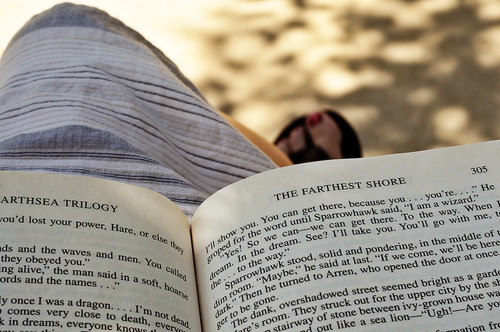
I've had the first book in The Hunger Games trilogy sitting on my nightstand for six months. Both of my sisters told me that once I started I wouldn't be able to put it down. I believed them and so I saved it, and then I think I just forgot about it. I got used to seeing it there, unopened by my bed.
Feeling a little desperate for reading material, I grabbed it on my way to my daughter's swim meet yesterday. In between races, she played with friends, and I read. After the meet, my husband worked the early evening shift in our try-to-keep-the-two-year-old-in-bed night job, and I kept reading. I'm an early-to-bed girl, but by 10:30 I was calculating the cost/benefit ratio of staying up to read till the end.
It took an act of will, but I eventually went to bed. Instead, I let my kids watch two hours of cartoons after breakfast so I could finish.
It's been a while since I last fell head-over-heels into a great story. It made me think about reading as a kid (the most perfect, magical books will always be the books we first loved) and all the reading I've done since. A lifetime of words and stories. A lifetime of living other lives, of seeing the world through other eyes.
Growing up in a family of six, I was the only reader. These days my mother and sisters troll my shelves like the local library and even my Dad can't get enough of his Kindle, but, back then, I was the butt of many jokes. They couldn't really understand my insatiable appetite for books.
I think their favorite joke (at least, it's the one I remember hearing the most often) involved the fact that I read while at our Grandmother's west Texas farm. Thinking about that farm, I remember jumping hay bales and making mud pies in the barn, but I've no doubt I plowed through quite a few books during those visits too. My family loved to say, "Look at her! She'd rather read about a farm than enjoy one!"
I suppose there's some truth to what they said. I could read about the hardships of Laura Ingalls' long winter again and again, but I'd never want to live them. Still, I don't subscribe to the assumption implicit in this joke: that books give second-hand experience and thus lead to a second-hand, perhaps even a second-rate, life.
All this has recently come back to me because I've been reading my way through a stack of books on bee-keeping, chicken-raising, and other farm pursuits. Lately, my small Florida vegetable patch has seemed like nowhere near enough, and I've been dreaming about raising (at least a little) of our own food. I may be planted in the suburbs for now (no chicken coops allowed), but a girl can dream.
The Backyard Homestead Guide to Raising Farm Animals may be a far cry from The Hunger Games, but, today, I'm feeling a little sorry for all the non-readers out there. Day-to-day, I may walk a fairly narrow path, but books like these have always set me in a wide-open place. Here, there's adventure. There’s heroism and triumph. There are even a few bees and laying hens. Just don't tell my community association. I'm sure their bylaws wouldn't approve.
by Christie Purifoy | Jul 4, 2011 | Family, Religion, Scripture

We've spent a lot of time in the pool this holiday weekend. Even the two-year-old has joined in the fun, thanks to an outgrown flotation vest passed on to us by our neighbor.
For some reason, I've always avoided things like vests and water wings. I imagined that those devices prevented children from learning to swim on their own, and I took it in stride every time I had to fish my toddler out of deep water. Watching my littlest boy in the pool this weekend, I'm grateful to be proved wrong. Wearing his vest, he loves to maneuver across the pool, looking for all the world like a tiny member of a retirees' aqua-jogging class. He pumps his arms and legs and shrieks with utter happiness: "I'm running! I'm running!"
This is also his cry when actually running. I'm afraid it's a sad commentary on the highly circumscribed nature of childhood in our society today, but whenever the two-year-old is set free – whether in our small backyard or the grassy lawn of our neighborhood playground – he streaks around yelling, "I'm running, I'm running!"
My own attitude toward running has always been very different. Watching someone else run is enough to give me an asthmatic wheeze and a stitch in my side.
Even running as metaphor makes me tired. "Let us run with perseverance the race marked out for us." Just reading those words in Hebrews is enough to send me to the sofa with a good novel and a cup of tea. To write that this verse has always been uninspiring for me is to put it very mildly.
Recently, I heard a similar Scripture read aloud in church, but it sounded entirely new: "Forgetting what is behind and straining toward what is ahead, I press on toward the goal to win the prize for which God has called me heavenward in Christ Jesus" (Philippians 3: 13, 14).
Forgetting what is behind. Straining toward what is ahead. For the first time, those words didn't strike me as another unpleasant item for my spiritual chore list. Rather than a charge to be disciplined, to work hard and push through the pain (ideas that motivate me not at all), I realized the hope contained within these words.
Forget yesterday. Run! There is good stuff ahead. Go and claim it!
The idea of running away from one's problems is rightly suspect. If I've wounded someone, I should go to them. Many of us have also learned that we do ourselves no favors when we run away from grief. However, I'm not talking about running away. I'm talking about running, as quick as we can, right on through.
There are days when I know that this may be my only hope. There are enough mistakes and disappointments in my past to keep me mired in a slimy pit for the rest of my life. I can't clean up the mess, whether or not I made it. Fortunately, I hear Philippians telling me that I don't have to: "Forget about it! Just run! Run for your life and every day you're moving closer to light, to joy, to rest."
Suddenly, running sounds very, very good. I can imagine running with the same joy and exhilaration as my young son: "Lord, I'm running! I'm running!"
Our lives might demand that we keep running the same tedious laps around the schoolyard, but God calls us to "run heavenward," a race that sounds, even to me, like sheer joy. Like freedom.
by Christie Purifoy | Jun 24, 2011 | Family, Religion
Yesterday, I turned 34. My son turned 5. So far, we’ve shared six birthdays, and I hope we share many, many more.
When people discover that we have the same birthday, I tend to say that this boy “is the best birthday present I’ve ever been given.” This is true, but it sounds silly and jokey, and I feel as if I am speaking in code. Most people will never know the depth of meaning these words hold for me.

(collage by yours truly, photos by, well, I suppose my husband was probably behind the camera for each of these)
Thinking of my boy, I think of grace. Not big-picture, heavily theological, grace-with-a-capital-G. I’m talking about God’s grace made small, sweet, and sized-just-for-me.
Like so many of the best things, this gift-of-grace began in pain and fear. Infertility. Failed treatments. Insurance complications. Many tears. And then the news that we would have a second child in late June. My prayers had been answered. I was being given a miracle baby. I also knew that I’d done nothing to earn or deserve this gift, and so I began to be afraid.
My heart (without ever informing my mind) believed that the spiritual economy is one of favors given and favors returned. Deep within, I believed that I would have to pay God back for this miracle. As if life proceeds through barter, and I was in God’s debt. And so I listened to the whispers in my mind that said my son would be sick, handicapped in some way, a challenge to care for. I accepted these fears, believing them to be the price for this blessing.
With two months still to go in my pregnancy, I heard God say to me that my son was “a gift.” Better than that, “a good gift.” I stopped being afraid.
When he was born on my birthday, perfect and beautiful, I laughed, understanding, finally, that God had really meant it. My son was a gift with no strings attached. Utterly undeserved. Utterly good. All God asked of me was that I receive, and enjoy, year after year.
by Christie Purifoy | Jun 21, 2011 | Family, Food
I had a different post planned for today. I was going to write something cute and sweet about the parent/child date nights we have planned for our summer. Monday was the first: a date for me and my oldest boy. It started well and ended horribly. Actually, I suppose it ended well, but the middle was truly bad.
I can’t write it out in detail (it’s too recent and too raw), but the condensed version is this: a quick and terrible allergic reaction, a mother who forgot to bring the epi-pen, a stranger standing next to us who hands me her own child’s pediatric epi-pen, an ambulance and a crowd of paramedics. The epi-pen did its job immediately and thoroughly, and the boy who couldn’t swallow or talk to me ended the night playing a wild game of cops and robbers all throughout the house.
This morning I used a stain-remover stick to dab a pair of size-4T shorts. The shorts are marked with chocolate sorbet (it was labeled dairy-free) and blood (those epi-needles are serious things). I don’t know if the stains will come out. I’m not sure that I care, but I do wish I had a stain-remover stick for my memory. At breakfast, my boy said, “Last night was scary.” Then I wished I had a stain-remover stick for his memory too.
A year ago, just before we left Chicago, two dear friends prayed for me and for my boy. It was the first time that I actually believed that my son might be healed. I also felt healed, no longer so afraid. For one year I have continued to monitor my son’s food, continued to carry his Benadryl and his epi-pens, but I stopped carrying the fear.
Last night, as I tried to fall asleep, I kept hearing this question: “Are you afraid?” I thought about it. This year I haven’t been afraid because I believed that my son was healed. I believed that food couldn’t hurt him anymore. Now I know that his allergies are worse. Now I see (again) that I am incapable of taking perfect care of him. Am I afraid?
I am tired, and I am sad, but I do not think that I am afraid.
I know that my son was made by a God who loves him even more than I do. And I know: “Because of the Lord’s great love we are not consumed” (Lamentations 3:22).
In this life, there will always be something to fear. I cannot work hard enough or be vigilant enough to erase every cause for fear.
The only antidote is love. I know that nothing can happen to me or to my child that is not filtered through Love. Nothing touches my life that Love has not allowed.
This doesn’t mean that my worst fears won’t be realized. I do think it means that my worst fears are not worth fearing. Death, for instance. From this side, it might look like the end, but, really, it’s a door. And I know that Love lives on the other side of that door.
What is the very worst that can happen? It might happen. Or, I might make a terrible mistake and forget the epi-pen, and find a stranger standing by my elbow with an epi-pen in her hand. No matter what, we will not be consumed.
“For I am the Lord, your God, who takes hold of your right hand and says to you, Do not fear.”
(Isaiah 41: 13)
by Christie Purifoy | Jun 20, 2011 | Books, Family, Food, Religion
Most (perhaps all) experts would advise aspiring writers to “just say no” to exclamation points. They are abused and overused. They make our writing appear amateur. There is seldom a good enough reason to use an exclamation point.
And yet . . . I choose to believe that the story I am writing today deserves an exclamation point. The title of this post may have unleashed sugary visions in your mind, but I’ll tell you here at the beginning that this isn’t really a story about sugar. It’s about bread. And it is exclamation-point worthy.
On Saturday, my almost-five-year-old boy tasted his first doughnut. One taste and his eyes were shining. Like this:

(photo by yours truly)
This boy is allergic to a handful of the most basic ingredients of an American childhood (dairy, wheat, eggs, and peanuts). Thanks to a recent discovery (the phenomenal vegan, gluten-free bakery cookbook Babycakes Covers the Classics) my son tasted a doughnut for the very first time.
Even better, we all tasted them. We all loved them. In fact, the leftovers are calling to me from the freezer drawer right now.
It’s a far cry from our usual breakfast routine. My husband makes dairy-free, wheat-free pancakes and waffles, but they will always taste just a little funny to anyone accustomed to bleached, all-purpose wheat flour. Most days, the boy enjoys his breakfast, while the father begins making something else for everyone else.
Strictly speaking, our family never breaks bread together. We break bread alongside one another. The good loaf for the four of us, the not-quite-right imposter for our oldest son, the middle child.
In our family, we often say ruefully that if we only ate like this boy we would all be so healthy. Some meals, this is true, but, deep down, I have always felt as if my boy’s diet has no heart. Something essential seems missing. I love the smell of yeasty bread baking, and I definitely prefer homemade pizza crust. The bread-like lumps that sit on the shelves at Whole Foods, heavy with ingredients like tapioca and bamboo (I am not kidding), strike me cold.
My son rarely complains. Some of those lumps, he actually likes. Only occasionally, does he seem to mind. “Isn’t there any bread for me?” he might ask as his sister dunks a baguette in her soup, and I try to pacify him with a few rice crackers.
In my head, I know that my son doesn’t need bread. His body seems to be growing pretty well without it. In my heart, I’m not so sure. What I want to give him, what I long to give him, is the thing I gave him on Saturday. Bread made with my own hands to nourish him: body and soul. Factory-made bamboo substitutes need not apply. They cannot do the job.
I am about to make a leap here (from nutrition to religion), but, honestly, I don’t believe it’s that much of a leap. I love symbols and metaphors, but this is more real than those. Our pastor reminded us this weekend that the Hebrew word for bread is also used to speak of God’s presence. And that is what I hunger for. That is what I want to give my son.
Depending on our culture, we might discover it in a corn tortilla or a yeasty baguette, but I know it’s available for all of us, whether we are breaking bread at home or in a church. It’s Life. Body, heart, mind, and soul. All of it.
Jesus said, “I am the bread of life. He who comes to me will never go hungry, and he who believes in me will never be thirsty” (John 6:35). Maybe when he spoke these words they were only a metaphor. However, when Jesus walked all the way through death and out into life, his words became much more than that. And if we’re wondering what to do, how exactly to access this life without hunger and thirst, the answer, I think, is so much less complicated and exclusionary than we often make it: Eat! And after, maybe a simple thank-you.
“He makes grass grow for the cattle, and plants for man to cultivate – bringing forth food from the earth: wine that gladdens the heart of man, oil to make his face shine, and bread that sustains his heart.”
(Psalm 104:15)
