by Christie Purifoy | Jun 5, 2017 | Books, Food, Gardening, Giveaway, Home, Pennsylvania, Roots and Sky, Seasons, Summer, Uncategorized
When I first imagined the book that eventually became Roots and Sky, I pictured an old-fashioned treasure, something like the books I seek out in thrift stores and used bookstores. I thought my stories would be interspersed with seasonal tips and recipes and nostalgic pen-and-ink illustrations.
Almost as soon as I began writing, I realized that the story I needed to tell was simpler and leaner. Those first four seasons at Maplehurst were more quiet and watchful than busy and industrious, and the book needed to reflect that.
But the idea of offering more – seasonal stories, tips, recipes, and beautiful illustrations – has never gone away.
This summer we will celebrate five years of cultivating home in this Victorian red-brick farmhouse.
I can’t think of a better way to mark that anniversary than by finally giving you the more I imagined so long ago. In fact, I plan to give you more (and more, and more, and more). I have four gifts planned, each one arriving with a new season.
First, summer.
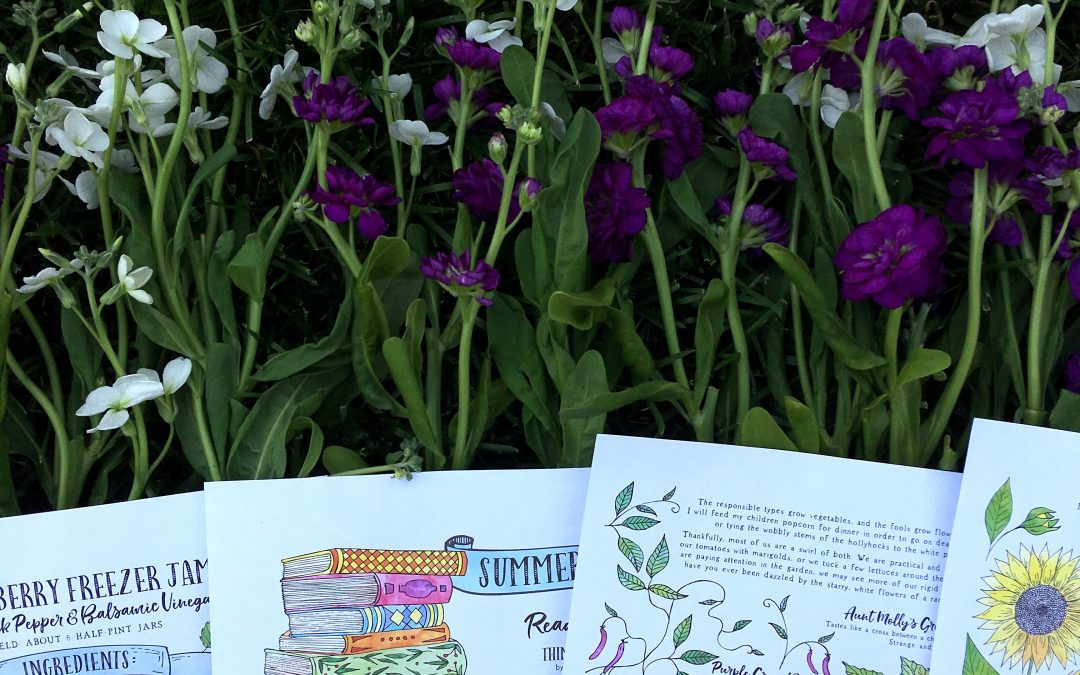
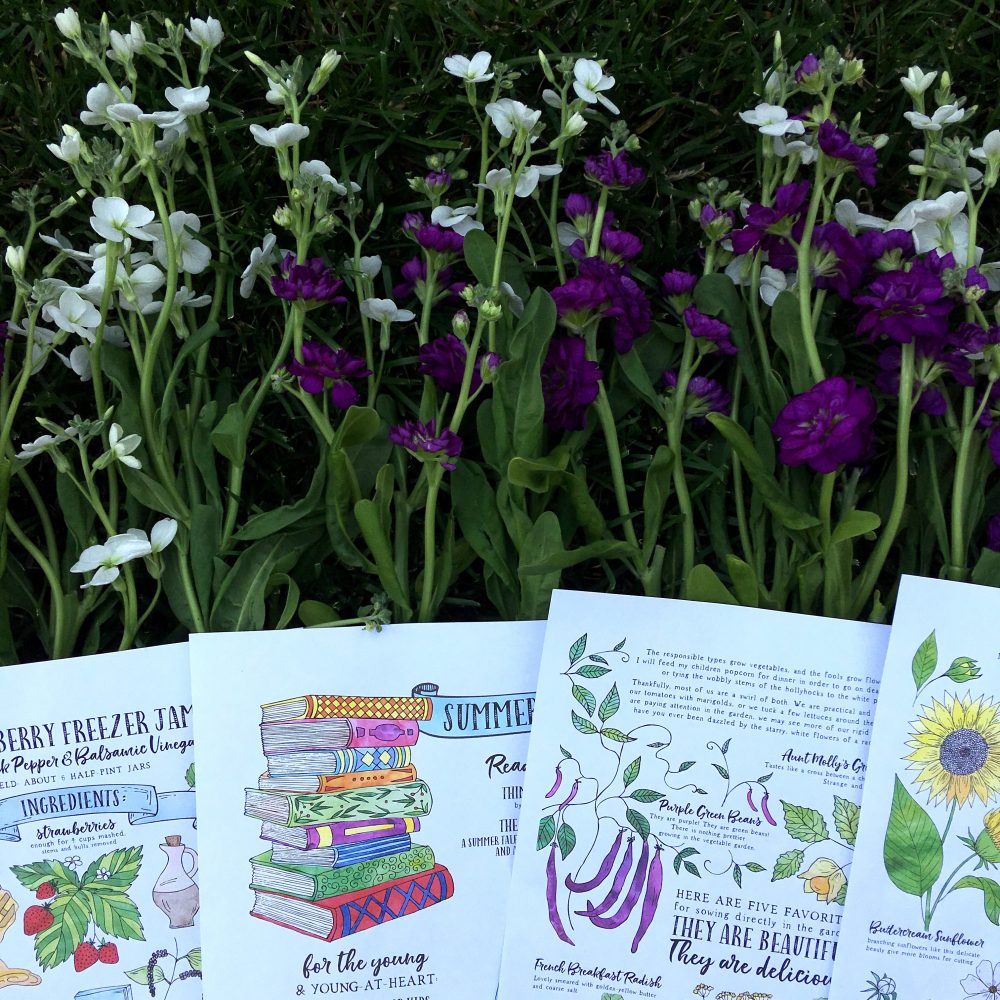
In collaboration with the talented designer and illustrator Jennifer Tucker of Little House Studio, I’ve created four summer-themed pages from that book of my dreams. They are free for every one of my email subscribers to download and print.
One comes from my kitchen, one from my flower garden, one from my vegetable garden, and one from my bookshelves. Each page offers something practical and beautiful wrapped up in my own lyrical point of view.
I’m planning to print and frame mine, but they’ll do just as well tacked to a bulletin board or tucked into a garden journal or recipe box. Feel free to share this post with friends who might like to print their own.
Simply input your email address to the subscribe box below, and an email with a link for the download will be sent straight to you. If you are already a subscriber, check your inbox. Your link should be waiting for you.

Here are two things to remember:
One: Summer is fleeting, and so is this gift. Two weeks from today, the offer expires, and the prints will no longer be available.
Two: Autumn follows fast on summer’s heels, and my fall pages should appear some time in September.

P.S. Because I couldn’t decide which I loved best – full color or black-and-white – I’m giving you both. I am also giving you the recipe page in two color options. Feel free to choose one or print all. Enjoy!
by Christie Purifoy | May 25, 2017 | Easter, Gardening, Grateful, Home, Homebound, Pennsylvania, Seasons, Spring, Uncategorized

A garden, unlike a house, is never still. It is not an object but a moment. To observe a garden, one must catch it like a butterfly in a net (but please do let it go again. Beauty cannot be preserved or it ceases to be itself).

When I give someone a tour of the gardens here at Maplehurst, I catch myself crying, “Oh, if only you had seen the daffodils that bloomed last week.” I am like a mother pouring over baby photos while the child who was that baby tugs at my hand, begging me to play another round of Candyland.
My heart inclines towards nostalgia, and I am easily tangled in the past, but today’s garden is only for today. I must pay attention or I’ll miss it, and there are no encores, no second chances.
Why keep a garden? Why grow flowers? The arguments against it are persuasive. A garden will keep you tethered because to plant something is to make a promise: I will clear the weeds from around you, I will bring you water when the sky turns dry. I will not walk away.
But there are worse things than being kept at home because someone there needs us. The word “homebound” alludes to difficult and heartbreaking realities, but it also speaks of the way home can hold us and keep us steady. And to live as one “bound for home” is to live as a pilgrim sure of the welcome that waits for us.


Right now this garden flows as swiftly as a swollen river. By mid-summer, its movement will have slowed to a trickle, though it never does stop.
The gift of a garden is that it brings movement and change to the still point that is our home.
In spring, I lift my eyes from washing dishes, feeding children, folding laundry, and all those tasks that keep me tied, through love and obligation, to this place. I lift them toward the open window, and I say,
Look! The world is new again.


Elizabeth and I are homebound. She, a writer of poetry and prose, is bound to Mersea, a 1904 white Victorian nestled in the historic district of a South Carolina shrimping village. I am bound to Maplehurst, a red-brick farmhouse built by Pennsylvania Quakers in 1880. We are both writers, wives, and mothers, but nearly twenty years and hundreds of miles lie between us.
Elizabeth and I exchanged a few “homebound” letters over Lent. The nature of a letter is to communicate over a distance, but the season of Lent introduced other distances – there was the space between winter and spring, the break between longing and fulfillment, and the chasm, so like a tomb, between death and new life. But what is Lent, after all, but a kind of long homecoming? It is a practice of return and a way of erasing distance.
Those who go out weeping, carrying seed to sow, will return with songs of joy, carrying sheaves with them (Psalm 126:6).
For Elizabeth and I, Easter has meant trading the distance of letter writing for the intimacy of a visit, first with a home tour and today with a tour of the garden.
Here is our invitation to Elizabeth’s garden at Mersea.

by Christie Purifoy | May 10, 2017 | children, Family, grief, guest post, Joy, motherhood, Uncategorized
I look forward to Mother’s Day. My life brims with beautiful mothers: my own, my mother-in-law, my two sisters, and my sister-in-law. Though my four children never have managed to plan a breakfast in bed, they are not stingy with homemade cards and hugs. When I stirred my youngest awake this morning, she said, before even opening her eyes, “Is today Mother’s Day?” That’s how eager she is to watch me open the brown paper-wrapped craft she brought home yesterday from preschool.
But I remember other Mother’s Days. I remember Sundays when the annual recognition of all the moms in the church congregation brought me nothing but pain. I wanted what they had. Desperately.
Having a mother and being a mother are blessings, which means they open us right up to both great joy and great pain. It seems a fitting thing to remember this week.
I am grateful to my friend and fellow writer Sharon McKeeman for sharing her story of grief and Joy with us.

When I was young, I tucked my dolls into bed safely each night. When I was young, I drew haphazard flowers on construction paper for my mom on Mother’s Day. Life was simple and sweet, and I trusted that it would always remain so.
I didn’t know then that I would hold a son stillborn on his due-date. I didn’t know I would caress his perfect but lifeless body before the nurses took him from me. In those moments, life shattered desolate. I returned home from the hospital to my two young sons, and somehow, we celebrated Thanksgiving a few weeks later. My heart had stopped right in its tracks, but the North Carolina sun kept shining, and the rhythm of ordinary and holidays continued. I offered thanks around our turkey-laden dinner table, and I wrapped presents for my children at Christmas. Grief is a long road, but as the chill of the winter months turned to warm spring, I felt my soul begin to revive. Then one day I woke up, and it was Mother’s Day. How could I survive this?
I was afraid I would come untethered, scared that I might just float away. Shame, despair, and heartache were so very close that day, but miraculously Christ was closer. The One who made me and holds my son, wrapped His arms tight around me and carried me through that day. This didn’t numb the pain, but as my two living children kissed my tear streaked cheeks, I lived the truth that, “Blessed are those who mourn, for they will be comforted. (Matthew 5:4 NIV) A mother just barely healing from sprinkling her son’s ashes in the sea, I was comforted. I can’t explain it other than I called out to Christ because I didn’t know how else to survive, and He surrounded me. He held me and didn’t let go.
I wish I could say that since then I have tucked my children into bed safe each night. Thankfully a healthy pregnancy followed the loss of my son on his due-date, but I lost another child when his heart stopped beating at sixteen weeks and another when her heart never began to beat. Even though I held three living children, Mother’s Day become a joke, a time to endure. Even as I collected hand drawn cards and red roses, my soul sank. While around me spring was bursting with life, my heart began to feel as dead as my womb. Despair and distrust of my heavenly Father grew until a friend reminded me that a weeping Jesus is always near.
Jesus entered this mess with us. He suffered and wept; He weeps with us still.
I came to rest in that truth.
I held three children, and I mourned three children. My arms were full, and my arms were empty. Through it all my Maker held me. When I was too weak, too consumed by grief, to hold on, God surrounded and carried me.
This spring an unexpected bloom has unfurled. After I held death within my body three times, a pregnancy blossomed into a healthy daughter who is filling my arms and heart. After all these years of mourning, we have named her Joy. Our family holds her close and breathes thanksgiving, but I know this happiness is just a step in our journey. There will be more storms, more barren months. The greatest gift comes in knowing that joy was not found alone in this precious little one, but in discovering that Christ weeps with me, and my Maker holds me so carefully that no tragedy can tear me from His embrace.
For every woman with empty arms and an aching heart in this season, I pray that she will feel a weeping Jesus near and comforting her. I pray that a miraculous joy will well up within, defy earthly pain, and speak heaven straight to her soul.
There is an everlasting spring yet to come, and even as these bodies of dust often fail us, its whispers take root in our hearts.

Sharon is a homeschooling mama to three sons and a daughter. She is a Midwestern girl at heart who now lives with her family on the sunny beaches of Southern California, where they enjoy reading together and playing in the surf. She is an author, educator, speaker, and photographer who shares more of her story as @sharonmckeeman on Instagram and at www.sharonmckeeman.com where you will find her blog, Writing in the Dust, as well as her newsletter, Mourning into Joy, which is filled with encouragement and resources for grieving mamas.

by Christie Purifoy | Apr 20, 2017 | Easter, Home, Homebound, hospitality, Lent, Pennsylvania, Spring, Uncategorized
Elizabeth and I are homebound. She, a writer of poetry and prose, is bound to Mersea, a 1904 white Victorian nestled in the historic district of a South Carolina shrimping village. I am bound to Maplehurst, a red-brick farmhouse built by Pennsylvania Quakers in 1880. We are both writers, wives, and mothers, but nearly twenty years and hundreds of miles lie between us.
Elizabeth and I exchanged a few “homebound” letters over Lent. The nature of a letter is to communicate over a distance, but the season of Lent introduces other distances – there is the space between winter and spring, the break between longing and fulfillment, and the chasm, so like a tomb, between death and new life. But what is Lent, after all, but a kind of long homecoming? It is a practice of return and a way of erasing distance.
Those who go out weeping, carrying seed to sow, will return with songs of joy, carrying sheaves with them (Psalm 126:6).
This is the meaning of Easter.
Easter is watching all that miserable distance shrink, almost to nothing. Easter is no more letter-writing but a face-to-face encounter. Elizabeth and I haven’t yet achieved that, it remains our not-quite-yet, but here is our literary equivalent. Here, for you Elizabeth, and for each one of you reading along: your very own tour of Maplehurst at Easter time. I am so glad you’ve come to visit.

The first thing I say to almost every guest arriving at my front door for the first time is: You found us! It always seems slightly miraculous to me. These narrow, winding Pennsylvania roads twist and curl in a way that confounds even Google and every form of GPS.
But, Elizabeth, you found us!
Even after you discovered my road (a road once traveled by George Washington and Abraham Lincoln on journeys between Philadelphia and Baltimore), even after you crawled, slowly, down our long driveway, craning your neck to see the faraway tops of the maple trees meeting in a green cathedral ceiling overhead, even then there was the matter of our front door.
Where is it?
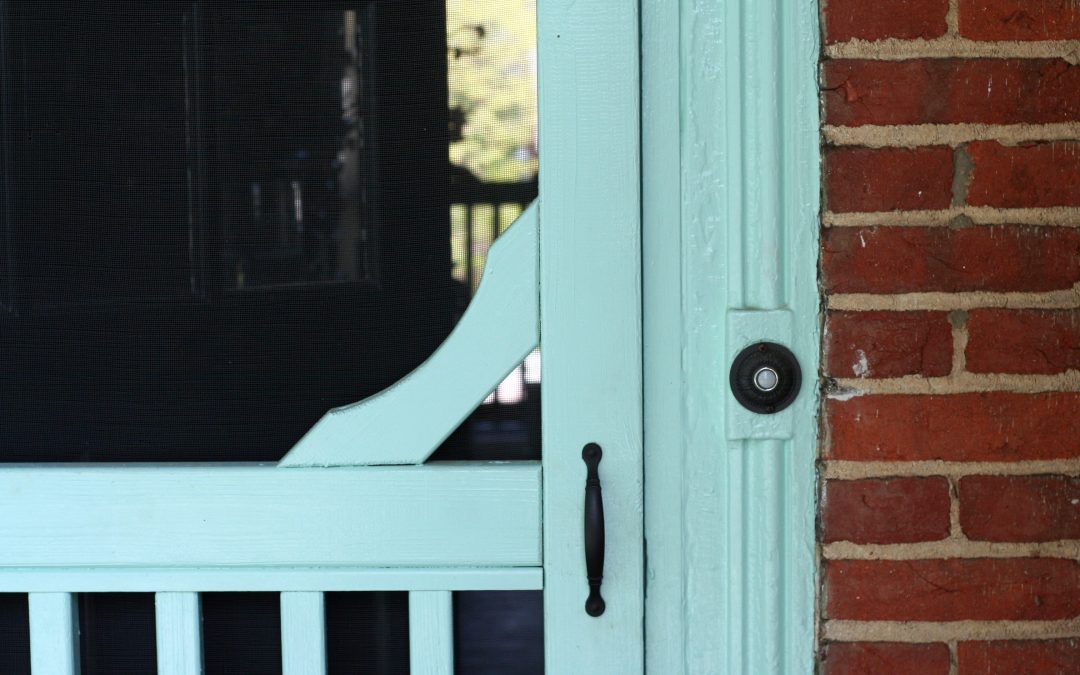
The apparent front of the house, facing the street, has no door, only a wide front porch and two tall windows. You followed the sign with its pointing arrow, glued to a rock at the place where the driveway splits, to the right. Here is a lamppost, here is a door painted the light green color of old copper, but is this the front door? The driveway curves on around the house, there is nowhere to park, and you were unsure. This is why you found me waiting and waving right there, half in and half out of the door.
You found us! You are here!
If this were your second visit, you would continue on the driveway’s curve around to the western side of the house. You would park your car next to my pickup truck near the old, red barn, and you would enter through the back door on that side of the porch. But this is your first visit, and I will open the front door, with its many glass panes, wide.
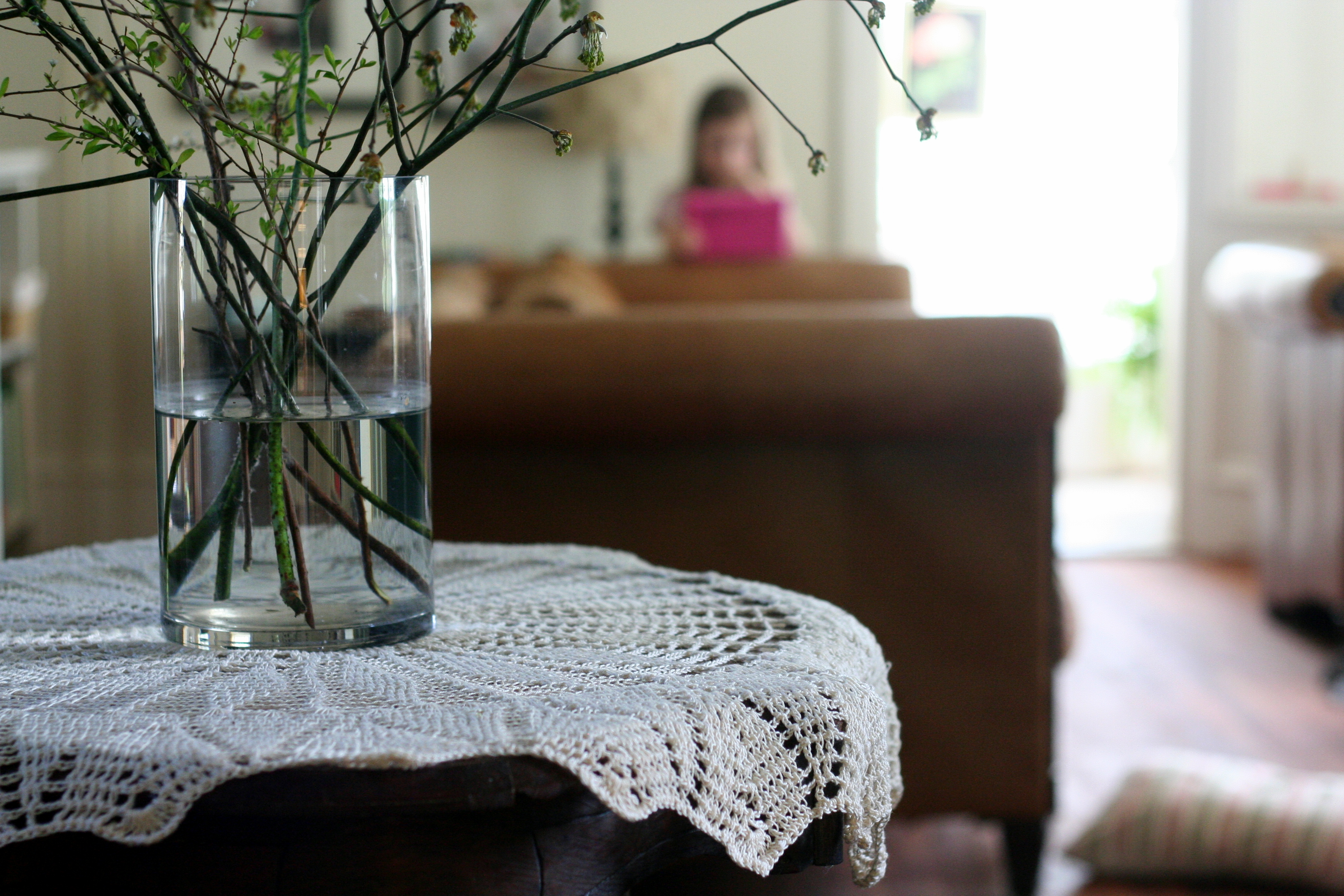
Here is the space we grandly call “the front hall,” but it isn’t so very big. A small, oval table sits in the center of an old red rug. The table once belonged to my husband’s great-grandparents in Mexico. I don’t know exactly why, but it looks right at home here at Maplehurst. On top is a glass vase I have filled with branches: the electric green of sassafrass buds and the starry white of spirea. The staircase with its scarred wooden banister moves up toward a tall window before turning out of sight.


Not only is it Easter now, but it is April, and the air is sweet in that way some people name warm and some people name cool. There is no need to pause at the coat closet. Instead, I place your bag on the table, take your hand, gesture to our left, and say,
“Here is the parlor. This is my quiet room. Unless the children are practicing their piano.”
I turn and indicate the room on our right,
“We call this larger room the family room, though I sometimes wonder what the Hughes family, who first built this house, would have called it.”
You see that a round, oak pedestal table sits in the curve of a bow window. The cloth is dark, dusty pink and covered in cabbage roses. I explain that it was once our kitchen table, but we, along with our guests, have outgrown it. Now it sits here for board games and library books and cups of tea with a view of the flower garden.
“Look,” I say pointing toward the garden just beyond the window, “Lent was for planting tiny shriveled pea seeds only to watch them be buried by snow. Easter is for that shower of wild violets. It has flooded the garden. Purple, lavender, white, and green everywhere you look. And there, in the middle of a purple sea, is my youngest. She is a hunter stalking dandelions. When she finds one, she will shout with pleasure before wishing, yet one more time, for a dog of her own.
Bless her heart. I’ve always insisted that Jonathan and I are not dog people, but maybe those dandelion wishes are more powerful than I know.
Would you like to step through to the kitchen?”
To be continued …


Elizabeth is giving me and my readers a personal tour of her home, Mersea. Will you join us?

by Christie Purifoy | Apr 4, 2017 | Books, These Farmhouse Bookshelves, Uncategorized
You probably know that I love to share about the books I’m reading just as often as I can, but it’s a rare day when I can tell you about a wonderful new book on friendship written by one of my oldest and dearest, real-life friends.


Never Unfriended: The Secret to Finding and Keeping Lasting Friendships by Lisa-Jo Baker
I want to tell you that Lisa-Jo was the perfect person to write this book because she is a perfect friend. I want to say this because she has always been such a very good friend to me. When we said goodbye many years ago, just before she and her husband left Chicago for Ukraine, I assumed our friendship would fade. But Lisa-Jo held on. And I will forever be grateful to her for that.
But I will not in fact tell you that Lisa-Jo wrote this book out of a place of perfection. I will not even tell you that she wrote it out of a place of personal strength. I know her well enough to know that she feels her own failures as a friend keenly, and that she has also felt the deep wounds only a friend can inflict.
Like most precious things, this book is the fruit of suffering and struggle. When Lisa-Jo reminds me that I am free to become a friend to others because I have found the most perfect friendship in Jesus, I listen.
I listen, because she knows this for herself, and because she tells the story so persuasively and so well.


One: Unity in a Divided World is the just-released book by Deidra Riggs. I don’t know Deidra nearly as well as I know Lisa-Jo (we are facebook friends who have never met in person), and yet, I know enough of Deidra, and of her wisdom and experience and passion, to know that this timely book should be embraced and widely read.
If you are troubled by the rancor and divisions that seem so prevalent today, here is a book to inspire you and challenge you to pursue the reconciling way of Jesus.


Whether you’ve never heard of the Enneagram or have read every book about it you can get your hands on, I highly recommend this new book by Ian Morgan Cron (the author of one of my favorite memoirs!) and Suzanne Stabile.
The Road Back to You: An Enneagram Journey to Self-Discovery is probably the most user-friendly introduction to the Enneagram I have read. Not only that, it is wonderfully written (in fact, this book is proof that instructive nonfiction can feature insanely good writing).
The Enneagram is an ancient personality typing system with roots in Christian monasticism. I have personally found it to be a powerful tool for gaining self understanding and, perhaps most importantly, compassion and even gratitude for those who are very different from me.


I am slowly reading my way through Anne Fadiman’s book At Large and At Small: Familiar Essays. I am reading slowly only because I am making myself read slowly. I want to devour these delightful, witty, intelligent essays like a bowl of ice cream (and Fadiman even has an essay on ice cream!), but I also want this treat to last as long as possible.
Tell me, do you read nonfiction?