
Lent: A Love Story
I thought there was only one way to tell the story. I was sure there was only one way to begin.
The beginning was the black page in my own little copy of the wordless book. The beginning was the black bead on the bracelet I made in Vacation Bible School. The beginning was the first bullet point in every gospel tract I’d ever seen. The beginning was that first brick on the Romans Road to Salvation: we all have sinned.
Sin, separation, estrangement: this is how the story always began.
***

***
I thought I knew the story. I thought I had it right.
It began with a great debt. I owed this Christ everything. This is the story I was taught, and this is the story I believed.
This is the story that has shaped my whole life. And this is the story I still believe.
But I spent years crawling my way back to the beginning of the story. And ten years ago, I arrived. Desperate with pain and unmet desire, I let go of that black page. I let go of the blood-red, and I let go of the white.
I’d spent my whole life clinging to my own cleanness, my own goodness, trying to pay back the debt I owed, but it no longer mattered. The only things that mattered were these: was I known? Was I loved?
***
When belief unraveled, when it no longer seemed to matter if I was good, I heard this: I see you.
God didn’t care if I was good. And he didn’t care if I believed. But he cared that I was hurting.
Because he loved me like I love my babies. And he held me like I hold my babies.
He held me until I could say, like Job, “My ears had heard of you but now my eyes have seen you.”
***
It is Lent, and I am thinking about sin. I am thinking about the Love I encountered ten years ago.
My prayer these weeks has been the same every day. It is brief and simple: search me, O God, and know my heart. The result has been surprisingly straightforward. It has felt like God placing a mirror right in front of my face.
I can’t help but see what the mirror reflects, and I cringe. I see something ugly, something so buried I would never have discovered it on my own, and I feel the expected shame. I’d like, just for a moment, to forget what I’ve seen. But then another thought occurs to me: it takes such love to hold up that mirror. Thank you, God, I whisper. Thank you for loving me enough to show me this.
It’s as if God is the friend who won’t let me leave the house with spinach stuck between my teeth or toilet paper clinging to my shoe. What a relief it is to have a friend like that.
***
And so, I have finally arrived at the black page. The black bead. The first brick. But I am not afraid. I am not ashamed. At least, not for long. Because I know what comes next. I know about the blood-red, and I know about the white.
And this story?
It is a love story.
***
Because We Have Not Yet Arrived at the End
“His soul swooned slowly as he heard the snow falling faintly through the universe and faintly falling, like the descent of their last end, upon all the living and the dead.”
– James Joyce, “The Dead”
***
***
I want to write spring stories. I want to write glorious endings.
And why not? I am the storyteller. I am the one tap, tapping at this keyboard.
I know that others in this world are observing spring’s first blooms and taking walks on balmy nights. My snow-covered world is not the world in which everyone is living. I am winter-weary, and I want to move on to other themes.
But I have ceded control over my own stories. I have made a promise (to myself? To God?) to write stories rooted in my own particular place and this particular time.
And this place is snow-covered.
And Easter is still a long way off.
***
On Saturday I walked the halls of a large art museum. I listened to echoes. I stared into the deep brown eyes of a woman who died in Egypt thousands of years ago. Her funeral portrait is lifelike. It hangs at eye level. She looked about my age. We might have been neighbors, I thought.
After that, each work of art seemed connected to some soul. The silversmith who worked the bracelet. The painter who held the brush. The model who sat for hours. The dancers portrayed in silk. The anonymous ones who wove the tapestry.
Each room revealed more of the vastness of our world. So many people live on planet earth today, I cannot even conceive of them all. But add in every life in every place and each time for all of history? My small mind struggles to believe there is a God who has known and loved each one.
***
The end of the story is always the best part. It is the place where the messiness of the middle is resolved. The point where pain is redeemed and suffering fades into something beautiful. It is the place where I want to pitch my tent.
But I do not think we are always given that choice.
I keep seeing one particular crucifix. I encountered it in one of the museum’s rooms of medieval art. It was carved out of wood and out of anguish. The Christ figure was elongated and emaciated. Reaching tendrils of warm wooden hair seemed to say that this is pain without end.
This is suffering unfinished.
I drove long miles between the art museum and my house, and I thought about the crucifix. The carving was small enough to hold with one hand, but I wanted it to be bigger. I felt the heaviness of all those lives, like shades in every corner of the galleries. I wanted Christ crucified to be big enough to heal every soul for all time.
And I wanted it finished.
As I drove, snow began to tumble through the air. I could see it churning in the light of streetlamps and headlights. As it dusted rooftops and cornfields, I could feel winter settling back in for a longer stay.
***
We privilege endings, but we live in the middle.
This place is snow-covered.
And Easter is still a long way off.
This Cruel Season of Promise
From my kitchen window I can see a blue plastic sled stranded at the top of a small hill.
Last year, our first spring at Maplehurst, we edged the hill on one side with blueberry bushes. We shored up the other side with an asparagus patch. We planted a peach tree and a cold-hardy fig like two flags at the top, but the kids have carved a downward path that manages, usually, to carry their sleds around their mother’s precious plants.
The snowcover on the hill is shrinking, and the sled is marooned. I can imagine it still sitting there in July, nearly forgotten in the weeds.
The sled I see clearly, but it is much harder for me to imagine July’s green abundance. Here, in early March, there are no signs of new life. Instead, the snow seems to be coughing up rusted buckets and wilted kickballs.
These hinge weeks between winter and spring are always ugly, but, thanks to February’s ice storm, this one is particularly awful. Brown grass and mud are mixed with splintered wood; our world looks as if it has only just survived some disaster.
From my kitchen window, I see a waste land.
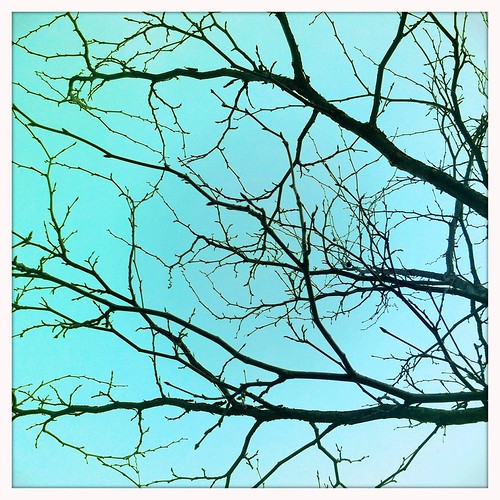
The trees, still bare, no longer remind me of elegant bones against the sky. Instead, they look naked, and I am ashamed for them.
***
***
At church, it is the first Sunday of Lent. The cross carried in procession is veiled in purple, as if we cannot yet bear the sight of our redemption. Easter, like spring, is still too good to be true.
The reading from the Old Testament this day is from Genesis. Adam and Eve discover their nakedness, and they are ashamed.
This season I am following my friend Sue’s example and praying daily one simple prayer: Search me, God, and know my heart.
This prayer is simple and brief, but it isn’t easy to pray. It feels like a deliberate stepping out into the open with no clothes. Not even a fig leaf.
***
I thought this prayer would open my eyes to some sin. Instead, my eyes have been opened to something much more complicated.
T. S. Eliot describes it in his own meditation on a wasted, blasted land:
April is the cruelest month, breeding
Lilacs out of the dead land, mixing
Memory and desire, stirring
Dull roots with spring rain.
Winter kept us warm, covering
Earth in forgetful snow …
Winter’s rest is melting away, and I am waking up to a great desire. And I find this terrifying. Exhilarating, too.
Spring won’t truly arrive until I have dreamed and ached to pick asparagus, blueberries, peaches and figs. First, the longing. Then, the feast.
And the new plans God has for my life can’t be realized unless I first recognize the desire planted in my heart. Certain dreams will never come true unless I first wake up and remember them. But to remember them enough to pray for them is to stand naked before God. There is no more hiding the depth of my desire. There is no shrinking from the fear that he will say no or not yet. Sometimes spring is interrupted by a killing freeze.
God is tugging me – and you – towards resurrection.
But the road is a cruel one.
***