by Christie Purifoy | Dec 8, 2011 | Advent, book of quotations, Books, Jesus
The following words can be found in Watch for the Light: Readings for Advent and Christmas. I’ve had this small volume on my Amazon wish list for several years, but this is my first season to read it. I should have clicked purchase long ago.
J. B. Phillips on Advent:
“What we are in fact celebrating is the awe-inspiring humility of God, and no amount of familiarity with the trappings of Christmas should ever blind us to its quiet but explosive significance. For Christians believe that so great is God’s love and concern for humanity that he himself became a man. Amid the sparkle and the color and music of the day’s celebration we do well to remember that God’s insertion of himself into human history was achieved with an almost frightening quietness and humility. There was no advertisement, no publicity, no special privilege; in fact the entry of God into his own world was almost heartbreakingly humble. In sober fact there is little romance or beauty in the thought of a young woman looking desperately for a place where she could give birth to her first baby. …
That is why, behind all our fun and games at Christmastime, we should not try to escape a sense of awe, almost a sense of fright, at what God has done. We must never allow anything to blind us to the true significance of what happened at Bethlehem so long ago. Nothing can alter the fact that we live on a visited planet.”
We live on a visited planet.
by Christie Purifoy | Nov 8, 2011 | Books, Home
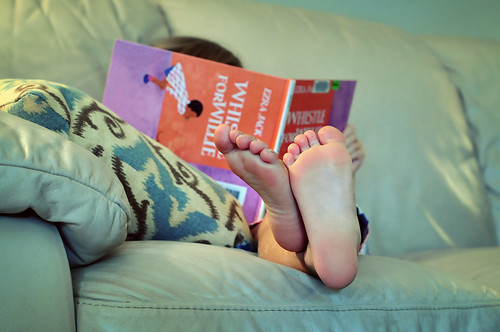
I recently bought a chair.
To be more precise, I bought an arm-chair.
This is no hard-backed dining chair. This is a reading chair, a tuck-in-by-the-window-with-a-stack-of-books-and-a-cup-of-tea-chair.
Full confession: I already had a good reading chair. With its faded green-velvet slipcover, it is soft and welcoming. It even has a small hole on the right arm, an x-marks-the-spot for the exact right place to rest my book. In our Chicago apartment, this chair sat between our third-floor window and a built-in bookcase. The ideal spot for reading; the ideal spot for thinking.
This chair still sits in the living room, but in our Florida house it has no window (the window, in this case, consisting of a sliding-glass door to the screened-in patio). A reading chair with no window is simply no good, in my opinion.
And so, I’ve been on the lookout for a new reading chair.
I’ve long kept its intended spot in mind. Because our Florida home is younger than our Chicago home (oh, by eighty years or so), the only consistently quiet spot in this house is in my bedroom (darn these contemporary “open” floor plans). If the quiet weren’t enough, the windows in this room would confirm it as the ideal place for reading: they are a tall, three-sided embrace for my writing desk with just enough room left over for an arm-chair.
And the view, you ask? Fruit trees, a spreading oak, water, and all kinds of birds.
Of course, as with any big purchase, there was no small amount of hand-wringing and budget-worrying. I want to live simply, but I recognize that my usual standards of comparison have become a bit skewed in a place where every other person appears to own a boat.
I might justify my purchase by saying, “Well, it isn’t as if I’m buying a boat.” And yet, I’ve learned that these two objects may not be all that different.
I know this because I sat next to a boat-owning businessman on my recent flight to Chicago. When he started talking to me about how much he loved living in Florida, I just smiled and nodded. I’ve learned that around here conversations tend to shut down once you admit to being more of a “cold-weather person.” It’s not hostility. Just bewilderment.
As I listened to him describe his weekends on the boat, the slow putt-putting to just the right quiet cove, I realized, with surprise, just how much we actually had in common. I understood that for some boat-lovers at least (and I’m afraid I must entirely exclude jet-ski lovers from this observation) a boat is like an arm-chair you can enjoy out on the water. It’s a place to sit, to hold a nice drink, to observe the glory of our world.
The biggest difference, as far as I can tell, is the cost of maintenance (in time and money). So, I am more than content to be an arm-chair kind of girl.
Still, it’s nice to know that I’m not quite the Florida-coast oddball I thought I was. I may not be a hot-weather person. I may not be a beach-person. I may not be a boat-person, but I know what it is to long for one inspiring, beautiful place.
I know what it is to sit in that place, quietly grateful.
by Christie Purifoy | Oct 31, 2011 | Books, Chicago, Poetry

I didn’t discover the poetry of George Herbert until graduate school (my undergraduate education in literature had more than a few gaps, I’m afraid. This due, mostly, to my own indiosyncratic course selection criteria: what time is the class and who is the professor?).
Thankfully, I did find Herbert, and I still remember my shock that we could actually discuss such Christ-centered poetry around a University of Chicago seminar table. Who says there’s no Jesus in higher education? Though, to be honest, there’s a lot more of Freud in my dissertation than Jesus. A lot more. I blame Virginia Woolf for leading me astray.
However, with the job market in the humanities being what it is, I have a good deal of time for Herbert these days. And, my love for the modernists notwithstanding, that’s a very good thing.
Without further ado, a poem on rest (one I’ve recently been feeling the truth of deep in my bones):
The Pulley
When God at first made man,
Having a glass of blessings standing by,
“Let us” (said He) “pour on him all we can;
Let the world’s riches, which dispersed lie,
Contract into a span.”
So strength first made a way;
Then beauty flow’d, then wisdom, honor, pleasure;
When almost all was out, God made a stay,
Perceiving that alone of all his treasure
Rest in the bottom lay.
“For if I should” (said He)
“Bestow this jewel also on my creature,
He would adore my gifts instead of me,
And rest in nature, not the God of nature:
So both should losers be.
“Yet let him keep the rest,
But keep them with repining restlessness;
Let him be rich and weary, that at least,
If goodness lead him not, yet weariness
May toss him to my breast.”
– George Herbert
by Christie Purifoy | Oct 17, 2011 | Art, Books, Poetry
In my ideal Christian bookstore, the Jesus knick-knacks and the Amish romances would be pushed to a far corner. The coveted window display space would be filled with books like the collected poems of Czeslaw Milosz.
I guess if I’m being perfectly honest, my ideal Christian bookstore would look exactly like my favorite independent bookstore in Chicago’s Hyde Park neighborhood, with a few more Bibles. As Madeleine L’Engle writes in Walking On Water, “Christian art? Art is art; painting is painting; music is music; a story is a story. If it’s bad art, it’s bad religion, no matter how pious the subject.”
Even if you think that L’Engle pushes the point too far, I imagine that many of you, having picked up a copy of Milosz’s New and Collected Poems (1931-2001), would agree that this is a writer Christians should be reading. A believer and a Nobel Prize winner, Milosz never turned his face away from the darkness of twentieth-century history. Yet he did this without losing his grip on hope and belief. A light shining in darkness. I think that may be my definition of Christian art.
Rays of Dazzling Light
Light off metal shaken,
Lucid dew of heaven,
Bless each and every one
To whom the earth is given.
Its essence was always hidden
Behind a distant curtain.
We chased it all our lives
Bidden and unbidden.
Knowing the hunt would end,
That then what had been rent
Would be at last made whole:
Poor body and the soul.
– Czeslaw Milosz
by Christie Purifoy | Oct 13, 2011 | Art, Books, Family, Stories, Writing
With three talkative children at the table, the ship of dinner-time conversation is rarely steered by the adults in our house. Which is surprising given that the youngest is working with a somewhat limited vocabulary. To make up for this handicap, he frequently resorts to loudly repeating a single word with varying intonations. His vocabularly may be small, but he certainly knows what talkative is supposed to sound like.
Recently, I yanked my mind from some daydream or other and recognized that the children were discussing Harry Potter. This, too, is strange, given that not one has finished reading a single book of the series, nor have they seen the films. I recognize, with a bit of sadness, that Harry Potter has joined the company of imaginative figures, untethered from any particular medium, which populate a child’s imagination. Harry Potter, Winnie the Pooh, a Jedi Knight … they’re all hanging out together in my five-year-old’s dreams.
As if trying to get a firmer grasp on all that she doesn’t yet know, the firstborn says, “But Harry Potter isn’t …”, and I gasp. I am suddenly sure that she’s about to say “true.” She doesn’t. Finishing her sentence over my raised eyebrows, she says, “Harry Potter isn’t real, is it Daddy?” He says easily, “No honey, it isn’t real.” And I sigh, grateful I don’t have to intervene.
But if she had said true? That would have been a very different story.
It isn’t simply that I love Harry Potter. I do. Much as I loved Narnia when I was my daughter’s age. But it isn’t love (or delusion, for that matter) that would have caused me such pain to hear my child say, “That story isn’t true.”
Despite what you may now be thinking, I don’t believe there are broom-flying wizards right around the corner. That’s our reality. No broom-flying wizards. I might wish it otherwise, but I accept this.
But true? Not true? To me, at least, those words suggest something very different from what we usually mean when we say “true-life.” No, Harry Potter’s world is not “true-life.” But true? Yes!
Ours is a fallen, not-quite-what-it-was-meant-to-be world, and our reality isn’t always true. At times, it lies. It says this world tends towards chaos, you are on your own, watch out for number one, pursuing goodness is a waste of time.
Stories – at least the excellent ones – give us a glimpse of the world as it was always meant to be. Through the lens of a story, we can see the world as it will be again one day.
Reality? Too often it is a cracked lookingglass. Stories? No matter how fantastical, this is often where we spy the truth.
When Jesus came walking in bare feet to rescue us, he was asked many questions. More often than not, he answered them with stories.
He told us himself that his name was Truth, and he told us stories.
by Christie Purifoy | Sep 19, 2011 | Art, Books, Poetry
The muscles in my legs have been achy and sore for two days. No, I didn’t go jogging (horror!). I spent most of Saturday rearranging my books, and it seems I vastly underestimated the after-effects of shuffling books from shelves to floor and back to different shelves.
The big book shuffle was prompted by a single new bookcase. It arrived on Friday, packed in one slender yet unbelievably heavy box. On Saturday morning the three boys tackled it with their respective hammers (plastic for the two-year-old, which pleased him not at all).
Within half an hour I was standing in front of one of the loveliest sights I can imagine: pristine, empty bookshelves.
They didn’t stay empty long. I gathered up the piles of books which have quietly accumulated in the corners of my house, and, after much dusting and a thorough rearranging, discovered that I should have ordered two new bookcases.
No matter. I can’t think of a better way to spend a cloudy, drizzly Saturday than handling (and remembering) each of my books as I slide them into place.
It was only as I carried my poetry collection from family room built-ins to dining room shelves that my pleasure dimmed. I haven’t reached for any of these books in such a long time (not since my last Intro. to Lit. class), and I felt suddenly sad to think of so much treasure sitting untouched, collecting dust.
I had the idea, then, to share some of these poems here on my blog. I grant you, it’s very self-indulgent. But isn’t blogging always that, to some extent?
The thing I’ve long loved most about teaching is the simple act of sharing beautiful things. I’ve missed that.
So, without further ado, a poem for you (inspired by last week’s post on the magic of mirrors):
Miracle Glass Co.
Heavy mirror carried
Across the street,
I bow to you
And to everything that appears in you,
Momentarily
And never again the same way:
This street with its pink sky,
Row of gray tenements,
A lone dog,
Children on rollerskates,
Woman buying flowers,
Someone looking lost.
In you, mirror framed in gold
And carried across the street
By someone I can’t even see,
To whom, too, I bow.
– Charles Simic
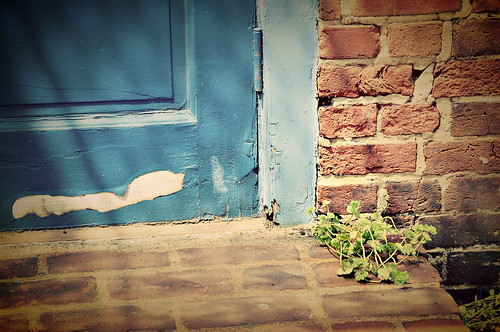
This is a perfect ode, in my opinion, for kicking off plans to reacquaint myself with the poetry on my shelves. It reminds me that creating art is often as simple as reframing the everyday (as my sister’s photograph moves us to see peeling paint with new eyes).
Within the gold frame of a poem, the ordinary is transformed. Simic is right. It is a miracle.
Blowing the dust off of a poem and reading it, we bow to the vision it offers, we bow to its maker, the poet, and we remember our own maker, who created us to create.
