by Christie Purifoy | Nov 5, 2012 | Art, Books, Faith, Pennsylvania, Poetry, Uncategorized
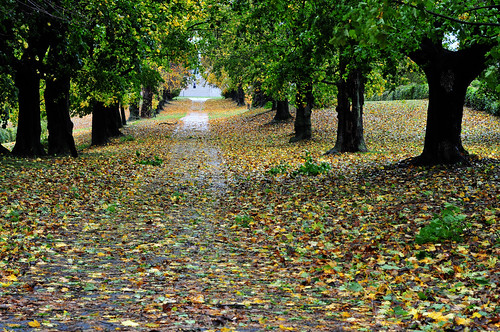
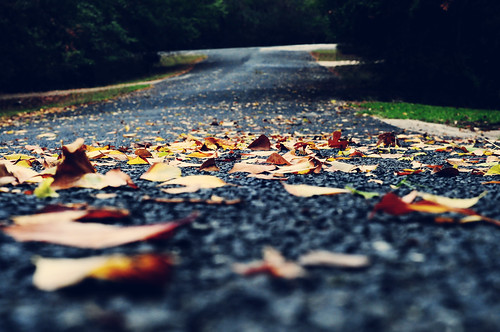
I watched these old, old maples bend in the wind of that hurricane. Because they yielded, they are still standing.
That is how I want to live. I am more and more sure that art and beauty and love grow best not by raging against the wind (or the storm, the dark day, the hard, unasked-for circumstance). They come through yielding.
To yield is not to give up. It is not throwing up my hands in defeat. This yielding is more like being carried. It is moving with what moves and watching – always watching – for the One who does the moving.
And then singing of what I see.
Vow
The need to work this land to fit my wants
I yield. I vow no more to walk with plans
like gossip falling from my mouth. I choose
to go in silence, learning, in my sure
refusal, the truth that yields to yielding.
At Equinox, before the flood of light
sets water loose, I covenant to give
the downward rush beneath the grass its head.
I’ll dam no stream. I’ll dig no pond. Nor will
I plant willows to suck the wet spots dry.
My work shall be to say the nature
of Creation’s slow unfolding, to name what
becoming new has always been, to praise
what lives without my praise unto itself.
– John Leax
by Christie Purifoy | Oct 22, 2012 | Books, Food, Poetry, Scripture, Uncategorized
Once upon a time, Mondays on this website were devoted to poetry. Because the small bites of poetry are about the only literary food I have time for these days, I’m reviving the tradition. Please tell me what you think. Would you like a poem each week?
To help you make up your mind, here’s one from a favorite poet, Luci Shaw.
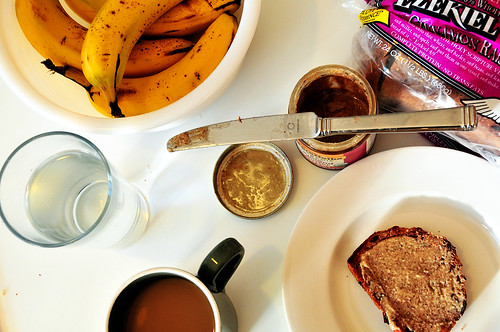
It reminds me that my own “quotidian wilderness” (a land of baby bottles and cinnamon toast, children with sniffles and autumn leaves) is saturated with glory.
Manna
They asked, and he brought quails,
and gave them food from heaven. Psalms 105:40
I’m not asking for quails for dinner
and, if they flew in my window, at mealtime,
in a torrent of wind, I would think
aggravation, not miracle.
Time is so multiple and fluid. If I lose a day
flying the Pacific and gain it back
returning, perhaps the prayer I offered
this morning at first light
was known and answered last week.
You never know what a simple request
will get you. So, no plea for birds
from heaven. Rather, I will commit myself
to this quotidian wilderness, watching for what
the wind may bring me next –
perhaps a minor wafer tasting like honey
that I can pick up with my fingers
and lay on my tongue to ease, for this day,
my hunger to know.
– Luci Shaw
by Christie Purifoy | May 3, 2012 | book of quotations, Books, Faith, Home, Jesus, Stories, Uncategorized
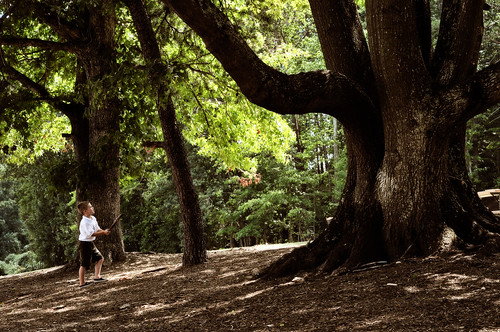
I love this photograph so much. It’s only a picture of my nephew and his stick at the edge of some woods. I think it is one of those pictures that reveals so much more than the sum of its parts: boy, stick, tree.
I look at this picture, and I see fairy tales. Knights with swords as alive as they are. Wickedness that must be sought out in dark forests. I see adventure stories. Those stories that make sleeping on a bed of leaves and cooking food over an open flame sound like heaven.
This photograph reminds me of all that I love about the very best stories: magic, beauty, goodness. Also, darkness, evil, confusion, until, finally, triumph and victory.
I think that I am a Christian because I believe these stories tell me something true about the world. They also tell me true things about myself and about other people.
I think that I will always be a Christian not because I will always believe exactly the same things, or because I have figured it all out, or even because my questions have all been answered. I think I will always be a Christian because the story of King Jesus is a story in which I can live. Within this story, I can move, and I can breathe.
In Still: Notes on a Mid-Faith Crisis, Lauren Winner shares her friend Julian’s memory of being confirmed as a twelve-year-old. A few days before the service, he panicked and told his father (who was also the minister) that he didn’t know if he believed all the right things and wondered if he could proclaim in front of the church that he was ready to believe them forever. Here is his father’s response:
“What you promise when you are confirmed,” said Julian’s father, “is not that you will believe this forever. What you promise when you are confirmed is that that is the story you will wrestle with forever.”
Sometimes, faith is like a wrestling match. Like Jacob wrestling all through the dark night with God himself. Jacob always bore the scar of that struggle.
Sometimes, faith is like coming home. Abiding in a place that reveals something of who we truly are.
Faith is not saying, “I know this” and “I am sure of that.”
To have faith is to say, “This is the place where I live.”
Jesus said, “Live in me. Make your home in me just as I do in you.”
John 15:4 (The Message)
by Christie Purifoy | Feb 9, 2012 | Books, Food

I write a great deal about books on this blog. You know that I love Irish poetry and the novels of Virginia Woolf. You know that I love Harry Potter and the Hunger Games. You may not know that I love well-written detective novels like those by Margery Allingham (past) and Kate Atkinson (present).
A significant sub-genre in the large category of Books I Have Loved is Food Books. This includes my childhood favorite Little Farmer Boy, by Laura Ingalls Wilder. Even today, I could happily read those descriptions of nineteenth-century farm meals over and over and over. Wilder can make me drool even for headcheese.
It also includes Food Memoir. This seems to be a very popular genre today. I haven’t actually read many of these books, but I have noticed whole stacks of memoirs with words like cupcake, lemon, chocolate, etc. in their titles. My own favorite food memoir may be Down the Kitchen Sink, by Beverley Nichols. His gardening books are the best, but I love Nichols no matter his subject. He’s sentimental, nostalgic, and rather snobbish (well aware of his own foibles, he would no doubt prefer the term “romantic”), but he’s witty, supremely British, fond of name-dropping and more comforting than the most comforting comfort food.
Lastly, there are cookbooks. I read them like novels and am drawn both to the glossy and new (Ina Garten! Babycakes!) and the vintage and worn (The Kitchen Garden Cookbook with watercolor illustrations by Tasha Tudor!). One of my all-time favorites for reading pleasure is Apples for Jam. The recipes are organized by color (pink! green! white!) rather than food type or meal. It’s totally impractical and wonderfully inspiring.
Last spring, I inherited (via estate sale) a whole stack of vintage cookbook treasures. When I paid for them, the daughter of their previous owner sighed and told me that her mother used to read cookbooks like novels. I told her I’d be keeping them on my bedside table for just that reason.
My favorite of her books is The Margaret Rudkin Pepperidge Farm Cookbook. The title may sound corporate and rather soul-less, but if you could hold it in your hands you would know right away how wrong that first impression is. This is a hefty, hardback covered inside and out with delicate ink drawings, many of them in full technicolor glory. Originally published in 1963, mine is the 1965 edition.
It is part cookbook, part memoir (as the best cookbooks usually are), and describes the life, times, and food of Margaret Rudkin. Apparently, Mrs. Rudkin was inspired to begin baking and selling Pepperidge Farm bread because of her child’s food allergies. Thus, she is dear to this mama’s heart.
Part One of this book describes Mrs. Rudkin’s childhood in a New York City brownstone. It seems they ate a lot of soup and fish. I might try the recipe for Strawberry Soup. Likely, I will skip the Pickled Lambs’ Tongues.
Of course, I also enjoy actually cooking. And certainly, I love to eat. Still, one can only cook or eat so much. But reading … ah, reading. With books I am never sated.
Do any of you share my love for cookbooks and books about food? Any recommendations? I’m always hungry for more.
by Christie Purifoy | Jan 13, 2012 | book of quotations, Books, healing
I’ve been sick. For a month. I’m worn out with it.
Worn out enough to have spent the last few days in bed. Worn out enough to have finally called the doctor. Having filled the prescription he gave, I can breathe again. Though I am still tired. And each breath has that ache-y, medicinal twinge suggesting that my body knows it isn’t yet breathing under its own strength.
To be confined to a sickbed feels like the ultimate waste. Productivity ceases. To-do lists are left undone. One can no longer give anything. Confined to bed, receiving is the name of the game.
In other words, it isn’t only the pain of illness that makes it so uncomfortable.
When sick, it is no longer possible to do; the challenge is simply to be. I focus on each breath in and out. At first, this brings fear. Later, comfort. To labor at something which is usually instinctive is to recognize that it has always been, will always be … a gift. Breath. The presence of God. Beyond us and within us.
When we are sick, the world shrinks. I have a book. The view from my bedroom window. A slowly ticking clock. This is life condensed. Which means there is more to notice, more to observe, more to think about in one minute of this life than in an hour of my usual busyness.
And that is a good thing.
Still, I hate the phrase “look on the bright side.” It suggests a yin-yang view of life that I simply can’t accept. I think you know what I mean: every cloud with its silver lining, every light with its shadow. No thank you.
Shadows only make me dream of a world without shadow. Of light without darkness. Of a day when “the moon will shine like the sun, and the sunlight will be seven times brighter … when the Lord binds up the bruises of his people and heals the wounds he inflicted” (Isaiah 30:26).
But, in the meantime, I do marvel that anything good can emerge from sickness. From brokenness. From darkness. This isn’t to say that “it’s all worthwhile” or “it happened for a reason.” Those are platitudes that do little justice to the utter wrongness of sickness. And brokenness. And darkness.
No, when I acknowledge the good gift I am marveling at the fact that darkness is never all. There is always something more. Something beyond.
For me, now, it is only a few words read in a book in the middle of the afternoon while I lie in bed and listen to the children scream their far-off screams. They are not, in this moment, my responsibility.
And so, released from every responsibility that says do, I lie still and read a description of wolves crying under a full moon in Yellowstone Park. I’ve never heard a wolf’s cry, I don’t know if I ever will, but now, having read these words, I can carry that cry with me for the rest of my life:
At the same time other wolves joined the first two, and we heard … the full-throated quiver of the pack. It haunted everything it touched, sanctified it. It rolled down the mountains and onto the plains and the bison heard it, the ground squirrels heard it, the crows nesting in the trees heard it. Mary began to tear.
“We are alive,” the wolves said. “And the world is beautiful.”
(from Eternal on the Water by Joseph Monninger)
by Christie Purifoy | Jan 10, 2012 | Books, Jesus, Stories
“Mom,” she asks, “What happens next in the story?”
I’m distracted, brushing my teeth, checking the clock. I realize that we only have 5 minutes before we need to leave for church. It takes more than 5 minutes to strap three kids into the car. At least, it does if one of those kids is a two-year-old who processes every instruction as an opportunity to run and hide.
“What story?” I ask.
“You know. The story at church. What happens after Christmas? What happens with Jesus?”
I rinse my mouth and give her a look of confusion. She says, “You know, the story! The angels and the stable and the star. What happens next?”
Finally, I understand her question, but I fumble for an answer. I may have an advanced degree in stories (I’m an expert! An authority!), but it only takes a child’s simple question to deflate those ego-balloons.
“Ummm … well … Jesus grows up. Then he starts teaching and performing miracles.”
Even I know my answer isn’t quite adequate, but the girl is thoroughly unconvinced. She huffs and rolls her eyes, and I know she thinks I still don’t understand.
But, I do. I do.
I know that it takes readers years to learn and even more years to appreciate that stories are not simply the sum of their plot developments. You could summarize a book by Agatha Christie and one by Virginia Woolf in the same number of sentences, but which summary would leave the most unsaid? You don’t need to have read Mrs. Dalloway to know the answer, I think.
“What happens next?” is not the only question we should ask. Why and how may be even more important.
I understand that my daughter, a new reader, is looking for excitement. We’ve had the star and the stable, the angels and the shepherds. What’s next? What’s next? Keep it coming! Keep it coming! Or, as her five-year-old brother might say, “Is there another picture in this book?”
We do get a few pictures between Christmas and Easter. Fishes and loaves. A broken jar of perfume. A man high up in a tree. Still, they aren’t quite as stunning as that stable or that cross. Neither the beginning nor the end, this is merely the hum-drum middle, right?
I’m not so sure. The middle may be less of a set-piece, less likely to be carved in wood or clay, but it’s the part that gives me the most hope for my day-to-day.
We live most of our lives in the middle. Between set-pieces. The funeral. The child’s birth. The phone call. The move. Those things happen, and they look like peaks and valleys as we glance back in time, but we mostly live in the in-between.
Jesus breaking bread. Jesus talking. Jesus healing. Jesus praying. That’s what the middle looks like. It’s beautiful and breath-taking in its own way. We only need to slow down enough to see it.
It’s like I always told my students when they first read Virginia Woolf. “Don’t rush. Take your time,” I would say. “If you hurry through only looking for what happens next you’ll turn the final page and realize that you’ve missed the story.”
I don’t want to miss the story. I want to live it.
