by Christie Purifoy | Aug 23, 2011 | Books, Family, guest post, healing, motherhood, Uncategorized

My love for books is well known. However, books haven’t always come through for me. They haven’t always given me the answers I’m looking for.
In my house, there is a particular shelf of books that have failed me utterly.
I’m honored to be writing over at Lisa-Jo’s place today. Won’t you join me there for the rest of the story?
by Christie Purifoy | Jul 22, 2011 | Books, Religion, Scripture
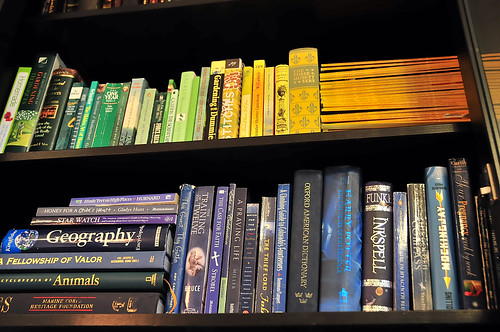
I recently came across news of another Gallop poll that attempts to sort and label people according to their beliefs about the Bible. You know the polls I'm talking about. Inevitably, they use catchwords like "literal" and "inspired" to tidy diverse opinions into neat categories.
I think I understand and sympathize with what is meant by statements like "I believe that the Bible should be read literally." However, I always bristle at that word literal. In my mind it makes Scripture sound too much like a set of instructions for assembling IKEA furniture.
Now, before I step on anyone's toes (oh dear, is it too late?), I should say that I do understand that theologians who use the word literal use it to mean something like the word straightforward. In their view, to read literally is to read straightforwardly, without twisting the meaning of the text to suit our own purposes.
They understand that the Bible is made up of diverse genres. They know that poetry must be read as poetry. History as history.
And yet, while I don't exactly disagree with this approach, I wonder if it doesn't compress the Word into a more human-sized package.
History is history, yes, but what if history is also more than history? What if it happened and is happening? The story of a people long ago and the story of you today?
It may be the poetry lover in me, but I find that only metaphor gives me a sense of the Bible that seems more God-sized, less me-sized. The Word is the Son of God, the Word is a lamp, the Word is a sword, the Word is food, the word is life.
This might not seem like very good news. Too often, I would rather have an instruction manual (especially where work and motherhood are concerned) than a person. I would rather go hungry if it meant that I could have every choice made for me. Every question answered. Every complex issue explained and categorized.
But we are so much more than IKEA furniture. Instead of a lifeless history lesson, we’ve been given a history that lives. Instead of diagrams, we’ve been given poetry. Instead of to-do lists, we’ve been given wisdom.
Hold the Bible tightly but your interpretation lightly. I read that somewhere recently. I can understand why it makes some believers nervous. We’re meant to be building our houses on rock, not shifting sand, right?
Yes! God’s word is solid and true, but, too often, our interpretations, those ideas we like to keep in neat little packages lined up on mental shelves . . . well, they are less so.
The risk of holding too tightly to our own understanding is that we can no longer be unsettled by the word of God. If we cannot see its somewhat wild, messy beauty, we risk assuming that we have God all figured out. We may assume that our lives look just as they should.
In The Cloister Walk, the poet and Christian Kathleen Norris describes her lifelong determination to “focus on the fuzzy boundaries, where definitions give way to metaphor.” It was a determination born in her one day in fourth grade math class. Her teacher, exasperated that Kathleen had once again failed to give the right answer, said sarcastically, “You see, it’s simple, as simple as two plus two is always four.”
At that moment, Kathleen had an epiphany and, without thinking, spoke up: “That can’t be.” She writes: “Suddenly, I was sure that two plus two could not possibly always be four. And, of course, it isn’t. In Boolean algebra, two plus two can be zero, in base three, two plus two is eleven. I had stumbled onto set theory, a truth about numbers that I had no language for. As this was the early 1950s, my teacher had no language for it either, and she and the class had a good laugh over my ridiculous remark.”
The Bible contains truth solid enough to stand on. To build our lives on. But it’s far from simple. It’s alive.
by Christie Purifoy | Jul 6, 2011 | Books, Family, Florida
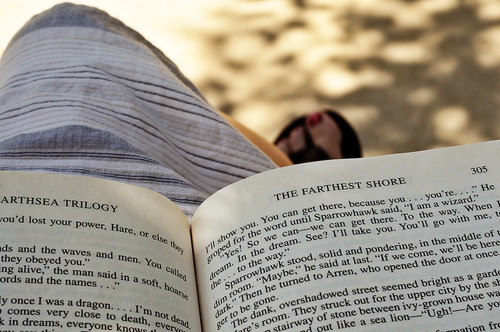
I've had the first book in The Hunger Games trilogy sitting on my nightstand for six months. Both of my sisters told me that once I started I wouldn't be able to put it down. I believed them and so I saved it, and then I think I just forgot about it. I got used to seeing it there, unopened by my bed.
Feeling a little desperate for reading material, I grabbed it on my way to my daughter's swim meet yesterday. In between races, she played with friends, and I read. After the meet, my husband worked the early evening shift in our try-to-keep-the-two-year-old-in-bed night job, and I kept reading. I'm an early-to-bed girl, but by 10:30 I was calculating the cost/benefit ratio of staying up to read till the end.
It took an act of will, but I eventually went to bed. Instead, I let my kids watch two hours of cartoons after breakfast so I could finish.
It's been a while since I last fell head-over-heels into a great story. It made me think about reading as a kid (the most perfect, magical books will always be the books we first loved) and all the reading I've done since. A lifetime of words and stories. A lifetime of living other lives, of seeing the world through other eyes.
Growing up in a family of six, I was the only reader. These days my mother and sisters troll my shelves like the local library and even my Dad can't get enough of his Kindle, but, back then, I was the butt of many jokes. They couldn't really understand my insatiable appetite for books.
I think their favorite joke (at least, it's the one I remember hearing the most often) involved the fact that I read while at our Grandmother's west Texas farm. Thinking about that farm, I remember jumping hay bales and making mud pies in the barn, but I've no doubt I plowed through quite a few books during those visits too. My family loved to say, "Look at her! She'd rather read about a farm than enjoy one!"
I suppose there's some truth to what they said. I could read about the hardships of Laura Ingalls' long winter again and again, but I'd never want to live them. Still, I don't subscribe to the assumption implicit in this joke: that books give second-hand experience and thus lead to a second-hand, perhaps even a second-rate, life.
All this has recently come back to me because I've been reading my way through a stack of books on bee-keeping, chicken-raising, and other farm pursuits. Lately, my small Florida vegetable patch has seemed like nowhere near enough, and I've been dreaming about raising (at least a little) of our own food. I may be planted in the suburbs for now (no chicken coops allowed), but a girl can dream.
The Backyard Homestead Guide to Raising Farm Animals may be a far cry from The Hunger Games, but, today, I'm feeling a little sorry for all the non-readers out there. Day-to-day, I may walk a fairly narrow path, but books like these have always set me in a wide-open place. Here, there's adventure. There’s heroism and triumph. There are even a few bees and laying hens. Just don't tell my community association. I'm sure their bylaws wouldn't approve.
by Christie Purifoy | Jun 27, 2011 | book of quotations, Books, Religion
I keep a book of quotations. It looks exactly like any other journal, but it’s for a different kind of journaling. Journaling with the words of other writers, if you will. Here I scribble down quotations from all kinds of books: poetry, theology, memoir, literary theory, fiction, you name it. I write down anything I want to remember.
Sometimes I use these quotations later, in my own writing or maybe just in conversation. But, it isn’t really about utility. It’s about beauty. Language can be so beautiful it stuns. However, I am generally reading so much, so quickly that I need a way to hold on to those beautiful bits that I just can’t bear to let wash down the stream of words, words, words.
Over the weekend, I added a new quotation to my book. It comes from the spiritual memoir Take This Bread by Sara Miles. Writing about her conversion as a “process” rather than a “moment,” she says that she struggled with belief: “It was tempting to rely on a formula – ‘accepting Jesus Christ as your personal Lord and savior,’ for example – that became itself a form of idolatry and kept you from experiencing God in your flesh, in the complicated flesh of others. It was tempting to proclaim yourself ‘saved’ and go back to sleep.”
I’ve placed these words near a quotation from Annie Dillard. In Pilgrim at Tinker Creek, she writes: “We wake, if we ever wake at all, to mystery.”
I cannot say comprehensively what it looks like to be a follower of Jesus who is fully awake. I do think that it has more to do with the mysteries of relationship than the certainties of formula. By mystery, I do not mean, doubt. Or, not exactly. I mean something closer to a journey of discovery that will never be finished on this side of life.
Over the years, my views on so many things have evolved. Actually, “evolved” might be putting it too delicately. In many cases, I have simply changed my mind. I’ve changed my mind about everything from politics and theology to whether or not I like blue cheese (turns out, I do). I’ve also decided that the number of questions I cannot answer far outweighs those that I can.
To be wide-eyed awake is to know that this life is not about having the right answer for everyone else’s wrong. Fully awake, I am aware of all that defies explanation. Bread and wine that is body and blood. My own self being made new. A divine love saying, rightly, that I have nothing to fear even while the earth is quaking.
Embracing mystery, I know that only the living Word is capacious enough to hold (in fact, to be) Truth. In humility, I accept that the little boxes in which I hold my little answers are only first steps toward a Maker who is more loving and more good than I ever dreamed. Unlike The Wizard of Oz, it is the waking life that is colorful, beautiful, and strange. Only the dream is black and white.

(photo by yours truly)
by Christie Purifoy | Jun 20, 2011 | Books, Family, Food, Religion
Most (perhaps all) experts would advise aspiring writers to “just say no” to exclamation points. They are abused and overused. They make our writing appear amateur. There is seldom a good enough reason to use an exclamation point.
And yet . . . I choose to believe that the story I am writing today deserves an exclamation point. The title of this post may have unleashed sugary visions in your mind, but I’ll tell you here at the beginning that this isn’t really a story about sugar. It’s about bread. And it is exclamation-point worthy.
On Saturday, my almost-five-year-old boy tasted his first doughnut. One taste and his eyes were shining. Like this:

(photo by yours truly)
This boy is allergic to a handful of the most basic ingredients of an American childhood (dairy, wheat, eggs, and peanuts). Thanks to a recent discovery (the phenomenal vegan, gluten-free bakery cookbook Babycakes Covers the Classics) my son tasted a doughnut for the very first time.
Even better, we all tasted them. We all loved them. In fact, the leftovers are calling to me from the freezer drawer right now.
It’s a far cry from our usual breakfast routine. My husband makes dairy-free, wheat-free pancakes and waffles, but they will always taste just a little funny to anyone accustomed to bleached, all-purpose wheat flour. Most days, the boy enjoys his breakfast, while the father begins making something else for everyone else.
Strictly speaking, our family never breaks bread together. We break bread alongside one another. The good loaf for the four of us, the not-quite-right imposter for our oldest son, the middle child.
In our family, we often say ruefully that if we only ate like this boy we would all be so healthy. Some meals, this is true, but, deep down, I have always felt as if my boy’s diet has no heart. Something essential seems missing. I love the smell of yeasty bread baking, and I definitely prefer homemade pizza crust. The bread-like lumps that sit on the shelves at Whole Foods, heavy with ingredients like tapioca and bamboo (I am not kidding), strike me cold.
My son rarely complains. Some of those lumps, he actually likes. Only occasionally, does he seem to mind. “Isn’t there any bread for me?” he might ask as his sister dunks a baguette in her soup, and I try to pacify him with a few rice crackers.
In my head, I know that my son doesn’t need bread. His body seems to be growing pretty well without it. In my heart, I’m not so sure. What I want to give him, what I long to give him, is the thing I gave him on Saturday. Bread made with my own hands to nourish him: body and soul. Factory-made bamboo substitutes need not apply. They cannot do the job.
I am about to make a leap here (from nutrition to religion), but, honestly, I don’t believe it’s that much of a leap. I love symbols and metaphors, but this is more real than those. Our pastor reminded us this weekend that the Hebrew word for bread is also used to speak of God’s presence. And that is what I hunger for. That is what I want to give my son.
Depending on our culture, we might discover it in a corn tortilla or a yeasty baguette, but I know it’s available for all of us, whether we are breaking bread at home or in a church. It’s Life. Body, heart, mind, and soul. All of it.
Jesus said, “I am the bread of life. He who comes to me will never go hungry, and he who believes in me will never be thirsty” (John 6:35). Maybe when he spoke these words they were only a metaphor. However, when Jesus walked all the way through death and out into life, his words became much more than that. And if we’re wondering what to do, how exactly to access this life without hunger and thirst, the answer, I think, is so much less complicated and exclusionary than we often make it: Eat! And after, maybe a simple thank-you.
“He makes grass grow for the cattle, and plants for man to cultivate – bringing forth food from the earth: wine that gladdens the heart of man, oil to make his face shine, and bread that sustains his heart.”
(Psalm 104:15)
by Christie Purifoy | Jun 13, 2011 | book of quotations, Books, Religion
I recently jotted down a few lines from Barbara Brown Taylor’s Leaving Church: A Memoir of Faith. Describing the honeysuckle and magnolia blossoms in her Atlanta neighborhood, she writes: “All these earthly goods were medicine for what ailed me, evidence that the same God who had breathed the world into being was still breathing.”
Generally, I imagine the act of divine creation as an over and done deal. God spoke. God breathed. Past tense.
Taylor’s words offer the best kind of literary shock: the shock of confronting a truth we know but have never really considered. A truth that suddenly appears, not only obvious, but vitally important.
Reading these few words, everything in me responds, “Yes, of course.” For creation, the very breath of God, continues to unfurl every moment.
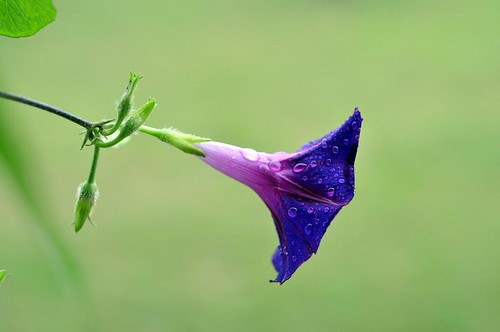
I hear a whispered breath in the utterly unique daily bloom of my morning glory vine. Each morning a new flower or two. There is also my own breath. Inhalation and exhalation require no act of decision or effort on my part. I can’t claim them. They are given to me, again and again, whether I think of them or not.
This moment by moment gift of breath would seem to be unadulterated good news, but, for me, it is also a source of fear. I grew up with asthma, can still feel that whistling wheeze in my chest, and when my own son struggles to breathe I feel, not only empathy, but fear. I can’t take breathing for granted, and my personal phobias are all rooted in this fact. Some people fear spiders or heights. For me, it’s something innocuous like scuba diving. Each breath measured from a tank, and a weight of water on my shoulders: this is someone’s idea of a vacation, but it feels like a nightmare to me.
It is only when I consider the character of the gift-giver (He is good. He is love. His plans are not to harm me.), that I can trade fear for peace. I cannot provide for myself the one thing I need most: breath. Fortunately, the one who can knows my needs better than I do and loves me more than I love myself. Even better, His love for my son swallows my own puny love. I can administer an inhaler and an epi-pen, but the God who made us, who loves us, who holds us, can breathe life.
In response, I breathe back my thanksgiving. Why do we sing our praises to God? As a friend(and talented musician) once shared with our church, we sing in order to give back to God that which he first gave us. Breath.
“And the Lord God formed man of the dust of the ground, and breathed into his nostrils the breath of life; and man became a living soul”
(Genesis 2: 7).
