by Christie Purifoy | Feb 19, 2013 | children, Dreams, Faith, Florida, God's Love, healing, Home, Joy, Pennsylvania, Stories, Uncategorized, Winter
I want my children to know that God’s love is as real as the cupcakes and green tea we shared on Monday afternoon. It’s as real as this house that shelters us from cold and frames our daily view of the sunset.
But this is actually a hard thing to believe, and my daughter goes straight for the crack in my story: what about the kids who have no cupcakes? What about the student my health teacher just told us about? The one with no money for a visit to the dentist? The one who is about to lose his house because his parents ran out of money to pay the owner?
And I can hear the real question whispering beneath our conversation: isn’t it a terrible thing to suppose God loves one child with a gift of cupcakes while another one is left to starve?
I’ve been listening to this firstborn of mine for years, and one word that always comes to mind is wisdom.
She reminds me that wisdom doesn’t necessarily know the answer, but she does ask good questions.
That is a good question, I tell her. I don’t know the answer.
All I really know are the stories that make up my own life. While I don’t believe in the God of Parking Spaces (in other words, a God who makes my life easier and more comfortable with special little favors), I do know that God loves in big ways and small.
Maybe God is loving you right now with cupcakes, I tell her. Maybe he is loving that other child with a bowl of rice from an aid worker.
One time, I tell her, God loved me with a sofa.
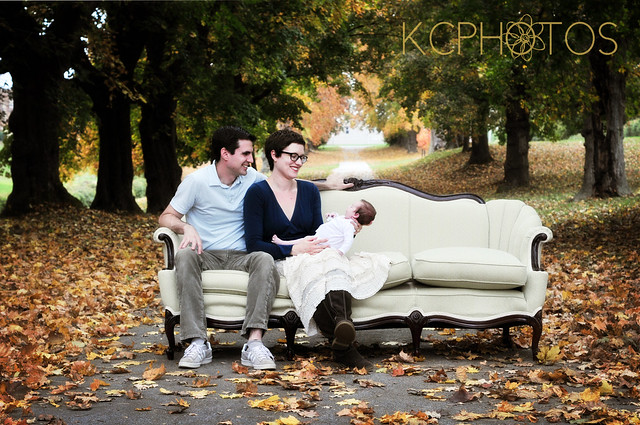
It was just over a year ago, and I had this farmhouse dream in mind. It was a dream about caring for an old house and a bit of land and welcoming lots of people around our table. In my mind, it looked like an antique sofa. The kind with a carved wood frame and pretty little legs. I don’t know why the dream looked that way to me, but it did.
But I was very sick that last winter in Florida. I spent every day in bed trying to breathe, trying to avoid the wicked, golden tree pollen wafting through the air.
Until the day, dear firstborn, when I couldn’t take your cabin-fever complaints, your boredom made manifest in bickering. I grabbed you and my inhaler and took off for some thrift-store therapy. I don’t think I ever felt so far away from my dream as I did then – struggling to breathe and desperate for escape. From pollen, from warm winters, from bickering children, from all of it.
We walked into the thrift store – headed for the twenty-five cent children’s books – and I saw it. My sofa. My farmhouse sofa.
But, we don’t have room for another couch, you said. You’re right, I said. We don’t have room in our Florida house, but I don’t think we’ll always be here. Dear God, tell me I won’t always be here. Desperate for breath. Dying to escape.
I bought that sofa. It sat in our Florida garage for a few weeks until I had enough faith to write the check. That’s when I googled upholsterers.
I chose the one with the coupon and the free in-person estimate. He loaded my sofa into his white van, and I went back to my sickbed. Not even a sofa in the garage to remind me of my dream.
Months went by, and there was no reason to think we’d be leaving Florida anytime soon. The sofa wasn’t ready when he said. Weeks went by, and I emailed. Soon! he wrote back. More weeks went by, and I emailed again. Very soon! he wrote.
I tried not to think about my farmhouse (but all I could think was where is it? And when will we go there?). I tried not to think about my sofa (but all I could think was where is it? And did I pick the right fabric?).
June 23. My birthday. 5 pm and there was a phone call. Your sofa is ready, and I’m in your neighborhood. Can I bring it by?
You and I, we don’t believe in the God of Parking Spaces. You and I, we can’t ever forget that starving child (which is as it should be).
But I know my own story, and I know God gave me a sofa for my thirty-fifth birthday.
Today, I am sitting at my desk in an old, old farmhouse. I can see my sofa from where I sit.
It was made for this house.
Which is as inconsequential as a parking space. And as miraculous as anything I know.
//
//
by Christie Purifoy | Feb 16, 2013 | Books, Religion, Scripture, Stories, Uncategorized
I like to think of myself as an adventurous reader. A curious reader. A willing-to-give-it-a-go reader.
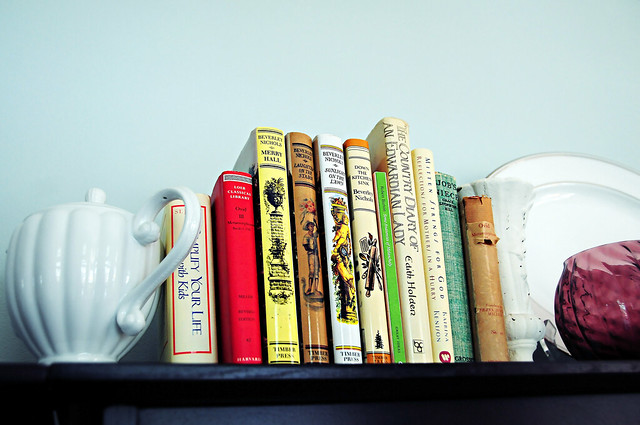
Truthfully, there are quite a few things that almost always trigger a “No, thanks,” from me. Almost always, that is. This Saturday, I bring you a few of those books I still don’t know why I read. But I’m so glad I did.
The descriptor ripped-from-the-headlines is a major stop sign for me. I can’t even watch Law and Order. I appreciate the headlines and the stories behind them (mostly via NPR). I love utterly fantastic, creative storytelling. I don’t like any mixing of the two.
In my view, the truth is generally more incredible than fantasy. Also, excellent fantasy is generally more truthful than reality.
Here’s the exception: Room: A Novel by Emma Donoghue. Actually, this book also defies another of my stop signs: never read a book in which terrible things happen to a child.
I wish I could remember why I ever picked up this book, but, heavens, am I glad I did. This is the story of a little boy who has never known anything but a single, small room. He is the child of a young woman who was kidnapped and is being held prisoner in a backyard shed.
I know I’ve already lost a few of you, but I hope you’ll stick with me. Truly, this is one of the most incredible novels I have ever read.
Because Donoghue tells her story from the little boy’s perspective, our overwhelming impression is one of wonder, never horror. The skill with which this child and his world are depicted simply boggles my mind. In fact, writing this, I am itching to read this one again. Just so I can figure out how she did it. Because what she has done is amazing.
This is a beautiful story. It will leave you in awe of the power of a mother’s love. It has an exciting, page-turning plot (will these two incredible people escape their imprisonment??). Finally, it has an emotionally satisfying ending.
Room breaks all my rules and does it beautifully.
Stories are a different kind of true. – Emma Donoghue in Room
Another of my rules? I don’t do literary adaptations. The sequal to Peter Pan? An update on Hamlet? Noooo! They can never equal the original, and they strike me as creatively lazy. Derivative. Come up with your own characters, why don’t you!
But, then I read The Flight of Gemma Hardy: A Novel (P.S.) by Margot Livesey. You could call this a retelling of Jane Eyre. Like me, you are probably thinking, “Why not just read Jane Eyre?” And, yes, if you haven’t, you should.
But thanks to Livesey, I think I now see the point of retellings, adaptations, and imaginative sequals and prequals. Art doesn’t exist in a vacuum. It creates echoes and other artists, in other places and other times, respond to those echoes. It is as if The Flight of Gemma Hardy is in conversation with Jane Eyre. It helps us to see the old classic with new eyes, and it is, in itself, a beautiful work of art.
Running, I soon realized, was the best way to stay ahead of fear. – Margot Livesey in The Flight of Gemma Hardy
One final no-go: gimmicks. I don’t like them. Also, anything that seems needlessly disrespectful towards the things I hold most dear. So, why I ever read The Year of Living Biblically: One Man’s Humble Quest to Follow the Bible as Literally as Possible by A. J. Jacobs is beyond me.
First, this book is hilarious and slightly gimmicky, but it is written with earnestness and humility. Jacobs really does want to understand the Bible and the many ways people profess to live it out, and he shares his growing wisdom with us.
In the end, this memoir is funny but it’s no joke. With curiosity and empathy, Jacobs encounters Biblical literalists from the Amish in Pennsylvania to Samaritans in Israel all while trying (and failing) to live the Bible as literally as possible. At the end of his experiment, Jacobs is humbler and wiser.
And so are we.
I’m still agnostic. But in the words of Elton Richards, I’m now a reverent agnostic. Which isn’t an oxymoron, I swear. I now believe that whether or not there’s a God, there is such a thing as sacredness. Life is sacred. The Sabbath can be a sacred day. Prayer can be a sacred ritual. There is something transcendent, beyond the everyday. It’s possible that humans created this sacredness ourselves, but that doesn’t take away from its power or importance. – A. J. Jacobs in The Year of Living Biblically
Find previous book recommendations here: week one, week two, week three, week four, week five, and week six.
by Christie Purifoy | Feb 12, 2013 | Church, Community, Faith, God, Home, Religion, rest, Uncategorized
We married young and hit the road. All we wanted was Texas dust in the rearview mirror. The rumble of the El was our siren song.
We weren’t afraid because we carried this around like a turtle shell: Church.
//

//
Baptist, Catholic, Greek Orthodox, Church of Christ … ours was a messy family stew that had finally deposited us both in a non-denominational box.
The box was what we knew. The box felt safe.
But boxes, it turns out, don’t travel well, and we were wanderers now. D.C., Chicago, Jacksonville, now this little country corner of the Philadelphia burbs.
Church has been a constant, but it’s been anything but safe. Anything but predictable. Not really a turtle shell, after all.
We thought there was one right way to do church. One right way to be the church. The way we were raised, of course.
But God kept us moving, and he kept our ideas about church moving, too. What had been small and safe became big and wild. Beautiful but unpredictable.
//
//
I’ve been thinking about those first Christians. They were “scattered” by persection, made wanderers for God’s own purposes. They wandered, and the church grew.
As we wandered, our understanding of church grew, too. Always bigger, always better than we knew.
//
I’ve sat in a Catholic mass and realized that the Eucharist might be more than the sum of its parts. Much more than the saltines and grape juice of my childhood.
I’ve stood in a gathering of Vineyard women when the doors of our meeting-place burst open with a loud wind. I watched that wind sweep around the room but I knew those doors didn’t open to the outside. What I saw and felt was no earthly wind but Pentacost miracle.
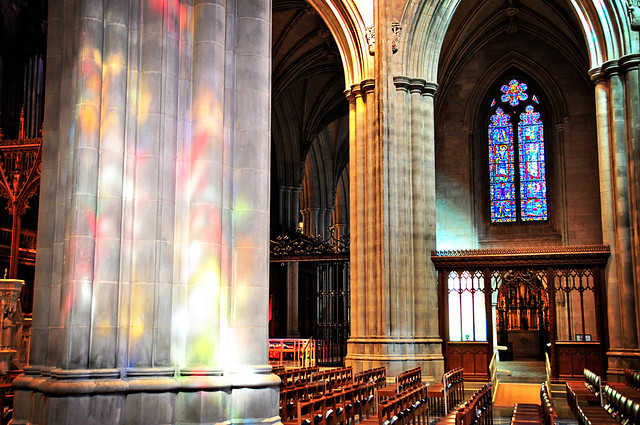
I’ve sat in an Easter morning service when the procession of colorful vestments and golden cross was so beautiful, so celebratory, I could have wept.
I once sat in an old wooden pew. A choir lifted its voice, and I suddenly knew what heaven sounds like.
I’ve seen adults baptized in Lake Michigan.
I’ve seen babies baptized with a cupful of water.
All of it so good.
//

//
Recently, we’ve taken to driving a long, long way to get to church. It’s something I’ve always said I’d never do. Join the imperfect neighborhood church, don’t go chasing “perfect” miles away. Perfect doesn’t exist.
But I don’t think I’m chasing perfect. I think I’m searching for home. The place where this wanderer can find rest.
Maybe this will be my church for a season. Maybe for a long, long time. Only my second Sunday there, and I was fretting about it instead of worshipping. I could hardly hear the music because I was listening to thoughts like these: Is this the place? Are we right to come so far? Will we make friends here? Or wil we set off searching, again?
The music finally broke through, and I realized what we were singing: Better is one day in your courts than thousands elsewhere.
I have been given so much more than one day. I’ve been given a lifetime of Sundays. A lifetime of small groups and youth groups. Of church retreats and coffee hours.
//
We pile the kids in the car and drive and drive. We do it because we need that soft brown bread. We need that sweet red wine.
We do it because one day in His courts really is that good.
by Christie Purifoy | Feb 9, 2013 | Books, Seasons, Uncategorized, Winter
Every winter I am surprised to remember that the return of the light is accompanied by the coldest weather. These days are snowier and chillier, but they are brighter, too.
Old, Pennsylvania farmhouses are known for their extra deep window sills. So, these days, instead of sitting in front of the fire, I am reading my book while perched on the sill of these floor-to-ceiling parlor windows. All the better to catch every ray of this golden, late-winter light.

Appropriately, I’ve been reading The Palace of the Snow Queen: Winter Travels in Lapland by Barbara Sjoholm. Part travel memoir, part history, this book is magical and intellectual.
Inspired by her childhood love of the Hans Christian Anderson fairytale, Sjohom helps us see the beauty of a world that is almost (but not quite) in total darkness. This book reminds us how special snow and ice can be. It also asks hard questions about the intersection of tourism and indigenous culture. We may share Sjoholm’s fascination with the Sami people, the reindeer herders of northern Norway, Sweden, and Finland, but we are not allowed to forget that they too live in the modern world. After all, some of them still herd reindeer, but they do it with helicopters and snowmobiles.
I was out of sight of the Icehotel now, far away on the snow-covered still-frozen river, sliding along on my simple kick sled, no desire to turn back yet, into the wide world, rejoicing. – The Palace of the Snow Queen
I like to think of myself as someone who collects seasonal children’s books. I imagine pulling out a basket of warm-weather themed books on midsummer’s eve and books about autumn and back-to-school in September. Truthfully, except for a few Easter titles, what I have actually accumulated is a collection of Christmas and winter books that is threatening to take over our house. (Winter! I love you, I hate you, and I am always and forever inspired by you. One of the saddest seasons of my life? The two years I spent reading Gingerbread Baby and It’s Snowing!
 in Florida.)
This December we added A Day On Skates by Hilda van Stockum, and I am in love. The kids are pretty happy, too.
First published in 1934, this is the (delightful! enchanting!) story of a Dutch ice-skating picnic.
I’m sorry, do I need to say more? Are you not already rushing out to buy this book? Because, truly, can you imagine anything more wonderful than spending your school-day skating frozen Dutch canals with your teacher and classmates while stopping occasionally for adventures and warm snacks?
Well, if you think you can, then I dare you to read this book. Van Stockum was a painter before she was a writer, and the full-color, full-page illustrations are … well, I don’t know what to say except this: I want to live in them! I want to wear wooden shoes, I want to join in a school-wide snowball fight, I want to see my twin brother rescued from beneath the ice, and I want, oh how I want, to eat Snow Pancakes.
In that small country called Holland, with its many canals and dykes, its low fields and quaint little villages, Father Frost went prowling round one January night, with his bag full of wonders. – A Day on Skates
Tell me there’s no need to go on?
Okay, I’ll say this one thing more: I may include amazon links for convenience, but this is where you should be discovering and buying children’s books. Yes, amazon is convenient. Yes, amazon will save you money. Yes, the big-box bookstores have a train table that keeps your three-year-old happy. However, they also have case after case of Disney-themed this and Wimpy Kid-that, and I can practically guarantee they do not carry works of art your children will always remember. No one ever wanted to live in a Captain Underpants book.
Since I’m already on this soapbox can I recommend one of the greatest short stories ever written (and, surely, it is the greatest short story featuring snow)?
The Dead by James Joyce (I own this edition: Dubliners: Text and Criticism; Revised Edition (Critical Library, Viking) ) concludes the stories collected as Dubliners. If you’ve tried to read Ulysses or Finnegan’s Wake and are afraid – don’t be. This is realist fiction at its finest: highly symbolic but readable. It is the story of a middle-class holiday party. It is the story of a marriage.
Like all of Joyce’s work, there are quite a few allusions to nineteenth-century Irish history and politics. Don’t worry about all that. Your job is to enjoy the party. Feel nervous with Gabriel as he prepares his toast. Indulge his self-important fantasies about a night away with his wife, and feel his shock and pain when he realizes how little he truly knows of life, and love, and death.
Most of all, your job is to read the final paragraphs aloud. Slowly. Quietly. Close the door, if you must, and listen to these words as they float, gently, on the air:
His soul swooned slowly as he heard the snow falling faintly through the universe and faintly falling, like the descent of their last end, upon all the living and the dead. – “The Dead”
Find earlier recommendations here: Week One, Week Two, Week Three, Week Four, and Week Five.
by Christie Purifoy | Feb 6, 2013 | Dreams, Faith, God, Seasons, Uncategorized
I’ve spent the past five years wondering, “Where will I be this time next year? What will I be doing? Where will I be living?”
I’ve been like a neglected houseplant, my leaves slowly curling. I had no roots.
Here at Maplehurst, we are in the freeze/thaw ugliness of midwinter, but I am fixated on the particular beauty of golden, late-afternoon winter light. I stretch toward the light and feel just how deep these roots can grow.
/

/
There are dreams planted everywhere here. Specific dreams about the vegetable garden and the blueberry bushes. Vague dreams about community and hospitality.
How did I get to this place? This place called Home? This place where dreams are realized?
I have no formulas to offer you. No guarantees. I suppose there are no shortcuts. All I have is this one thing: when I look back I see all the dreams we let go.
It turns out knowing when to let go of a dream is a necessary part of the dreaming life.
/
Jonathan and I fell in love at an inconveniently young age. He had always planned to attend medical school. He gave up that dream so we could marry. So I could earn a PhD.
We dreamed of moving overseas. We imagined living in Scotland or Ireland. We let the dream go and moved to Chicago. Spent two weeks hiking Ireland’s west coast, instead.
We dreamed of moving closer to family. Maybe a farmhouse in the Midwest? Close to grandparents in Kansas, not too far from grandparents in Texas. Instead, we moved to Pennsylvania.
/
When I tell you that my dreams are coming true, I do not mean I saw this life in advance. What I mean is this: life unfolds and something deep within us says, “Yes. This. Yes.”
A dream-come-true is a thing both surprising and deeply familiar.
It is the future you were made for before you even knew enough about yourself to dream it.
/
I have these words starred and underlined in my Bible, “May he give you the desire of your heart” (Psalm 20:4). One day I read those words, and it felt as if I’d tipped my head beneath a stream of warm water. That warm-water-feeling was real enough that I wrote the date, too. The ink is a bit smudged, but I can still read this: “So I pray / 12-14-2008.”
I didn’t write anything else, because, at that time, I had nothing else to write. I had no dreams. I had no desires. I couldn’t picture the future at all.
Now I know the most incredible thing. God not only gives us the desire of our hearts, he plants it there too.
He gives us the dream. He gives us the desire. He makes it come true.
And our hearts say, “Yes.”
