by Christie Purifoy | Nov 12, 2015 | allergies, children, Deeper Story, Family, Food, healing, Stories, Uncategorized
I shared a special photograph on facebook this week.
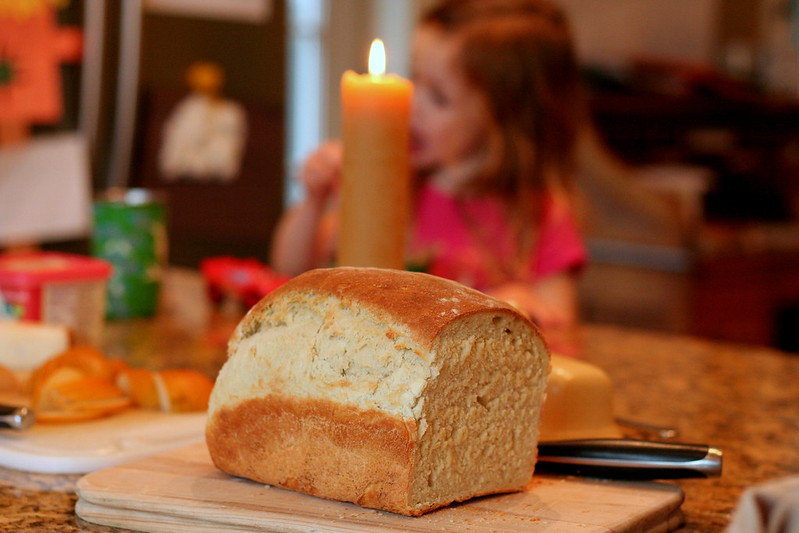
My son, a small smile, and a slice of warm, wheat bread.
After nine years with no bread or pizza crust, no pasta or ice cream cones, our boy successfully completed a food challenge for wheat at the children’s hospital.
No more allergy.
I started baking bread the very next day.
There are other allergies. More severe allergies. There will be more food challenges. But this is something new. Something wonderful.
Something delicious.
***
I once wrote about my son and his allergies for the website Deeper Story. It’s one of my favorite things.
I’m sharing it again, and on my own website, because the truth I was trying to discover then feels even more important now as we navigate this change.
We haven’t arrived at the end of this story, but we have begun a new chapter.
The full story remains complicated. A little bit beyond my grasp. I am comforted to remember that the very best stories are never the easy ones. Not the easy ones to tell. Not the easy ones to hear. Certainly not the easy ones to live.
Here is that old, still continuing, story.
***
“Finally, the lessons of impermanence taught me this: loss constitutes an odd kind of fullness; despair empties out into an unquenchable appetite for life.”
– Gretel Ehrlich, The Solace of Open Spaces
I know two ways to tell this story.
The first way follows a trail of brokenness. Like a mountain path marked by rubble.
I don’t like to tell it this way. It feels so negative, even somehow un-Christian. But I do sometimes tell it like this, especially when you ask me directly about my son’s food allergies.
The twin themes of this story are loss and fear.
This is the story of eight years with no bread or pizza. No ice cream or cheese. No peanut butter-and-jelly, no granola bars. No yogurt. No mac-and-cheese or fish fingers or chicken nuggets. No birthday cake at the parties of his friends.
This is a story about epi-pens and calls to 911 and too many visits to the E.R.
I might leave out the details of that one mother-son date when I forgot the epi-pen. No happy ending (in this case, a stranger with a pediatric epi-pen in her purse) can erase the horror of five minutes spent listening to death rattle in your little boy’s throat and knowing it is entirely your fault.
The central episode of this first story might be the year my son spent eating lunch alone at a table on the stage of the school cafeteria. The only kid in the “nut-free” zone.
***
The second version of the story is more positive. You might call it pie-in-the-sky. Or, possibly, head-in-the-sand.
I’m not sure the story told this way is any closer to the truth, but it is easier to tell and easier to hear.
Highlights of this story include the gluten-free bakery only ten minutes from our small Pennsylvania town. They make pizza crusts and hamburger buns and even cupcakes without wheat or dairy or nuts. The pizza crusts are a little sad, but I will leave that part out.
This second story will make your mouth water. I will tell you about our special fried chicken and meatballs made without bread crumbs. I will tell you about a little concoction we call “pizza rice.” I will tell you how much my son adores his seaweed snacks. I will tempt you with my recipe for pumpkin bars.
***
Neither story gets it right. Neither one touches the heart of our experience these eight years. The first points out all that is missing. All that is twisted and wrong. The second tries to distract you from the brokenness with a pile of deliciousness.
Both versions leave me hungry for the truth.
I think the true story follows a third way. As so many of the best stories do.
I’ve been feeling out the contours of this other way for years, as if searching for a secret place. The place where loss is still loss but is also, somehow, gain. The place where grief remains grief but where it is also the color of joy.
How do you tell a story built on contradictions?
I can’t send my son to summer camp, but my son lacks no good thing.
I pray every day that my son will be healed, but I believe the answer I’ve long been given: he is already healed.
Our family table is ringed round with fear and loss. Death and sickness. We never sit down to eat without noticing those shadows at our feet. And yet the food we eat at this table is good. Each bite tastes like a gift.
How can I ever account for the wonder of a table prepared in the presence of my enemies?
***
When my son tells the story of his old school, he tells it like this:
“Mom, remember when I ate lunch on the stage in the cafeteria?”
“Yes,” I say. “How could I forget.”
“I was all by myself. It was like eating on top of a mountain! It was so quiet there.”
Watching him tell his story, I see a far-off gaze. I see something around his mouth. It is like the memory of a smile.
As if he’s glimpsed some other, hidden world. Some truer place.
by Christie Purifoy | Nov 3, 2015 | Autumn, Books, Family, Food, Grateful, Life Right Now, Uncategorized
Has turned a corner and is picking up speed.
The trees are racing to drop their leaves. Everything is sunset colored. Only the evergreen trees stand still and unchangeable. They do not rush about seizing the day.
I do rush about but mostly regret that by nightfall. Strange, how all the hurry never seems to amount to much other than a headache.
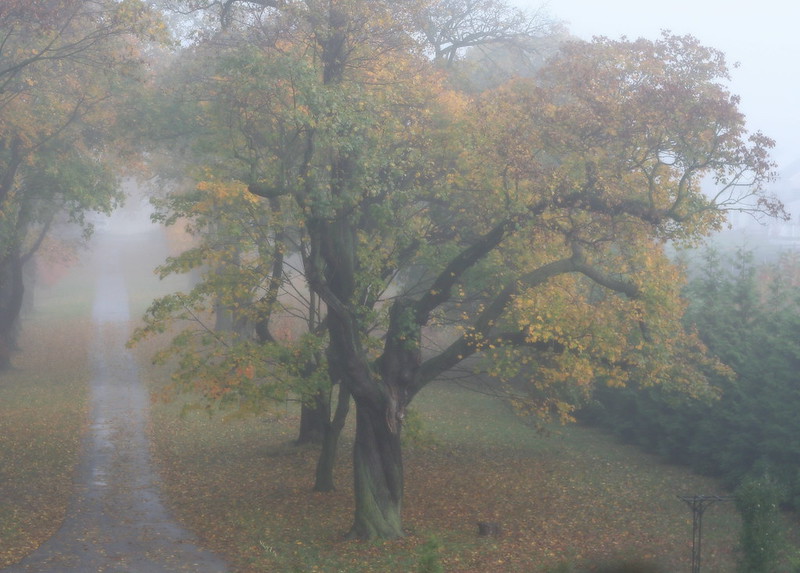
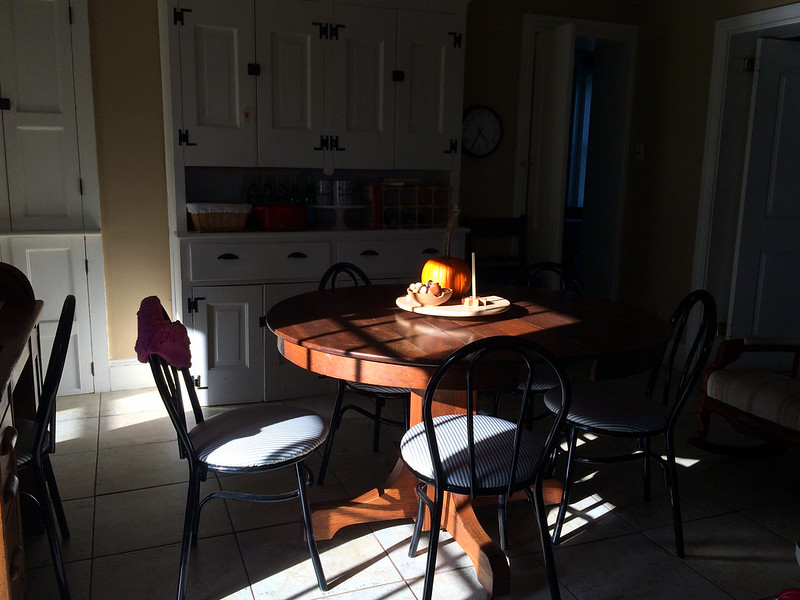
Now the days end in sudden darkness. We light a candle every night at dinner. We read Thoughts to Make Your Heart Sing, and we eat pumpkin chili or an orange lentil curry.
I ordered a stack of new fiction from my library before realizing I am really only in the mood for gardening books. Like this one. Or this one.
My good friend Amy served me this tea recently. I do not exaggerate when I say that the taste is astonishing. It’s a cup of tea even a coffee drinker would love. A steaming cup is a very good antidote to hurry.
Tell me, what’s slowing you down these days? It may be lovely (like tea), it may be awful (like autumn allergies or the way young children pay no attention to the new time on the clock), but I hope that, together, we can say thank you.
For this dark month is for saying thank you.
I am grateful to be sharing my words in new places. Today, I am at The Laundry Moms writing about motherhood and calling. You can read it here.
Have you read Wild in the Hollow , the beautiful new book by Amber Haines? I recently shared a few words about church for her “Wild in the Hollow” blog series. You can read them here.
by Christie Purifoy | Oct 30, 2015 | Autumn, children, Community, Faith, motherhood, Religion
I wrote these words exactly one year ago. Today, we will carve pumpkins, adjust costumes, and pull the old decorations from the basement. The boys made a scarecrow last week, but he still needs a pumpkin head.
The kids are so much taller, and Elsa is old enough now to refuse the costume we chose for her. But so much is the same. These words are still true.
*
My friend looks up toward the trees and says I had forgotten how graceful dying can sometimes be.
I follow her glance and know that she is right. I, too, have forgotten. I remember autumn through snapshots. Which means, I remember the brilliance of that one sugar maple down the road. Or, I remember the startling red of a Burning Bush shrub against a deep blue sky.
The snapshots help me to remember true moments, fiery moments, but they do not give an accurate picture of the whole.
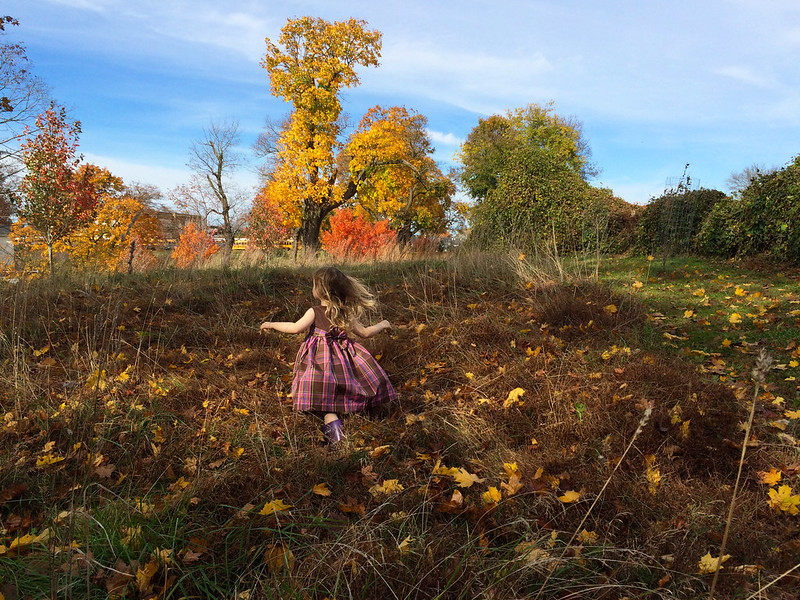
Autumn, taken as a whole, does not look like clear, bright brilliance. Here in my corner of Pennsylvania, it is gentle. Faded. It is burnished gold and copper. It is gray clouds and wet pavement.
This autumn world does not rage against the dying of the light. It smolders, quietly.
Gracefully.
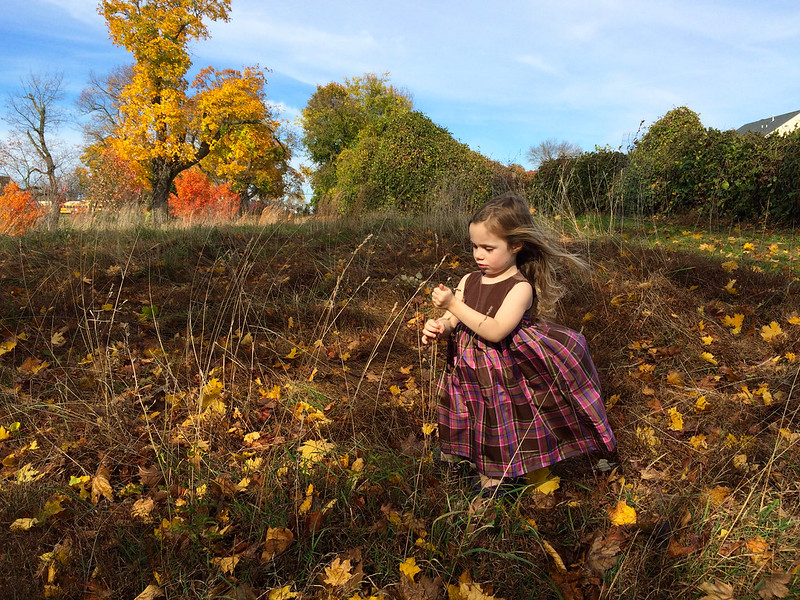
Christians like to talk about Halloween on the internet. I have usually abstained from those “conversations.” So much depends upon context. Like the context of our own memories. Like the context of our own communities. Often, the internet is a conversation without a context.
Here is a bit of mine. In the church of my childhood, Halloween was ever-so-slightly taboo. We wore costumes, but we wore them to collect candy at our church’s “Harvest Fair.”
As new parents, we discovered the great adventure of escorting a temperamental two-year-old ladybug down city streets. We stole her candy when she wasn’t watching, and we hugged our neighbors. We tried to catch the eye of their over-tired Dorothy or Scarecrow. To tell each one we had no idea it was them.
Still, decorating my home for Halloween always seemed like a step too far. Until we came here. Now we live in the farmhouse on the hill and how else can we entice our neighbors and their children to climb our hill, to receive our gift of love and candy, but with a few smiling ghosts and candle-lit pumpkins?
Context. It changes things. Changes us.
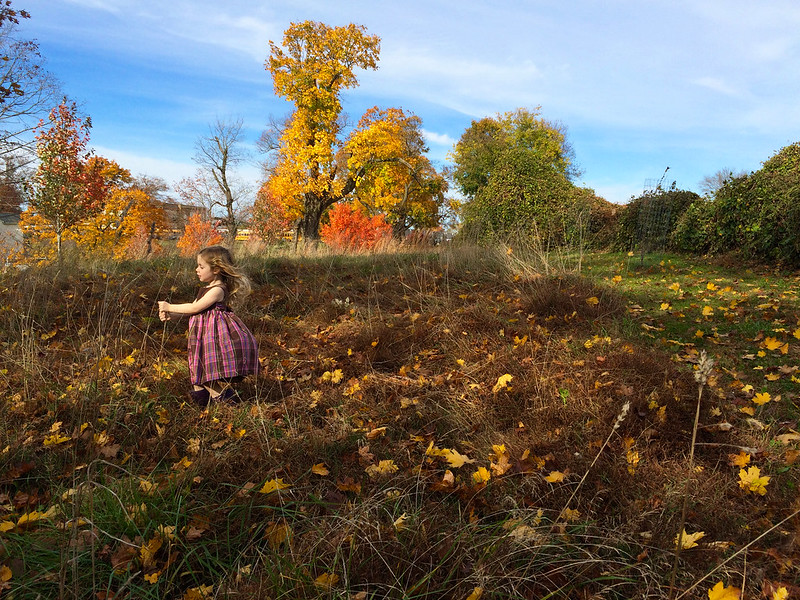
We live in a culture that largely ignores death.
Our children no longer walk to church through churchyards dotted with graves. Our own church is that rare thing with its own cemetery, but it is all the way around by the back door. My children often ask to walk that way, but I am in a hurry. Another time, I say, as I rush them through the front door.
I am sorry for this. And so, this year, I am grateful for Halloween. I am grateful for the space it opens up. I am less grateful for the gory zombie poster set at a child’s eye level at the local Wal Mart, but mostly I am grateful for the opportunity to talk about death. About dying. About our baptism and what it might mean that we have already died with Christ.
Which is, to say, we will have a conversation about living.
Soon, we will bring out the plywood grave markers my husband made last year. Our kids painted them gray with black crosses and the letters R I P. We will tuck them near the crumbling stone foundations of the old farm buildings, and we will drape them with twinkly lights.
As we outline a path for candy-seeking neighbors, my daughter will ask me again about those letters R I P. And as darkness settles, and the lights begin to flicker and gain strength, she will tell me, It’s beautiful.
So beautiful.
by Christie Purifoy | Oct 23, 2015 | Autumn, Faith, God, grief, Joy, Pennsylvania, Scripture, Seasons, Uncategorized
It was the time between the lights when colours undergo their intensification and purples and golds burn in window-panes like the beat of an excitable heart; when for some reason the beauty of the world … which is so soon to perish, has two edges, one of laughter, one of anguish, cutting the heart asunder. – Virginia Woolf, A Room of One’s Own
It is October. Blog posts should come easily right now. Beauty upon beauty spins gently from the maple trees. The world is polished to a coppery shine. Yet I have felt anxious. Tongue-tied.
Virginia Woolf was right about the beauty that is particular to October days. Yes, there is laughter (children diving into piles of leaves, Jonathan and I planting daffodil bulbs together), but there is anguish, too.
For weeks now I have been trying to understand why the beauty of October makes me sad. Has it always been this way? Is it more pronounced this year?
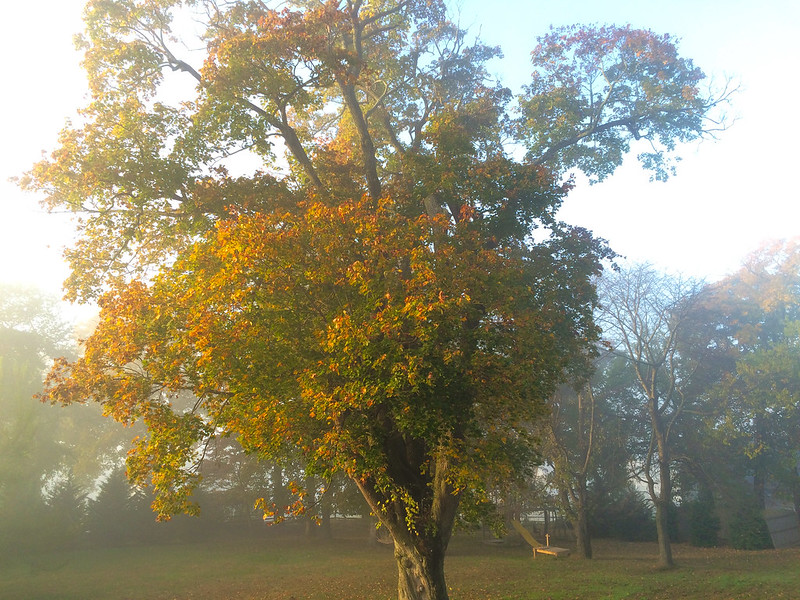
Last spring, I wrote about the beauty of the golden hour. Here at Maplehurst, the whole month of October is golden. There is the glow of all these maple trees, but it is more than that. The light itself has changed. It is rich and thick, like caramel sauce. Or melted butter. Now, even the blue sky has a golden tint.
What is the golden hour? What is this golden, October light?
It is good news from a far country (Proverbs 25:25).
But that country is not yet our possession. It remains just out of reach. During October, it draws near, but it will not stay for long. I never can forget that all these trees will soon be bare.
Perhaps one way we follow in the footsteps of a wounded redeemer is when we do not look away. When we refuse the numbness and distraction of our cellphone or our television show or whatever it is that is so much less beautiful and so much easier to behold.
It isn’t easy to live our lives against the backdrop of rich, ringing gold. The rift between October’s beautiful song and our own tempers and headaches and worries is too great. It would be easier not to look. Not to see.
In October, I understand that I live most of my days with a veil over my eyes.
Will we ever be bold enough to lift our heads towards an October sky and “with unveiled faces contemplate the Lord’s glory?” (2 Cor 3:18).
The cost is anguish, but the prize is laughter.
by Christie Purifoy | Oct 6, 2015 | Books, guest post, Uncategorized
My friend Erika Morrison is an unconventional soul. But hers isn’t the sort of uniqueness to make the rest of us feel dull.
Rather, she has that special knack for helping everyone around her to wake up and be more themselves.
Her new book Bandersnatch: An Invitation to Explore Your Unconventional Soul is out today. I am so pleased to host Erika in this space as she tells us more about it.

The cardinals make it look so easy. The honeybees make it look so easy. The catfish and the black crow, the dairy cow and the cactus plant, all make being created appear effortless. They arise from the earth, do their beautiful, exclusive thing and die having fulfilled their fate.
None of nature seems to struggle to know who they are or what to do with themselves.
But humanity is the exception to nature’s rule because we’re individualized within our breed. We’re told by our mamas and mentors that–like snowflakes–no two of us are the same and that we each have a special purpose and part to play within the great Body of God.
(If your mama never told you this, consider yourself informed: YOU–your original cells and skin-print, guts and ingenuity–will never ever incarnate again. Do you believe it?)
So we struggle and seek and bald our knees asking variations of discovery-type questions (Who am I? Why am I here?) and if we’re semi-smart and moderately equipped we pay attention just enough to wake up piecemeal over years to the knowledge of our vital, indigenous selves.
And yet . . . even for all our wrestling and wondering, there are certain, abundant factors stacked against our waking up. We feel and fight the low ceiling of manmade definitions, systems and institutions; we fight status quo, culture conformity, herd mentalities and more often than not,
The original shimmering self gets buried so deep that most of us end up hardly living out of it at all. Instead we live out of all our other selves, which we are constantly putting on and taking off like coats and hats against the world’s weather. ~Frederick Buechner
So, let me ask you. Do you know something–anything–of your true, original, shimmering self?
I don’t mean: Coffee Drinker, Jesus Lover, Crossfitter, Writer, Wife, Mama. Those are your interests and investments.
I do mean: Who are you undressed and naked of the things that tell you who you are?
Who are you before you became a Jesus lover or mother or husband?
Who are you without your church, your hobbies, your performances and projects?
I’m not talking about your confidence in saying, “I am a child of God,” either.
What I am asking a quarter-dozen different ways is this: within the framework of being a child of God, what part of God do you represent? Do you know where you begin and where you end? Do you know the here-to-here of your uniqueness? Do you know, as John Duns Scotus puts it, your unusual, individual “thisness”?
I can’t resolve this question for you, I can only ask you if you’re interested. (Are you interested?)
I can only tell you that it is a good and right investment to spend the energy and time to learn who you are with nothing barnacled to your body, to learn what it is you bleed.
Because you were enough on the day of your birth when you came to us stripped and slippery and squeezing absolutely nothing but your God-given glow. And who you were on that born-day is also who you are now, but since you’ve been living on this planet long enough to learn how to read this article, then it follows that you’ve also lived here long enough to collect a few layers of horsefeathers and hogwash.
So, yet again, I’m inquiring: What is it that you see before the full-length bathroom mirror after you’ve divested of clothes and masks and hats and accessories and roles and beliefs and missions and persuaders and pressures– until you’re down to just your peeled nature, minus all the add-ons mixed in with your molecules?
Do you see somebody who was made with passion, on purpose, in earnest; fearfully and wonderfully, by a Maker with a brow bent in the center, two careful hands, a stitching kit and divine kiss?
Can you catch between your fingers even the tiniest fragment of self-knowledge, roll it around and put a word to it?
Your identity is a living organism and literally wishes to unfurl and spread from your center and who will care and who will lecture if you wander around a little bit every day to look for the unique shine of your own soul?
One of the central endeavors of the human experience is to consciously discover the intimacies of who we already are. As in: life is not about building an alternate name for ourselves; it’s about discovering the name we already have.
Will you, _______, rise from your own sacred ash?
Because the rest of us cannot afford to lose the length of your limbs or the cadence of your light or the rhythm of your ideas or the harmony of your creative force. The way you sway and smile, the awkward this and that and the other thing you do.
These are the days for opening our two clumsy hands before the wideness of life and the allure of a God who stops and starts our hearts. These are the days for rubbing our two imperfect sticks together so we can kindle another feeble, holy light from the deep within–each of us alone and also for each other.
There is no resolution to this quest; the only destination is the process. But I hope there’s a small spark here that will leave you wanting, that will leave you with a blue-fire lined in your spine, that will inspire a cellular, metamorphic process in you; an odyssey of the soul unique to you and your individual history, organisms, and experiences.
There is maybe a fine line between being lethargic about learning ourselves and not being self-obsessive and with that tension in mind, how do we begin (or continue) the process of unearthing and remembering the truth of our intrinsic selves?
Bandersnatch: An Invitation to Explore Your Unconventional Soul was written because sometimes we all need a little hand-holding and butt-nudging in our process; someone or something to come alongside us while we pick up our threads of soul discovery and travel from one dot and tittle to the next.
We are the Kingdom people and learning your own fingerprint is something of what it means for the Kingdom to come in response to an earth which groans forth it’s rolling desire for the great interlocking circle of contribution to reveal the luminous and loving Body of Christ and slowly, seriously–like it’s our destiny–set the world to rights.
Kingdom come. Which is to say: YOU, [be]come and carve your glorious, powerful, heaven-appointed meaning into the sides of rocks and communities and cities and skies.
Without being formulaic and without offering one-size-fits-all “how-to” steps, Bandersnatch is support material for your soul odyssey; a kind of field guide designed to come alongside the moment of your unfurling.
Come with me? And I will go with you and if you’re interested, you can order wherever books or ebooks are sold.
Or, if you’d like to read the first three chapters and just see if Bandersnatch is something for such a time as the hour you’re in, click HERE.
All my love,
Erika Morrison

