by Christie Purifoy | Dec 8, 2015 | Advent, children, Jesus, peace, Uncategorized
On Friday night, we sat in a high school auditorium beneath the flutter of paper doves and peace signs dangling on strings. The theme of my children’s annual holiday show was peace on earth.
There were musical performances from around the world. I was glad the first-graders were assigned the United States, though somehow my little boy and I still managed to clash over which sweater and which pair of blue jeans he would wear.
There was a video tribute to the victims in Paris. Then the head of school remembered the even more recent tragedy in California. While hundreds of childish voices swelled in song, I thought, Maybe we should recall the politicians and put the schoolkids in charge?
On the drive home, a small voice piped up from the backseat, “What happened in California?”
/

/
On Saturday morning, I dragged a bag of garbage out toward the shed. The air was frosted pink and blue, and each blade of grass was edged in white. Halfway across the lawn I stumbled over some contraption hammered together with scrap wood and nails. Shifting it with my foot, I recognized a military gun. My boys had been fighting imaginary battles again.
I don’t know what that kind of weapon is called, but my nine-year-old son could tell you. He reads a lot of history. He knows a great deal about war.
/
On Sunday, we lit the second Advent candle, the candle of peace. Or, we tried to. An argument broke out between my younger son on one side of the table and my firstborn girl on the other. As quickly as he lit the candle, she blew it out. Light the candle. Blow it out.
“It’s not your turn,” someone hissed.
/
That same Sunday morning, I had read an article in the newspaper about the band U2. They were preparing to perform the Paris concerts that had been cancelled in the immediate wake of the attacks. Their stage show features the sounds of a car bomb, recalling the violence that Bono and his band knew as adolescents in Ireland.
Bono said, “Peace is the opposite of dreaming. It’s built slowly and surely through brutal compromises and tiny victories that you don’t even see. It’s a messy business bringing peace into the world. But it can be done, I’m sure of that.”
/
Peter had a sword. We have car bombs and semi-automatic guns. As humanity creates deadlier and deadlier weapons, turning the other cheek begins to look more and more ridiculous.
Jesus said, “Blessed are the peacemakers, for they will be called children of God.”
Perhaps that’s the root of our problem. We don’t want to be children.
We want to be heroes.
/
My nine-year-old son and I are a lot alike. We both love history. We are both dreamers. We both need a better story.
He needs to hear that laying down your life requires more bravery than defending it. I need to hear that peace is possible.
That it is even possible in my own home.
by Christie Purifoy | Dec 5, 2015 | Advent, Books, children, Family, Grace Table, Stories, Uncategorized, Winter
The weather here in our corner of Pennsylvania is soggy rather than snowy, but our stack of Christmas books is helping to set the mood.
If you’re looking to start your own collection, or maybe writing a list for the library, here are a few of our favorites.
(this post contains affiliate links)
Christmas Day in the Morning by Pearl Buck is a beautiful picture-book edition of a classic.
Buck, who won both the Nobel and the Pulitzer, originally published this story in 1955. It’s a very simple story of an adolescent boy’s gift to his hardworking, farmer father on Christmas Day. Even my young children are inspired by this story, but it’s a tale that gets better and means more the older you are.
Little One, We Knew You’d Come by Sally Lloyd-Jones appears to be out of print, but it is really worth seeking out. This one may be my favorite Christmas book.
The illustrations tell a straightforward story about the birth of Christ (though their beauty is anything but typical or generic), but it’s the sweetness and lyricism of the text that makes this story something bigger and more beautiful than it first appears to be.
Little one, we knew you’d come. We hoped. We dreamed. We watched for you.
It can be hard for us to fully grasp the longing of creation for Christ or even to understand what it means to long for our King’s return during this Advent season, but many of us know what it is to long for a baby. The words of this book tell that story so many of us know intimately, that story of “our miracle child, our dreams come true.”
This book makes the perfect gift for new moms, or anyone familiar with the special love we have for a long-anticipated child, no matter the time of year.
This Advent the kids and I are reading a new book at bedtime. It’s The Christmas Mystery by Jostein Gaarder, the philosopher and writer of Sophie’s World (a novel I remember loving in college).
Translated from the Norwegian, this is a strange but wonderful tale within a tale about a magic Advent calendar and an odd pilgrimage back through history to the Bethlehem of Christ’s birth. The story is divided up according to the twenty-four windows of an Advent calendar so it’s ideal for nightly reading.
My paperback copy is high quality and lovely to look at, but there are quite a few typos and a handful of places where the translation seems a little awkward. Still, as a read-aloud capable of keeping the attention of a six, nine, and twelve-year-old at Christmastime, it seems just about perfect.
It isn’t a devotional book, and yet Gaarder’s philosophical observations (quite a few spoken by the “wise man” Caspar) have given even me a few mysteries to ponder. We haven’t finished it yet, so I can’t vouch for where the whole narrative is heading, but I do know we are headed to Bethlehem. I’m eager to discover what Gaarder has in store for us there.
If you only have time for a short Advent read this morning, may I suggest my latest post at Grace Table? Titled “The Irrational Hospitality of Advent,” you can find it right here.
Peace be with you, friends.
by Christie Purifoy | Dec 2, 2015 | Advent, Christmas, Gardening, Uncategorized
I wrote a version of this post last year for the website Deeper Story. It feels even more true this year.
/
I am standing in the yard with a rake in my hands when I feel the circle of the year begin to tie itself up with a neatly finished knot.
Since moving to this old farmhouse on the hill, my late November chores are always the same. Chopping up the great drifts of fallen maple leaves with the mower. Cleaning out the brittle tomato vines and the slimy, still-green nasturtiums from the vegetable garden. Covering each raised bed with a winter blanket of chopped leaves.
I tear the blackened cords of morning glory and moonflower from the porch, scattering the seeds of next summer’s flowers in the process. Our compost bins overflow.
I circle the fruit trees in our tiny orchard with deer fencing. I mound the roses with wood chips.
The year is dying. The trees and shrubs prepare to sleep. And every wheelbarrow load of mulch underscores the end of our year’s work.
/
/
My friend and I meet each week in the local, big-chain coffee shop. December was still weeks away when I walked in to find that our familiar corner table now sat beneath dangling paper bells. And was it snowing in there? I am sure it was snowing glitter.
It felt so deeply wrong but also festive, and I wondered if I had become a thirty-seven-year-old curmudgeon.
I’m not the bah-humbug type. I don’t begrudge anyone their seasonal fun. But it was clear to me, sitting in a coffee shop that shone like red tin foil, that my heart, mind, and soul were tuned to some other rhythm.
It was still November, and I was not ready for Christmas feasting. The old, dying year hadn’t yet been laid to rest.
/
“Do not conform to the pattern of this world …”
I’ve known those words since childhood. But I think that it is only now, having watched the year circle this hilltop a few times, that I feel the rift, small but growing, that lies between me and long familiar patterns.
It turns out there is a difference between the earth and the world. One is a circle, a globe if you will, shaped by the shifting tides of work and rest. The other is also a circle, but it is more like a hamster’s wheel jangling away beneath twenty-four-hour floodlights.
I am increasingly out of sync with the world. I am longing to inherit the earth.
/
/
December blows in on a polar wind. We mark this month’s progress with a circle of candles. Sunday after Sunday there is more light by which to see.
What I see, from the top of this hill, is an earth gone to sleep. While the world spins itself out in dizzy circles of consumption, the earth recognizes that its work is done. New things, like new years, begin with sleep (which is to say, surrender), and winter is a season for rest.
I like to think that this is what it looks like to store up treasure in heaven. The trees know they need only wait. A few more months, and heaven will return every good thing we have lost. That is the meaning of spring.
The world knows little of Advent and will be, I fear, all worn out by the evening of December 25. The traditional twelve days are too many when the feast began in mid-November.
But the earth has one sermon that has never lost its power.
When spring returns, even the weary world rejoices.
by Christie Purifoy | Nov 28, 2015 | Advent, Books, Christmas, Uncategorized, Winter
Books are a year-round pleasure in this house.
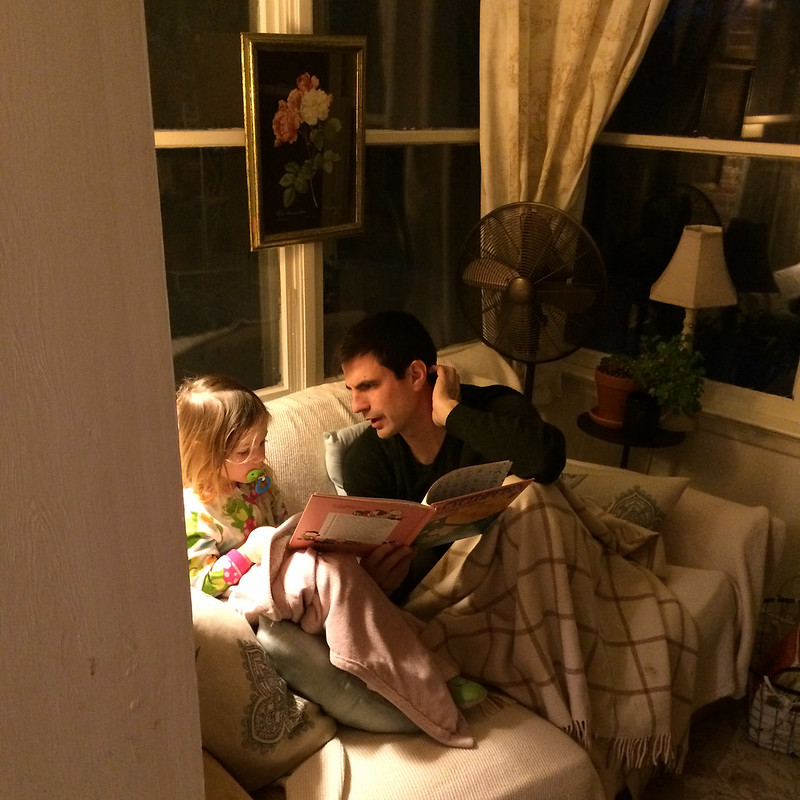
I always have a bedside pile (okay, tower) of books I am currently reading, and I read aloud to my children (yes, even my twelve-year-old) nearly every day. But something happens to my book love when we feed the last of the porch pumpkins to the chickens and go in search of our Advent wreath.
It becomes an obsession.
Perhaps it’s the early darkness and cold and all those hours to fill indoors. Perhaps it’s the discipline of Advent observance. Perhaps it’s the anticipation of Christmas. Maybe it’s because I am buying so many books to give as gifts. Or, maybe it is for every one of these reasons.
However I account for it, our December days are marked by the turning of pages.
*
*
During Advent, my reading takes on a heightened focus. I don’t read anything “just because.” For instance, this is the month when I reread Winter Solstice by Rosamunde Pilcher.
I think of this novel, set in snowy Scotland in the days leading up to Christmas, as my version of those sentimental holiday movies so many enjoy this time of year. It’s a great, warm, afghan of a novel, but it’s made of high-quality Scottish wool. Nothing cheap or slap-dash here. Pilcher’s story is full of love and sentiment but never sentimental. I am always so glad to pick it up again.
*
One of our favorite recent read-alouds would make a great stocking stuffer (it really is just the right size! and price!). It’s The Children of Noisy Village by Astrid Lindgren, of Pippi Longstocking fame.
I bought this book after enjoying her picture book Christmas in Noisy Village (Picture Puffin) for years. The Children of Noisy Village features the same children but describes their activities not only at Christmas but all through the year on a traditional Swedish farm. It’s a chapter book, but the chapters are brief. It’s pretty much an ideal bedtime read.
I think anything Scandinavian is perfect for the Christmas season, but I am recommending this book because my two sons, one a reluctant reader and the other a reluctant reader and reluctant listener, both adored it. The storytelling is simple and so true to childhood. It’s all about food and games, special celebrations and traditions, childish friendships and milestones as momentous as being given the responsibility for shopping at the village store entirely on your own.
We finished the book weeks ago, but when my nine-year-old quoted one of the lines from the book last night at dinner, the boys and I were practically rolling on the floor with laughter.
*
I love to read through a daily Advent book and usually alternate between Watch for the Light: Readings for Advent and Christmas and God With Us: Rediscovering the Meaning of Christmas (Readers Edition). But there are so many wonderful, possibilities for a daily devotion. This would be the perfect time of year to begin one of my favorite books, Madeleine L’Engle’s The Irrational Season (The Crosswicks Journal, Book 3)
 .
.
The Jesus Storybook Bible: Every Story Whispers His Name has exactly twenty-four stories from Old Testament beginning to the birth of Jesus and makes ideal Advent reading with small children. I have also enjoyed Ann Voskamp’s beautifully illustrated Advent devotional Unwrapping the Greatest Gift: A Family Celebration of Christmas
 with my older kids.
*
I know that for many, December begins with a Christmas tree. We won’t cut down our tree for a few weeks yet, but our anticipation begins when I pull out our collection of Christmas storybooks. I’ll gather those books from a shelf in the third floor-closet on Sunday afternoon (something that will require at least four trips up and down those narrow, old stairs) and tell you about a few of them next Saturday.
If you have small children or grandchildren, Advent is the perfect time of year to begin a Christmas picture book collection. I’ve included amazon affiliate links in this post, but one of my favorite sources for beautiful, meaningful holiday books is Chinaberry.
When my kids were small, I began buying two or three Christmas books each year (I found many of them at our local thrift store) and that collection is now my very favorite thing to pull out each year. Better even than the familiar tree ornaments made with macaroni and glitter.
*
Farmer Boy, by Laura Ingalls Wilder, is one of our favorite family books no matter the season. Over the summer, our family visited the original Wilder homestead in Malone, NY. I recently wrote about that visit (and so much more) for Art House America. You can read all about my harvest of memory right here.
by Christie Purifoy | Nov 19, 2015 | children, Desire, Family, God's promises, Home, hospitality, Jesus, Roots and Sky, Uncategorized
I didn’t plan to talk to my children about terrorism or the Syrian refugees, but my children are older now and I have less control. Sometimes, I thank God I have less control.
When my daughter said her school had held a moment of silence to remember or pray for Paris, my older son asked why.
I spoke a few words about the terrorists and those who died at their hands. I mentioned the millions of children who have lost their homes and are searching for new ones.
My younger son interrupted us, impatient and eager to clear away this heavy conversation.
Sweeping his arm toward the rest of our house, he asked, “Why can’t they just stay here?”
We only stared at him.
For a moment, it was completely silent in my kitchen.
*
I wrote Roots and Sky because I wanted to explore questions I had been asking for years. I wrote it because I knew I wasn’t the only one asking them.
Why do I feel such longing for a home?
Is that desire a distraction from my commitment to follow the One who had no place to lay his head?
Is it even possible to feel at home this side of heaven?
As I wrote, I discovered the answer to this last question is yes.
*
With all the recent talk of immigrants and refugees, I have had a few terrible words lodged in my mind.
Go home! Go back to where you came from!
That has been the taunt for generations, hasn’t it? I imagine a few of my own ancestors may have heard it. Perhaps a few of yours, too.
But today, in my imagination, I hear a refugee voice crying, If only, if only, if only I could.
*
As I wrote my book, I encountered my own refugee roots.
In the beginning, our spiritual father and mother called paradise home. That home slipped from their grasp and there was no going back. Whether we call that ancient story myth or history or wisdom poetry, we all know the shadow of that loss.
Soon we will celebrate the good news that while we still wandered, heaven came to us. God’s message of peace and goodwill to all men was once a refugee baby in Egypt. The message wasn’t some spiritual abstraction. It was flesh and blood. Mary sheltered good news in her arms.
The story of Roots and Sky is the story of Jesus’s promise to come to us and make his home with us (John 14:23). In my life, that promise has been fulfilled in the old bricks and crumbling plaster of a farmhouse called Maplehurst. If his banner over us is love, my own particular banner is three stories high and a bit ragged around the edges.
No wonder my heart breaks for the homeless.
*
I have two spare beds in my house. There is a big bed in our guestroom and a little bed tucked against the wall in my office. Those extra beds are often full but not always. We are grateful for the young woman who lives in another spare bedroom. When we began looking for an old house, it was always because we wanted room for others to live with us. Her presence here is another of God’s promises kept.
Maybe if I lived on the front lines of this humanitarian crisis, I could invite homeless families to share my home. Like this man did. For now, I am seeking out other ways to help.
That incredible man and his family remind me that doing good is not complicated nor is it abstract. Rather, it is very hard and very simple.
The good news is also very simple. It might be food. It might be medicine. It might even be a large chest of drawers, hauled up too many flights of steps. All of it given, with no strings attached, in the name of Jesus.
It is in Jesus that I have found my way home to God. That is why I will leave the door of this old house open. That is why I will say what’s mine is yours.
It isn’t safe. It isn’t smart. But it is the right thing to do.
Because I am not the only one who wants to come home.