by Christie Purifoy | Nov 2, 2011 | Family, motherhood, Stories

Fairies flying in my sister's yard.
Monday night witnessed our first visit from the Candy Fairy. For parents of highly allergic and/or cavity prone children (and I have one of each), she is a Very Good Thing. After the trick-or-treating, after the just-one-more-piece before bedtime binging, she empties the still-brimming candy buckets and drops a small toy into the plastic orange void.
For the firstborn: rosebud earrings and a Pippi Longstocking book. For the middle child: a Lego alien “blaster” (The language of a five-year-old boy is amazingly onomatopoeic). For the baby: a red Thomas the Train engine with an unpronounceable name stamped on his side.
This largesse came fast on the heels of another nighttime visitor: the Pacifier Fairy. When Jonathan noticed the baby’s teeth looking more than a little misshapen we took quick action (assuming, rightly I think, that delay would be deadly for our resolve). The baby was sweet-talked into stuffing the mailbox with much-loved pacis, and the Pacifier Fairy soon whisked them away, leaving a blue Thomas the Train engine behind.
Add in Tooth Fairy, Santa Clause, and Easter Bunny, and our home is a busy intersection in the fairy/magical creature highway.
Since she was first old enough to string words into sentences, my daughter has asked me, “Mom, do you believe in fairies?” And I always say the same thing, “Well, I’ve never seen one, but that doesn’t mean they don’t exist.” (And for the rational-minded among you, shuddering at my deceit, all I can say is how often have scientists discovered bizarre new species in ocean trenches or volcano tops, creatures more surprising than any fairy?)
I tend to think that belief (in anything unseen) is a subtle orientation towards the world. It’s a just slightly off-kilter way of looking around oneself. A way of seeing that goes beyond the physical perception of your eyes. To believe, is to be always ready to say, “Perhaps, there’s more (rather than less) than meets the eye.”
And so, I’ve introduced my children to more. Fairy rings and tomtens. Santa Clause and mermaids.
I don’t share this under the category “advice for parents.” Perhaps, you’ve heard me mention before that I believe in the sharing of stories but not the sharing of advice?
I’m sure any number of you could put together a highly convincing, highly reasonable argument for why I am wrong. Honestly, I’m already half-convinced, and we will probably be telling the firstborn the truth about Santa Clause this year (the truth: Santa Clause is a magical story that you now get to help tell for your little brothers).
But here is what I cannot do: I cannot give my children lists of beings worthy of belief (Jesus, the angels) without demonstrating for them a capacity for belief. I want them to see in me a willingness to be surprised, to be proved wrong. I want them to know that the world God made is always more beautiful, more startling, more good than what we previously knew.
This world is full of magic. It’s evident in science textbooks and in fairytales.
I believe that the great magician behind it all has revealed himself to us in the figure of a man. This man walked the same solid ground that we do. In him, story and history intersect. Magic and flesh-and-blood-reality are joined.
He is the good news, too good to be true.
And he lives.
by Christie Purifoy | Oct 31, 2011 | Books, Chicago, Poetry

I didn’t discover the poetry of George Herbert until graduate school (my undergraduate education in literature had more than a few gaps, I’m afraid. This due, mostly, to my own indiosyncratic course selection criteria: what time is the class and who is the professor?).
Thankfully, I did find Herbert, and I still remember my shock that we could actually discuss such Christ-centered poetry around a University of Chicago seminar table. Who says there’s no Jesus in higher education? Though, to be honest, there’s a lot more of Freud in my dissertation than Jesus. A lot more. I blame Virginia Woolf for leading me astray.
However, with the job market in the humanities being what it is, I have a good deal of time for Herbert these days. And, my love for the modernists notwithstanding, that’s a very good thing.
Without further ado, a poem on rest (one I’ve recently been feeling the truth of deep in my bones):
The Pulley
When God at first made man,
Having a glass of blessings standing by,
“Let us” (said He) “pour on him all we can;
Let the world’s riches, which dispersed lie,
Contract into a span.”
So strength first made a way;
Then beauty flow’d, then wisdom, honor, pleasure;
When almost all was out, God made a stay,
Perceiving that alone of all his treasure
Rest in the bottom lay.
“For if I should” (said He)
“Bestow this jewel also on my creature,
He would adore my gifts instead of me,
And rest in nature, not the God of nature:
So both should losers be.
“Yet let him keep the rest,
But keep them with repining restlessness;
Let him be rich and weary, that at least,
If goodness lead him not, yet weariness
May toss him to my breast.”
– George Herbert
by Christie Purifoy | Oct 13, 2011 | Art, Books, Family, Stories, Writing
With three talkative children at the table, the ship of dinner-time conversation is rarely steered by the adults in our house. Which is surprising given that the youngest is working with a somewhat limited vocabulary. To make up for this handicap, he frequently resorts to loudly repeating a single word with varying intonations. His vocabularly may be small, but he certainly knows what talkative is supposed to sound like.
Recently, I yanked my mind from some daydream or other and recognized that the children were discussing Harry Potter. This, too, is strange, given that not one has finished reading a single book of the series, nor have they seen the films. I recognize, with a bit of sadness, that Harry Potter has joined the company of imaginative figures, untethered from any particular medium, which populate a child’s imagination. Harry Potter, Winnie the Pooh, a Jedi Knight … they’re all hanging out together in my five-year-old’s dreams.
As if trying to get a firmer grasp on all that she doesn’t yet know, the firstborn says, “But Harry Potter isn’t …”, and I gasp. I am suddenly sure that she’s about to say “true.” She doesn’t. Finishing her sentence over my raised eyebrows, she says, “Harry Potter isn’t real, is it Daddy?” He says easily, “No honey, it isn’t real.” And I sigh, grateful I don’t have to intervene.
But if she had said true? That would have been a very different story.
It isn’t simply that I love Harry Potter. I do. Much as I loved Narnia when I was my daughter’s age. But it isn’t love (or delusion, for that matter) that would have caused me such pain to hear my child say, “That story isn’t true.”
Despite what you may now be thinking, I don’t believe there are broom-flying wizards right around the corner. That’s our reality. No broom-flying wizards. I might wish it otherwise, but I accept this.
But true? Not true? To me, at least, those words suggest something very different from what we usually mean when we say “true-life.” No, Harry Potter’s world is not “true-life.” But true? Yes!
Ours is a fallen, not-quite-what-it-was-meant-to-be world, and our reality isn’t always true. At times, it lies. It says this world tends towards chaos, you are on your own, watch out for number one, pursuing goodness is a waste of time.
Stories – at least the excellent ones – give us a glimpse of the world as it was always meant to be. Through the lens of a story, we can see the world as it will be again one day.
Reality? Too often it is a cracked lookingglass. Stories? No matter how fantastical, this is often where we spy the truth.
When Jesus came walking in bare feet to rescue us, he was asked many questions. More often than not, he answered them with stories.
He told us himself that his name was Truth, and he told us stories.
by Christie Purifoy | Sep 30, 2011 | book of quotations, Poetry

I keep a book of quotations. It looks exactly like any other journal, but it’s for a different kind of journaling. Journaling with the words of other writers, if you will. Here I scribble down quotations from all kinds of books: poetry, theology, memoir, literary theory, fiction, you name it. I write down anything I want to remember.
Sometimes I use these quotations later, in my own writing or maybe just in conversation. But, it isn’t really about utility. It’s about beauty. Language can be so beautiful it stuns. However, I am generally reading so much, so quickly that I need a way to hold on to those beautiful bits that I just can’t bear to let wash down the stream of words, words, words.
In The Poetics of Space the French philosopher* Gaston Bachelard tells us that “the house shelters day-dreaming, the house protects the dreamer, the house allows one to dream in peace.”
That is pure poetry and reminds me, once again, that I will always find more truth in poetry (and myth, and story, and art) than in the dictionary.
Like many introverts, I imagine, I am happiest when in my own home. I also love the purely abstract idea of houses. As a middle-schooler, I wanted to be an interior designer. As an almost-college student, I considered architecture. Ultimately, my desire for fame and fortune led me to study literature. (For those perhaps unfamiliar with the current job market in the humanities, I should explain: that was a joke.)
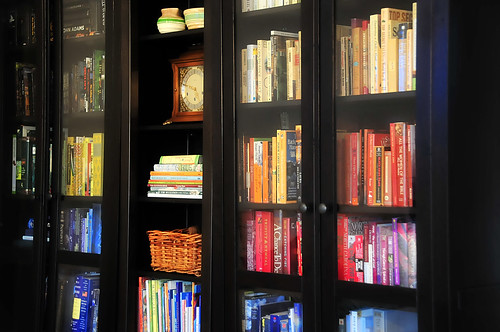
After ten years of English lit. and babies, I finally did finish with school, and we left Chicago. I have missed my Chicago home for one year and six months. When I picture what it is that I miss, I see what Bachelard prompts me to call my “dreaming spot.” A soft green chair is huddled up against a corner window. A tall built-in bookshelf is just on the other side of the window, and through the glass there are rooftops with one-hundred year old chimneys and treetops that shift from bare, to bright green, to rich green, to shades of fire, and back again.
When I leave this Florida house, I am sure that I will miss the big bay window that shelters my writing desk. I still have the soft, green chair, but I no longer spend much time there. I prefer the hard-backed desk chair, here by the window, where I can see vegetable beds, ripening citrus, water, and (when I’m lucky) river otters. Right now, this is my spot for dreaming.
For me, one of the saddest and most troubling verses in the Bible is Matthew 8:20 where Jesus tells us, “‘Foxes have holes and birds of the air have nests, but the Son of Man has no place to lay his head.’” To follow Jesus, is to say, “Lord, I will make my home in you.”
But we have also been given a promise. In John 14:2 Jesus says, “’In my Father’s house are many rooms . . . I am going there to prepare a place for you.’”
I love houses, mine (wherever it happens to be) most of all. I simply cannot imagine having no place (let alone a cozy, book-filled place) to lay my head. And so I stumble upon yet one more difficult, beautiful paradox: my desire for Home is God-given and good, but this fact gives me no right to hold my house in a possessive, white-knuckled grip.
“Then Jesus said to his disciples, ‘If anyone would come after me, he must deny himself and take up his cross and follow me. For whoever wants to save his life will lose it, but whoever loses his life for me will find it.’”
(Matthew 16: 24-25)
*Lest anyone formulate an unduly high regard for my intellectual habits, I must admit that I do not actually spend my days reading French philosophy. I encountered this quotation in the travel section of my Sunday New York Times. Poetry can find us in the most surprising places.
by Christie Purifoy | Sep 21, 2011 | Family, poverty, prayer

I’ve always had a tendency to let the mail pile up unopened (which means that we have realized, on more than one occasion, that we’re driving a car that may no longer be insured).
We put systems in place. For instance, a basket for recycling junk mail sits by the front door just beneath a tray for bills. I vow to do a better job, but I never quite keep up with the flurry of paper.
One particular unopened letter had been troubling me for weeks. The return address said Compassion, and “a message from your sponsored child!” was splashed across the envelope. I knew as soon as I pulled it from the mailbox that it was a note from our new Compassion child (I picked him from the lineup because he reminded me of my middle boy). He isn’t the only child we sponsor, so I knew the drill. I would need to write a letter introducing him to our family, and I remembered that it was customary to include a family photo.
It’s the photo’s fault. At least, that’s what I’d like to think.
As soon as I open this letter, I told myself, then I’ll have to add “take and print a family photo” to my to-do list. I felt tired just considering my to-do list, yet my perfectionism wouldn’t let me send a year-old photograph (because our baby boy has changed so much).
And so, I let the letter sit.
I kept spotting it. I noticed it every time I added a few more bills to the now-teetering pile in the tray. The guilt grew with the pile, but I couldn’t get past the need for a photo.
Until yesterday.
I shook my perfectionist, procrastinating self and opened the letter. Immediately, I noticed a small box with the prompt “Please pray for my family.” Within that square were these dictated words: “Please pray that my father finds a job and stops drinking.”
I was devastated. My chest hurt.
A heart-cry in a handful of words: how could I have let it sit unread?
Adding another Compassion child to our monthly giving was a financial stretch for us. However, I’ve found that opening my eyes just a little bit to the rest of the world makes it much harder to justify the ease with which I buy books. Or new boots for my daughter. Or another weekly dance class.
It’s about money. God has his eye on the poor, and I see them too. We both know that He’s given American Christians more than enough to wipe out mountains of misery, if only we would share what has never been ours to begin with.
Yet, believing it was just about money made it easier to leave that letter lying on the tray. Now I know: it’s about money (I say I care about the poor, so I better put my money where my mouth is), and it’s about so much more.
It’s about a small boy. One precious life. Only five years old, and yet he knows things that my own kids have never even imagined. I’m still trying to figure out how to share this prayer request with them. I don’t think that they have ever even heard the word drunk. Let alone seen it.
But this boy . . . oh how my heart aches when I consider what he has seen. What he is seeing even now as I type.
So, I’ll keep writing the checks. But now my checks go out dripping with prayer. Simple, nearly wordless prayers:
Jesus, Carlos, Jesus, Carlos’s daddy, Jesus, Carlos’s mommy, Jesus, Jesus, Jesus.
