by Christie Purifoy | Nov 21, 2011 | Poetry, Seasons

Soon we take our seats around the table in order to say, “Thank you.”
Gerard Manley Hopkins shows us how.
Pied Beauty
Glory be to God for dappled things –
For skies of couple-colour as a brinded cow;
For rose-moles all in stipple upon trout that swim;
Fresh-firecoal chestnut-falls; finches’ wings;
Landscape plotted and pieced – fold, fallow, and plough;
And all trades, their gear and tackle and trim.
All things counter, original, spare, strange;
Whatever is fickle, freckled (who knows how?)
With swift, slow; sweet, sour; adazzle, dim;
He fathers-forth whose beauty is past change;
Praise him.
– Gerard Manley Hopkins
by Christie Purifoy | Nov 14, 2011 | Faith, Poetry, prayer, Uncategorized

For you on this Monday: a sonnet from Irish farmer-turned-poet Patrick Kavanaugh.
I suppose there are those who might find heresy in this poem. “Pantheism,” they would say.
I don’t defend the idea. If God is everything and everything is God then what good is God, I wonder? And yet, I do not think that this is a heresy strong enough to deserve much disapproval (at least not today in the United States). We have silenced nature very effectively with our parking lots and our strip malls, our corporate ladders and our electronic shadow selves.
This poem reminds me to listen for the voice of God whispering all around.
I can’t prove that His is the voice you hear in water and wind. But, to borrow Kavanaugh’s words, some arguments aren’t meant to be proven.
Canal Bank Walk
Leafy-with-love banks and the green waters of the canal
Pouring redemption for me, that I do
The will of God, wallow in the habitual, the banal,
Grow with nature again as before I grew.
The bright stick trapped, the breeze adding a third
Party to the couple kissing on an old seat,
And a bird gathering materials for the nest for the Word
Eloquently new and abandoned to its delirious beat.
O unworn world enrapture me, encapture me in a web
Of fabulous grass and eternal voices by a beech,
Feed the gaping need of my senses, give me ad lib
To pray unselfconsciously with overflowing speech
For this soul needs to be honoured with a new dress woven
From green and blue things and arguments that cannot be proven.
– Patrick Kavanaugh
by Christie Purifoy | Nov 4, 2011 | Jesus, Scripture, Uncategorized

How’s that for a title? Did it draw you in? Turn you off?
To be honest, I’m trying not to care whether or not His name is an effective lure for a blog post. I’m trying not to care because I’ve realized something important: it’s all about Him, but I make it about so many other things.
I’ve tended to think that this is a problem for “those other” Christians (and, I promise you, there will always be “others” in this gorgeously diverse body of Christ).
I point my finger at an earlier generation of believers and say, “Thanks to you, too many people in this country think Christianity is about right-wing politics, pseudo-science, celebrity preachers, and churches that look like clones of corporate America.” I may be the quiet, introverted type, but I’m quite good at pointing fingers, even if only in my own mind.
However, I’ve been convicted (a heavy, old-fashioned word, right? Yet, I think it’s the only one to use). I, too, have made this believing life to be about so many other things: social justice, creation care, orphan care, free-trade coffee … well, you get the idea.
Surely those are good things? Justice for the poor, caring for widows and orphans: aren’t these necessary components of a religion that pleases our maker?
Yes, I’m quite sure that they are. I’m not about to buy chocolate harvested by trafficked African children, and the grief I personally feel over abortion and capital punishment can’t be untangled from my Christian spirituality.
And yet … I’m beginning to see how a commitment to good things (to causes, to ideals) is not exactly the same thing as a commitment to Him. To Jesus. One certainly flows from the other, but they are not interchangeable.
If someone asks, “What is Christianity all about? What does it have to offer?” the right answer is “Jesus,” not “feeding the hungry” (though that doesn’t, for one minute, let me off the hook for feeding the hungry).
I pray that my life speaks on behalf of justice for the least of these. I must do (and keep on doing) some serious self-reflection about the size of my house, and the overflowing state of my children’s toyboxes (not to mention my own closet). In my view, following Jesus demands these responses. Yet, I can no longer live as if this is the heart of the Good News that Jesus came to preach.
The treasure we’ve been given, the treasure we should be proclaiming, the treasure we should always be giving away … is Jesus himself. Emmanuel. God with us.
I have hardly begun to see how this Jesus-centered faith will reveal itself in my life. Is it only semantics? What, really, needs to change?
I can point to small things. Reading the Bible with my kids, I try not to reduce the story of Noah and the ark to a moral lesson about obedience or trust. Jesus told us that Scripture was all about Him, and I want to take that seriously. I want my kids to see Noah and his ark, not in isolation, but as a part of one beautiful, world-changing Jesus story (thank you, The Jesus Storybook Bible!). I’m also grateful to attend a church where the Eucharist (Communion, Lord’s Supper) is not an afterthought but the highlight of our weekly gathering. The sharing of this Jesus-meal is the purest, most compelling sermon we can preach. It communicates perfectly to seeker and believer, child and adult.
I sense that there’s more … much more. What a relief to know that this is not merely one more theological knot to untangle. This is not one more item to check off of some spiritual to-do list.
This is far more personal because it’s all about a person; it was, is, and always will be about the One who sits enthroned. Jesus.
by Christie Purifoy | Nov 2, 2011 | Family, motherhood, Stories
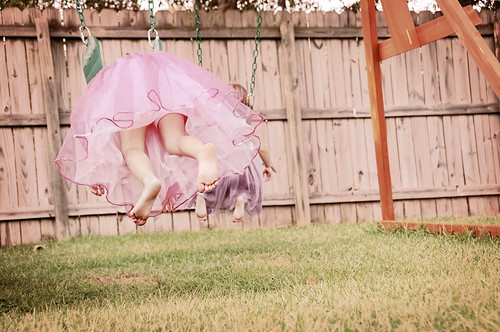
Fairies flying in my sister's yard.
Monday night witnessed our first visit from the Candy Fairy. For parents of highly allergic and/or cavity prone children (and I have one of each), she is a Very Good Thing. After the trick-or-treating, after the just-one-more-piece before bedtime binging, she empties the still-brimming candy buckets and drops a small toy into the plastic orange void.
For the firstborn: rosebud earrings and a Pippi Longstocking book. For the middle child: a Lego alien “blaster” (The language of a five-year-old boy is amazingly onomatopoeic). For the baby: a red Thomas the Train engine with an unpronounceable name stamped on his side.
This largesse came fast on the heels of another nighttime visitor: the Pacifier Fairy. When Jonathan noticed the baby’s teeth looking more than a little misshapen we took quick action (assuming, rightly I think, that delay would be deadly for our resolve). The baby was sweet-talked into stuffing the mailbox with much-loved pacis, and the Pacifier Fairy soon whisked them away, leaving a blue Thomas the Train engine behind.
Add in Tooth Fairy, Santa Clause, and Easter Bunny, and our home is a busy intersection in the fairy/magical creature highway.
Since she was first old enough to string words into sentences, my daughter has asked me, “Mom, do you believe in fairies?” And I always say the same thing, “Well, I’ve never seen one, but that doesn’t mean they don’t exist.” (And for the rational-minded among you, shuddering at my deceit, all I can say is how often have scientists discovered bizarre new species in ocean trenches or volcano tops, creatures more surprising than any fairy?)
I tend to think that belief (in anything unseen) is a subtle orientation towards the world. It’s a just slightly off-kilter way of looking around oneself. A way of seeing that goes beyond the physical perception of your eyes. To believe, is to be always ready to say, “Perhaps, there’s more (rather than less) than meets the eye.”
And so, I’ve introduced my children to more. Fairy rings and tomtens. Santa Clause and mermaids.
I don’t share this under the category “advice for parents.” Perhaps, you’ve heard me mention before that I believe in the sharing of stories but not the sharing of advice?
I’m sure any number of you could put together a highly convincing, highly reasonable argument for why I am wrong. Honestly, I’m already half-convinced, and we will probably be telling the firstborn the truth about Santa Clause this year (the truth: Santa Clause is a magical story that you now get to help tell for your little brothers).
But here is what I cannot do: I cannot give my children lists of beings worthy of belief (Jesus, the angels) without demonstrating for them a capacity for belief. I want them to see in me a willingness to be surprised, to be proved wrong. I want them to know that the world God made is always more beautiful, more startling, more good than what we previously knew.
This world is full of magic. It’s evident in science textbooks and in fairytales.
I believe that the great magician behind it all has revealed himself to us in the figure of a man. This man walked the same solid ground that we do. In him, story and history intersect. Magic and flesh-and-blood-reality are joined.
He is the good news, too good to be true.
And he lives.
by Christie Purifoy | Oct 31, 2011 | Books, Chicago, Poetry

I didn’t discover the poetry of George Herbert until graduate school (my undergraduate education in literature had more than a few gaps, I’m afraid. This due, mostly, to my own indiosyncratic course selection criteria: what time is the class and who is the professor?).
Thankfully, I did find Herbert, and I still remember my shock that we could actually discuss such Christ-centered poetry around a University of Chicago seminar table. Who says there’s no Jesus in higher education? Though, to be honest, there’s a lot more of Freud in my dissertation than Jesus. A lot more. I blame Virginia Woolf for leading me astray.
However, with the job market in the humanities being what it is, I have a good deal of time for Herbert these days. And, my love for the modernists notwithstanding, that’s a very good thing.
Without further ado, a poem on rest (one I’ve recently been feeling the truth of deep in my bones):
The Pulley
When God at first made man,
Having a glass of blessings standing by,
“Let us” (said He) “pour on him all we can;
Let the world’s riches, which dispersed lie,
Contract into a span.”
So strength first made a way;
Then beauty flow’d, then wisdom, honor, pleasure;
When almost all was out, God made a stay,
Perceiving that alone of all his treasure
Rest in the bottom lay.
“For if I should” (said He)
“Bestow this jewel also on my creature,
He would adore my gifts instead of me,
And rest in nature, not the God of nature:
So both should losers be.
“Yet let him keep the rest,
But keep them with repining restlessness;
Let him be rich and weary, that at least,
If goodness lead him not, yet weariness
May toss him to my breast.”
– George Herbert
