by Christie Purifoy | Oct 28, 2011 | Chicago, Community, Faith, Florida, Seasons, Stories, Uncategorized
I believe in stories more than advice. In other words, I believe that a light is shined on our way forward, not when we finally hear the exact, right piece of advice, but when someone shares their story with us.
True stories contain all of the messy, untranslateable details of a life. Somehow, they also point us toward the maker of life.
I wish I could tell you how to live without the kind of community I described earlier this week. I wish I could tell you how to get it back. I even wish I could tell you that developing that kind of community in your own setting is the most important use of your time. But I can’t tell you these things.
If this whole Jesus-following-way-of-life is truly a relationship (as I’ve been hearing all my life) then we need to stop comparing our circumstances with everyone else’s. My marriage to Jonathan is fifteen-years-old (or fifteen-years-good), and it makes no sense for me to look at those still-awkward newlyweds and wonder why our lives are so different. Other than the fruits of the spirit, I’m not sure there are many things we can point to in order to say “that is a good Christian life” and “that is not.” At times Jesus walks us through joy and other times he walks us through trouble, but we can be confident in both that he has not and will not abandon us.
I lived in community for ten years, and it was good and it was painful, and I hope I haven’t said goodbye to that way of life forever. I could beat my head against my Bible wondering why my life no longer looks like that and how to get it back, or I can accept that when God empties our lives he also fills them up again. Not with the things we are missing, necessarily, but with himself.
In this world, we are wanderers. And that is not always a bad thing, not always a sin thing. We can wander quite a distance pursuing the good things of God’s kingdom on earth. Still, there’s little rest in wandering, and God knows we need rest. But where to find it?
God’s people “wandered over mountain and hill and forgot their own resting place” (Jeremiah 50:6).
Sometimes we need silence and emptiness, loneliness and barrenness in order to remember. We need winter.
The four walls of my suburban existence can feel like a prison, but they have been just the thing for feeling the heavy, holy pressure of God’s hand on me.
“You hem me in – behind and before; you have laid your hand upon me. Such knowledge is too wonderful for me, too lofty for me to attain.”
Psalm 139: 5-6
by Christie Purifoy | Oct 25, 2011 | Chicago, Community, Seasons

Taken by Yours Truly at Chicago's Art Institute. This painting, with its people like stone columns, always reminds me that living in a crowd is not the same thing as living in community.
Our airplane tilts away over city rooftops, and I feel as if I am leaving home in order to return to a house. It is not an altogether blue feeling (it is a house inhabited by my favorite people, after all), but it is disorienting. An emotional confusion to match a physical one; as the plane banks, I can no longer tell if I am pointed toward ground or sky.
I’ve spent four days trying to understand what I left behind when I moved away from Chicago. It seems important to do this, because I do not yet know if my life is a straight line heading always away from it or a curve that will one day return. I think the only word for what has been lost is community, but that word seems beyond inadequate.
In Florida, when my husband leaves for a business trip, I lie awake wondering who I would call if one of the children had an accident or became suddenly ill. I know that there are people in our neighborhood and people in our church who would graciously, even eagerly, help out, but it would involve some tracking down of phone numbers and many apologies for having “bothered” them in the middle of the night.
Living in community meant that there were no apologies.
We frequently woke to midnight phone calls, whispered midnight prayers for friends in crisis, made beds on the floor for small children whose parents were racing to hospitals. I have rushed behind a curtain in the emergency room to find a friend sitting at my son’s bedside: the friend who held him down for the epi-pen, the friend who drove him to the hospital.
But community is so much more than a safety net.
It is a web of interdependence that is often uncomfortable, even painful. It is the downstairs neighbor who calls (again) because my children are pounding on her ceiling (again). It is the woman pushing the stroller down my street who asks me (again) for bus money. Walking near my old building this week, I saw her, remembered her, and was not at all surprised when she stopped me to ask for money. I passed her again on my last evening in Chicago, and she asked (again) for money. I hand over my bus pass knowing that she will always need, and I hope, for Jesus’ sake, that someone will always be there to give.
Community is trying to keep the kids quiet in the kitchen in order that the group of church ministry leaders meeting in the living room won’t be disturbed. Community is making the bed in the spare room for friends of friends. Community is waking up early to make them breakfast, too.
Community is being inconvenienced.
It is straightening up the living room in order to host a weekly gathering for a church small group when all you want to do is climb into bed. Community is when the unmarried, male graduate student from that same small group surprises you with home-cooked Indian food two weeks after your baby is born.
Community is life in abundance.
This is the gift of the one who made us (the one who said it is not good to be alone): to be poured out again and again in order to be filled again and again. Of course, I am not talking about martyring oneself so that bitterness and resentment destroy all hope of relationship. But I have seen that when I open my hands to give until it hurts I receive … oh, I receive so much in return.
On Sunday, I sat once again in my former church. I was joined by a friend, and we both had tears in our eyes just for the joy of sitting next to one another. She turned to me and whispered, “This is our life,” and I knew just what she meant.
This is our life: it is real, it is now, it is beautiful and difficult, and, above all else, it is shared.
by Christie Purifoy | Oct 19, 2011 | Family, Grace, Vacation, Waiting
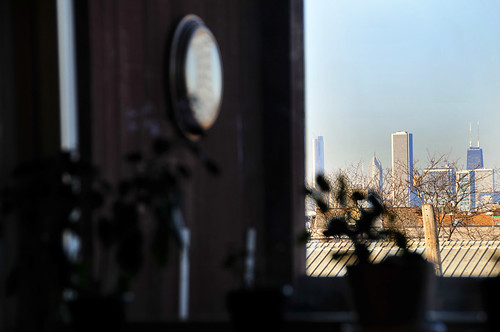
The firstborn and I will be back in Chicago soon. Four days with the people and places we both love best.
I feel an urge to write that we are going home, except that we aren’t.
It isn’t only that we sold our Chicago apartment 18 months ago. It isn’t because we have no family there. We do have many friends, and they were our family for ten good years. Rather, it is that I was once planted in Chicago. I’m not planted there any longer, though I haven’t yet laid down roots in any other place. I feel as if (actually, I hope as if) we are in between homes. (Florida, you are lovely, but I do not think you will ever be home.)
Perhaps I can write of Chicago from my daughter’s point of view. She was born there, after all, and has more of a claim to the place than I do. Here is the hospital where she took her first breath. A few blocks away is the converted hotel (with a tunnel where Al Capone once smuggled gin). It was her first home. Here is the museum that became her own private wonderland; fairy castle, baby chicks, and all. And there is pebble beach, our pebble beach, where we swam in summer and climbed ice dams in winter. Even now when I stand at some water’s edge and look to my left, I half expect to see the glittering wall of a downtown skyline. Perhaps she does, too.
In this life, home is always temporary. In Chicago, I learned that it is possible to feel at home in a temporary place. It is possible to breathe deeply and live thoroughly in a home that won’t always be home.
Possible, yes, but never a given. Or, perhaps I should say that it is exactly that: a given thing. A grace thing.
When God tells his exiled people in Jeremiah that he will bring them home one day, he also says: “Build houses and settle down; plant gardens and eat what they produce. Marry and have sons and daughters; find wives for your sons and give your daughters in marriage …” (Jeremiah 29:5-6). His gift to them is a home in exile. Permission to live, even as they wait.
“For the Lord your God is bringing you into a good land – a land with streams and pools of water, with springs flowing in the valleys and hills.”
(Deuteronomy 8:7)
by Christie Purifoy | Oct 17, 2011 | Art, Books, Poetry
In my ideal Christian bookstore, the Jesus knick-knacks and the Amish romances would be pushed to a far corner. The coveted window display space would be filled with books like the collected poems of Czeslaw Milosz.
I guess if I’m being perfectly honest, my ideal Christian bookstore would look exactly like my favorite independent bookstore in Chicago’s Hyde Park neighborhood, with a few more Bibles. As Madeleine L’Engle writes in Walking On Water, “Christian art? Art is art; painting is painting; music is music; a story is a story. If it’s bad art, it’s bad religion, no matter how pious the subject.”
Even if you think that L’Engle pushes the point too far, I imagine that many of you, having picked up a copy of Milosz’s New and Collected Poems (1931-2001), would agree that this is a writer Christians should be reading. A believer and a Nobel Prize winner, Milosz never turned his face away from the darkness of twentieth-century history. Yet he did this without losing his grip on hope and belief. A light shining in darkness. I think that may be my definition of Christian art.
Rays of Dazzling Light
Light off metal shaken,
Lucid dew of heaven,
Bless each and every one
To whom the earth is given.
Its essence was always hidden
Behind a distant curtain.
We chased it all our lives
Bidden and unbidden.
Knowing the hunt would end,
That then what had been rent
Would be at last made whole:
Poor body and the soul.
– Czeslaw Milosz
by Christie Purifoy | Oct 7, 2011 | Blog, Food, God's promises, Seasons, Writing

It’s a mystery. One day (in a succession of many, many such days) you are a still and brackish puddle of water. No movement. Not much life. Then, something imperceptible happens. Perhaps, Someone breathes just a bit of Himself over the stillness? And the still puddle begins to trickle. It’s no river, certainly, but there is just a hint of movement, just a hint of renewal. Some fresh spring has begun to flow.
Nine months ago I began writing a story. My story. For the past five months the draft of that story has sat, locked in my computer, untouched. But this week I opened it up again. I started rewriting, tweaking, adding new thoughts.
It feels good to be at work again.
The only problem is that I’m feeling, here at the end of the week, just a bit dried up where words are concerned. Perhaps it’s only laziness, but I feel better remembering George MacDonald’s words: “Work is not always required. There is such a thing as sacred idleness.”
I’m giving myself over to idleness for the next few days. Let’s hope it’s of the sacred sort.
Meanwhile, since I have few words of my own today, here are the words (and a few images) I’m carrying with me into this weekend:
“I am the Lord your God, who brought you up out of Egypt. Open wide your mouth, and I will fill it.”
Psalm 89: 9-11