by Christie Purifoy | Nov 2, 2011 | Family, motherhood, Stories
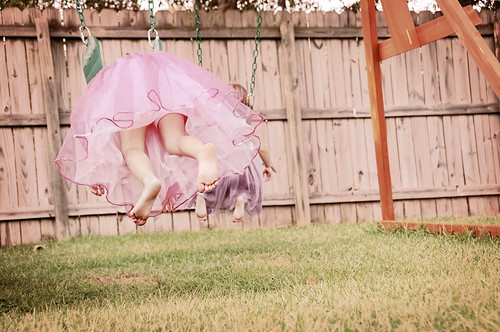
Fairies flying in my sister's yard.
Monday night witnessed our first visit from the Candy Fairy. For parents of highly allergic and/or cavity prone children (and I have one of each), she is a Very Good Thing. After the trick-or-treating, after the just-one-more-piece before bedtime binging, she empties the still-brimming candy buckets and drops a small toy into the plastic orange void.
For the firstborn: rosebud earrings and a Pippi Longstocking book. For the middle child: a Lego alien “blaster” (The language of a five-year-old boy is amazingly onomatopoeic). For the baby: a red Thomas the Train engine with an unpronounceable name stamped on his side.
This largesse came fast on the heels of another nighttime visitor: the Pacifier Fairy. When Jonathan noticed the baby’s teeth looking more than a little misshapen we took quick action (assuming, rightly I think, that delay would be deadly for our resolve). The baby was sweet-talked into stuffing the mailbox with much-loved pacis, and the Pacifier Fairy soon whisked them away, leaving a blue Thomas the Train engine behind.
Add in Tooth Fairy, Santa Clause, and Easter Bunny, and our home is a busy intersection in the fairy/magical creature highway.
Since she was first old enough to string words into sentences, my daughter has asked me, “Mom, do you believe in fairies?” And I always say the same thing, “Well, I’ve never seen one, but that doesn’t mean they don’t exist.” (And for the rational-minded among you, shuddering at my deceit, all I can say is how often have scientists discovered bizarre new species in ocean trenches or volcano tops, creatures more surprising than any fairy?)
I tend to think that belief (in anything unseen) is a subtle orientation towards the world. It’s a just slightly off-kilter way of looking around oneself. A way of seeing that goes beyond the physical perception of your eyes. To believe, is to be always ready to say, “Perhaps, there’s more (rather than less) than meets the eye.”
And so, I’ve introduced my children to more. Fairy rings and tomtens. Santa Clause and mermaids.
I don’t share this under the category “advice for parents.” Perhaps, you’ve heard me mention before that I believe in the sharing of stories but not the sharing of advice?
I’m sure any number of you could put together a highly convincing, highly reasonable argument for why I am wrong. Honestly, I’m already half-convinced, and we will probably be telling the firstborn the truth about Santa Clause this year (the truth: Santa Clause is a magical story that you now get to help tell for your little brothers).
But here is what I cannot do: I cannot give my children lists of beings worthy of belief (Jesus, the angels) without demonstrating for them a capacity for belief. I want them to see in me a willingness to be surprised, to be proved wrong. I want them to know that the world God made is always more beautiful, more startling, more good than what we previously knew.
This world is full of magic. It’s evident in science textbooks and in fairytales.
I believe that the great magician behind it all has revealed himself to us in the figure of a man. This man walked the same solid ground that we do. In him, story and history intersect. Magic and flesh-and-blood-reality are joined.
He is the good news, too good to be true.
And he lives.
by Christie Purifoy | Oct 31, 2011 | Books, Chicago, Poetry

I didn’t discover the poetry of George Herbert until graduate school (my undergraduate education in literature had more than a few gaps, I’m afraid. This due, mostly, to my own indiosyncratic course selection criteria: what time is the class and who is the professor?).
Thankfully, I did find Herbert, and I still remember my shock that we could actually discuss such Christ-centered poetry around a University of Chicago seminar table. Who says there’s no Jesus in higher education? Though, to be honest, there’s a lot more of Freud in my dissertation than Jesus. A lot more. I blame Virginia Woolf for leading me astray.
However, with the job market in the humanities being what it is, I have a good deal of time for Herbert these days. And, my love for the modernists notwithstanding, that’s a very good thing.
Without further ado, a poem on rest (one I’ve recently been feeling the truth of deep in my bones):
The Pulley
When God at first made man,
Having a glass of blessings standing by,
“Let us” (said He) “pour on him all we can;
Let the world’s riches, which dispersed lie,
Contract into a span.”
So strength first made a way;
Then beauty flow’d, then wisdom, honor, pleasure;
When almost all was out, God made a stay,
Perceiving that alone of all his treasure
Rest in the bottom lay.
“For if I should” (said He)
“Bestow this jewel also on my creature,
He would adore my gifts instead of me,
And rest in nature, not the God of nature:
So both should losers be.
“Yet let him keep the rest,
But keep them with repining restlessness;
Let him be rich and weary, that at least,
If goodness lead him not, yet weariness
May toss him to my breast.”
– George Herbert
by Christie Purifoy | Oct 17, 2011 | Art, Books, Poetry
In my ideal Christian bookstore, the Jesus knick-knacks and the Amish romances would be pushed to a far corner. The coveted window display space would be filled with books like the collected poems of Czeslaw Milosz.
I guess if I’m being perfectly honest, my ideal Christian bookstore would look exactly like my favorite independent bookstore in Chicago’s Hyde Park neighborhood, with a few more Bibles. As Madeleine L’Engle writes in Walking On Water, “Christian art? Art is art; painting is painting; music is music; a story is a story. If it’s bad art, it’s bad religion, no matter how pious the subject.”
Even if you think that L’Engle pushes the point too far, I imagine that many of you, having picked up a copy of Milosz’s New and Collected Poems (1931-2001), would agree that this is a writer Christians should be reading. A believer and a Nobel Prize winner, Milosz never turned his face away from the darkness of twentieth-century history. Yet he did this without losing his grip on hope and belief. A light shining in darkness. I think that may be my definition of Christian art.
Rays of Dazzling Light
Light off metal shaken,
Lucid dew of heaven,
Bless each and every one
To whom the earth is given.
Its essence was always hidden
Behind a distant curtain.
We chased it all our lives
Bidden and unbidden.
Knowing the hunt would end,
That then what had been rent
Would be at last made whole:
Poor body and the soul.
– Czeslaw Milosz
by Christie Purifoy | Sep 26, 2011 | Family, grief, motherhood, Poetry, Seasons
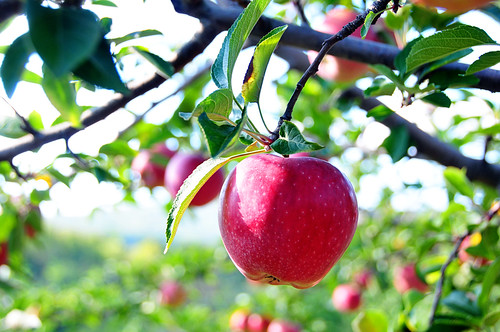
This comes from one of my favorite poets, the Irish writer Eavan Boland.
Reading it again this morning, I remember that myths are some of the truest stories we tell. The myth of Persephone is not merely a way of explaining the change of seasons before our age of scientific discovery. More than this, it is a story of loss and restoration. This poem reminds me that I have been Persephone. It also reminds me that my oldest child is swiftly becoming Persephone. I say, with Boland, that I will not deny her her own unique life story, though no good story is without pain.
The Pomegranate
The only legend I have ever loved is
The story of a daughter lost in hell.
And found and rescued there.
Love and blackmail are the gist of it.
Ceres and Persephone the names.
And the best thing about the legend is
I can enter it anywhere. And have.
As a child in exile in
A city of fogs and strange consonants,
I read it first and at first I was
An exiled child in the crackling dusk of
The underworld, the stars blighted. Later
I walked out in a summer twilight
Searching for my daughter at bedtime.
When she came running I was ready
To make any bargain to keep her.
I carried her back past whitebeams.
And wasps and honey-scented buddleias.
But I was Ceres then and I knew
Winter was in store for every leaf
On every tree on that road.
Was inescapable for each one we passed.
And for me.
It is winter
And the stars are hidden.
I climb the stairs and stand where I can see
My child asleep beside her teen magazines,
Her can of Coke, her plate of uncut fruit.
The pomegranate! How did I forget it?
She could have come home and been safe
And ended the story and all
Our heartbroken searching but she reached
Out a hand and plucked a pomegranate.
She put out her hand and pulled down
The French sound for apple and
The noise of stone and the proof
That even in the place of death,
At the heart of legend, in the midst
Of rocks full of unshed tears
Ready to be diamonds by the time
The story was told, a child can be
Hungry. I could warn her. There is still a chance.
The rain is cold. The road is flint-coloured.
The suburb has cars and cable television.
The veiled stars are above ground.
It is another world. But what else
Can a mother give her daughter but such
Beautiful rifts in time?
If I defer the grief I will diminish the gift.
The legend must be hers as well as mine.
She will enter it. As I have.
She will wake up. She will hold
The papery, flushed skin in her hand.
And to her lips. I will say nothing.
– Eavan Boland
by Christie Purifoy | Sep 19, 2011 | Art, Books, Poetry
The muscles in my legs have been achy and sore for two days. No, I didn’t go jogging (horror!). I spent most of Saturday rearranging my books, and it seems I vastly underestimated the after-effects of shuffling books from shelves to floor and back to different shelves.
The big book shuffle was prompted by a single new bookcase. It arrived on Friday, packed in one slender yet unbelievably heavy box. On Saturday morning the three boys tackled it with their respective hammers (plastic for the two-year-old, which pleased him not at all).
Within half an hour I was standing in front of one of the loveliest sights I can imagine: pristine, empty bookshelves.
They didn’t stay empty long. I gathered up the piles of books which have quietly accumulated in the corners of my house, and, after much dusting and a thorough rearranging, discovered that I should have ordered two new bookcases.
No matter. I can’t think of a better way to spend a cloudy, drizzly Saturday than handling (and remembering) each of my books as I slide them into place.
It was only as I carried my poetry collection from family room built-ins to dining room shelves that my pleasure dimmed. I haven’t reached for any of these books in such a long time (not since my last Intro. to Lit. class), and I felt suddenly sad to think of so much treasure sitting untouched, collecting dust.
I had the idea, then, to share some of these poems here on my blog. I grant you, it’s very self-indulgent. But isn’t blogging always that, to some extent?
The thing I’ve long loved most about teaching is the simple act of sharing beautiful things. I’ve missed that.
So, without further ado, a poem for you (inspired by last week’s post on the magic of mirrors):
Miracle Glass Co.
Heavy mirror carried
Across the street,
I bow to you
And to everything that appears in you,
Momentarily
And never again the same way:
This street with its pink sky,
Row of gray tenements,
A lone dog,
Children on rollerskates,
Woman buying flowers,
Someone looking lost.
In you, mirror framed in gold
And carried across the street
By someone I can’t even see,
To whom, too, I bow.
– Charles Simic
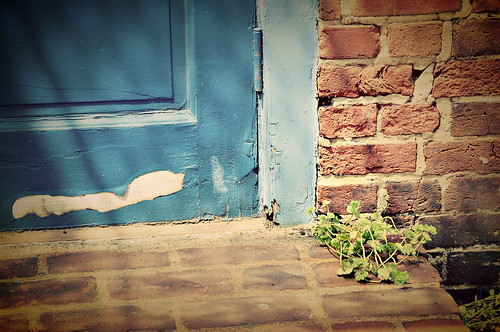
This is a perfect ode, in my opinion, for kicking off plans to reacquaint myself with the poetry on my shelves. It reminds me that creating art is often as simple as reframing the everyday (as my sister’s photograph moves us to see peeling paint with new eyes).
Within the gold frame of a poem, the ordinary is transformed. Simic is right. It is a miracle.
Blowing the dust off of a poem and reading it, we bow to the vision it offers, we bow to its maker, the poet, and we remember our own maker, who created us to create.
