by Christie Purifoy | May 3, 2012 | book of quotations, Books, Faith, Home, Jesus, Stories, Uncategorized
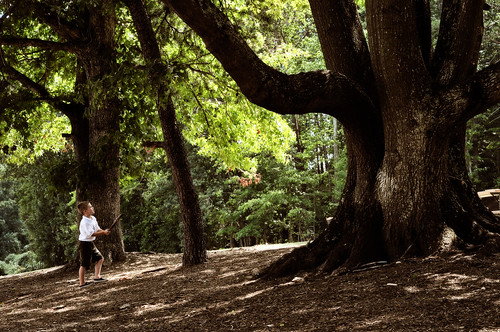
I love this photograph so much. It’s only a picture of my nephew and his stick at the edge of some woods. I think it is one of those pictures that reveals so much more than the sum of its parts: boy, stick, tree.
I look at this picture, and I see fairy tales. Knights with swords as alive as they are. Wickedness that must be sought out in dark forests. I see adventure stories. Those stories that make sleeping on a bed of leaves and cooking food over an open flame sound like heaven.
This photograph reminds me of all that I love about the very best stories: magic, beauty, goodness. Also, darkness, evil, confusion, until, finally, triumph and victory.
I think that I am a Christian because I believe these stories tell me something true about the world. They also tell me true things about myself and about other people.
I think that I will always be a Christian not because I will always believe exactly the same things, or because I have figured it all out, or even because my questions have all been answered. I think I will always be a Christian because the story of King Jesus is a story in which I can live. Within this story, I can move, and I can breathe.
In Still: Notes on a Mid-Faith Crisis, Lauren Winner shares her friend Julian’s memory of being confirmed as a twelve-year-old. A few days before the service, he panicked and told his father (who was also the minister) that he didn’t know if he believed all the right things and wondered if he could proclaim in front of the church that he was ready to believe them forever. Here is his father’s response:
“What you promise when you are confirmed,” said Julian’s father, “is not that you will believe this forever. What you promise when you are confirmed is that that is the story you will wrestle with forever.”
Sometimes, faith is like a wrestling match. Like Jacob wrestling all through the dark night with God himself. Jacob always bore the scar of that struggle.
Sometimes, faith is like coming home. Abiding in a place that reveals something of who we truly are.
Faith is not saying, “I know this” and “I am sure of that.”
To have faith is to say, “This is the place where I live.”
Jesus said, “Live in me. Make your home in me just as I do in you.”
John 15:4 (The Message)
by Christie Purifoy | Mar 27, 2012 | Jesus, poverty, Stories, Uncategorized

A good friend of mine just returned from a trip to India, and she came by recently to share her stories. Stories of hopelessness. Stories of darkness. Stories of Jesus in the midst of it all.
In addition to her stories, she gave me another gift: a gorgeous, hand-sewn bag covered in the faded colors of vintage sari fabric. The label inside says it was sewn by Shamoli.
My friend told me about visiting Shamoli and her coworkers at SariBari in Kolkata, India. She described the laughter and happy conversation that fills the space where they sew blankets, pillows, bags of all sizes, and (this I’m really excited about!) baby blankets, changing pads, and diaper bags.
These women have been rescued from slavery. Their happiness testifies to the truth of another label tucked into my bag. This one says: “making life new.” And yet, for every woman given hope and a new livelihood, so many women and girls continue to be trafficked into the darkest forms of suffering. We wonder together, my friend and I, if it’s enough. What is a little happiness when set against so much ongoing evil?
Is Jesus enough? Is Jesus enough, even when the darkness remains dark and happiness is unimaginable? I think we should all be asking this question.
For me, it took being bedridden by asthma, pregnancy, and various nasty cold bugs (not to equate these three but, physically at least, none is a walk in the park) to acknowledge that I haven’t been happy in a long time.
Happiness. Maybe you prefer a different word, but I’m talking about that it-just-feels-good-to-be-alive rush. I’m talking about those days when we wake up singing “This is the day that the Lord has made. Let us rejoice and be glad in it.” I’m talking about the days when we’re still singing that song as the sun goes down.
The truth is, I haven’t been really, truly, all-day-long happy since we moved to Florida two years ago.
My confession isn’t a complaint however. My Florida life is packed with blessings: a few friends, a good church, a comfortable home. But I’ve been living this verse: “Just as I watched over them to uproot and tear down … so I will watch over them to build and to plant” (Jeremiah 31:28). Well, I’ve been living the first half, at least.
For two years God has held me in his hand while uprooting old dreams and plans, while tearing down old joys and comforts. In two years I’ve gone from pursuing an academic career to staying home with my kids and stealing hours to write a book that may never see the light of day. I’m content with that trade, but it hasn’t been easy either.
For two years I’ve lived without almost every single thing that used to make me happy: my city neighborhood, my university, my large circle of friends, the apartment in which I hosted dinners and parties nearly every week.
I’ve missed winter, the city skyline, bumping into friends on every sidewalk. I’ve missed apple picking, drives through rolling corn fields, and long summer evenings when it seems that every neighbor you’ve ever known has come down to walk by the lake.
I know that happiness is possible, but I’m not sure that it’s a promise. Or, even, that it’s always in our best interest. Which is why it took a few months of being imprisoned near my bedroom air-purifier to tell God how much I wanted to be happy again.
I accept that the uprooting and the tearing down have been good things, but, oh Lord, am I ready for the building and the planting.
A few hours after my friend’s visit, I carried my new bag to the library. I had one book to pick up and the big bag was overkill, but I was eager to carry it around. Standing at the librarian’s desk, I saw her struggling my way under a tower of books. I expected one book, but it seemed that every book I’d ordered in a month had arrived this day.
I filled my beautiful bag with these long-anticipated library books until the bag overflowed. I stood, considering my bounty, and was suddenly bathed in warm, delicious light. I was standing beneath a skylight, and, I don’t know, maybe a cloud had just blown away from the sun, but it felt like a shower of grace.
In an instant, my heart was filled and overflowing with happiness. My bag – my cup! – overflowed. And then, I remembered the words that come just a little higher on the page: “Even though I walk through the darkest valley, I will fear no evil, for you are with me” (Psalm 23:4).
I knew then that Jesus is enough.
I don’t have the authority to speak that truth on my own. Honestly, I haven’t suffered enough. My own troubles are small.
I speak it because others who have suffered say it is so. They have shared their stories. The shepherd David. The Indian seamstress Shamoli.
Before giving me the bag, my friend told me story after story of Jesus’s presence in the darkest places. In my friend’s own words, this Jesus is enough because he “steps into our suffering and brings love, joy and peace where it just doesn’t make sense to have it.”
It’s true in the valley of the shadow of death. And, to my surprise, it is even true in the library.
We all know babies in need of welcome gifts, mothers in need of mother’s day presents, and nesters who would love a pretty pillow. The equation here is actually quite simple. The more items sold by Sari Bari, the more women will gain their freedom from either the reality or the threat of human trafficking and forced prostitution in Kolkata, India. Our dollars are one way we get to be the hands and feet of Jesus in a suffering world.
You can find more beautiful products made by women freed from Kolkata’s sex trade at Freeset and at Love Calcutta Arts (I can personally attest to the beauty of their handmade paper journals).
by Christie Purifoy | Jan 10, 2012 | Books, Jesus, Stories

“Mom,” she asks, “What happens next in the story?”
I’m distracted, brushing my teeth, checking the clock. I realize that we only have 5 minutes before we need to leave for church. It takes more than 5 minutes to strap three kids into the car. At least, it does if one of those kids is a two-year-old who processes every instruction as an opportunity to run and hide.
“What story?” I ask.
“You know. The story at church. What happens after Christmas? What happens with Jesus?”
I rinse my mouth and give her a look of confusion. She says, “You know, the story! The angels and the stable and the star. What happens next?”
Finally, I understand her question, but I fumble for an answer. I may have an advanced degree in stories (I’m an expert! An authority!), but it only takes a child’s simple question to deflate those ego-balloons.
“Ummm … well … Jesus grows up. Then he starts teaching and performing miracles.”
Even I know my answer isn’t quite adequate, but the girl is thoroughly unconvinced. She huffs and rolls her eyes, and I know she thinks I still don’t understand.
But, I do. I do.
I know that it takes readers years to learn and even more years to appreciate that stories are not simply the sum of their plot developments. You could summarize a book by Agatha Christie and one by Virginia Woolf in the same number of sentences, but which summary would leave the most unsaid? You don’t need to have read Mrs. Dalloway to know the answer, I think.
“What happens next?” is not the only question we should ask. Why and how may be even more important.
I understand that my daughter, a new reader, is looking for excitement. We’ve had the star and the stable, the angels and the shepherds. What’s next? What’s next? Keep it coming! Keep it coming! Or, as her five-year-old brother might say, “Is there another picture in this book?”
We do get a few pictures between Christmas and Easter. Fishes and loaves. A broken jar of perfume. A man high up in a tree. Still, they aren’t quite as stunning as that stable or that cross. Neither the beginning nor the end, this is merely the hum-drum middle, right?
I’m not so sure. The middle may be less of a set-piece, less likely to be carved in wood or clay, but it’s the part that gives me the most hope for my day-to-day.
We live most of our lives in the middle. Between set-pieces. The funeral. The child’s birth. The phone call. The move. Those things happen, and they look like peaks and valleys as we glance back in time, but we mostly live in the in-between.
Jesus breaking bread. Jesus talking. Jesus healing. Jesus praying. That’s what the middle looks like. It’s beautiful and breath-taking in its own way. We only need to slow down enough to see it.
It’s like I always told my students when they first read Virginia Woolf. “Don’t rush. Take your time,” I would say. “If you hurry through only looking for what happens next you’ll turn the final page and realize that you’ve missed the story.”
I don’t want to miss the story. I want to live it.
by Christie Purifoy | Nov 17, 2011 | Family, God's Love, Grace, Jesus, motherhood, Scripture, Stories, Uncategorized

A brief story about a Purity Ball in my Sunday newspaper catches my attention. There is an image (a church altar decked in lace like a bridal veil) and there are words spoken by a twelve-year-old girl (“I’m saving my purity for my husband”), and I feel troubled, as if there is a small pebble in my shoe.
I don’t know why I am troubled. These are my people, after all. We speak the same church-y language, we love the same Lord. And goodness knows we need more fathers like this one, fathers who dance with their daughters and whisper prayers over their heads.
It would be easy to keep turning the pages, forget the nagging pebble, but I do have an eight-year-old daughter, after all. I hold the paper still and say to the sky, “Lord, do you have wisdom for a firstborn girl raising a firstborn girl? I’m troubled, and I don’t know why.”
And I can’t say if it’s an answer to my prayer but what comes to me is a story: the woman at the well. The woman with five husbands and one who wasn’t even that. Considering her, I decide that she wasn’t created for a husband (or five). She was created for Jesus.
In fact, she was so highly esteemed by him that Jesus chose her to be the first to hear his earth-shattering news: the Messiah you have longed for is here. I am He.
I want to take this lovely twelve-year-old girl by the hand, look her in the eyes, and try to explain (but how to explain?) that purity isn’t some thing wrapped up in a box. It isn’t a commodity exchanged for a price. It’s a fire, it’s a light, it’s a fountain, and, yes, it turns the values of this world upside down because it’s holy and it’s a sacrifice.
What I would try to say is something like this: purity is a renewable gift, not a thing to grow dingy and worn (though I’m not quite sure who is the giver and who it is that receives, is it me? Is it Jesus?).
But the best news of all? Husband or no, you are invited to live the kind of love story in which even a prostitute can be the belle of the ball.
So, dear little girl, may your light shine, may my light shine, may the light given my daughter and my sons shine and shine. For He is ours, and we are His.
Good news.
by Christie Purifoy | Nov 2, 2011 | Family, motherhood, Stories

Fairies flying in my sister's yard.
Monday night witnessed our first visit from the Candy Fairy. For parents of highly allergic and/or cavity prone children (and I have one of each), she is a Very Good Thing. After the trick-or-treating, after the just-one-more-piece before bedtime binging, she empties the still-brimming candy buckets and drops a small toy into the plastic orange void.
For the firstborn: rosebud earrings and a Pippi Longstocking book. For the middle child: a Lego alien “blaster” (The language of a five-year-old boy is amazingly onomatopoeic). For the baby: a red Thomas the Train engine with an unpronounceable name stamped on his side.
This largesse came fast on the heels of another nighttime visitor: the Pacifier Fairy. When Jonathan noticed the baby’s teeth looking more than a little misshapen we took quick action (assuming, rightly I think, that delay would be deadly for our resolve). The baby was sweet-talked into stuffing the mailbox with much-loved pacis, and the Pacifier Fairy soon whisked them away, leaving a blue Thomas the Train engine behind.
Add in Tooth Fairy, Santa Clause, and Easter Bunny, and our home is a busy intersection in the fairy/magical creature highway.
Since she was first old enough to string words into sentences, my daughter has asked me, “Mom, do you believe in fairies?” And I always say the same thing, “Well, I’ve never seen one, but that doesn’t mean they don’t exist.” (And for the rational-minded among you, shuddering at my deceit, all I can say is how often have scientists discovered bizarre new species in ocean trenches or volcano tops, creatures more surprising than any fairy?)
I tend to think that belief (in anything unseen) is a subtle orientation towards the world. It’s a just slightly off-kilter way of looking around oneself. A way of seeing that goes beyond the physical perception of your eyes. To believe, is to be always ready to say, “Perhaps, there’s more (rather than less) than meets the eye.”
And so, I’ve introduced my children to more. Fairy rings and tomtens. Santa Clause and mermaids.
I don’t share this under the category “advice for parents.” Perhaps, you’ve heard me mention before that I believe in the sharing of stories but not the sharing of advice?
I’m sure any number of you could put together a highly convincing, highly reasonable argument for why I am wrong. Honestly, I’m already half-convinced, and we will probably be telling the firstborn the truth about Santa Clause this year (the truth: Santa Clause is a magical story that you now get to help tell for your little brothers).
But here is what I cannot do: I cannot give my children lists of beings worthy of belief (Jesus, the angels) without demonstrating for them a capacity for belief. I want them to see in me a willingness to be surprised, to be proved wrong. I want them to know that the world God made is always more beautiful, more startling, more good than what we previously knew.
This world is full of magic. It’s evident in science textbooks and in fairytales.
I believe that the great magician behind it all has revealed himself to us in the figure of a man. This man walked the same solid ground that we do. In him, story and history intersect. Magic and flesh-and-blood-reality are joined.
He is the good news, too good to be true.
And he lives.
by Christie Purifoy | Oct 28, 2011 | Chicago, Community, Faith, Florida, Seasons, Stories, Uncategorized
I believe in stories more than advice. In other words, I believe that a light is shined on our way forward, not when we finally hear the exact, right piece of advice, but when someone shares their story with us.
True stories contain all of the messy, untranslateable details of a life. Somehow, they also point us toward the maker of life.
I wish I could tell you how to live without the kind of community I described earlier this week. I wish I could tell you how to get it back. I even wish I could tell you that developing that kind of community in your own setting is the most important use of your time. But I can’t tell you these things.
If this whole Jesus-following-way-of-life is truly a relationship (as I’ve been hearing all my life) then we need to stop comparing our circumstances with everyone else’s. My marriage to Jonathan is fifteen-years-old (or fifteen-years-good), and it makes no sense for me to look at those still-awkward newlyweds and wonder why our lives are so different. Other than the fruits of the spirit, I’m not sure there are many things we can point to in order to say “that is a good Christian life” and “that is not.” At times Jesus walks us through joy and other times he walks us through trouble, but we can be confident in both that he has not and will not abandon us.
I lived in community for ten years, and it was good and it was painful, and I hope I haven’t said goodbye to that way of life forever. I could beat my head against my Bible wondering why my life no longer looks like that and how to get it back, or I can accept that when God empties our lives he also fills them up again. Not with the things we are missing, necessarily, but with himself.
In this world, we are wanderers. And that is not always a bad thing, not always a sin thing. We can wander quite a distance pursuing the good things of God’s kingdom on earth. Still, there’s little rest in wandering, and God knows we need rest. But where to find it?
God’s people “wandered over mountain and hill and forgot their own resting place” (Jeremiah 50:6).
Sometimes we need silence and emptiness, loneliness and barrenness in order to remember. We need winter.
The four walls of my suburban existence can feel like a prison, but they have been just the thing for feeling the heavy, holy pressure of God’s hand on me.
“You hem me in – behind and before; you have laid your hand upon me. Such knowledge is too wonderful for me, too lofty for me to attain.”
Psalm 139: 5-6
