by Christie Purifoy | Sep 1, 2011 | Family, motherhood, Seasons, Vacation
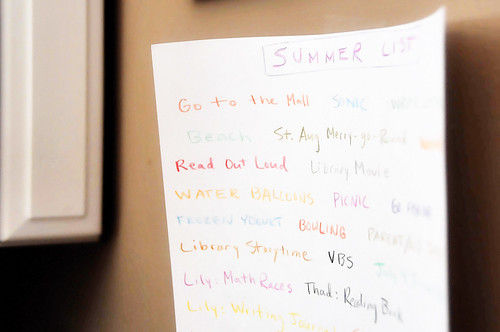
Our Summer List is nearly illegible. Most of the items are crossed through. I might have drawn a neat pencil line through each activity (trying to check it off but not erase it). My young daughter, who has not yet learned to grasp desperately at passing time, obliterated most of the list with a thick, black marker.
On the record, I’d say that our list helped shape an enjoyable summer. Though, the perfectionist zeal of my first-born did lead to a difficult argument on one of the final days of summer vacation. No, I had to tell her, we cannot visit the carousel, go on a picnic, keep a writing journal, and make playdough all in a single day just because they are still on the list. The compromise was a half-hour drive to the carousel. And a few more memories for our piggy banks.
The Summer List did not completely silence the eternal summer cries of “Mom, I’m bored!” Nor should it have.
I tend to think that boredom is good for children, like green beans and sharing a bedroom. I tell them as much, though they remain unconvinced.
I thought I believed my own preaching, but I began to doubt that over the summer. I too have been bored. Very bored. I discovered that, for me at least, green beans and sharing a bedroom are much, much better than being bored.
Of course, boredom is a privilege. If I had to walk miles in fear to collect water for my family, I would not be bored.
I wonder, is boredom merely a lesser evil, or might it have some good to offer?
I know that I don’t like it, I know that I don’t want it, and yet I write out here a few of the gifts boredom has recently given me:
To be bored is to be unhurried.
When my toddler throws a screaming fit, I let him scream. But, I also sit down close by because nothing else is screaming for my attention. When he’s ready to climb into my lap, I’m right there.
To be bored is to be waiting.
I have been thinking (and, let’s face it, hoping) that boredom might be one of the final stages of resting. When we first rest from work, we are content to simply be. After a while, our minds, our hearts, our bodies are ready, once again, to do.
To be bored is to be listening.
God is always talking. Sometimes He has a lot to say, and He says it in some big way, but, more often, He is whispering. When I am bored out of my mind, my ears are searching for any sound from Him, so eager am I to hear the extraordinary break into my ordinary.
by Christie Purifoy | Jul 1, 2011 | Florida, Religion, Seasons

No one likes to wait. Still, there is a general acknowledgement within our culture that waiting isn’t exactly a bad thing. Good things come to those who wait, we say.
Christian teaching kicks it up a notch. Strength will rise as we wait upon the Lord. Blessed are all who wait for Him.
Still, I don’t think there are many of us who, if given the chance, wouldn’t choose to fast-forward through the waiting. If there existed some cosmic remote control, I would be strongly tempted to hit that button.
Why does God make us wait? Why does Scripture link waiting with blessing? It’s hard not to feel as if waiting has been devised by some strict disciplinarian. Where is the love in making us wait? It seems more than a little cruel. Especially so when we are waiting for relief from pain, for healing, for hope, for a miracle.
However, if I am honest, I have to admit that I know how good waiting can be.
When we first moved from Chicago to northern Florida, I imagined that the long, hot summers would be hardest. I expected the worst and was pleasantly surprised. In the Fall I was surprised again, but the surprise was less pleasant. It turns out that hot, humid days were easy to take in August. Roasting a turkey on Thanksgiving Day when the outside temperature was in the 80s: that was not so easy to take. There may have been tears.
Apparently, I was okay with a hot summer but not okay with seasons that seemed stubbornly stuck. I missed colorful fall leaves, apple-picking at the orchard, and wearing sweaters to the pumpkin patch.
During the first week of December, we had our first freezing temperatures, and I watched as the maple tree just outside my kitchen window suddenly turned scarlet. It was beautiful but, coming in December, also strange. By Christmas the tree had shed its leaves, and the view outside the window began to look just a little bit wintery. A very little bit. And then January arrived and ushered in sunnier, warmer days. Sitting at my kitchen table eating breakfast one morning, I noticed small buds beginning to grow on my maple. By the end of January, small, green maple leaves were once again dancing in the breeze.
I felt as if I had been watching one of those nature documentaries, slow changes effected over time had been sped up by a time-lapse camera. Only there had been no camera. Three seasons really had come and gone in the space of two months.
I hated it. It turns out that the changing seasons brought me little joy when introduced at a sprinter’s pace. Midwestern winters may be long and dark, but there is nothing like the rush of feeling that comes after spotting the first tiny buds.
I still don’t think that waiting is easy. I don’t think that it’s enjoyable. But, I also don’t think that waiting is like green vegetables or exercise; God the stern parent doling out what’s good for us. Rather than good for us, waiting, it seems, is simply good.
There is a prayer for the one finding it hard to wait, a prayer whispered for generations: “O Lord, come quickly to help me” (Psalm 40:13). And the voice of the Holy Spirit responds: “Be strong, do not fear; your God will come” (Isaiah 35: 4).
by Christie Purifoy | Jun 28, 2011 | Religion, Seasons

I was raised in a church that didn’t have much to do with the traditional Christian liturgical calendar. I don’t think that this was inherently a good thing or a bad thing. I do think it was probably inevitable that I would grow up and move in a different direction.
I began to love stories when I was tiny (my father told a serial tale about a little girl and her many exotic pets), and that love has only grown. It makes perfect sense to me that I would want to measure my days with the Story. Walking through a year with the liturgical calendar is, essentially, living the story of my faith from its beginning to its triumphant end.
Right now, we are in the season of Ordinary Time. As has happened to me before (and likely always will, for this seems to me the point of living the story), my own spiritual life has recently mirrored the spiritual life of the larger church, at least as it is expressed in the calendar.
To put it plainly: my days are ordinary.
Ordinary Time seems somehow outside of story. There is no drama, no central narrative. It isn’t Advent, Lent, or Easter. The meaningful intensity of those periods is lacking. Though time passes, it doesn’t feel as if we are on any kind of journey. The days simply are.
I find it easy to wish these days away. I like the excitement of storytelling. I like to know that I am quickly moving from point A to point B, from introduction to conclusion. I like that in books, I like that in church. I like that in life.
I suppose I could make an argument that we are never, truly, outside of the story. We never actually pause in our journeys, as humans, as communities. However, it doesn’t feel right to me to push these days into the narrative mold. It’s dishonest, I think, to dress these days up as more meaningful and significant than they are.
Perhaps they aren’t significant in terms of the story. But could it be this lack of significance that makes them so amazing?
They are gloriously excessive. They are like the galaxies, the uncounted stars and planets that have been created yet remain unseen by our eyes. What are they for? Why did God make them, anyway? For the joy of it?
These ordinary days don’t matter all that much, but they’ve been given to us. God gives the extraordinary – the birthdays, the graduation days, the holidays, the days spent on the mountaintop, and the days endured deep in a valley. As if these weren’t enough, God gives us more. He gives us the ordinary.
The blue-sky day in a month of blue skies. The hand-holding day in a decade of holding that child’s hand. The sunrise and the sunset, always and again. My husband in the kitchen making breakfast for all of us, not because it’s Mother's Day, but because it’s morning.
by Christie Purifoy | Jun 9, 2011 | Seasons

Today I tried writing a Summer List and discovered that this once-favorite tradition hasn’t traveled well. I started writing Summer Lists in Chicago. At first, they were just for me, but my oldest child did contribute an item or two in recent years.
A Summer List is exactly what it sounds like: a list of activities and experiences you want to do and have before September arrives. It might sound sentimental and overly precious, but my Chicago Summer Lists were deadly serious things.
Having endured months of bitter cold and forced hibernation, I often felt a little stressed at the beginning of Chicago’s second season (you know, don’t you, that Chicago is called the Second City because it has two newspapers, two baseball teams, and two seasons? You don’t need me to tell you what those seasons are, do you?). A Chicago summer offers so much goodness, I actually worried about fitting it all in. What if Labor Day arrived and I hadn’t seen a film on the grass in Grant Park? What if the wind turned cold, and I hadn’t yet eaten apricots and just-made goat cheese on a blanket at the Green City Market? What if busyness or laziness kept me from packing up the kids and the snacks and listening to music under the stars at Millennium Park? What if we said “yes” to too many weekend birthday parties and forgot to leave time for blueberry picking in Michigan City? Thus, the Summer List.
Those lists helped me to make the most of a glorious but, ultimately, fleeting season. It felt like an antidote for the to-do lists that kept me rushing and preoccupied the other nine months of the year.
The problem with a Florida Summer List is that the season is not fleeting. I’ve discovered that this part of our country also has two seasons: hot and not so hot. Everything I could think of to write on my list today caused me to think, “Well, but I’d rather do that when it’s not so hot.” Beach? I prefer to collect seashells in February sunshine. Pool? Yes, of course, but we’ve been swimming since March, and I’m already a little tired of wet swimsuits. The zoo? It was beautiful in January. Disney? Not if you paid me. Too many tourists this time of year. Fruit picking? Florida’s strawberry season ended months ago.
So many people love Florida because the joys of summer last for most of the year. And even I can’t complain about weather like this. After all, I enjoyed those grilled pizzas on Christmas Eve. But what do I make of summer now? Is there anything special about June, July, and August when our activities and experiences are mostly the same? What is summer, anyway? A date? A point of view?
For now, I’m focusing on the one thing I have in abundance only during these months: time. I’m not teaching, my two oldest are out of school, the babysitter for my youngest has shortened her hours. We have time.
We’ll get bored. We’ll get hot. No doubt, tempers will flare. But, unlike summer itself, these hours will never come around again. Once crossed off the list, they’re gone for good. I do not know what they’re for or why they’ve been given, but I’m glad that, for now, they’re still mine to anticipate. Each hour listed neatly on pristine paper.
by Christie Purifoy | Jun 7, 2011 | Religion, Seasons

For several weeks, I have thought of barbecue every time I stepped outside my door. It’s a smell that burns, and a fog that makes my eyes smart. It isn’t my neighbor’s backyard grill (though that smell is common year-round. Really. This year we grilled pizzas on Christmas Eve).
It’s wildfire.
When I first moved to Florida in late spring one year ago, I worried about the summer. I grew up in the heat and humidity of central Texas, but I’d always hated it. I’d also escaped the land of six-month summers more than a decade before, and I wasn’t sure I could handle it again.
Fortunately, it never got as hot as I had feared. It turns out that living near the coast really does make a difference. It may get very warm and very humid and stay that way for many months, but it’s always breezy and, best of all, nearly every afternoon the humidity ushers in a spectacular thunderstorm. And then . . . there are rainbows.
Sometime around last August, the thunderstorms stopped. The meteorologists on the radio talked about a dry spell. They kept talking about it, but I stopped paying attention as the temperatures cooled, and I enjoyed pulling out my sweaters while keeping my snow boots packed away. Now they talk about drought, and I don’t have to listen to them to know what they’re talking about. I can see it for myself. I can smell it, too.
The retention pond behind my house has sunk within itself, and muddy banks have grown up around it. The palms and palmettos are fading from green to gold. And there is smoke. Some days I won’t let the kids go outside because the haze of it burns my throat.
I pray for rain. My livelihood doesn’t depend on it (as it does for a farmer in Africa). My home isn’t threatened (as so many are, even now, in Arizona). Still, I pray for rain.
I pray for rain because the zinnias I planted need help. I pray for rain because a beautiful magnolia tree on my street is dying.
I pray for rain because I seek the face of a God who first revealed himself as Love to a people living in a desert. We were made, each of us, to seek the source of rain, of rivers, of streams and creeks and oceans.
I pray for rain, and I wait for the fulfillment of so many promises.
“A fountain will flow out of the Lord’s house and will water the valley of acacias” (Joel 3: 18).
“Water will gush forth in the wilderness and streams in the desert. The burning sand will become a pool, the thirsty ground bubbling springs” (Isaiah 35: 6,7).
"He sends you abundant showers, both autumn and spring rains, as before. . . . and you will praise the name of the Lord your God, who has worked wonders for you" (Joel 2: 23, 26).
by Christie Purifoy | Jun 3, 2011 | Religion, Seasons
Do you know what a new moon looks like? Of course, I do, you’re probably thinking. Until two days ago, I would have thought exactly the same, but I wouldn’t really have been seeing a new moon in my head.
Because I have been in the middle of one book (or six) pretty much ever since I picked up my first kindergarten reader, many of the ideas floating around in my head are attached to letters but not pictures. For example, having read a towering stack of nineteenth-century British novels, I have the word rookery firmly planted in my head. However, I have no solid picture to go along with it. Instead, when I happen upon this word, maybe in Jane Eyre, I see the letters r-o-o-k-e-r-y with a vague image of big black birds sitting on rocks. Which is funny, really, because a rookery shares nothing with rocks but “r,” “o,” and “k.” Though, I had to look it up in wikipedia to be sure even of that.
So, new moon. Two days ago, I googled the phases of the moon. If you’re following a train of thought and sitting in front of a computer (or smartphone, I suppose) it’s amazing how far you can follow said train. My thought began with a complaint and a worry.
I have a two-year-old, and he is a terrible sleeper. Always has been. Which means that my husband and I haven’t slept well in more than two years (because those last few months of pregnancy are never great for sleep, either). Lately, this boy has taken to creeping into our bedroom several times each night and trying to sleep on the floor beside our bed. It’s a little sad and a little cute, but, mostly, it’s exhausting because the two-year-old can’t actually fall back to sleep on our floor, and we can’t fall back to sleep with the loud sucking sounds of his pacifier. Also, I’ve been worried that I’ll get up in the night, not realize he’s there, and step on him. Did I mention that our bedroom has been very, very dark lately? We have transom windows that let in a lot of moonlight, but recently there’s been no light at all and why has there been no light? . . . well, I started googling. The first page that popped up had a huge image of Wednesday night’s moon. A new moon.
This is what a new moon looks like: black, empty, nothing. Somewhere in my head I suppose I knew that. However, it’s the word new that throws me off. New suggests promise, possibility, beginnings. New things should be light, bright, and shimmery. Shouldn’t they? Yet a new moon looks like a black hole. The opposite of promising. The opposite of fresh. The opposite of, well, new.
Staring at that shadowy, black circle where a moon should be, I felt both surprised and encouraged. I’ve been waiting and watching and longing for new things. Months ago, I read these words and felt a promise for my own life: “See, I am doing a new thing! Now it springs up; do you not perceive it?” (Isaiah 43: 19). Some days, I did perceive it. Lately, not so much. I read David’s confession that God lifted him “out of the mud and mire” and “put a new song” in his mouth. I too want a “new song,” but I’ve seen so few signs of it. The landscape of my life looks a little dark. Mostly empty.
Seeing rightly what a new moon is, I recall what I do know: new things start out small. New things begin growing in darkness. In their earliest days, new things look a lot like nothing.
Today, I am choosing to believe that what looks like emptiness and nothingness to me is actually the most promising sign of something new. It is fertile ground for the new thing I choose to believe that God is doing.
I’m afraid I’m mixing metaphors here (from sky to earth), but the new moon reminds me of nothing more than a bed of fertile soil. It looks like absolutely nothing. It looks like darkness and emptiness. It isn’t.
“Those who sow in tears will reap with songs of joy. He who goes out weeping, carrying seed to sow, will return with songs of joy, carrying sheaves with him” (Psalm 126: 5,6).

