by Christie Purifoy | Oct 11, 2011 | Family, God's promises, motherhood, Waiting

If there is one word to describe most parents of young children, it is this: tired.
However, the tiredness itself doesn’t always make sense. It isn’t always logical. For instance, there is this strange equation: I am less tired, less overwhelmed now with three children than I was with one (and my youngest has yet to learn to sleep all night in his own bed).
I’ve come to believe that many of the most difficult periods of parenting are like bad weather. The radar map of my early years as a mother was covered in angry reds and oranges. More recently, the forecasts have called for blue skies, occasional rain.
Is there some parenting secret to be tapped here? Have my years of experience brought me wisdom and thus fair weather?
I don’t think so. If anything I have abandoned my early intensity to always do the right thing. I have forgotten much of my new-mother knowledge.
Absorbed in the busyness of living, I can no longer recall the good advice of the parenting books I used to read. When the two-year-old refuses his bedtime and asks for popcorn instead, I sometimes remember how firm and controlling we once would have been. Now, more often than not, our evening couples time is spent in the company of a toddler. We talk over his head and share our popcorn. Maybe it isn’t ideal, but it isn’t terrible, either. He’s very cute eating his popcorn, this one is.
And yet, the “secret” if there is one doesn’t lie in a relaxation of standards or parental laziness. The weather is fair, but I’m convinced that we can take little credit for this.
The little girl who was overwhelmed by life (and so overwhelmed her mother) has shifted into the child who starts her homework as soon as she walk in the door after school, the child who makes her bed every day because she likes her room to look nice. Knowing firsthand how emotions spiral out of control, she says to me, “The girls will probably fight to sit next to Emma at the birthday party. But, I’ll be okay sitting next to someone else.”
How did this happen? And why did I assume that the weather would always be rough? Why did I listen to the well-meaning older parents who said, “Oh, just wait! If you think it’s hard now …”
Jesus has said, “Don’t worry about tomorrow. Tomorrow will worry about itself.” And, yes, I find that each day does have its own trouble. But far worse than the particular trouble of each day is our despair when we believe that all we can hope for are storms. The storm is one thing, but the hopelessness that says, “morning will never come” is much more destructive.
Morning will dawn, and the one who is beaten down by life’s storms will open the door and find sunshine. Perhaps that day is coming sooner than you think?
by Christie Purifoy | Oct 4, 2011 | Faith, Family, God's promises, motherhood, Waiting

Taken yesterday by Yours Truly. Ok, it was six years ago. It just feels like yesterday.
I read tall, teetering stacks of parenting books when I was pregnant with my first. Not one told me how much it would hurt.
Oh, sure, they talked about childbirth. The pain of it. I read a lot about that, and I was prepared. Well, as prepared as you can ever be.
But not one of those books prepared me for the pain of loving.
To love a child is to hurt. Desperately. They seem to grow and change by the minute, and this growth is both a good thing and a terrible loss. Every day you are saying goodbye: to the baby you held, the toddler who made you laugh, the brave one who left for her first sleepover. And on it goes. They’re relentless, these goodbyes.
I have never looked at old photographs without an almost physical pain. Of course, there’s pleasure too. But you expect that. It’s the pain that feels so strange. It’s the pain that seems to demand some sort of answer. God, does love have to make us cry?
There’s a song by the group Mumford and Sons called “After the Storm.” My favorite line is this: “There will come a time, you’ll see, with no more tears and love will not break your heart.”
Do you believe that? Do you believe that one day love, like everything else, will be perfect and whole? That one day there will be no more goodbyes?
Peter told us that “[Jesus] must remain in heaven until the time comes for God to restore everything” (Acts 3:21). And I can’t help but wonder: when he says “everything,” does he mean everything? Will God restore everything that we seem to lose in this life?
Will there come a day when love will not break our hearts?

by Christie Purifoy | Sep 26, 2011 | Family, grief, motherhood, Poetry, Seasons
This comes from one of my favorite poets, the Irish writer Eavan Boland.
Reading it again this morning, I remember that myths are some of the truest stories we tell. The myth of Persephone is not merely a way of explaining the change of seasons before our age of scientific discovery. More than this, it is a story of loss and restoration. This poem reminds me that I have been Persephone. It also reminds me that my oldest child is swiftly becoming Persephone. I say, with Boland, that I will not deny her her own unique life story, though no good story is without pain.
The Pomegranate
The only legend I have ever loved is
The story of a daughter lost in hell.
And found and rescued there.
Love and blackmail are the gist of it.
Ceres and Persephone the names.
And the best thing about the legend is
I can enter it anywhere. And have.
As a child in exile in
A city of fogs and strange consonants,
I read it first and at first I was
An exiled child in the crackling dusk of
The underworld, the stars blighted. Later
I walked out in a summer twilight
Searching for my daughter at bedtime.
When she came running I was ready
To make any bargain to keep her.
I carried her back past whitebeams.
And wasps and honey-scented buddleias.
But I was Ceres then and I knew
Winter was in store for every leaf
On every tree on that road.
Was inescapable for each one we passed.
And for me.
It is winter
And the stars are hidden.
I climb the stairs and stand where I can see
My child asleep beside her teen magazines,
Her can of Coke, her plate of uncut fruit.
The pomegranate! How did I forget it?
She could have come home and been safe
And ended the story and all
Our heartbroken searching but she reached
Out a hand and plucked a pomegranate.
She put out her hand and pulled down
The French sound for apple and
The noise of stone and the proof
That even in the place of death,
At the heart of legend, in the midst
Of rocks full of unshed tears
Ready to be diamonds by the time
The story was told, a child can be
Hungry. I could warn her. There is still a chance.
The rain is cold. The road is flint-coloured.
The suburb has cars and cable television.
The veiled stars are above ground.
It is another world. But what else
Can a mother give her daughter but such
Beautiful rifts in time?
If I defer the grief I will diminish the gift.
The legend must be hers as well as mine.
She will enter it. As I have.
She will wake up. She will hold
The papery, flushed skin in her hand.
And to her lips. I will say nothing.
– Eavan Boland
by Christie Purifoy | Sep 23, 2011 | Family, motherhood

She leaned forward, looked right into my eyes, and said, “You’re a good mother, aren’t you?”
Yes, she really did. My jaw dropped a little, and I said nothing but “Ummm.” Then I watched those inarticulate sounds hang there in the air between us.
Fortunately, she was a talker, and she barreled right ahead, “Well, of course you are, but my own mother now . . .” and she was off, telling me her life story. We were strangers making small talk in a Starbucks, though our talk (or hers, at least) quickly ballooned.
At least a decade older than me, she was beautiful. Like a model for hip, expensive yoga-wear. She was also honest. I heard all about her many failed relationships, failures for which she was quick to accept responsibility (though not without some wickedly funny anecdotes about her exes). And when it came to her children, she was confident. She had always, she was sure, been an excellent mother. Nothing like the alcoholic who had raised her.
Our conversation took place more than a year ago, but I still marvel at the certainty with which she announced: “I am a good mother.” Not “good enough” (to use the psychoanalytic catchphrase I learned in graduate school) but truly, thoroughly good.
In the radiance cast by her lovely, shiny blonde hair, my own self-doubt emerged as if spotlighted. For that’s exactly what her bold question had done: shined a light on my weakness.
I don’t think that I will ever say with confidence or certainty that I am a good mother. I love my kids. I love being a mother (though I don’t always like it). And I’ll even admit that if you lined up a cross section of the world’s mothers, I might show up somewhere near the top, at least according to superficial, measurable factors (I kiss them, I say “I love you,” I feed them organic as much as possible, I make them brush their teeth).
For whatever reason, I tend not to focus on the things I do well. Instead, I see the failures: from lost tempers and angry threats to my consistent refusal to play Legos with my son (I’m just not good at that. Why don’t you wait till Daddy’s home?).
Over the years (well, eight years, to be exact), I’ve made peace with my weakness. I cannot stand up boldly to claim the title “good mother,” but today I’m okay with that.
Mothering is now so much less about me and so much more about Grace. The more impossible I find this role, the more room there is for God (and for His presence, His love, His power, His many good gifts).
As my friend Courtenay recently told me, all that hard, cannot-possibly-get-it-done, certainly cannot-do-it-well stuff on your horizon? Well, that’s what grace is for.
“Three times I pleaded with the Lord to take it away from me. But he said to me, ‘My grace is sufficient for you, for my power is made perfect in weakness.’ Therefore I will boast all the more gladly about my weaknesses, so that Christ’s power may rest on me. That is why, for Christ’s sake, I delight in weaknesses, in insults, in hardships, in persecutions, in difficulties. For when I am weak, then I am strong.”
(2 Corinthians 12:8-10)
by Christie Purifoy | Sep 1, 2011 | Family, motherhood, Seasons, Vacation
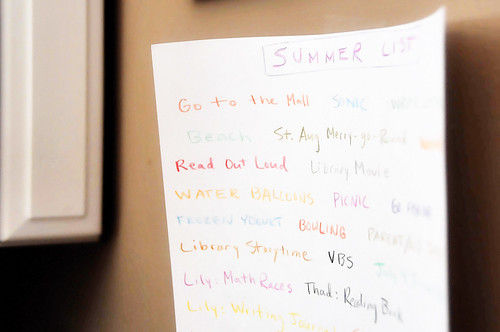
Our Summer List is nearly illegible. Most of the items are crossed through. I might have drawn a neat pencil line through each activity (trying to check it off but not erase it). My young daughter, who has not yet learned to grasp desperately at passing time, obliterated most of the list with a thick, black marker.
On the record, I’d say that our list helped shape an enjoyable summer. Though, the perfectionist zeal of my first-born did lead to a difficult argument on one of the final days of summer vacation. No, I had to tell her, we cannot visit the carousel, go on a picnic, keep a writing journal, and make playdough all in a single day just because they are still on the list. The compromise was a half-hour drive to the carousel. And a few more memories for our piggy banks.
The Summer List did not completely silence the eternal summer cries of “Mom, I’m bored!” Nor should it have.
I tend to think that boredom is good for children, like green beans and sharing a bedroom. I tell them as much, though they remain unconvinced.
I thought I believed my own preaching, but I began to doubt that over the summer. I too have been bored. Very bored. I discovered that, for me at least, green beans and sharing a bedroom are much, much better than being bored.
Of course, boredom is a privilege. If I had to walk miles in fear to collect water for my family, I would not be bored.
I wonder, is boredom merely a lesser evil, or might it have some good to offer?
I know that I don’t like it, I know that I don’t want it, and yet I write out here a few of the gifts boredom has recently given me:
To be bored is to be unhurried.
When my toddler throws a screaming fit, I let him scream. But, I also sit down close by because nothing else is screaming for my attention. When he’s ready to climb into my lap, I’m right there.
To be bored is to be waiting.
I have been thinking (and, let’s face it, hoping) that boredom might be one of the final stages of resting. When we first rest from work, we are content to simply be. After a while, our minds, our hearts, our bodies are ready, once again, to do.
To be bored is to be listening.
God is always talking. Sometimes He has a lot to say, and He says it in some big way, but, more often, He is whispering. When I am bored out of my mind, my ears are searching for any sound from Him, so eager am I to hear the extraordinary break into my ordinary.
by Christie Purifoy | Aug 23, 2011 | Books, Family, guest post, healing, motherhood, Uncategorized

My love for books is well known. However, books haven’t always come through for me. They haven’t always given me the answers I’m looking for.
In my house, there is a particular shelf of books that have failed me utterly.
I’m honored to be writing over at Lisa-Jo’s place today. Won’t you join me there for the rest of the story?

