by Christie Purifoy | Apr 4, 2012 | Family, Home, Lent, motherhood, Seasons, Uncategorized

(photos by yours truly)
It’s Holy Week. It’s also – in our house – Spring Break.
Which means there are fewer quiet prayers and meditations, more picnics at the park and kids screaming in the car. In other words, the holy is not hard to find. It’s in my face, and it’s ringing in my ears (quite literally).
My Bible has stayed mostly closed, and I’m not sure if Friday’s Tenebrae service is appropriate for my eight-year-old, but this may all be for the best.
There has been time, after all, to cross one item off of my most important
to-do list.
Flowers for the Doll Family.

(the dollhouse dining room prepared for Easter brunch)
by Christie Purifoy | Jan 4, 2012 | Community, Florida, Home

That’s the name lettered over the door of the small shop. Home At Last. It makes me laugh. Somewhat bitterly, I’m afraid.
On this day, we are fifteen-years married, and, to celebrate, we wander the streets of this Texas hill-country town, the fruit of our union miles away at Grammie and Granddad’s house.
Sitting down to eat lunch amidst a babbling brook of soft, Texas accents, we talk about home. We may have grown up in this place, but each return only emphasizes how far we’ve fled. We’ve lived away nearly as long as we lived within, and even the memory of Texas as home is fading.
Our waiter asks where we’re from, and I suddenly realize how often we’ve heard this question today. Why? How do they know? Jonathan wrinkles his forehead and says, “Well, we don’t have accents?” Maybe, I say. Then my husband, the one I often imagine to be the less observant in our partnership, states what should have been obvious: “I don’t think we look like Texans. At least not small-town, hill-country Texans.”
My husband sits across from me in skinny cords and a sweater vest, looking unsure, and I laugh because the truth is suddenly so obvious. The men who pass by our window are all dressed as if they’ve just left either a football stadium or a deer blind. They are window shopping with their wives, they are nowhere near a stadium or a deer blind, but they look utterly at home.
Where are we from? We can no longer answer that question. It did take years, but at one time I could say “Chicago” with ease. Now, each time we’re asked, Jonathan says, “We live in Florida,” but we both know that this is not the answer to “where are you from?” or even “where is your home?”
We have a house in Florida, but we only dream about home.
I like to imagine that home is somewhere with snow. The kids tell me it’s a place with room for a dog.
Others tell me that the ache for home is all there is. At least for now. At least on earth.
I don’t believe them.
Home is too good. Too necessary.
We may be souls walking the shadowlands, but these shadows are God-made and God-breathed. The place that feels like home may only be a taste of what’s in store, but it is still good.
And the best part? To find a home is to reach, not an end, but a beginning.
by Christie Purifoy | Dec 1, 2011 | Advent, Community, Home
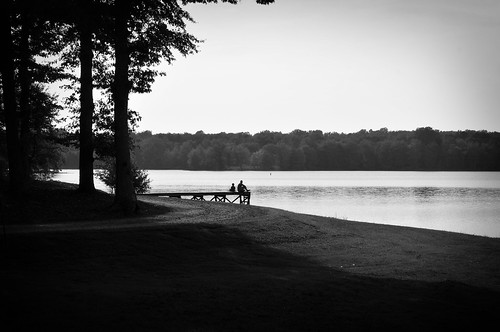
Perhaps the most difficult thing about darkness is that it tells us we are alone.
Darkness, it lies.
Long ago, the church began celebrating its new year during winter’s darkest days. This seems right and good, to me. It’s in times of darkness that we most need to be reminded that we do not wait alone.
Whether or not we’re able to attend church regularly, whether or not we’ve found a place to call our church “home,” and whether or not we truly feel at home there, we do not wait alone.
I believe that this is true, even on the days when it doesn’t feel true. Even on the days when I find community in the pages of a book written decades ago rather than in flesh-and-blood conversation.
In fact, waiting with others is the point of Christian community. One of my favorite writers, Henri Nouwen puts it well:
“The whole meaning of the Christian community lies in offering a space in which we wait for that which we have already seen. Christian community is the place where we keep the flame alive among us and take it seriously, so that it can grow and become stronger in us. In this way we can live with courage, trusting that there is a spiritual power in us that allows us to live in this world without being seduced constantly by despair, lostness, and darkness. That is how we dare to say that God is a God of love even when we see hatred all around us. … We say it together. We affirm it in one another. Waiting together, nurturing what has already begun, expecting its fulfillment – that is the meaning of marriage, friendship, community, and the Christian life.” (from “A Spirituality of Waiting,” as written in my Book of Quotations)
Sometimes I feel lost in the darkness, whether it is a global darkness (famine, crimes against children, poverty) or the darkness that descends when I forget that life is not meant to be as complicated as I sometimes make it (with my buying, my rushing, my worrying).
Advent reminds me to slow down, to light my candle, to find comfort in the many candles lit around me, and to know, again, that if the only thing I do most days is wait patiently, with thanksgiving, then I have lived well.
“The Photographer,” otherwise known as Kelli Campbell, invites each of you to contribute your own Advent images to the Advent Flickr group. If you are not a photographer, we hope you will still join both of us there to watch as the season quietly unfolds in pictures.
by Christie Purifoy | Nov 16, 2011 | Florida, God's Love, Home, Seasons

My children make lists for Santa (yes, already), and I peer over their shoulders considering the annual dilemma. Which is better, to receive just what you have asked for or to be surprised with the lovely yet utterly unexpected? In other words, the castle Lego set he spied at the big-box store or the box of fairytale Lego figures that I think will inspire more creative play? The book she read at her friend’s house and loved, or the book she’s never heard of that I’m sure she’ll enjoy?
It’s a question I wrestle with particularly during this time of year. Autumn. A season when I long for predictable gifts: falling leaves, cold blue skies, and crisp apples hand-picked by my children.
But these are not the gifts given to me. Instead, as I write this, I can see from my window hot pink camellia blossoms and pale orange tangerines. God, don’t you know that I’m not really a hot-pink kind of girl? Can I exchange the showy flower for something a little more subtle, leaves crackling underfoot, perhaps?
It would be too easy to write that these, tropical flowers and citrus fruits, are the true gifts, and I just need to learn to appreciate them. Who am I to criticize the good things God gives? Who am I to find fault with a creation that is undeniably beautiful and sweet?
And yet … as good as tangerines may be, they do not feel like home to me. Some may taste a personal love note from God in the taste of a just-picked tangerine, but I taste nothing so personal. Good, yes, but not exactly personal.
Still, I can say thank you for the tangerine, and I can mean it. Thank you, God, for speaking a thousand different languages of beauty. Tropical. Desert. Aquatic. Forest. Prairie. Mountain. All good.
Thank you, too, for making me uniquely me. It may look as if I’m hard-to-please. I prefer to think that I am hungry for the love notes that are mine especially. It isn’t that I deserve them, or that I can’t live well without them. It’s simply that I’ve tasted those honey words before, and I trust that there is more, much more.
“… with honey from the rock I would satisfy you.” Psalm 81:16
I remember the sweet taste of things I love best and know that I have tasted God’s goodness. I could spend the rest of my life in the shadow of citrus trees and camellia shrubs, but every day would be drawing me closer to the source of all beauty. Every day would be bringing me towards the love that speaks my language. The love that knows my name.
by Christie Purifoy | Nov 8, 2011 | Books, Home

I recently bought a chair.
To be more precise, I bought an arm-chair.
This is no hard-backed dining chair. This is a reading chair, a tuck-in-by-the-window-with-a-stack-of-books-and-a-cup-of-tea-chair.
Full confession: I already had a good reading chair. With its faded green-velvet slipcover, it is soft and welcoming. It even has a small hole on the right arm, an x-marks-the-spot for the exact right place to rest my book. In our Chicago apartment, this chair sat between our third-floor window and a built-in bookcase. The ideal spot for reading; the ideal spot for thinking.
This chair still sits in the living room, but in our Florida house it has no window (the window, in this case, consisting of a sliding-glass door to the screened-in patio). A reading chair with no window is simply no good, in my opinion.
And so, I’ve been on the lookout for a new reading chair.
I’ve long kept its intended spot in mind. Because our Florida home is younger than our Chicago home (oh, by eighty years or so), the only consistently quiet spot in this house is in my bedroom (darn these contemporary “open” floor plans). If the quiet weren’t enough, the windows in this room would confirm it as the ideal place for reading: they are a tall, three-sided embrace for my writing desk with just enough room left over for an arm-chair.
And the view, you ask? Fruit trees, a spreading oak, water, and all kinds of birds.
Of course, as with any big purchase, there was no small amount of hand-wringing and budget-worrying. I want to live simply, but I recognize that my usual standards of comparison have become a bit skewed in a place where every other person appears to own a boat.
I might justify my purchase by saying, “Well, it isn’t as if I’m buying a boat.” And yet, I’ve learned that these two objects may not be all that different.
I know this because I sat next to a boat-owning businessman on my recent flight to Chicago. When he started talking to me about how much he loved living in Florida, I just smiled and nodded. I’ve learned that around here conversations tend to shut down once you admit to being more of a “cold-weather person.” It’s not hostility. Just bewilderment.
As I listened to him describe his weekends on the boat, the slow putt-putting to just the right quiet cove, I realized, with surprise, just how much we actually had in common. I understood that for some boat-lovers at least (and I’m afraid I must entirely exclude jet-ski lovers from this observation) a boat is like an arm-chair you can enjoy out on the water. It’s a place to sit, to hold a nice drink, to observe the glory of our world.
The biggest difference, as far as I can tell, is the cost of maintenance (in time and money). So, I am more than content to be an arm-chair kind of girl.
Still, it’s nice to know that I’m not quite the Florida-coast oddball I thought I was. I may not be a hot-weather person. I may not be a beach-person. I may not be a boat-person, but I know what it is to long for one inspiring, beautiful place.
I know what it is to sit in that place, quietly grateful.
