by Christie Purifoy | Apr 24, 2013 | children, Grateful, Pennsylvania, Uncategorized
Here is one thing I know: the world will keep on falling apart.
Sometimes it’s terrible, and you think you can’t go on. Bombs explode and guns are aimed at children, and the unimagined thing becomes our new reality.
Sometimes it’s a pebble in your shoe, a child apparently born without an indoor voice, and the discovery that you can, in fact, ruin brown rice even when you make it with an automatic rice cooker.
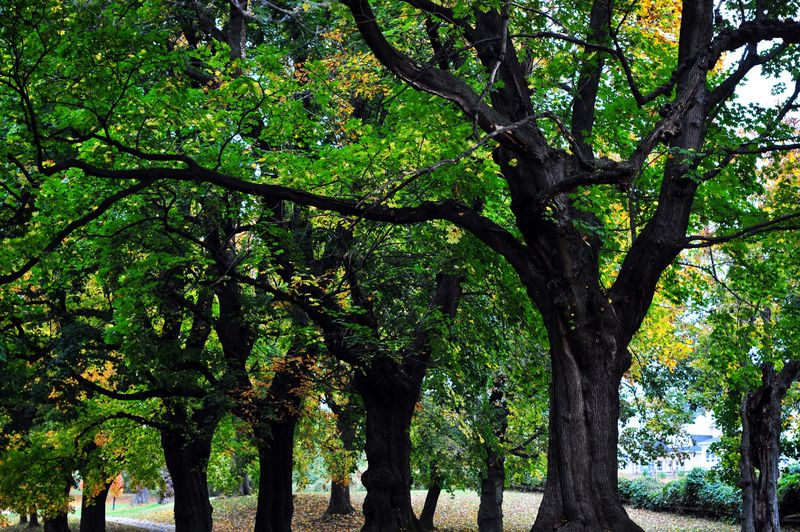
Sometimes it’s a Friday night thunderstorm that sounds terrible but lasts only fifteen minutes. You wake the next morning to blue skies and sunshine and the sight of a once-beautiful and massive maple tree lying stricken across your lawn.
The gloomy face of your chain-saw wielding husband annoys you. The tears of your firstborn both sadden and exasperate.
You move swiftly to combat both gloom and grief.
The tree was already at the end of its life! It was only a matter of time! It’s the circle of life! Nothing to cry about!
But you are wrong.
It is worth the gloom. It is even worth the grief.
The young girl is right, and you consider that even flowers were not created to fade. Life was never intended for death.
If we numb ourselves to the loss of one great tree, do we lose our capacity to grieve the harsher pain? The less explainable calamities?
Can our optimism become a kind of blindness? A refusal to see and acknowledge that all is not as it should be?

You are grateful your Saturday story does not end here. You consider that pain rarely seems to signal The End. In your (admittedly) limited experience, there is always something more.
Joy does come in the morning.
On this morning it appears in the form of a half-dozen teenagers. Needing to earn money for summer camp, you had agreed weeks ago (and quickly second-guessed your agreement) to give them odd jobs. You’d spent too much of the previous week worrying about the tall ladders involved in window washing and the poison ivy involved in brush clearing.
But here they are, and there, you have only just discovered, is the tree, and for that entire Saturday morning and the next Sunday afternoon, they will haul and carry and load. They will be your very own, unasked-for, tree-clearing work team, and your children will only occasionally slow their progress by treating the log pile like a jungle gym.
The tree is lost, and that is a terrible thing.
But it is not the only thing.
by Christie Purifoy | Apr 20, 2013 | Books, Gardening, Home, Pennsylvania, Spring, Uncategorized
This is a gardener’s favorite time of year. All is new green growth and hopeful expectation. Weeds, bugs, and wilting heat are yet to come. Snow and freezing temperatures seem more and more remote.
It is my favorite time of year.
Whether you are an armchair gardener or a gardener with dirt under your nails (I’m a little bit of both), here are three books for the season.

Wild violets in the yard here at Maplehurst.
(all the photos in this post taken by yours truly)
Gardening books are some of the favorites on my shelves. In the age of google you’d imagine the internet would be a gardener’s best resource. In my opinion, the internet is almost too helpful. It can be difficult to sort the good advice from the bad, and I rarely google a gardening question without ending up overwhelmed. A well-edited, common-sense garden reference book is so much better.
My copy of The Garden Primer: Second Edition by Barbara Damrosch is creased and dirty. Like a good cookbook, this is a sign of its worth. When we planted apple trees, this book showed us how. When choosing blueberry varieties, I consulted this book. From roses to vegetables, from seed starting to planting bulbs, this book has just enough (and never too much) to say about almost everything that grows.

I need to learn the name of these white-flowering shrubs. They are stunning.
I bought The Tree Book for Kids and Their Grown Ups by Gina Ingoglia for my children. They’ve enjoyed it, but I know I’ve opened it up more than they have.
The watercolor illustrations are beautiful and informative. Yes, we could always turn to google images, but it is so much more satisfying to take this book along for a walk, identifying leaves and bark and fruit along the way.
It’s one of my goals to know the names of all the trees growing here at Maplehurst. This book is a very nice way to start.

Lawns without weeds or dandelions make me nervous. Our own lawn supports a healthy ecosystem of weeds.
The title of Ruth Stout’s Gardening Without Work: For the Aging, the Busy & the Indolent pretty much speaks for itself. Originally published in 1961, this book by the folksy grand dame of American home gardening is funny, entertaining, and, occasionally, quite helpful.
Stout’s advice can pretty much be summed up in one word: mulch. But, it’s a very good word. Ask me in a few years if mulching has really made vegetable gardening easier, however my broccoli seedlings do look very cozy in their mulched bed.

The magnolia blossoms are almost as beautiful after they’ve fallen.
Do you garden?
by Christie Purifoy | Apr 17, 2013 | Florida, Gardening, God's promises, Grateful, Home, Joy, Pennsylvania, Seasons, Spring, Uncategorized, Waiting
Spring has finally come to Maplehurst, and we are living in a watercolor world. Trees are smudged with the almost-neon green of new buds. The ground is blurred by the purple and white of wild violets. Move your head too quickly, and the brilliant yellow of the dandelions might just look like a lightning strike.
For several days, I have noticed a spot of garish orangey-red near the laundry room steps. I assumed it was a child’s toy. Something awful and plastic. Today, I realized it was a patch of tulips striped orange and yellow. They have large, black polka-dots in their middles. They are the tackiest flowers I have ever seen, more like circus clowns than plants. These tulips, bursting out near the propane tank, prove spring does, in fact, have a sense of humor.

I was twenty-one before I witnessed a real spring, the kind that only comes after a long, cold winter. We were living near Washington D.C.. I had never seen redbuds and forsythia, cherry blossoms and tulips. And the dogwoods. Oh, the dogwoods.
I’d been raised by a farmer-turned-gardener, but I’d never paid much attention to plants. That first spring, something woke up in my twenty-one-year-old soul, and I’ve been paying attention to plants ever since.
On a walk to see the cherry blossoms near the Jefferson Memorial that spring, I noticed a spectacular flowering tree. It looked as if a hundred thousand delicate, pink-winged birds had come to rest on its branches. I took a closer look at the flowers, and I knew they resembled magnolia blooms.
I may not have paid much attention to Texas flora beyond the justifiably famous bluebonnets, but I, like any southern girl, knew that magnolias never lost their dark, glossy green leaves. I also knew that magnolia blooms are pure white, as big (or bigger) than a baby’s head, and they merely dot the tree, like ornaments placed just so.
In other words, this brilliant pink explosion of a tree could not be a magnolia.
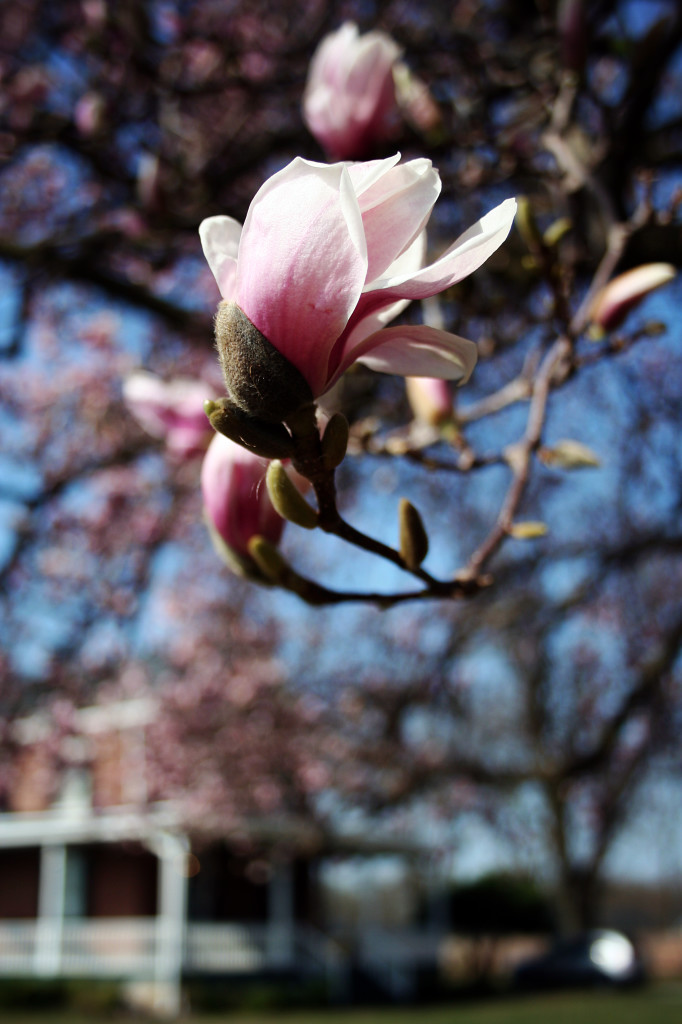
But it was. That year, that first spring, I learned the difference between the south’s evergreen magnolias and the deciduous varieties grown farther north. I learned the difference, and I chased it.
After two years in Virginia, it was time to choose a graduate school. I took one look at the blooming pink magnolias lined up against the gothic grey of quadrangle walls and knew I’d be moving to Chicago.
After Chicago, I lived for two years in a Florida house with an evergreen magnolia centered proudly in the front yard. It was lovely, yes, but it reminded me that I was living in an eddy. My life had turned backwards and sideways. For two years, I had no spring.
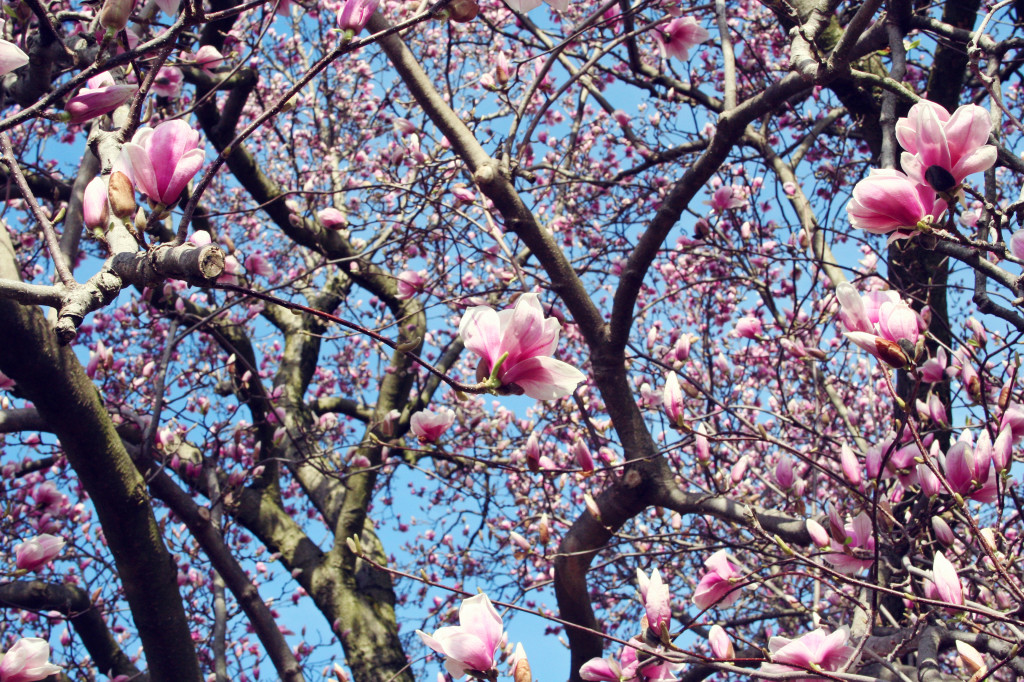
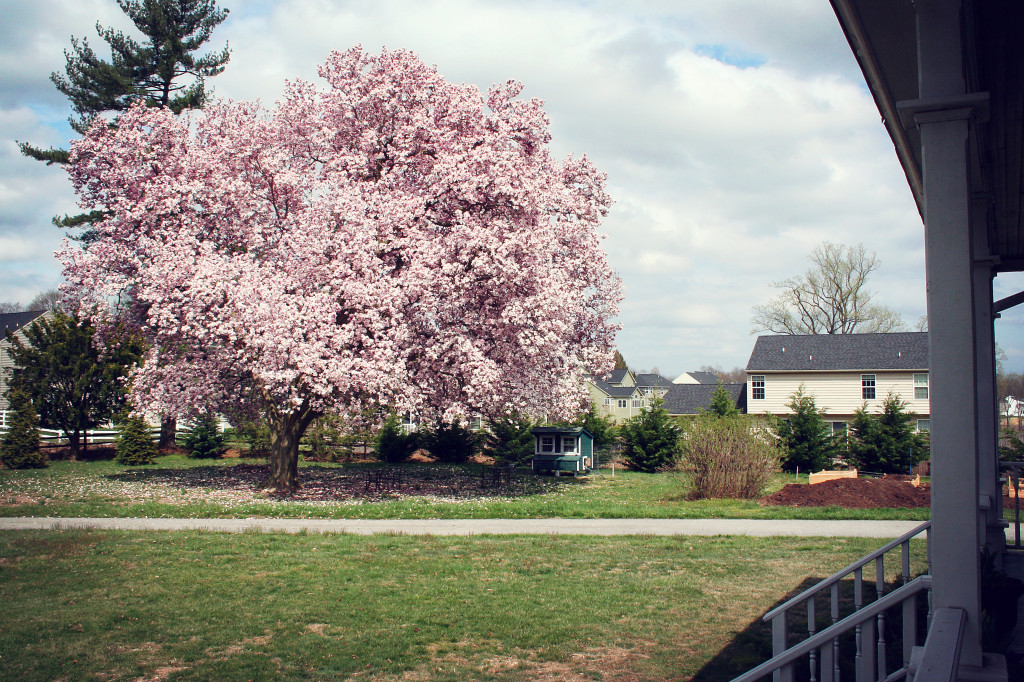
Nine months ago, we moved to Pennsylvania, to this Victorian farmhouse called Maplehurst. I knew the old tree planted north of our front porch (a tree that must be as old as the house itself) was a magnolia. A deciduous magnolia. The largest I have ever seen.
And I’ve been waiting.
Waiting for God to keep his promises, waiting for life to get a little easier, waiting for spring – spring like we haven’t seen for three years – to come.
This was waiting as it is meant to be. Waiting with hope. Waiting with full expectation. This, not because I’ve finally mastered the spiritual discipline of waiting, but only because I have lived through a few winters, and I have seen them all end.
I have been waiting with eyes wide open because I could see the tree always outside my window. I knew what it had in store for me because I’ve seen it before.
But never this big.
Never this beautiful.
Never this good.
“Flowers appear on the earth; the season of singing has come.”
Song of Songs 2: 12

by Christie Purifoy | Apr 13, 2013 | Books, Uncategorized
I didn’t read many fairy tales as a child. I’m afraid my fairy-tale education was managed entirely by Disney.
I think, now that I’m grown, I’m making up for that deficiency.
I love stories with their roots in faerieland. I love books in which the line between fantasy and reality is, not blurred exactly, but elusive, as if we are experiencing the world we know but reflected, as in a mirror or pool of water.
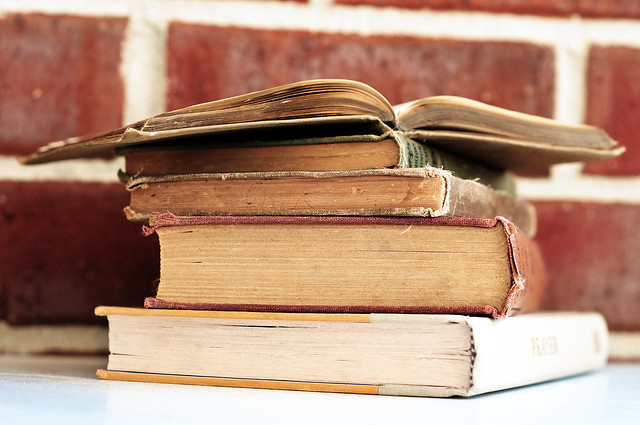
The books I’m thinking of are not magical realism. They are stories in which the magic is decidedly bookish. They are stories that remind us we cannot actually separate what we call reality from the tales we pass down around campfires and cradles.
To believe that stories (and the wonders and monsters with which they are filled) belong to some reality that does not touch us in our daily lives is to grossly underestimate the power of a fairy tale.
There are some truths we can only face by fencing them off and naming them Cinderella or Sleeping Beauty.
These books suggest that those fences may not be as strong as we like to think.

The Snow Child: A Novel by Eowyn Ivey is a new favorite. The story it tells is at once familiar and strange. There is an old man and an old woman. They have no children. One day they build a child out of snow, and that child is made alive by love and longing.
This is also a story about homesteading in Alaska in 1920. If cabbages grow to enormous sizes almost overnight because the sun never really sets is that fairy tale or reality? It’s difficult to say, and that is what I loved best about this novel. Our ideas of real and not real are tested, but they still matter.
Ivey does a masterful job of keeping her story always precisely on the line between fairy tale and real, lived experience. By the end, this beautiful, enjoyable novel proves that the line between the two is much less important than the fact that love is the most powerful element in both.
In my old age, I see that life itself is often more fantastic and terrible than the stories we believed as children, and that perhaps there is no harm in finding magic among the trees. – Eowyn Ivey
Little Black Book of Stories is A.S. Byatt’s collection of fairy tales for adults. I haven’t read this one in a few years (I think I’ll remedy that over the weekend), but I remember being captivated by stories that are dark, smart, and twisty-with-surprises. These are most definitely tales for adults, but the darkness is not unrelenting. One of my favorites is the tale of a grieving woman slowly turning into stone. It sounds horrifying but it is in fact beautiful, even redemptive, and the explicit link between Byatt’s story and Icelandic fairy tales is just the kind of thing I love.
She thought human thoughts and stone thoughts. The latter were slow, patchily coloured, textured and extreme, both hot and cold. They did not translate into the English language, or into any other she knew: they were things that accumulated, solidly, knocked against each other, heaped and slipped. – A.S. Byatt
I couldn’t recommend fairy tales for adults without mentioning at least one book by George MacDonald. Phantastes is the one I have in mind to re-read. Do you have a favorite book by MacDonald?
Rather than describing this particular book, or any of the others, I will only remind you what some of my favorate writers have said about him.
C.S. Lewis said, “I have never concealed the fact that I regarded George MacDonald as my master; indeed, I fancy I have never written a book in which I did not quote from him.” W.H. Auden called MacDonald “one of the most remarkable writers of the nineteenth century.” My beloved Madeleine L’Engle wrote that “Surely, George MacDonald is the grandfather of us all – all of us who struggle to come to terms with truth through fantasy.”
All mirrors are magic mirrors. The commonest room is a room in a poem when I turn to the glass … – George MacDonald
Do you have a favorite fairy tale?
by Christie Purifoy | Apr 9, 2013 | children, Grateful, guest post, poverty, Uncategorized
Are you visiting from J.R.’s Love is What You Do? Welcome.
I write about the kingdom of God. About motherhood. About books.
I pray that the kingdom comes down to my own bit of Pennsylvania countryside.
I try to pay attention when it does.
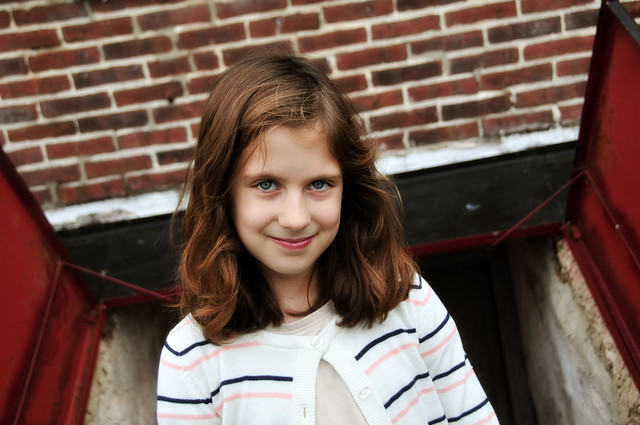
J. R. Goudeau is a PhD candidate in English literature. When I was a PhD candidate in English literature, I used my spare time to lounge senseless on the sofa while my husband bathed and bedtimed our young kids. J.R. also has young kids, but she has used her spare time to found and direct Hill Country Hill Tribers, a nonprofit helping to support the skilled artisans of refugee communities in Austin, Texas.
Yes, she’s amazing. I’m blessed to call her a friend. I’m blessed to be sharing this story at her place today.
Blessed
Our refrigerator is a typical mess of grocery lists, crayon drawings, and expired coupons. In the middle of the mess is something more precious: the photographed faces of three young children. They are not family, not even friends, exactly. They live on three different continents, and we do not speak their languages. They are our sponsored children.
My daughter is writing a letter to the oldest girl. They share a birthday. This child has written to us that she loves to play ball. Also, the rains have been plentiful.
My daughter stops writing, looks up at me, and I see something like guilt in her eyes. “I’m glad we’re not poor,” she says.
//
I believe in the work of this sponsorship program. I believe in holding wealth with open hands. I believe in giving it away. But I worry about the unintended message these three photographs may be sending to my children, children who know their own faces appear on no one’s refrigerator but Grandma’s.
I wonder if these images in our kitchen are bridging a wall or building it up.
A wall distinguishing us from the poor.
A wall separating us from the poor.
A wall we only cross with dollars, cents, and the occasional letter.
Because we, thank you Jesus, are not poor.
…
You can find the rest of my story here.


