If there is one word to describe most parents of young children, it is this: tired.
However, the tiredness itself doesn’t always make sense. It isn’t always logical. For instance, there is this strange equation: I am less tired, less overwhelmed now with three children than I was with one (and my youngest has yet to learn to sleep all night in his own bed).
I’ve come to believe that many of the most difficult periods of parenting are like bad weather. The radar map of my early years as a mother was covered in angry reds and oranges. More recently, the forecasts have called for blue skies, occasional rain.
Is there some parenting secret to be tapped here? Have my years of experience brought me wisdom and thus fair weather?
I don’t think so. If anything I have abandoned my early intensity to always do the right thing. I have forgotten much of my new-mother knowledge.
Absorbed in the busyness of living, I can no longer recall the good advice of the parenting books I used to read. When the two-year-old refuses his bedtime and asks for popcorn instead, I sometimes remember how firm and controlling we once would have been. Now, more often than not, our evening couples time is spent in the company of a toddler. We talk over his head and share our popcorn. Maybe it isn’t ideal, but it isn’t terrible, either. He’s very cute eating his popcorn, this one is.
And yet, the “secret” if there is one doesn’t lie in a relaxation of standards or parental laziness. The weather is fair, but I’m convinced that we can take little credit for this.
The little girl who was overwhelmed by life (and so overwhelmed her mother) has shifted into the child who starts her homework as soon as she walk in the door after school, the child who makes her bed every day because she likes her room to look nice. Knowing firsthand how emotions spiral out of control, she says to me, “The girls will probably fight to sit next to Emma at the birthday party. But, I’ll be okay sitting next to someone else.”
How did this happen? Andwhy did I assume that the weather would always be rough? Why did I listen to the well-meaning older parents who said, “Oh, just wait! If you think it’s hard now …”
Jesus has said, “Don’t worry about tomorrow. Tomorrow will worry about itself.” And, yes, I find that each day does have its own trouble. But far worse than the particular trouble of each day is our despair when we believe that all we can hope for are storms. The storm is one thing, but the hopelessness that says, “morning will never come” is much more destructive.
Morning will dawn, and the one who is beaten down by life’s storms will open the door and find sunshine. Perhaps that day is coming sooner than you think?
It’s a mystery. One day (in a succession of many, many such days) you are a still and brackish puddle of water. No movement. Not much life. Then, something imperceptible happens. Perhaps, Someone breathes just a bit of Himself over the stillness? And the still puddle begins to trickle. It’s no river, certainly, but there is just a hint of movement, just a hint of renewal. Some fresh spring has begun to flow.
Nine months ago I began writing a story. My story. For the past five months the draft of that story has sat, locked in my computer, untouched. But this week I opened it up again. I started rewriting, tweaking, adding new thoughts.
It feels good to be at work again.
The only problem is that I’m feeling, here at the end of the week, just a bit dried up where words are concerned. Perhaps it’s only laziness, but I feel better remembering George MacDonald’s words: “Work is not always required. There is such a thing as sacred idleness.”
I’m giving myself over to idleness for the next few days. Let’s hope it’s of the sacred sort.
Meanwhile, since I have few words of my own today, here are the words (and a few images) I’m carrying with me into this weekend:
“I am the Lord your God, who brought you up out of Egypt. Open wide your mouth, and I will fill it.”
Taken yesterday by Yours Truly. Ok, it was six years ago. It just feels like yesterday.
I read tall, teetering stacks of parenting books when I was pregnant with my first. Not one told me how much it would hurt.
Oh, sure, they talked about childbirth. The pain of it. I read a lot about that, and I was prepared. Well, as prepared as you can ever be.
But not one of those books prepared me for the pain of loving.
To love a child is to hurt. Desperately. They seem to grow and change by the minute, and this growth is both a good thing and a terrible loss. Every day you are saying goodbye: to the baby you held, the toddler who made you laugh, the brave one who left for her first sleepover. And on it goes. They’re relentless, these goodbyes.
I have never looked at old photographs without an almost physical pain. Of course, there’s pleasure too. But you expect that. It’s the pain that feels so strange. It’s the pain that seems to demand some sort of answer. God, does love have to make us cry?
There’s a song by the group Mumford and Sons called “After the Storm.” My favorite line is this: “There will come a time, you’ll see, with no more tears and love will not break your heart.”
Do you believe that? Do you believe that one day love, like everything else, will be perfect and whole? That one day there will be no more goodbyes?
Peter told us that “[Jesus] must remain in heaven until the time comes for God to restore everything” (Acts 3:21). And I can’t help but wonder: when he says “everything,” does he mean everything? Will God restore everything that we seem to lose in this life?
Will there come a day when love will not break our hearts?
It isn’t that I had no time for reading this weekend. I spent most of Saturday and Sunday tucked up close to a window, book in hand, enjoying the cool breeze. It’s only that I played Gungor’s just-released album as background music, but the story this album tells refuses to stay in the background. I kept lowering my book in order to pay better attention to Gungor’s stories.
Ghosts Upon the Earth is an album* to listen to from start to end, from God creating (“Let There Be”) to creation worshipping (“Every Breath”).
I’ve written quite a bit about waiting. This song, “The Fall,” puts it so much better than I ever could, especially when the line “turn your face to me,” becomes a duet.
I have sometimes wondered lately if I am waiting on God or if God is waiting on me. I think that the same can be said of our world. We look around at all the misery and wonder why God seems silent. Some pray, “God, turn your face to me.”
But how can we forget that God whispers the same words to us? God waits for his creation, he waits for us, and he cries, “Turn your face to me, turn your face to me.”
* When I introduce music on this blog, it’s because I’ve already purchased the song (or, more likely, the entire album) for myself, and I think you should too!
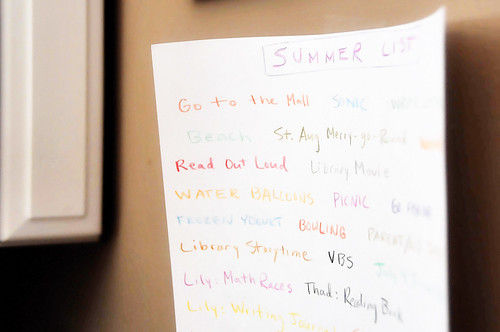
Our Summer List is nearly illegible. Most of the items are crossed through. I might have drawn a neat pencil line through each activity (trying to check it off but not erase it). My young daughter, who has not yet learned to grasp desperately at passing time, obliterated most of the list with a thick, black marker.
On the record, I’d say that our list helped shape an enjoyable summer. Though, the perfectionist zeal of my first-born did lead to a difficult argument on one of the final days of summer vacation. No, I had to tell her, we cannot visit the carousel, go on a picnic, keep a writing journal, and make playdough all in a single day just because they are still on the list. The compromise was a half-hour drive to the carousel. And a few more memories for our piggy banks.
The Summer List did not completely silence the eternal summer cries of “Mom, I’m bored!” Nor should it have.
I tend to think that boredom is good for children, like green beans and sharing a bedroom. I tell them as much, though they remain unconvinced.
I thought I believed my own preaching, but I began to doubt that over the summer. I too have been bored. Very bored. I discovered that, for me at least, green beans and sharing a bedroom are much, much better than being bored.
Of course, boredom is a privilege. If I had to walk miles in fear to collect water for my family, I would not be bored.
I wonder, is boredom merely a lesser evil, or might it have some good to offer?
I know that I don’t like it, I know that I don’t want it, and yet I write out here a few of the gifts boredom has recently given me:
To be bored is to be unhurried.
When my toddler throws a screaming fit, I let him scream. But, I also sit down close by because nothing else is screaming for my attention. When he’s ready to climb into my lap, I’m right there.
To be bored is to be waiting.
I have been thinking (and, let’s face it, hoping) that boredom might be one of the final stages of resting. When we first rest from work, we are content to simply be. After a while, our minds, our hearts, our bodies are ready, once again, to do.
To be bored is to be listening.
God is always talking. Sometimes He has a lot to say, and He says it in some big way, but, more often, He is whispering. When I am bored out of my mind, my ears are searching for any sound from Him, so eager am I to hear the extraordinary break into my ordinary.