by Christie Purifoy | Mar 7, 2015 | Books, Gardening, Uncategorized, Winter
No doubt most of you are not sitting under a foot of snow as we are here at Maplehurst, but early March days are still ideal reading days.
I’m reading mostly gardening books, which, I suppose, must mean that I am a very hopeful person. Or else that I am practiced in denial.
I have a stack of gardening books currently checked out from my library, including the coffee-table treasury Visions of Paradise by photographer Marina Schinz. It begins with these words:
To create a garden is to search for a better world. In our effort to improve on nature, we are guided by a vision of paradise. … This hope for the future is at the heart of all gardening.
I think this is true of gardening, but my late-winter prayer is that these words would be true in every area of my life. That my reading, my loving, my working – everything – be motivated by hope for the future.
The following post contains affiliate links. You can find all my book recommendations here.
My favorite book in that stack of gardening books is The Essential Earthman: Henry Mitchell on Gardening .
.
Henry Mitchell was a columnist for the Washington Post. This posthumous collection has been called “one of the great American gardening books,” and I absolutely agree. This is wonderful reading: informative, practical, hilarious, witty. In its own subtle way, it is brilliant.
Its appeal for gardeners is obvious, but as I read I decided the book was worthy of an even broader audience. Almost all of the pieces are wonderful examples of what newspaper opinion writing can be.
We can all learn something from Henry Mitchell. We might learn about planting peonies or which varieties of daffodil are the most glorious. Or, we might learn the subtle art of communicating one’s own strong opinions in the most disarming and entertaining way.
*
Dept. of Speculation (Vintage Contemporaries) by Jenny Offill is not like any other novel you have read. I am sure of that. It is more like one of those works of art that looks, from a distance, like a hyper-realist portrait but is, upon closer examination, found to be made up entirely of buttons or bottle caps.
From a distance, this is the story of a marriage that is falling apart. Now, I know that sounds entirely too depressing for late-winter, but the full arc of the story is hopeful and beautiful.
But close up? This is a strange collection of thoughts and facts and memories. I tend not to like experiments in fiction, James Joyce excepted, of course. But when an experiment works, it really, really works. And this one works.
There is nothing self-indulgent about Offill’s writing. Instead, she has found a new way to tell a familiar story, and the result is astonishing.
*
I sometimes postpone writing these book recommendation posts because I worry that I haven’t read enough new, great books. I forget that the premise, when I began, was simply to tell you about the books on my shelves. Or, more accurately, the books taken off the shelves and left lying near beds and armchairs.
We’ve loved Mary Ann Hoberman’s picture book The Seven Silly Eaters for years, but this book has recently come off the shelf for round after round of reading. Elsa loves it, but my nearly-six and nearly-nine-year-old boys come like moths to a flame when they hear me reading it.
We are big fans of other Hoberman books, especially A House Is a House for Me and The Llama Who Had No Pajama: 100 Favorite Poems
 , but The Seven Silly Eaters is special. It’s the rhyming story of a tired mother with seven picky-eaters for children, but, like all great picture books, it offers so much more. Every illustration tells a story of its own, and, I think, every family will find something of themselves in its pages.
Do you think your child is too old for picture books? Do you think you are too old for picture books? Then I recommend The Seven Silly Eaters as a very necessary corrective.
Happy reading, friends.
*
by Christie Purifoy | Jan 17, 2015 | Books, Gardening, Seasons, Uncategorized, Writing
Books have always felt like bread and water to me. Necessary. Daily. Delicious.
I am finding that to be even more true as I round the final bend of book writing. There seems to be an almost exact correlation between words in and words out.
These days, I am reading in order to keep the sounds and rhythms of good writing foremost in my mind. I am reading to jolt new ideas. I am reading to learn. I am reading to rest. It usually takes a book to shut my own book out of my head for a while.
Here is a little bit of what I’ve been reading.
You can find all the book recommendations in my occasional Saturday series right here. These posts contain affiliate links.
*
I never, ever recommend books I haven’t actually finished, but I’m making an exception for Jean Hersey’s The shape of a year . This book is a vintage gem, and I think I bought my copy for one dollar plus shipping. It’s worth fifty times that.
Hersey was a garden writer, and this book observes the four seasons on her rural Connecticut property with curiosity and joy. This is a book all about the simple pleasures of the seasons. It begins in January, and I have only allowed myself to read through March (because I want to walk through all of this year with this book nearby).
Some might complain that nothing much happens. It’s true that this isn’t a book full of human dramas. But Hersey knows what everyone with eyes to really see the world around them has discovered. There is always something happening.
*
I am afraid that the lady doth protest too much because I find myself recommending one more book I haven’t quite finished. Perhaps that is the true theme of this post: Books I’ve Partly Read! But the new nonfiction book by the novelist Ann Patchett is another one for savoring. I could sit down and read it in one gulp, but it’s January. Self-control and discipline are in the air this time of year.
This Is the Story of a Happy Marriage is a collection of essays and magazine pieces. Together they explore everything from how and why Patchett became a writer to what it’s like to try out for the Los Angeles police department. There’s a great bit about an RV road trip.
Patchett’s book is funny and fun. It hits all the buttons for me right now. Good writing that prompts new thinking in a collection that makes a restful, distracting escape.
*
This third book I not only finished but finished quickly. It is that mythical beast known as a page-turner. Fortunately, it is also well written and gives you a great deal to think about. It is Elizabeth Is Missing by Emma Healey.
This is a psychological mystery with a dose of historical fiction, but, mostly, it is a powerful portrait of growing older and of care-giving. I dare anyone to read this book without growing in empathy and compassion for the elderly.
What are you reading these days? And, perhaps more importantly, why?
*
by Christie Purifoy | Dec 6, 2014 | Advent, Blog, Books, Food, Uncategorized
It’s Saturday. Let’s have a little fun, shall we?
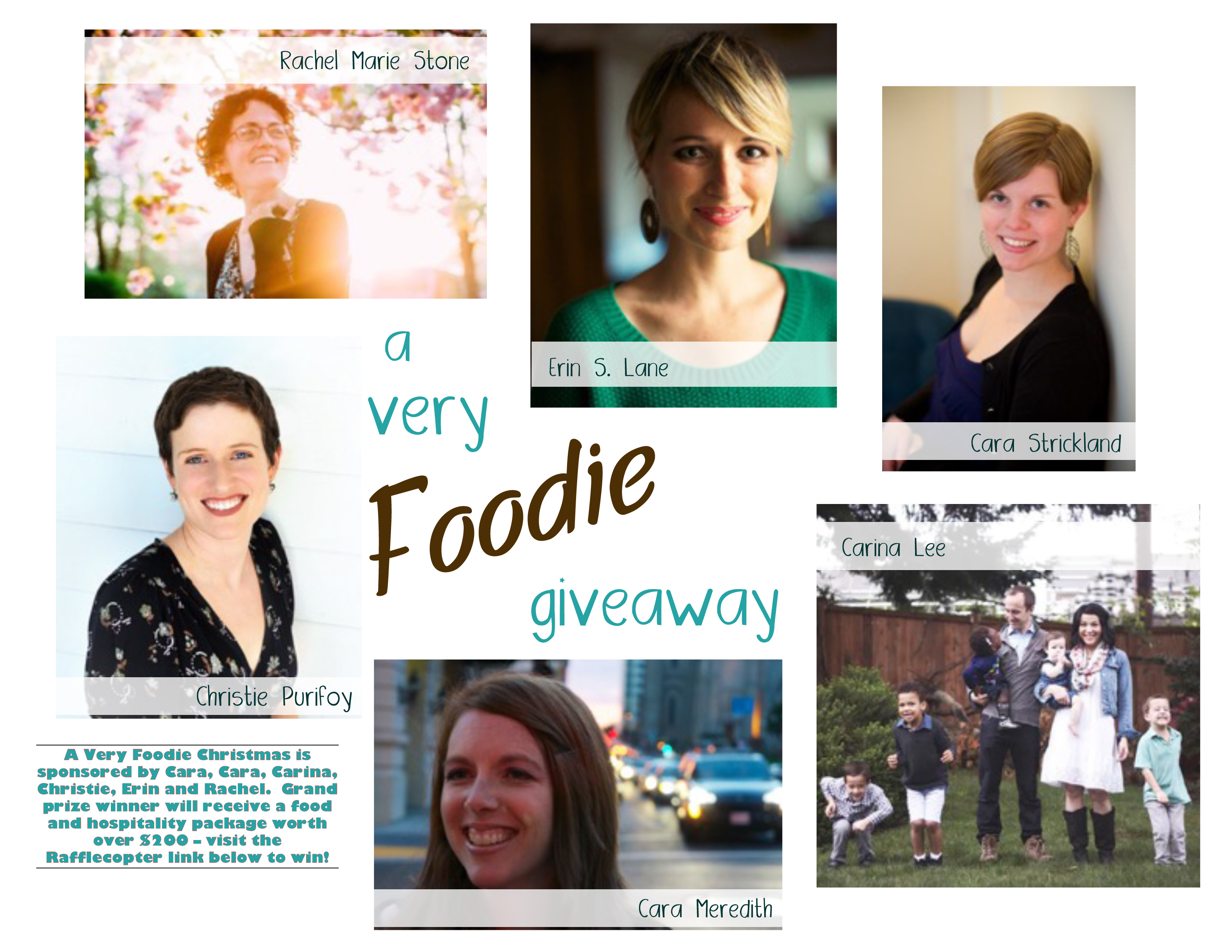
In addition to another installment of my Saturday series of book recommendations, I am inviting you to enter a fabulous foodie-themed prize giveaway organized by some of my favorite writers and a few new friends.
Let’s take a look:

I’m giving away a copy of one of my favorite cookbooks (a book I’ve recommended before), The Homemade Pantry by Alana Chernila, and a box of the magic white powder that changed my life. Seriously.
With Pomona’s Pectin you can make jam without any added sugar. Unlike every other pectin you’ll find on your grocery-store shelves that require equal (horrifying) amounts of sugar and fruit, with Pomona’s you can make your jam with fruit only, with a little honey, with fruit juice, with maple syrup, just however you like it. And jam-making (especially freezer-jam making) is one of the easiest, most satisfying things you can do in the kitchen.
Life-changing stuff, I tell you.

Cara Meredith is a writer, speaker and musician from the greater San Francisco bay area. She is passionate about theology and books, her family, meals around the table, and finding Beauty in the most unlikely of places. A seven on the Enneagram, she also can’t help but try to laugh and smile at the ordinary everyday. You can connect with her on her blog, Facebook, and Twitter.
*
Erin S. Lane is author of Lessons in Belonging from a Church-Going Commitment Phobe (forthcoming, February 2015) and co-editor of Talking Taboo, an anthology of writing by young Christian women on the intersection of faith and gender. Confirmed Catholic, raised Charismatic, and married to a Methodist, she blogs about faith, feminism, and, yes, cupcakes on her blog, Holy Hellions. You can also connect with her on Twitter.
*
Rachel Marie Stone is a writer living near Philadelphia. In the past eight years, she has lived in four countries and two states, and will gladly tell you about the various kinds of pizza she ate (or didn’t eat) in each place. Her book, Eat With Joy, won the Christianity Today Book Award for Christian Living. You can connect with her further on her blog, Twitter, andFacebook.
*
Carina is an etsy shop owner, writes when she can, works with Noonday to advocate for women around the world, and loves food. Preparing it, consuming it, sitting together around a table filled with friends and family enjoying it. She lives in Seattle, WA with her five lively children and one awesome husband, and drinks way too much coffee. You can connect with her on her blog, etsy shop, and Instagram(among other places).
*
Cara Strickland is a writer, editor, and food critic in Spokane, Washington. She writes about singleness, food, feminism, and the way faith intersects life (among other things) on her blog Little Did She Know. Come say hi to her on Twitter or Facebook. She likes making new friends.
If you’re reading this post in an email or a reader, you’ll need to click over to enter.
Rafflecopter giveaway
Good luck!
And now – books!
This week I picked up an old favorite and remembered why I love it so much. We may already be a few days into Advent, but this little gem can be enjoyed here and there as you make the time. The readings are diverse, all wonderful, and you never know what you might discover on a given day. It’s Watch for the Light: Readings for Advent and Christmas
While preparing this post I noticed that the paperback copy I own is no longer available. I am actually glad about that. This book deserves a hard cover, especially since, like me, you’ll be pulling it out year after year.
Winter Solstice by Rosamunde Pilcher is the perfect, cozy novel to reread each Advent season. I’m about to begin rereading it myself.
I say cozy, which it is, but I think this cozy is a cut above your typical holiday movie. This novel is thoughtful, sweet, never too sweet, atmospheric. It takes place in Scotland. Need I say more? This is one for reading by a twinkling Christmas tree.
I think books make the best Christmas gifts, and I especially love to give beautiful editions of classic favorites.
Of course, the problem with beautiful books is that I really just want them for myself. These new editions of the classic L.M. Montgomery series are lovely: Emily of New Moon: A Virago Modern Classic (Emily Trilogy).
Happy Advent, my friends.
by Christie Purifoy | Oct 11, 2014 | Books, Dreams, Gardening, Pennsylvania, Seasons, Uncategorized
Today, I am not giving you a peek at the bookshelves lining the walls of this old farmhouse.
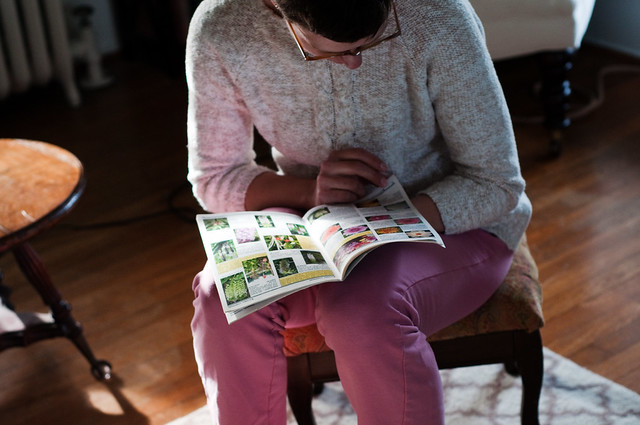
Instead, I am giving you a peek at what you’ll find spilling out of baskets and boxes. What you’ll find stacked beside my bed and by my armchair near the fireplace. I’m showing you my pile of dreams. My paper stack of wishes.
I am recommending plant and seed catalogs.
Why now? Why now as I put my vegetable garden to bed and watch for the first hard freeze?
Because gardens are born in winter. And this is the perfect time to sign up for at least a few (free) catalogs. They’ll be the guides to your dreams come December.
A garden should make you feel you’ve entered privileged space – a place not just set apart but reverberant – and it seems to me that, to achieve this, the gardener must put some kind of twist on the existing landscape, turn its prose into something nearer poetry. – Michael Pollan
The vegetable and flower seed catalog from Seed Savers Exchange is always a glossy, full-color treasure trove. This one is perfect for winter browsing, almost as good as a collection of short stories. You’ll read about the real “Grandpa Ott” behind “Grandpa Ott’s Morning Glories,” and the fascinating history of the “Moon and Stars” watermelon. Even better, by ordering heirloom seeds from the exchange you are also supporting the biodiversity of our planet.
The supermarket produce shelf offers a tiny slice – not even that, perhaps a pin drop – of the variety of creation. If a blight shows up this year favoring the (tasteless) grocery-story tomato, it will be the home-gardening seed savers and networks like Seed Savers Exchange who save tomatoes for future generations.
I don’t save many of my own seeds beyond a few dried flower heads. I’ve listed that activity under things I’ll do when I no longer have children underfoot. Until then, I do my part by ordering from Seed Savers.
Gardening is akin to writing stories. No experience could have taught me more about grief or flowers, about achieving survival by going, your fingers in the ground, the limit of physical exhaustion. – Eudora Welty
If you ever buy bulbs through the mail, especially daffodils and tulips, your mailbox will be flooded with catalogs claiming direct links to Dutch tulip fields. They will have phrases like “fine purveyors” on their covers. Brent and Becky’s Bulbs, a family operation based in Virginia, is pretty much the opposite of that. And I love them.
Brent and Becky (yes, they are real people) offer excellent service, quality bulbs, and fair prices. You can buy all the classic varieties, and you can find homegrown varieties they have named for a favorite relative or friend. Their catalog is full of advice and inspiration, and you can enjoy it at least twice a year. They send out separate catalogs for spring and fall-planted bulbs.
I buy my daffodil and tulips bulbs here every year. Last year I filled a bed with their lily bulbs. And I’ll soon be planting a few of their purple alliums.
I am intrigued by writers who garden and gardeners who write. The pen and the trowel are not interchangeable, but seem often linked. – Marta McDowell
The Antique Rose Emporium in Independence, Texas is a magical place. I grew up visiting it with my father, a farmer-turned-gardener, yet I somehow never dreamed of growing roses myself. Until, I came to Maplehurst.
Our little corner of Pennsylvania was once well-known for the roses Quaker farmers grew here for city markets. That heritage is still evident in street names and in long memories. Last year, it seemed important to me to bring roses back to Maplehurst. Of course, now I’m hooked.
I used to hear “antique roses” and imagine fussy, hard-to-please plants. If caring for antique furniture was more complicated than dusting a piece from IKEA, then surely plants were the same. Strangely, the opposite is true. If you are looking for a rose that is easy to grow, less susceptible to diseases and insects, and (bonus!) highly scented, then it is an antique rose that you want.
You can also find them described as “Old Garden Roses,” and the catalog from the Antique Rose Emporium is one of the best ways to learn about these wonderful plants. Thanks to this catalog and other books published by its founder, I have gorgeous, cabbage-y pink roses still blooming in my garden today. In the middle of October. Yes, you can call me a fan.
Also, I think it very important to support any business with “emporium” in its name. Just a personal pledge of mine.
I love my garden, and I love working in it. To potter with green, growing things, watching each day to see the dear, new sprouts come up, is like taking a hand in creation, I think. Just now my garden is like faith – the substance of things hoped for. – L.M. Montgomery, Anne’s House of Dreams
I grew dahlias for the first time this year, and I am hooked. My gardens all look a bit shabby by October, but the flower bed across from our front door has exploded with beautiful, bouncy, mop-headed dahlias. You can find a million pictures (approximately) of my dahlias on instagram. Like this one. And this one. I can’t seem to stop taking their pictures.
I’ve done little dahlia comparison shopping, but Swan Island Dahlias was recommended to me, and I will be ordering from them again. Their catalog is beautiful and extensive, and every one of the tubers they sent grew and thrived. My favorite bit? They stamp each tuber with the name of the variety. This made it easy to remember what I was planting and where.
Dahlias always intimidated me because I knew they weren’t cold-hardy. The thought of planting something only to dig it up again in the fall seemed ridiculous. Why would I do that? Well, now I know exactly why. (Also, here’s a tip. If you aren’t sure you can handle that amount of effort: plant them anyway. No one will ever know if you just leave them in the ground. And if it’s a mild winter? They may just come blooming back again.)
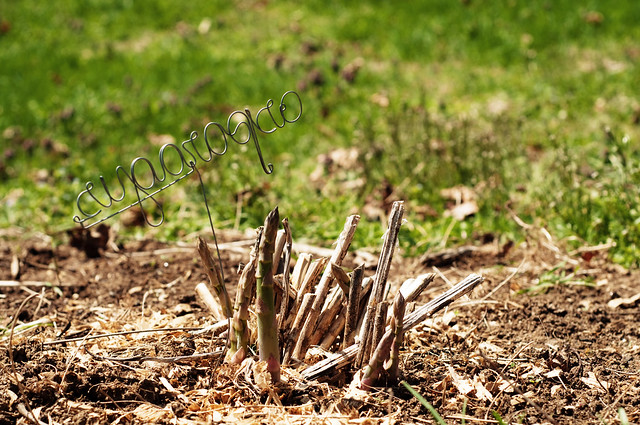
However many years she lived, Mary always felt that “she should never forget that first morning when her garden began to grow.” – Frances Hodgson Burnett
Now I’d love to know, do any of you garden? What are your favorite sources? Please share them in the comments!
by Christie Purifoy | Sep 27, 2014 | Books, Uncategorized, Writing
I’m afraid it’s been too long since I wrote anything new for this, my occasional series of Saturday book recommendations.
Truthfully, I’ve been reading up a storm, but it all felt so weirdly personal. Either I was reading very particular books intended to fuel my own book writing, or I was escaping into novels that seemed either too lightweight or too well known (or both!) to be worth mentioning.
But then I realized something. The only thing really holding me back from writing another addition to this series was pride. Pride because I didn’t feel I’d been reading anything earth-shattering enough, or esoteric enough, or special enough. As if I share book recommendations in this space in order to cultivate a certain self-image.
But pride is so boring. My own pride, especially. So, I’m kicking it aside and telling you, honestly, what I’ve been reading. It’s an oddball pile of books, but I think you might just find something you like. I know I did.
(P.S. These posts contain affiliate links. Find all my book recommendations here.)

I first read A Country Year: Living the Questions by Sue Hubbell months ago on a good friend’s recommendation. Hubbell is a university-librarian-turned-beekeeper in rural Missouri. This book offers four seasons worth of reflections rooted in her mountain home. It’s a quiet book. A plain book. But it sticks with you. Lately, I’ve been rereading it, hoping that some of Hubbell’s no-nonsense, beautifully observant style will wear off on me.
The Wisdom of Stability: Rooting Faith in a Mobile Culture by Jonathan Wilson-Hartgrove is new to me, though it was released a few years ago. Wilson-Hartgrove is probably best known as one of the so-called “New Monastics.” He writes simply and straightforwardly about his choice to stay in an impoverished, urban neighborhood. The book offers an easy introduction to monastic spirituality and what that might look like for us today. That is, it’s easy to read and Wilson-Hartgrove’s storytelling is easy to enjoy, but the stability he describes is hard. The kind of hard I want and need and hope to spend the rest of my life learning.
My love for picture books is well documented in this space. I’ve told you before that I think we push chapter books too often and too early. Quality picture books are not only works of art, but they tend to aim at a higher level of storytelling and language. All the Places to Love by Patricia Maclachlan is no exception.
This one was recommended to me by another friend. It isn’t new, but I’d never encountered it until this year. The art feels slightly dated, but that is a small, small quibble with a beautiful book. This one makes me cry. Every time. It isn’t a sad story; it’s a lovely story. Reading this book you realize just how heart-breakingly beautiful are our small lives and small homes and ordinary days. This book is for anyone who has ever loved some special place, and, especially, for anyone who has ever shared that love of place with another.
I’m reading a lot of heavy, heady stuff right now, but if my own book is inspired by anything I hope it is inspired by this picture book.
Anyone ready for a big, fat, fun novel? Liane Moriarty’s novels always fit the bill. I’ve told you before how much I loved What Alice Forgot , and Moriarty’s latest, Big Little Lies
 , is another excellent, fun, funny, thought-provoking romp. This one tackles the heavy topic of domestic violence, but does so with such a uniquely hilarious Moriarty touch that you can’t help but be charmed even as you find your eyes being opened, your heart softened.
This isn’t high-art by any stretch of the imagination, but I think Moriarty is a genius.
Tell me, what’s sitting on your shelf these days?