by Christie Purifoy | Oct 10, 2011 | Art, Food, Poetry

This is the first (and best) of all refrigerator poetry. It reminds me that the line between the mess of everyday and the wholeness of art is sometimes very slight. And yet, there is a line. Transforming ordinary raw materials (a pigment, a word) is not as easy as it looks.
If the raw material is depleted or broken, what then? Light from darkness. Beauty from ashes. Is it possible?
Those are cosmic considerations. This … well, this is more like a post-it note turned poem. And yet, when Williams turns the ordinary into something lovely, I perceive a giant’s theology on a dollhouse scale.
This Is Just To Say
I have eaten
the plums
that were in
the icebox
and which
you were probably
saving
for breakfast
Forgive me
they were delicious
so sweet
and so cold
– William Carlos Williams
by Christie Purifoy | Sep 30, 2011 | book of quotations, Poetry

I keep a book of quotations. It looks exactly like any other journal, but it’s for a different kind of journaling. Journaling with the words of other writers, if you will. Here I scribble down quotations from all kinds of books: poetry, theology, memoir, literary theory, fiction, you name it. I write down anything I want to remember.
Sometimes I use these quotations later, in my own writing or maybe just in conversation. But, it isn’t really about utility. It’s about beauty. Language can be so beautiful it stuns. However, I am generally reading so much, so quickly that I need a way to hold on to those beautiful bits that I just can’t bear to let wash down the stream of words, words, words.
In The Poetics of Space the French philosopher* Gaston Bachelard tells us that “the house shelters day-dreaming, the house protects the dreamer, the house allows one to dream in peace.”
That is pure poetry and reminds me, once again, that I will always find more truth in poetry (and myth, and story, and art) than in the dictionary.
Like many introverts, I imagine, I am happiest when in my own home. I also love the purely abstract idea of houses. As a middle-schooler, I wanted to be an interior designer. As an almost-college student, I considered architecture. Ultimately, my desire for fame and fortune led me to study literature. (For those perhaps unfamiliar with the current job market in the humanities, I should explain: that was a joke.)
After ten years of English lit. and babies, I finally did finish with school, and we left Chicago. I have missed my Chicago home for one year and six months. When I picture what it is that I miss, I see what Bachelard prompts me to call my “dreaming spot.” A soft green chair is huddled up against a corner window. A tall built-in bookshelf is just on the other side of the window, and through the glass there are rooftops with one-hundred year old chimneys and treetops that shift from bare, to bright green, to rich green, to shades of fire, and back again.
When I leave this Florida house, I am sure that I will miss the big bay window that shelters my writing desk. I still have the soft, green chair, but I no longer spend much time there. I prefer the hard-backed desk chair, here by the window, where I can see vegetable beds, ripening citrus, water, and (when I’m lucky) river otters. Right now, this is my spot for dreaming.
For me, one of the saddest and most troubling verses in the Bible is Matthew 8:20 where Jesus tells us, “‘Foxes have holes and birds of the air have nests, but the Son of Man has no place to lay his head.’” To follow Jesus, is to say, “Lord, I will make my home in you.”
But we have also been given a promise. In John 14:2 Jesus says, “’In my Father’s house are many rooms . . . I am going there to prepare a place for you.’”
I love houses, mine (wherever it happens to be) most of all. I simply cannot imagine having no place (let alone a cozy, book-filled place) to lay my head. And so I stumble upon yet one more difficult, beautiful paradox: my desire for Home is God-given and good, but this fact gives me no right to hold my house in a possessive, white-knuckled grip.
“Then Jesus said to his disciples, ‘If anyone would come after me, he must deny himself and take up his cross and follow me. For whoever wants to save his life will lose it, but whoever loses his life for me will find it.’”
(Matthew 16: 24-25)
*Lest anyone formulate an unduly high regard for my intellectual habits, I must admit that I do not actually spend my days reading French philosophy. I encountered this quotation in the travel section of my Sunday New York Times. Poetry can find us in the most surprising places.
by Christie Purifoy | Sep 19, 2011 | Art, Books, Poetry
The muscles in my legs have been achy and sore for two days. No, I didn’t go jogging (horror!). I spent most of Saturday rearranging my books, and it seems I vastly underestimated the after-effects of shuffling books from shelves to floor and back to different shelves.
The big book shuffle was prompted by a single new bookcase. It arrived on Friday, packed in one slender yet unbelievably heavy box. On Saturday morning the three boys tackled it with their respective hammers (plastic for the two-year-old, which pleased him not at all).
Within half an hour I was standing in front of one of the loveliest sights I can imagine: pristine, empty bookshelves.
They didn’t stay empty long. I gathered up the piles of books which have quietly accumulated in the corners of my house, and, after much dusting and a thorough rearranging, discovered that I should have ordered two new bookcases.
No matter. I can’t think of a better way to spend a cloudy, drizzly Saturday than handling (and remembering) each of my books as I slide them into place.
It was only as I carried my poetry collection from family room built-ins to dining room shelves that my pleasure dimmed. I haven’t reached for any of these books in such a long time (not since my last Intro. to Lit. class), and I felt suddenly sad to think of so much treasure sitting untouched, collecting dust.
I had the idea, then, to share some of these poems here on my blog. I grant you, it’s very self-indulgent. But isn’t blogging always that, to some extent?
The thing I’ve long loved most about teaching is the simple act of sharing beautiful things. I’ve missed that.
So, without further ado, a poem for you (inspired by last week’s post on the magic of mirrors):
Miracle Glass Co.
Heavy mirror carried
Across the street,
I bow to you
And to everything that appears in you,
Momentarily
And never again the same way:
This street with its pink sky,
Row of gray tenements,
A lone dog,
Children on rollerskates,
Woman buying flowers,
Someone looking lost.
In you, mirror framed in gold
And carried across the street
By someone I can’t even see,
To whom, too, I bow.
– Charles Simic
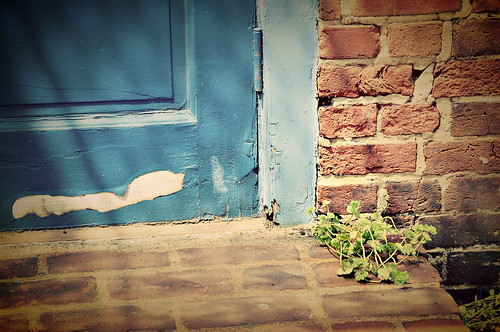
This is a perfect ode, in my opinion, for kicking off plans to reacquaint myself with the poetry on my shelves. It reminds me that creating art is often as simple as reframing the everyday (as my sister’s photograph moves us to see peeling paint with new eyes).
Within the gold frame of a poem, the ordinary is transformed. Simic is right. It is a miracle.
Blowing the dust off of a poem and reading it, we bow to the vision it offers, we bow to its maker, the poet, and we remember our own maker, who created us to create.
