by Christie Purifoy | Nov 16, 2011 | Florida, God's Love, Home, Seasons

My children make lists for Santa (yes, already), and I peer over their shoulders considering the annual dilemma. Which is better, to receive just what you have asked for or to be surprised with the lovely yet utterly unexpected? In other words, the castle Lego set he spied at the big-box store or the box of fairytale Lego figures that I think will inspire more creative play? The book she read at her friend’s house and loved, or the book she’s never heard of that I’m sure she’ll enjoy?
It’s a question I wrestle with particularly during this time of year. Autumn. A season when I long for predictable gifts: falling leaves, cold blue skies, and crisp apples hand-picked by my children.
But these are not the gifts given to me. Instead, as I write this, I can see from my window hot pink camellia blossoms and pale orange tangerines. God, don’t you know that I’m not really a hot-pink kind of girl? Can I exchange the showy flower for something a little more subtle, leaves crackling underfoot, perhaps?
It would be too easy to write that these, tropical flowers and citrus fruits, are the true gifts, and I just need to learn to appreciate them. Who am I to criticize the good things God gives? Who am I to find fault with a creation that is undeniably beautiful and sweet?
And yet … as good as tangerines may be, they do not feel like home to me. Some may taste a personal love note from God in the taste of a just-picked tangerine, but I taste nothing so personal. Good, yes, but not exactly personal.
Still, I can say thank you for the tangerine, and I can mean it. Thank you, God, for speaking a thousand different languages of beauty. Tropical. Desert. Aquatic. Forest. Prairie. Mountain. All good.
Thank you, too, for making me uniquely me. It may look as if I’m hard-to-please. I prefer to think that I am hungry for the love notes that are mine especially. It isn’t that I deserve them, or that I can’t live well without them. It’s simply that I’ve tasted those honey words before, and I trust that there is more, much more.
“… with honey from the rock I would satisfy you.” Psalm 81:16
I remember the sweet taste of things I love best and know that I have tasted God’s goodness. I could spend the rest of my life in the shadow of citrus trees and camellia shrubs, but every day would be drawing me closer to the source of all beauty. Every day would be bringing me towards the love that speaks my language. The love that knows my name.
by Christie Purifoy | Nov 10, 2011 | allergies, Community, Faith, Family, Food, God's Love, grief, healing, Jesus, motherhood

On Friday, our weekly pizza-and-a-movie night had to be postponed (and, yes, for those of you wondering, I make two: one deliciously normal for four of us, one dairy-free, wheat-free and “pizza” in name only for the middle child).
This middle child, our accident-prone five-year-old, had to be taken to the emergency room after a fall onto the cement floor of our garage. He came home late that same night happy to show off his new plastic dinosaur and the half-dozen staples on the back of his head.
I still remember, years ago, the preschool teacher who told me that if any child was going to fall into a puddle or trip on the curb it would be my son. Always. This has never stopped being true.
Twenty-four hours later, three of us kneel to receive communion. We prepare to remember death and taste resurrected life while the boy so recently knitted back together stands behind us. The boy who knows what death tastes like better than any of us. He does not yet receive the elements, but he is always given a short blessing, a gentle hand on his head.
Our servers are an elderly couple unfamiliar to me. They must be Sunday-morning regulars moonlighting at our Saturday-evening service. The husband places his hand on my son’s head and leans in close. He prays and prays until it seems that the attention of a whole room has condensed and fixed itself on this prayer for one small boy. I don’t remember a communion blessing that ever continued so long.
It is long enough for this memory: I am seven-months pregnant with my miracle baby, my-sewn-in-tears-and-reaped-in-joy son. I am filled up with a baby and with fear. Having waited so long for him, I am sure that this gift cannot be given with no strings attached. There must be some price, in pain, that I must pay. Until someone touches my own head and prays for me, and I see … well, I hardly know what I see, but it is as if my unborn son and his maker are alone together. Then I understand that I have only a peripheral role in the relationship between them, and I see that my love is small and weak compared with the love God has for the child he’s made.
Kneeling at the communion rail, I can see that the young couple next to me are also watching my son and the gray-haired man. I can see tears in her eyes and feel them in my own, and I know that this, this, is what it means to live in a beloved community. We have been so well-loved by God that our hearts break for how he loves everyone around us. We are loved, and we are loving, and our hands touching broken heads and fearful hearts are the hands of Jesus, always.
And the heavy burden of love that I carry for my son is shared. It is not, has never been, mine alone. Of course, my husband shares it, the firstborn (who runs to her room weeping as the car leaves for the emergency room) shares it, but Jesus also shares it and his beautiful church shares it.
We are a beloved community.
by Christie Purifoy | Oct 25, 2011 | Chicago, Community, Seasons

Taken by Yours Truly at Chicago's Art Institute. This painting, with its people like stone columns, always reminds me that living in a crowd is not the same thing as living in community.
Our airplane tilts away over city rooftops, and I feel as if I am leaving home in order to return to a house. It is not an altogether blue feeling (it is a house inhabited by my favorite people, after all), but it is disorienting. An emotional confusion to match a physical one; as the plane banks, I can no longer tell if I am pointed toward ground or sky.
I’ve spent four days trying to understand what I left behind when I moved away from Chicago. It seems important to do this, because I do not yet know if my life is a straight line heading always away from it or a curve that will one day return. I think the only word for what has been lost is community, but that word seems beyond inadequate.
In Florida, when my husband leaves for a business trip, I lie awake wondering who I would call if one of the children had an accident or became suddenly ill. I know that there are people in our neighborhood and people in our church who would graciously, even eagerly, help out, but it would involve some tracking down of phone numbers and many apologies for having “bothered” them in the middle of the night.
Living in community meant that there were no apologies.
We frequently woke to midnight phone calls, whispered midnight prayers for friends in crisis, made beds on the floor for small children whose parents were racing to hospitals. I have rushed behind a curtain in the emergency room to find a friend sitting at my son’s bedside: the friend who held him down for the epi-pen, the friend who drove him to the hospital.
But community is so much more than a safety net.
It is a web of interdependence that is often uncomfortable, even painful. It is the downstairs neighbor who calls (again) because my children are pounding on her ceiling (again). It is the woman pushing the stroller down my street who asks me (again) for bus money. Walking near my old building this week, I saw her, remembered her, and was not at all surprised when she stopped me to ask for money. I passed her again on my last evening in Chicago, and she asked (again) for money. I hand over my bus pass knowing that she will always need, and I hope, for Jesus’ sake, that someone will always be there to give.
Community is trying to keep the kids quiet in the kitchen in order that the group of church ministry leaders meeting in the living room won’t be disturbed. Community is making the bed in the spare room for friends of friends. Community is waking up early to make them breakfast, too.
Community is being inconvenienced.
It is straightening up the living room in order to host a weekly gathering for a church small group when all you want to do is climb into bed. Community is when the unmarried, male graduate student from that same small group surprises you with home-cooked Indian food two weeks after your baby is born.
Community is life in abundance.
This is the gift of the one who made us (the one who said it is not good to be alone): to be poured out again and again in order to be filled again and again. Of course, I am not talking about martyring oneself so that bitterness and resentment destroy all hope of relationship. But I have seen that when I open my hands to give until it hurts I receive … oh, I receive so much in return.
On Sunday, I sat once again in my former church. I was joined by a friend, and we both had tears in our eyes just for the joy of sitting next to one another. She turned to me and whispered, “This is our life,” and I knew just what she meant.
This is our life: it is real, it is now, it is beautiful and difficult, and, above all else, it is shared.
by Christie Purifoy | Aug 30, 2011 | book of quotations, God's Love
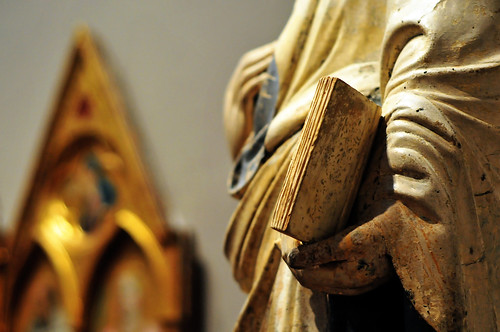
I keep a book of quotations. It looks exactly like any other journal, but it’s for a different kind of journaling. Journaling with the words of other writers, if you will. Here I scribble down quotations from all kinds of books: poetry, theology, memoir, literary theory, fiction, you name it. I write down anything I want to remember.
Sometimes I use these quotations later, in my own writing or maybe just in conversation. But, it isn’t really about utility. It’s about beauty. Language can be so beautiful it stuns. However, I am generally reading so much, so quickly that I need a way to hold on to those beautiful bits that I just can’t bear to let wash down the stream of words, words, words.
During our recent vacation, I read Ian Morgan Cron’s Jesus, My Father, the CIA, and Me: A Memoir of Sorts.
It fully lives up to its title. Which means that the story it tells is crazy and beautiful, wise and, frequently, very, very funny.
Toward the end of his story, Cron describes the life-changing moment when he hears (or thinks he hears) the voice of Jesus asking him, Cron, for forgiveness. These words heal an ugly wound in Cron’s heart, but they puzzle him too.
He knows in his head that Jesus is perfect. Knows that there can never be any reason why He would need to ask for forgiveness.
When asked, theologians, pastors, and priests consistently fail to unravel this apparent contradiction. Finally, a woman named Miss Annie, a woman with no seminary training, does exactly that. She tells Cron, “Why wouldn’t Jesus humble himself and tell a boy he was sorry for letting him down if he knew it would heal his heart?” Cron interrupts with what he knows: “But if Jesus is perfect?”
“Miss Annie ambled the five or six feet that separated us and took my hand. ‘Son,’ she said, rubbing my knuckles with her thumb, ‘love always stoops.’”
Since finishing the book, I’ve been considering the truth of Miss Annie’s words. I can remember years where the things I knew about God seemed to stand like a wall between me and His love. Learn just a little bit about God’s power, his glory, his holiness . . . do that, and it can be hard to fit your own miserable, tiny little self into the picture.
Maybe there are those who can hear a Sunday School lesson on God’s love and then feel it in their bones. All I really know is that it didn’t work that way for me. Perhaps my head and my heart are farther apart than they should be.
I will always be grateful that Love stooped down and came looking for me. Like Miss Annie said, Love humbles itself, Love stoops, and what this means to me is that Love pursues. Love chases. Love makes itself small enough for even our short-sighted, human eyeballs.
Love searches desperately for one lost sheep, and love keeps on searching until that sheep is safe, until that sheep knows and feels that she is loved.
by Christie Purifoy | Aug 3, 2011 | Family, God's Love

The middle child, the oldest boy, starts kindergarten in just a few weeks. Not only that, but he will ride the bus (which is, possibly, a bigger deal for both of us even than kindergarten itself).
I’ve been a mother long enough to know that the days are long but the years are short. These summer days drag (how to fill the time between dinner and bed?), but I will wake up tomorrow and watch my son graduate from high school. I know this, and it has prompted me to wonder: what do I want this boy to grow up to do? To know? To be?
Like most parents in these enlightened days, I say, “I only want him to be happy. Whatever makes him happy. If that means becoming a doctor, great. If it’s an auto mechanic, fine by me.” Unlike most parents, I suspect, I really do mean it.
I’ve spent enough time around highly-educated Ivy-leaguers to know that the things which spell success in our culture (straight A’s! a University of Chicago degree!) are not necessarily markers of either success or happiness.
Not only that, but I know that there is some kind of Murphy’s law of parenting: whatever I plan for my child, the opposite will happen. My father gave me only this bit of advice as I prepared for college: “Study anything you want, but be practical. Don’t major in English or History.” I was never a rebellious child, but Murphy’s law kicked in and, by the end of college, I was graduating with a double major in English and History.
What then do I want for my boy? For his big sister? His little brother?
Only this: to know deep down in their heart of hearts that God loves them. Truly, that is all.
Unfortunately, there is such a big chasm between head knowledge and heart knowledge, between assenting to an idea or concept and feeling the truth of it deep inside. I tell them over and over: you are loved. By me. By others. But, most importantly, you are loved by the Love who created everything beautiful and that Love is vaster and more intimate than you may ever know.
I heard that too as a child. I sang these words in so many Sunday school classes: “Jesus loves me, this I know.” But I didn’t know. I nodded my head and agreed, but I didn’t really know.
Praying that my children know God’s love is sometimes difficult. It is as if I am praying that they suffer. Maybe I’m wrong. Maybe there is some other way in which this knowledge can travel from head to heart, but the enormity of God’s personal love was only revealed to me in some very dark places.
Looked at another way, I am not praying that they suffer. I am praying that they be comforted.
And this is what I want for my babies? Yes, this is what I want for them: that, like Hagar, they will one day say, “I have now seen the One who sees me.”
This is my prayer:
“I pray that you, being rooted and established in love, may have power, together with all the saints, to grasp how wide and long and high and deep is the love of Christ, and to know this love that surpasses knowledge – that you may be filled to the measure of all the fullness of God” (Ephesians 3:17-19).
I’m afraid that it will hurt, but I promise you: it is worth every tear.
“My ears had heard of you but now my eyes have seen you.” (Job 42: 5)
