
These Farmhouse Bookshelves
Let’s be honest. My springtime reading looks less like reading and more like one hour spent weeding the perfect reading spot under the sour cherry tree and then fifteen minutes given to sitting under that tree watching the peonies dance and catching my book as it just slips from my lap.
So, not a great deal of actual reading.
But books are food for me and even in springtime I manage to take a few bites here and there. Lately, these quick bites have been all about the letter P: pruning, poetry, and prayer.
(You can find more information about my occasional Saturday series of book recommendations here. These posts do include affiliate links. Thank you for clicking and buying. Thank you for reading along. And thank you for sharing your own recommendations in the comments!)
***
***
I learned about Lee Reich’s Pruning Book, The: Completely Revised and Updated
If you’ve ever wondered what to do with that old apple tree (or the apple whip you recently planted), or how to keep your tomatoes from sprawling into a disease-ridden mess, or how to keep your clematis vine blooming then you really should own this book. I first checked out a copy from the library, but it only took me about five minutes of flipping pages to realize I needed this one on my shelf.
***
If anyone could turn pruning into poetry that someone would be Verlyn Klinkenborg. His eloquent observations of life on his New York farm are deservedly famous. The Rural Life
You might think you don’t have much interest in nature or country living (and I should mention that just the words nature documentary put me straight to sleep), but if you appreciate language and metaphor, if you want to learn how to see to the depths of what is always right in front of our eyes, then you should be reading Klinkenborg.
I haven’t yet read his follow-up collection More Scenes from the Rural Life
Everyone reaches for fullness in summer, but the fullness that most of us know best belongs to the memory of childhood. What was it that made summer days so long back then and made the future seem so distant? What was the thing we knew or didn’t know? – Verlyn Klinkenborg
***
Phyllis Tickle’s prayer books are year-round favorites of mine, but I love them especially during the busyness of spring and summer. I don’t pray the hours (morning, noon, and night) regularly, but when I only have a few minutes and don’t even know where to begin with prayer or Bible-reading I almost always find myself reading the morning office in Prayers for Springtime.
The Divine Hours (Volume Three): Prayers for Springtime: A Manual for Prayer (Tickle, Phyllis)

I sometimes think that fifteen minutes spent sitting under the sour cherry tree observing the birds and noticing the breeze is a form of prayer. Reading a bit from this book as I sit only makes it more official.
And you? Which books are you reading on the patio as the sun begins to set?
This is Now (This is Always)
… for history is a pattern / Of timeless moments.
– T. S. Eliot, Four Quartets
The kids and I are reading the Little House books. One chapter each night. We began with Farmer Boy and a fire in the old stone hearth. Now we are in the big woods of Wisconsin, and there is birdsong through our open window.
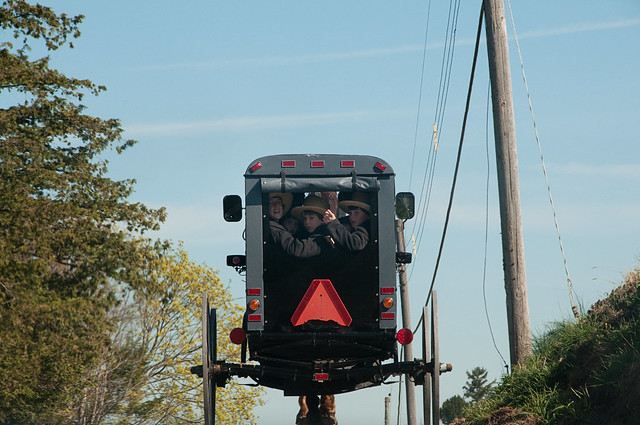
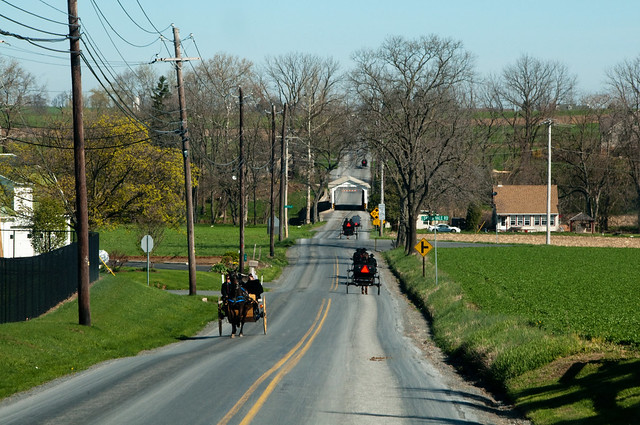
It is also haying time in the fields west of this house. When we drive in that direction, to buy chicken feed from the feed and lumber store or flats of annuals from a greenhouse, we watch teams of muscled, shaggy horses at work in every field. They look as if they have been plowing the same red-clay soil for two hundred years. Day in, day out.
Sometimes there is a young boy holding the reins. He wears suspenders and a straw hat, and together we wriggle to keep from pointing and shout “Look! Farmer Boy!”
***
***
In this place, when the breeze carries the bracing smell of hay, just-cut, I am able to understand something about time that is normally hidden from me.
Time is not a line carrying us always farther from the past. Time is not a thread, and we are not simply biding it until the day ours is cut.
These days, in Lancaster County, I can see that time is a spring. Past and present and future bubble up together, and the sound is like music. Like the clip-clop of horses’ hooves. Like birdsong through an open window.
But my children appear to be lines racing, racing away from me. Willowy is the word that comes to mind when I observe my firstborn girl. For nearly two years, I’ve seen her baby face when I look at my youngest, my second girl, but that face is now lost. Elsa Spring has grown into herself. There is a family resemblance, yes, but more and more she looks only like Elsa. Something has been shed, and the lines of her eyes and chin are now hers alone. No longer her older sister’s.
And thus, two baby girls vanish from every place but memory.
***
I don’t really know if I am living in a country of lost things or a kingdom of restoration and everything made new. I look around, I read the news, and I find both. Hopelessly jumbled.
We lose babies and grandmothers. We lose marriages and homes. We lose our younger selves and friendships and health and peace between nations and on and on forever, it seems.
But every new season is also a return, and the month of May, this pivot between spring and summer, reminds me that it is possible to root myself in that bubbling spring. To live sure of what I cannot always see: that time is not linear but rhythmic. It is a song where every note returns and every note is new.
And this is the living water that sustains me. This is the living water I hold out. To my racing children. To my thirsty neighbor.
Maybe eternity begins when I read a favorite story for the third, fourth, fifth time.
Maybe eternity begins here. Now.
***
***
What Were You Made To Do?
You were made for the impossible thing.
You were made for the goal you cannot conceivably achieve. You were made for the task you are ill-equipped to manage. The high bar you can never reach.
You were made for the thing that terrifies you the most. The thing those others can do but never you.
You were made for the dream too good even to dream.
Some of you know this. You have already seen that the impossible thing slowly, gradually becomes more than just an impossible thing. It becomes a prayer. In other words, impossibility is shot through with cruel desire. You hardly know how it happens, but somehow you begin to want this impossible thing.
Until, one day (but truly it is never one day; it is always slowly over many days) the prayer is answered. The promise inherent in prayer is fulfilled. And the impossible thing becomes a gift, given freely.
To you.
***

***
Writing is my impossible thing. It is the dream I buried in a million books. Books I was convinced I could never write.
My friend Cara Strickland, a writer of delicious details, sent a few questions my way. They are questions meant for writers, but I’ve been considering them with all our many impossible dreams in mind.
- What are you working on?
I am working on noticing.
The more I notice, the more convinced I become that our lives, and the world in which we live them, are not the chaotic, meaningless jumbles they often appear to be.
When I notice the connections among a few dots, I write out those connections here on this blog. I try to do this once per week, but dots do not always obey our commands (pleas, bribes, etc.) to reveal their associations.
But I keep showing up and, sometimes, I am rewarded.
Slowly (very slowly), I am also writing out the connections among some bigger dots. Dots like homesickness and desire and kingdom come. I am gathering up these bits in a file called “My Book.” We shall see whether the title of this computer file proves itself prophetic.
- How does your work differ from others of its genre?
One of my greatest fears is that it does not. That, indeed, there is nothing new under the sun. But I find in the Psalms a command that has also become my prayer: “sing to the Lord a new song.”
I think this is why we are here on this planet. To sing to our God a new song. But, like most commands we find in the Bible, it is impossible. It asks too much. Every word I write rings in my ears like an echo of some other, better writer.
But I am learning to stand in the river that is the source of every new thing. I am learning to recognize the new when it bubbles up like a spring. New words, new stories, new beauties, new mercies. New is the keyword of the kingdom of God, and we are Christ’s own. We hold the keys to the kingdom.
- Why do you write what you do?
I write because the world holds so much beauty my heart would break if I couldn’t pause and gather some of it up.
I write because there is a river, and it has filled me with good news. Somehow I, the quiet one, the cautious one, want only to “go up on a high mountain” and shout “Here is your God!” (Isaiah 40:9).
- How does your writing process work?
It works like this: I stand near a sink overflowing with dirty dishes, a paper calendar in hand. I carve out quiet time. This is exhausting, difficult work. My knife is never sharp enough. And then, typically, I must let go of the time I have so carefully cut away. The baby does not nap, or the preschooler will not fulfill the “quiet” portion of his afternoon quiet-time obligation, or school is canceled, or I get sick, and on and on it goes.
Until, while wiping the counters or raking leaves or changing a diaper, I am visited by an image. Maybe two. The beginnings of a story.
***
My friend Laura Lynn Brown sings beautiful songs. She sings with words (you can find her award-winning essay “Fifty Things About My Mother” at Slate). She sings with paintbrush and pencil. She sings with an Irish flute. I’m passing the baton of these questions on to her. Look for her own thoughts on writing and the writing process at her website in the coming weeks.
Now tell me. How do you sing your own new song?
***
“Sing to the Lord a new song, for he has done marvelous things.”
(Psalm 98:1)