
An Empty Seat at Our Table
We’ve kept an extra place at our kitchen table for years, and lately I’ve been trying to figure out the whys and hows of the uninvited guest who frequently sits there.
I never notice him right away. Usually, we’re a few minutes into our meal when I first realize that he’s joined us. I see my son’s eyes grow a little bigger and a little rounder. Next, he says something like, “Is this my special pizza?” Or, maybe, “I think this hot dog is making my throat hurt.”
The name of our guest? Fear.
Sometimes, he’s just a shadow flitting around at the edges of our conversation. “Don’t worry,” I say. “You probably scratched your throat with that tortilla chip. You’re fine.”
Other times, he monopolizes the meal, entirely. My heart starts racing. Unsure of what’s happening, I mentally thumb through each of the possibilities. Did baby brother touch his food? Did I doublecheck that label? The package looked a little different. Did they change the formula?
I whisper to my husband, “Get the Benadryl. Let’s get it ready, just in case.”
My son sits staring into space, and I can tell that he’s making an effort to swallow. I know that he’s afraid and trying to figure out what’s happening in his throat. I keep up a conversation hoping that if I look unafraid my boy will be able to relax.
Then I notice that the hand holding my fork is shaking.
The thing about this particular fear is that it always takes me to the same place. Utter dependence. I pray without using any words. And I remember: this boy is loved. He is, and always will be, safe in his Father’s arms. All will be well. No matter what.
Only then do I start to breathe easily again.
I walk away from the table, stooped a little with fear, limping like Jacob.
The fear, like a hip out of joint, is not an entirely bad thing. I can’t feel it without remembering that I too wrestled with God. When failed fertility treatments and another month of bad news said, “Despair,” God gave me faith to grab the hem of His son’s robe, to pray and pray without letting go and to be healed. This boy, this good gift, was on the way.
Will I ever send my son to school without worrying that a stray spill on the cafeteria table might cause death to flare up in his throat?
We pray for healing. We pray for miracles.
Lately, the miracle I’ve been dreaming of looks a little different than the one I used to imagine. It isn’t a dream that my son grows out of his allergy (something that would be miraculous given the severity of his reactions). It isn’t a dream of supernatural, spontaneous healing, although I believe deeply that such things do happen. I may be a rational academic by training, but, like Shakespeare’s Hamlet, I know that “there are more things in heaven and earth, Horatio, than are dreamt of in your philosophy.”
The miracle looks more like this: a team of scientists and doctors at Mt. Sinai discovering that some children, fed a steady diet of baked milk proteins in carefully calibrated amounts, can increase their tolerance. They may never sit and drink a glass of milk, but they can eat a slice of cheese pizza at a class party without risk of anaphylaxis.
Miraculous.
Suddenly, a healing touch straight from heaven seems . . . a little boring. A little limited. What seems truly miraculous is the divine at work in a doctor’s lab. The divine bringing hope to more than just one child. Miracles baked into muffins.
Book of Quotations: Why I Have Fewer Answers Now Than I Once Did

I keep a book of quotations. It looks exactly like any other journal, but it’s for a different kind of journaling. Journaling with the words of other writers, if you will. Here I scribble down quotations from all kinds of books: poetry, theology, memoir, literary theory, fiction, you name it. I write down anything I want to remember.
I recently finished Amy Boesky's memoir What We Have, in which she describes her attempts to live unafraid despite the hereditary cancer that had killed nearly every woman in her family. Toward the end, she writes: "Now, I wanted to ask the right questions, not give the right answers. Was that what it meant to grow up?"
This is exactly what growing up has meant for me. Fewer answers. Better questions. So much less fear.
When I was a child, I assumed that the adults around me had all the answers. Maybe all kids think that. I imagine it's the only way to keep the enormity of the whole strange, unfamiliar world at bay.
Here are just a few of the things I once thought I knew (or, at the very least, was sure I would know once I found the exact right book or expert): what happens when we die, why the innocent suffer, the eternal fate of those who've never heard the name Jesus, how to get children to sleep all night in their own beds . . . I'll stop there, but, trust me, I could go on.
I'm afraid that I, like so many Christians, have taken the imperative in I Peter to "be prepared to give an answer to everyone who asks you to give the reason for the hope that you have" just a little too far.
There is only one answer that we can all give with total confidence: Jesus.
Do we need to have answers neatly packaged for every question that plagues our culture (gay marriage, government debt, capital punishment, organic food vs locally grown)? Big, important questions proliferate all around us on a daily basis, and I applaud those who are (let's recall the rest of I Peter 3: 15 here), with "gentleness and respect," seeking out answers. But our faith does not rest on these things.
It's okay to say, "I don't know." More often than not, it's the only honest answer we can give.
"Now we see but a poor reflection as in a mirror, then we shall see face to face. Now I know in part; then I shall know fully, even as I am fully known" (I Corinthians 13: 12).
If answers were what really mattered, we would be given them. Instead, we've been told to love and not to fear. We can't go wrong if we stick to that.
One day every question will be answered (and I imagine that many questions will simply disappear because they never really mattered). These answers will come, not with words, but in a face. We shall see face to face.
In his novel Till We Have Faces, C.S. Lewis, an English professor who loved words, put words in their proper place: "I know now, Lord, why you utter no answer. You are yourself the answer. Before your face questions die away. What other answer would suffice? Only words, words; to be led out to battle against other words."
I too love words, but words can’t get me out of bed some days. On those days, I get up and keep going only because I glimpse the face of the One who made me, the One who knows me, the One who yet loves me.
There is a River
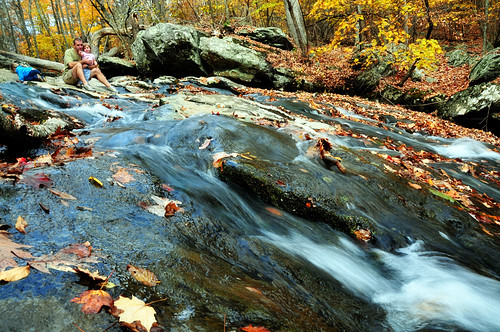
(That's my brother-in-law and two of my nieces perched at the top. Not pictured: my own children who had just fallen into the water and sat, crying, in a wretched, soggy pile at the water's edge.)
The name of this blog ("There is a River") comes from Psalm 46:4: "There is a river whose streams make glad the city of God, the holy place where the Most High dwells."
I didn't know what this blog would look like when I began writing it in May. I think I sensed that it would not be topic-driven, and this still seems accurate to me today. Instead, I would say that this blog is focused on a particular perspective rather than a particular subject.
This blog explores the perspective of a Jesus-following writer, reader, wife, and mother who is looking for hope and beauty wherever it can be found.
I like to think that my spiritual perspective is not an example of Christian pie-in-the-sky thinking but, rather, more like pie-right-here-and-now with the promise of so much more to come.
But, really, my perspective has little to do with pie and everything to do with water.
"There is a river" points us to a place, the place where God's glory dwells, but, even more importantly, it testifies to a presence that is not contained by the flood-gates of heaven. This river washes us, it transforms us, and it quenches our thirst forever. It is here and now as well as there and then.
It is "the fountain of life" (Psalm 36:9). It is the man of sorrows who promises that whoever "believes in me will never be thirsty" (John 6:35).
I've been listening to the new album by Josh Garrels. It is beautiful and wise (and free! Download your own copy here). In the song "Farther Along," he sings, "go down into the river" and "let the flood wash me."
My hope is that "There is a River" (the blog) reads a lot like this song sounds. Click through below to track # 3 and enjoy.