by Christie Purifoy | Nov 19, 2012 | Family, motherhood, Poetry, Seasons, Uncategorized
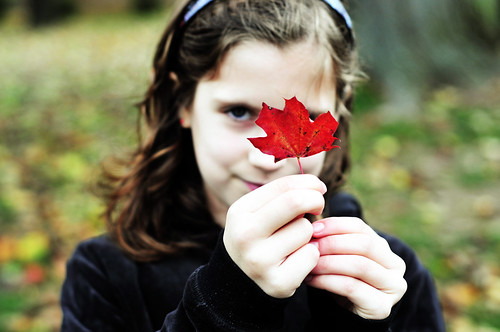
My firstborn holds my fourth and all I can think is how much time gives us and how much it takes away.
I looked forward to autumn for ages, it seems, and now, suddenly, we have tipped over into frosts and bare trees. Is it any wonder, holding this tiny baby and reading this book to the nine-year-old, that I want to slow everything down? Time, itself, included?
Later, arms emptied by bedtime, I read “In Season.” Now I wonder, would I really see these two daughters, and in seeing, love them, if I weren’t prompted by the shifting season?
If the season were as endless as this poem’s tea-cup climate would I be content, like the tea-cup couple, to hold my family at arm’s length? To love them, but only in convenient ways?
In Season
The man and woman on the blue and white
mug we have owned for so long
we can hardly remember
where we got it
or how
are not young. They are out walking in
a cobalt dusk under the odd azure of
apple blossom,
going towards each other with hands outstretched.
Suddenly this evening, for the first time,
I wondered how will they find each other?
For so long they have been circling the small circumference
of an ironstone cup that they have forgotten,
if they ever really knew it, earth itself.
This top to bottom endlessly turning world
in which they only meet
each other meeting
each other
has no seasons, no intermission; and if
they do not know when light is rearranged
according to the usual celestial ordinance –
tides, stars, a less and later dusk –
and if they never noticed
the cotton edge of the curtains brightening earlier
on a spring morning after the clocks have changed
and changed again, it can only be
they have their own reasons, since
they have their own weather (a sudden fog,
tinted rain) which they have settled into
so that the kettle steam, the splash of new tea are
a sought-after climate endlessly folded
into a rinsed horizon.
– Eavan Boland

by Christie Purifoy | Nov 12, 2012 | God's Love, Poetry, prayer, Seasons
This poem is well suited to November’s darker days.
The changing of the clocks seems like an example of humanity’s authority over its own environment, and yet it always reminds me just how out-of-our-control day and night, light and dark truly are. The days will grow shorter, no matter our efforts or anxieties. Nature will begin to die. We will too, come to that.
This poem suggests that embracing the inevitable (whether it be the changing of the seasons or death itself) need not be an act of despair. It can be an act of great trust.
Technically, I should call this a pastoral poem, but, to me, it always reads more like prayer.
Let Evening Come
Let the light of late afternoon
shine through chinks in the barn, moving
up the bales as the sun moves down.
Let the cricket take up chafing
as a woman takes up her needles
and her yarn. Let evening come.
Let dew collect on the hoe abandoned
in long grass. Let the stars appear
and the moon disclose her silver horn.
Let the fox go back to its sandy den.
Let the wind die down. Let the shed
go black inside. Let evening come.
To the bottle in the ditch, to the scoop
in the oats, to air in the lung
let evening come.
Let it come, as it will, and don’t
be afraid. God does not leave us
comfortless, so let evening come.
– Jane Kenyon
(I also shared this poem last November.)
by Christie Purifoy | Nov 5, 2012 | Art, Books, Faith, Pennsylvania, Poetry, Uncategorized
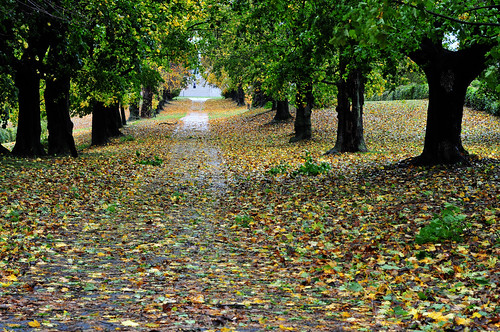
I watched these old, old maples bend in the wind of that hurricane. Because they yielded, they are still standing.
That is how I want to live. I am more and more sure that art and beauty and love grow best not by raging against the wind (or the storm, the dark day, the hard, unasked-for circumstance). They come through yielding.
To yield is not to give up. It is not throwing up my hands in defeat. This yielding is more like being carried. It is moving with what moves and watching – always watching – for the One who does the moving.
And then singing of what I see.
Vow
The need to work this land to fit my wants
I yield. I vow no more to walk with plans
like gossip falling from my mouth. I choose
to go in silence, learning, in my sure
refusal, the truth that yields to yielding.
At Equinox, before the flood of light
sets water loose, I covenant to give
the downward rush beneath the grass its head.
I’ll dam no stream. I’ll dig no pond. Nor will
I plant willows to suck the wet spots dry.
My work shall be to say the nature
of Creation’s slow unfolding, to name what
becoming new has always been, to praise
what lives without my praise unto itself.
– John Leax
by Christie Purifoy | Oct 22, 2012 | Books, Food, Poetry, Scripture, Uncategorized
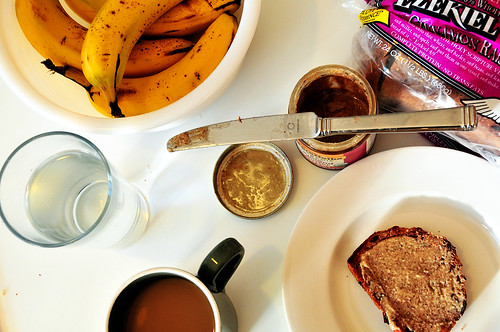
Once upon a time, Mondays on this website were devoted to poetry. Because the small bites of poetry are about the only literary food I have time for these days, I’m reviving the tradition. Please tell me what you think. Would you like a poem each week?
To help you make up your mind, here’s one from a favorite poet, Luci Shaw.
It reminds me that my own “quotidian wilderness” (a land of baby bottles and cinnamon toast, children with sniffles and autumn leaves) is saturated with glory.
Manna
They asked, and he brought quails,
and gave them food from heaven. Psalms 105:40
I’m not asking for quails for dinner
and, if they flew in my window, at mealtime,
in a torrent of wind, I would think
aggravation, not miracle.
Time is so multiple and fluid. If I lose a day
flying the Pacific and gain it back
returning, perhaps the prayer I offered
this morning at first light
was known and answered last week.
You never know what a simple request
will get you. So, no plea for birds
from heaven. Rather, I will commit myself
to this quotidian wilderness, watching for what
the wind may bring me next –
perhaps a minor wafer tasting like honey
that I can pick up with my fingers
and lay on my tongue to ease, for this day,
my hunger to know.
– Luci Shaw
by Christie Purifoy | Oct 19, 2012 | Family, God's Love, Grateful, Home, motherhood, Pennsylvania, Poetry, Seasons, Uncategorized
A few mornings ago, I heard an interview on NPR with the poet Mary Oliver. Speaking of the experiences which inspire her poetry, she said, “The world doesn’t have to be beautiful to work. But it is beautiful. Why?”
Some questions don’t need to be answered in order to open our eyes. There is wisdom to be had just in the asking.
We tend to think of the world’s pain as the senseless thing. The meaningless thing. But what of the world’s beauty? Whatever did we do to deserve autumn leaves? The smell of a campfire? The honey-wine taste of a pear?
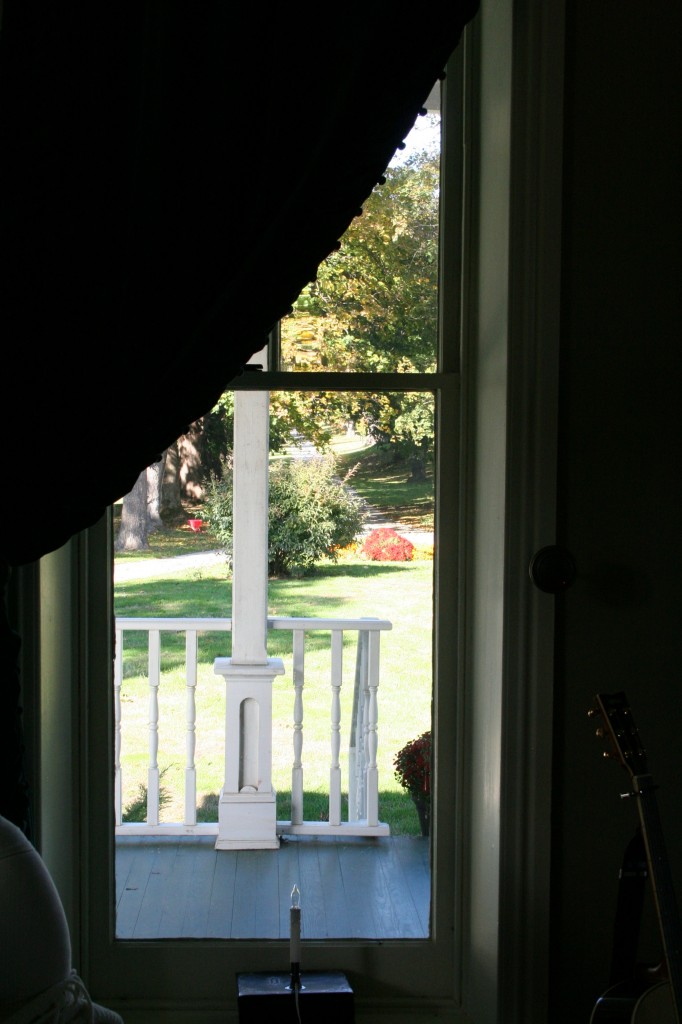
This is the view from my window. With apologies to The Photographer (who I’m sure can look at this shot and know exactly how I should have tuned my camera settings), it’s a view to make you catch your breath.
Sitting in the chair by this window, I notice just how tired I am. And I can hear the boys fighting on the other side of the house. And then the baby starts to cry, and it’s time (again!) to fiddle with formula and plastic feeder bits and bobs because my body is fundamentally broken.
But, all I can think is “Thank you, thank you, thank you.”
My bed faces a set of three windows. The glass is so old it’s wavy, and the autumn colors outside look like they’ve been spun through a kaleidoscope. Sitting there, I can still hear those boys fighting, and I can see the fearsome dust bunnies lurking in every corner of this room, and, oh, I am so, so tired.
But, again, all I can think is “Thank you, thank you, thank you.”
Following a season of drought, my life today is one of excess. I am too tired. I am too happy. I am so disappointed. Those boys are too loud and will they ever learn to play without fighting??
But, it’s the beauty I can’t get over. The over-the-top, cup-runneth-over beauty that is everywhere in my life right now.
So, yes, I am tired and my house is dirty and I wish I had the time and energy to cook all those mouth-watering recipes I just pinned on pinterest, but I open my eyes just the tiniest bit, and the only words I can think of are these:
Thank you, thank you, thank you.
by Christie Purifoy | May 31, 2012 | Faith, God's promises, Music, Poetry, prayer, Pregnancy, Uncategorized, Waiting
Pentecost Sunday was nearly a week ago, but I still feel stuck in that room. Waiting. Asking this question: how did they survive the long, empty days between Jesus leaving and the Comforter coming?
How did they endure being lifted up by the joy of a promise believed only to drop again into the discouragement of yet another not yet?
And why the gap? Why did they have to wait at all?
We do know that the wait moved them to gather together. I imagine the promise was easier to believe when they could see the hope in one another’s faces. When they could pass around their Jesus stories, like a platter of bread and fish. Stories multiplied into hope. And faith.
And I imagine they worshipped. Sang and prayed.
Was this what it was all for? Was their worship the reason?
Did God wait, strain with holding himself back, because he wanted to hear their songs?
“Call to me,” he had once told them. “And I will answer you and tell you great and unsearchable things you do not know” (Jeremiah 33:3).
Call. My husband tells me this word suggests something organized, something formal. Something created. Like a song. Like a poem. Something more than careless words tossed at the sky.
Maybe you don’t sing songs. Maybe you don’t write poems. But maybe you journal. Maybe you sketch. Maybe you take photographs or bake bread for the neighbors. Maybe you orchestrate elaborate finger-painted messes with the three-year-olds at church and maybe, just maybe, that is your call? Your song? Your cry for more of God?
And maybe that is the point of it all. The point of waiting. The point of living. To add our call to the many others until a crescendo of sound and beauty and worship rises to heaven and All is unleashed.
Then, just as it was that Pentecost when God’s church was born, wind and fire reveal the great unknowns.
What have we all been waiting for? To hear the mysteries of God’s glory in a language we can comprehend.
Those unsearchable glories we never even knew to seek.