by Christie Purifoy | Aug 1, 2011 | Florida, Religion
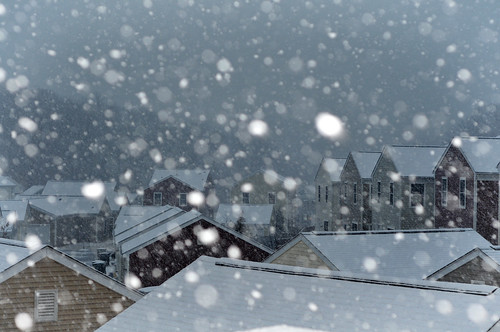
Understandably, winters in Chicago were long and hard. Still, I enjoyed them more than most of my friends and neighbors. I’ve always imagined that my Texas childhood created a snow deficit deep inside of me that no amount of Midwestern cold could fill up. As much as we all longed for spring come March, I was never sad, even then, to see snowflakes fall.
The hardest thing about winter for me was always the thaw. Those of you with experience living in frigid climates know what I’m talking about. The thaw is that period (maybe it comes once, maybe it comes and goes repeatedly, every winter is different) in which the sidewalks and streets are impassable. Snow has melted and refrozen until not even a polar bear could walk the ice safely. Or, layers of snow have turned to slush all the way through, and it’s impossible to move without icy meltwater pouring over the tops of my boots. Pushing a stroller through the muck and mess of a thaw? Absolutely impossible.
The hardest thing about winters in Chicago? Not being able to (safely) leave the house.
The hardest thing about summers in Florida? Not being able to (safely) leave the house.
Obviously, we’re no longer in danger of breaking our bones as we slip and slide on the sidewalks. But when my daughter asks at noon whether we can go for a bike ride, all I can think is “heat stroke.” It’s 95 degrees and very humid and I actually convince my kids to watch another half hour of tv rather than take them outside.
There are bright spots in both seasons. Here, swimming pools dot the landscape like weeds and as long as I’m willing to walk the gauntlet of sunscreen application (which always requires chasing the two-year-old around the house and listening to the seven-year-old whine that her face is white), we can enjoy being outside without too much pain.
In Chicago, the compensation came with sledding and snowman building. As long as I was willing to bundle up three children in snowsuits and long underwear, we could forget the discomfort of cold noses and tender fingers for an hour of fun.
In Chicago, I loved to sit directly on the warm radiator cover and watch snow fall past our third-story window. In Florida, I sit on the small sofa and watch that day’s thunderstorm pile up in the west. Seeing the palm fronds flatten in the wind and sensing the house go dark, I like to imagine that it’s cold outside. The reality feels more like getting hit in the face with solid swamp, but I keep the door shut and pretend. It’s very cozy.
More than cabin-fever and long hours spent indoors, these two seasons in these two places share a mood of longing. In Chicago, I yearned for warmth and color. In Florida, I want crisp air and sunshine that doesn’t burn like fire.
I’ve often felt guilty about giving in to this mood. As if desire is always an altogether bad thing, a temptation to ignore the good gifts right in front of us.
I think that is sometimes the case.
However, occasionally we only recognize the best things in life because we’ve longed for them and waited for them. Tulips in spring. The first day in fall when the humidity plunges.
The goal, I’ve decided, should not be some stay-in-the-moment mental trick we play on ourselves, but a more straightforward acceptance of goodness in the present and desire for something else. And why should these be mutually exclusive?
I love Florida’s daily summer thunderstorms. I love the wind, the dark clouds, and thunder rumbling all afternoon. But I am also eager for cooler temperatures and hours that can be spent outdoors. Summer, here, is about enjoying and longing.
And when the cooler days come, I’ll say goodbye to the thunderstorms with no regrets, knowing that I loved them in their time, but the thing I’ve really wanted, the thing I am now prepared to enjoy, has finally come.
Hope justifies longing.
“But hope that is seen is no hope at all. Who hopes for what he already has?” (Romans 8:24)

by Christie Purifoy | Jul 9, 2011 | Florida, Religion, Work
Yesterday was all about the space shuttle in our house. The littlest boy jumped up and down when he saw the rocket poised for takeoff on television. The older boy zoomed around the house with his own plastic space shuttle. The husband kept his eyes glued to the live feed from NASA.
The daughter and I watched them for a bit and then decided it was a good morning to replenish the refrigerator with a visit to Costco.
Later, as I carried warehouse shopping odds and ends from the car to the kitchen, I could hear from the television and the three boys on the couch that the shuttle was finally beginning its journey. I walked outside for another load and spied the southern stretch of sky where we've watched other shuttles speed away, chased by their fiery tails. Because of the low-lying clouds, we could only watch this historic takeoff on television. The husband and I are both glad that he took the time, months ago, to drive our two oldest down to a beach where they could feel the rumble of space flight deep in their bones.
Perhaps it was the tantalizing thought of "right there but unseen" that prompted my thoughts. I knew exactly where the shuttle's flight path arced over my neighborhood, but I couldn't see it. I wondered if God was watching. What did he think of it all?
I imagined his delight as his tiny yet magnificent creatures explored a little patch of space.
I've always given space exploration little value, both with my political self (I'd rather see tax dollars spent on teachers and healthcare) or my spiritual one (shouldn't more of that innovation and energy go to helping AIDS orphans?).
For a moment, I let go of my usual practical mindset and glimpsed the joy of our creator when he watches his people. Creation isn't comprised only of stars and trees and rivers. It is also everything we add to it with our minds and hands and hearts: our work, our play, our praise.
I won’t try to convince you that washing dishes is holy. It may be, but I’m afraid if I begin to argue that point I’ll find myself typing out bitter phrases like unending cycle of futility. It is summer, after all. My kids are at home and eating all day long, and I loaded and unloaded my dishwasher four times yesterday. I think some bitterness is understandable.
Still, I’ve begun to think that we sometimes needlessly complicate our lives by insisting on purpose and meaningfulness in all that we do. Surely that can lead to a whole lot of dissatisfaction. For the born-evangelist who spends his days trying to build a small business. For the one called to be a teacher who must spend more time mopping floors than instructing. And for me, who has a paper on the wall that says PhD but picks up stacks of academic journals only because the youngest needs a booster seat.
I’m sorry, but washing dishes will never seem meaningful to me, and yet, I think I can begin to understand how even this menial work contributes to some bigger, some more glorious creation. From the perspective of vast, unexplored space, the effort of this space shuttle flight also appears very, very small. Inconsequential, even. And it may be exactly that. But I don’t think we should measure our work by the weight of it or by its duration. There is a perspective that says the just-cooked meal and the space shuttle’s flight are both a blink of an eye.
I think we can take our cue from the mind of the maker. The one who made redwoods that live thousands of years is the same one who makes mayflies. He has given his effort to both. He isn’t a God who sifts his creation into worthy and unworthy, like a man sifting gold from rock. He’s a God who delights in more, more, more. Especially the small more of our own contribution.
“How many are your works, O Lord! In wisdom you made them all; the earth is full of your creatures.”
(Psalm 104: 24)
by Christie Purifoy | Jul 6, 2011 | Books, Family, Florida
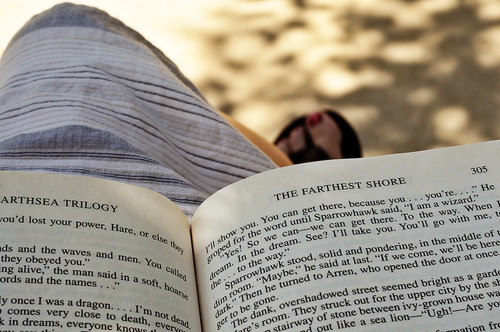
I've had the first book in The Hunger Games trilogy sitting on my nightstand for six months. Both of my sisters told me that once I started I wouldn't be able to put it down. I believed them and so I saved it, and then I think I just forgot about it. I got used to seeing it there, unopened by my bed.
Feeling a little desperate for reading material, I grabbed it on my way to my daughter's swim meet yesterday. In between races, she played with friends, and I read. After the meet, my husband worked the early evening shift in our try-to-keep-the-two-year-old-in-bed night job, and I kept reading. I'm an early-to-bed girl, but by 10:30 I was calculating the cost/benefit ratio of staying up to read till the end.
It took an act of will, but I eventually went to bed. Instead, I let my kids watch two hours of cartoons after breakfast so I could finish.
It's been a while since I last fell head-over-heels into a great story. It made me think about reading as a kid (the most perfect, magical books will always be the books we first loved) and all the reading I've done since. A lifetime of words and stories. A lifetime of living other lives, of seeing the world through other eyes.
Growing up in a family of six, I was the only reader. These days my mother and sisters troll my shelves like the local library and even my Dad can't get enough of his Kindle, but, back then, I was the butt of many jokes. They couldn't really understand my insatiable appetite for books.
I think their favorite joke (at least, it's the one I remember hearing the most often) involved the fact that I read while at our Grandmother's west Texas farm. Thinking about that farm, I remember jumping hay bales and making mud pies in the barn, but I've no doubt I plowed through quite a few books during those visits too. My family loved to say, "Look at her! She'd rather read about a farm than enjoy one!"
I suppose there's some truth to what they said. I could read about the hardships of Laura Ingalls' long winter again and again, but I'd never want to live them. Still, I don't subscribe to the assumption implicit in this joke: that books give second-hand experience and thus lead to a second-hand, perhaps even a second-rate, life.
All this has recently come back to me because I've been reading my way through a stack of books on bee-keeping, chicken-raising, and other farm pursuits. Lately, my small Florida vegetable patch has seemed like nowhere near enough, and I've been dreaming about raising (at least a little) of our own food. I may be planted in the suburbs for now (no chicken coops allowed), but a girl can dream.
The Backyard Homestead Guide to Raising Farm Animals may be a far cry from The Hunger Games, but, today, I'm feeling a little sorry for all the non-readers out there. Day-to-day, I may walk a fairly narrow path, but books like these have always set me in a wide-open place. Here, there's adventure. There’s heroism and triumph. There are even a few bees and laying hens. Just don't tell my community association. I'm sure their bylaws wouldn't approve.
by Christie Purifoy | Jul 1, 2011 | Florida, Religion, Seasons

No one likes to wait. Still, there is a general acknowledgement within our culture that waiting isn’t exactly a bad thing. Good things come to those who wait, we say.
Christian teaching kicks it up a notch. Strength will rise as we wait upon the Lord. Blessed are all who wait for Him.
Still, I don’t think there are many of us who, if given the chance, wouldn’t choose to fast-forward through the waiting. If there existed some cosmic remote control, I would be strongly tempted to hit that button.
Why does God make us wait? Why does Scripture link waiting with blessing? It’s hard not to feel as if waiting has been devised by some strict disciplinarian. Where is the love in making us wait? It seems more than a little cruel. Especially so when we are waiting for relief from pain, for healing, for hope, for a miracle.
However, if I am honest, I have to admit that I know how good waiting can be.
When we first moved from Chicago to northern Florida, I imagined that the long, hot summers would be hardest. I expected the worst and was pleasantly surprised. In the Fall I was surprised again, but the surprise was less pleasant. It turns out that hot, humid days were easy to take in August. Roasting a turkey on Thanksgiving Day when the outside temperature was in the 80s: that was not so easy to take. There may have been tears.
Apparently, I was okay with a hot summer but not okay with seasons that seemed stubbornly stuck. I missed colorful fall leaves, apple-picking at the orchard, and wearing sweaters to the pumpkin patch.
During the first week of December, we had our first freezing temperatures, and I watched as the maple tree just outside my kitchen window suddenly turned scarlet. It was beautiful but, coming in December, also strange. By Christmas the tree had shed its leaves, and the view outside the window began to look just a little bit wintery. A very little bit. And then January arrived and ushered in sunnier, warmer days. Sitting at my kitchen table eating breakfast one morning, I noticed small buds beginning to grow on my maple. By the end of January, small, green maple leaves were once again dancing in the breeze.
I felt as if I had been watching one of those nature documentaries, slow changes effected over time had been sped up by a time-lapse camera. Only there had been no camera. Three seasons really had come and gone in the space of two months.
I hated it. It turns out that the changing seasons brought me little joy when introduced at a sprinter’s pace. Midwestern winters may be long and dark, but there is nothing like the rush of feeling that comes after spotting the first tiny buds.
I still don’t think that waiting is easy. I don’t think that it’s enjoyable. But, I also don’t think that waiting is like green vegetables or exercise; God the stern parent doling out what’s good for us. Rather than good for us, waiting, it seems, is simply good.
There is a prayer for the one finding it hard to wait, a prayer whispered for generations: “O Lord, come quickly to help me” (Psalm 40:13). And the voice of the Holy Spirit responds: “Be strong, do not fear; your God will come” (Isaiah 35: 4).
by Christie Purifoy | Jun 17, 2011 | Florida, prayer, Religion
Trees are dying, fires are burning, and I’ve been praying for rain. On Monday, it rained. A good, soaking rain. I went to bed and imagined the smoke being scrubbed from the air.
On Tuesday, we woke up to find that the smoke was much, much worse. “What happened,” we wondered. Hadn’t the rain done its job? Throughout the day, the smoke seemed to grow denser, heavier, and by the late afternoon our car was coated in a fine dusting of metallic ash.
It turns out that a neighbor of ours is something of an amateur meteorologist. While we traded complaints about sore throats and burning eyes, he explained that the rain had been part of a low-pressure system. Where air pressure is low, new air rushes in. The rain that seemed such a good thing was like an invitation to the fires. The rain stopped, and the smoke poured in.
Lately, I’ve been thinking I may need to be more specific in my prayers. I prayed for rain, but I didn’t intend to pray for smoke. In another example, I’ve lately been praying that we could live nearer our families. My sister, a military wife, then shared that they would be moving to northwestern Florida, only (only!) a six-hour drive away. They had been asked to prioritize three choices for their move, and Florida wasn’t one of those choices. I realized that I’d imagined God moving us out of Florida in order to be near family, but, instead, God moved my sister and her family here. I’m grateful, but it isn’t really what I’d hoped for.
My prayer for rain, and the unforeseen consequences of that rain, remind me how limited my vision is. Prayer is such a mystery. I’m glad that we are able to participate in God’s work in the world through prayer. I could tell beautiful stories of answered prayers in my life and the lives of my family and friends. But, I’m also glad to know that the God who created the universe isn’t some sort of mechanical robot: I push his buttons with prayer and wait for the expected result. He’s so much more alive than that. So much more dangerous. So much more loving. To use C. S. Lewis’s word, he isn’t a “tame” God.
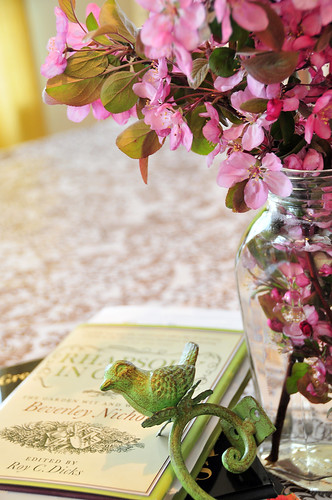
And yet . . . sometimes my hopes, dreams, and desires feel like fragile little birds. They don’t seem able to withstand the force of some fierce, lion-God stomping around on them. Considering these dreams, I feel like both the mother and the baby bird. I am tender and nurturing toward these parts of myself. I am also very, very vulnerable. Can the God who holds the Big Picture be trusted with hopes that are so small and easily crushed?
“Even the sparrow has found a home, and the swallow a nest for herself, where she may have her young – a place near your altar, O Lord Almighty, my King and my God.”
(Psalm 84:3)
by Christie Purifoy | Jun 15, 2011 | Art, Family, Florida

(photo by yours truly)
I waited and prayed for children for a long time. I first knew that God had heard my prayer when, crying out to Him for an answer, any answer, I saw a brilliant orange moon rising over Lake Michigan. One year later, we brought our daughter home from the hospital and sat by her Moses basket in the light of another full moon rising over the lake.
For nine months, I’ve written a hefty monthly check to a local dance studio for this daughter’s ballet class. Each month, I worried that the money was being wasted. Wouldn’t it be better to sponsor another Compassion child? Or, put the money away in a college fund?
My daughter enjoys the class, but I have no dreams of grandeur for her involving a career as a dancer. I’m afraid the gene pool in our house quashed that dream before she was even born. And I don’t have to take it that far. I remember clearly the moment in my own childhood ballet class when I realized that my body wasn’t made to do the things being asked of it. I was eight. I quit and never looked back. Should I really be devoting so much of our monthly budget for a ballerina-fairytale-dream that will probably end in a year or two?
Last night, sitting in a beautiful old theater as class after class danced for us I saw how wrong I have been. I filter my budget (and my world) through concepts like productivity, utility, and remuneration. Words like beauty and art don’t enter those equations.
The annual dance recital was art. The whole of it and the little moments: from the graduating dancers performing their elegant senior solos to the three-year-olds dressed like pink bumblebees standing on stage looking dazed.
I can’t dance to save my life, but, watching those dancers, I knew that this is what we were made for. To dance. To sing. To perform and write and paint and rhyme and . . . create beauty.
Still, there are doubts. In a world in which so many suffer while the rest look away, how can I justify any time or money or energy that is not spent on aid, in protest, or at work? These things matter. A lot. In fact, I’ve just decided that we do need to sponsor another Compassion child. However, I’ll shift the money from our Christmas fund instead.
Driving home from the downtown theater, we followed a full moon tinted deep orange by the still-burning wildfires, and I remembered the moons that announced the gift of this girl, my girl. The moon stayed centered in our windshield, and I could have sworn we were being led through the desert by a pillar of fire, the only sound in our car the subtle tapping of silvery ash against the window. My daughter’s dance is gone. Blown away with the ash on a Florida wind. Like life itself, it is over and gone before I’ve fully registered its beauty. But it was good and worth far more than dollars can count.
“Why, you do not even know what will happen tomorrow. What is your life? You are a mist that appears for a little while and then vanishes.”
(James 4: 14)
