by Christie Purifoy | Dec 21, 2013 | Advent, Books, children, Uncategorized
I finished the Christmas grocery shopping today.
That means I have nothing to do for days but read and read and read by the tree. Well, that and wrap presents. I do tend to put that chore off till the last possible minute. And, I suppose the children will still demand to be fed. Strange how they expect regular meals even while on holiday.
But, still, rest assured, there will be a great deal of reading in the days ahead. I hope that proves true for you as well.
Here are a few more favorites from our stack of Christmas stories.
(You can find all my book recommendations here along with a disclaimer about the affiliate links I use.)
***
***
Today, I’m recommending three picture books, but wait … these books aren’t really meant for small children. My second-grader and fourth-grader enjoy these, but I would share these books with anyone from an older child to an adult.
This first book would make an especially nice gift for a poetry or art-lover.
It is Robert Frost’s Stopping By Woods on a Snowy Evening with gorgeous illustrations by Susan Jeffers.
With its intricately detailed illustrations of snowy landscapes, this is a book that demands we slow down. My children love to search out the forest animals hidden in each image, and Jeffers gives this familiar poem a lovely, new twist of an ending through her designs.
But I have promises to keep, / And miles to go before I sleep
Christmas Day in the Morning was originally published by Pearl Buck in 1955. This picture-book version features full-color artwork by Mark Buehner.
If you don’t know the story already, I won’t spoil the surprise. I’ll only say that this one inspired my daughter to shovel the driveway as a Christmas gift to her Dad.
Buck’s classic story always makes me tear up a little. Okay, I have trouble not breaking down whenever I read it out loud.
The best Christmas gift I ever had, and I’ll remember it, son, every year on Christmas morning, so long as I live.
Winter’s Gift is another sentimental favorite (but what’s Christmas without a little sentimentality?). It is written and illustrated by Jane Monroe Donovan and tells the story of an old man spending his first Christmas alone. He is without hope until a horse, lost in the woods, brings with her a very special gift.
‘The star is the most important part of the tree,’ she would always say. ‘It’s a symbol of hope, and no matter how bad things get, you should always have hope.’
by Christie Purifoy | Dec 14, 2013 | Advent, Books, children, Seasons, Uncategorized, Winter
It is at about this point in the season when I despair of reading every one of the books in our Advent / Christmas / Winter collection.
But then I remember – Christmas lasts 12 days! Of course, we’ll get to them. We only need a few more snow days to help us along.
Here are three more of my favorite books for the time of year.
Madeleine L’Engle’s The Irrational Season (The Crosswicks Journal, Book 3) makes excellent reading any time of year, but it is especially nice to pick up at Advent time. L’Engle’s meditation on the seasons of faith and life follows the traditional calendar of the Christian church, beginning with Advent.
There are so many things I could say about L’Engle’s work, I hardly know where to begin. Perhaps my favorite thing is L’Engle’s commitment to asking difficult questions. What I discover in her books – and in the Crosswicks journals, in particular – is that unknowing is not a scary place to be. In fact, L’Engle shows us that we can sometimes experience God’s presence in more beautiful and more comforting ways when we take the time to sit with the questions we do not have answers for.
Also, L’Engle’s family home, Crosswicks, has been described as a “farmhouse of charming confusion,” which pretty much sums up the thing I most hope to attain in life.
Hisako Aoki’s Santa’s Favorite Story: Santa Tells the Story of the First Christmas (with illustrations by Ivan Gantschev) is new to me this year, passed on by a kindred spirit.
This is a beautiful little book in its own right, but it is also a book that fills a very big need. Whether or not yours is a Santa-believing family, children can use our help integrating Santa (who is unavoidable this time of year) and the babe in the manger. Simply and sweetly (but not too sweetly) this book does exactly that.
Santa is still Santa (he works hard to share gifts with everyone, particularly, in this book, small forest animals), but he knows Christmas is not all about presents. In Santa’s words,
“Love was the gift God gave to us on the first Christmas, and it still is, you know.”
I appreciate that this book does not give us another storyline about Santa. It simply uses Santa, a character every child knows, to speak the most important story – the life-changing true story – of the first Christmas.
Lastly, we always make time for at least a few readings of Holly Hobbie’s Let It Snow (Toot & Puddle) . If you have not already made the acquaintance of these piglet friends, well then, I feel privileged to point you in their direction. These are books about the pleasures of friendship, the seasons, and the varied joys of far-flung travel and a quiet life lived close to home. Let it Snow offers more of this with the added drama of choosing just the right gift and wondering when it might snow. If I weren’t reading these books with wiggly children, I would feel inclined to pour a cup of tea before beginning each one.
Let me be explicit: Toot and Puddle are not just for kids!
I’ll be sharing a few more seasonal books next Saturday, but I’d love to know … what are you reading?
by Christie Purifoy | Dec 9, 2013 | Advent, Books, God, Jesus, Poetry, Uncategorized
I’ve mentioned this book before. I’m keeping it close this Advent season.
I find it incredible how an old, old form can open my eyes to everything New.
Here is a poem for this, the second Monday of Advent.

O Emmanuel
O come, O come, and be our God-with-us,
O long-sought with-ness for a world without,
O secret seed, O hidden spring of light.
Come to us Wisdom, come unspoken Name,
Come Root, and Key, and King, and holy Flame,
O quickened little wick so tightly curled,
Be folded with us into time and place,
Unfold for us the mystery of grace
And make a womb of all this wounded world.
O heart of heaven beating in the earth,
O tiny hope within our hopelessness,
Come to be born, to bear us to our birth,
To touch a dying world with new-made hands
And make these rags of time our swaddling bands.
– Malcolm Guite, from Sounding the Seasons
by Christie Purifoy | Dec 7, 2013 | Advent, Books, Family, Uncategorized
Saturdays are reserved for a peek at the bookshelves which fill so many rooms in this old farmhouse. Books live everywhere here.
This month, this Advent month, I’ll be sharing some of our favorite books for the season. Advent books. Christmas books. Wintery and snowy books. These are books that live most of the year in two big boxes in a third-floor closet. I lug these boxes down two flights of stairs before I ever even look for the Christmas decor.
Mostly, these are books for kids. Or the kid in each of us (a self we simply must indulge this time of year, in my opinion). Quite possibly, these books are loved more by me than by any child in my house. Although, considering the state of it, Jan Brett’s Gingerbread Baby is well loved by all.
(You can find my full series of book recommendations here, including more information about my personal book review policy and a disclaimer about affiliate links.)
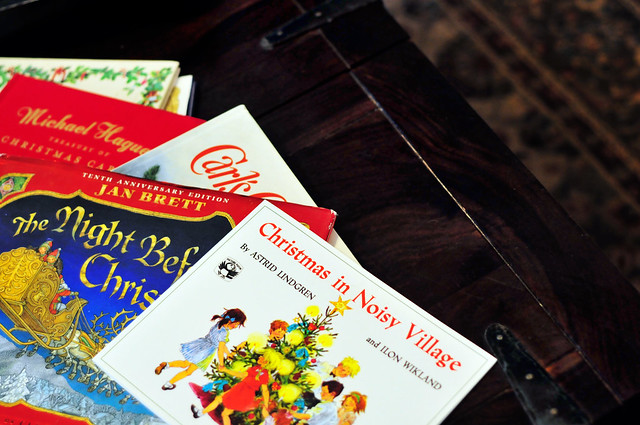
I love Luci Shaw’s Accompanied by Angels: Poems of the Incarnation year round. I love it especially at Advent.
Shaw’s poems hit that magic mark for me. They are conversational yet lyrical. They are accessible, but they do not give up all of their secrets with one reading. These are poems to return to year after year.
This is a season of serial visions, and a bodily God, / and a sword in the heart. – Luci Shaw
Astrid Lindgren is the Swedish writer best known for her books featuring Pippi Longstocking. Christmas in Noisy Village (Picture Puffin) , part of a series of picture books about the “noisy children,” is a family favorite. Really, this is the Holy Grail of children’s literature: a book that pleases parents, toddlers, early readers … even my soon-to-be “tween.”
This is a fairly straightforward telling of a child’s Christmas in rural Sweden, but there is magic in realism like this. Gingersnap pigs, an early-morning sleigh ride to church, and gifts of skis and skates.
We have bigger books, funnier books, more spiritual books, but, this time of year, we probably read this book more times than any other. (Bonus recommendation: Lindgren’s The Tomten is a wintery classic. One of our all-time family favorites.)
‘Everything is so beautiful and Christmasy that it gives me a stomach-ache,’ said Anna.
I’m sad to see that this third recommendation appears to be out-of-print. However, it looks like you should be able to track down a copy without too much trouble. Little One, We Knew You’d Come is a sentimental favorite of mine. This is the story of the nativity, yes, but it is also a lullaby and a love song for every parent and child.
Sally Lloyd-Jones is well known for The Jesus Storybook Bible: Every Story Whispers His Name . This is a quieter, more poetic take on the story of Jesus. I’m not sure my children even know it is a book about Jesus. They each think it’s a book about them. And they are right.
Lloyd-Jones beautifully captures the longing and love parents feel for their children. It is the longing felt by all creation for her redeemer.
And every year, we remember you, / Our miracle child, our dreams come true. / Oh, how we thank Heaven for you, / And the day that you were born. – Sally Lloyd-Jones
Lastly, I have one bonus recommendation: Sounding the Seasons by Malcolm Guite. I’ve mentioned my love for these poems before, but, if possible, I love them even more this time of year.
by Christie Purifoy | Nov 2, 2013 | Books, Poetry, Uncategorized
Autumn is a time for hoarding books. Like a squirrel and its acorns. Like my children and their Halloween candy.
Winter, the reader’s favorite season, will soon be here. And, yes, despite what we might say, winter is our favorite season. We can admire the beauty of fall, the fresh breezes of spring. We can enjoy mucking about in our gardens come summer. But, as readers, we are always at our happiest curled up with a book.
Short, dark days are welcome because they let us off the hook. What else is there to do but pull the blanket closer and go on reading our book?

Here are a few recommendations to help pad your winter reading list.
The first is welcome throughout the year, but I usually only remember it come fall. The Autumn Board Book , by Gerda Muller, is one of four wordless board books focused on the seasons.
I’m afraid I lost some of you when I wrote board book. But this is no ordinary board book.
As one of my favorite picture book characters would say, board books are the raisins and zeros of the book world. Condemned to be chewed upon. Containing only simplified, shortened versions of classic stories. I like to have a few lying around for the actual baby, but, otherwise, I give them a pass.
Except for these.
Muller’s four books are exquisite. I keep one nestled in with the candles and bowl of acorns on our kitchen table. It’s the kind of book you will want to pick up and enjoy for at least a few minutes every day.
These books make great first gifts for a new baby, but they are wonderful for older children, too. A good friend with grown children recently purchased all four. She told me she’s setting them aside for future grandchildren, but I’m quite sure she’s enjoying them in the meantime.
Autumn … the year’s last, loveliest smile. – William Cullen Bryant
One of my favorite things about this hinge season between summer and winter is the food. No more quick pestos or sauteed garden veggies. Now is the season for slow-simmered curries and meaty sauces and cranking the oven back to high.
Whether or not you care much for food or cooking, you will enjoy Ruth Reichl’s memoir, Tender at the Bone: Growing Up at the Table (Random House Reader’s Circle) . Reichl, a celebrated food writer and restaurant critic, is the exact right person for memoir. Not only is she a great writer, but she is curious. She collects stories and experiences like I collect books.
This memoir is full of fun and sweetness, but it tells some hard stories, too. I realized while reading it that quite a few of my favorite memoirs are written about girls growing up with mentally ill mothers. I have no idea why this is. I do know that Reichl’s book is an excellent addition to a list that includes memoirs by Mary Karr and Jeannette Walls.
The most powerful things about this book is the way it makes you care. First, for Ruth, and then for her family and friends and even the stray characters who cross her path. Reichl sees the world (and writes about it) through a lens of love. And I believe we only see the world, other people, and our own lives truly when we look with love.
My parents entertained a great deal, and before I was ten I had appointed myself guardian of the guests. My mission was to keep Mom from killing anybody who came to dinner. – Ruth Reichl
Luci Shaw is one of my favorite poets. I’ve mentioned her here before. She is a poet of faith and substance and beauty.
What the Light Was Like: Poems is a perfect collection for this season of shifting light. Reading poetry slows us down, something I always long to do this time of year, and Shaw’s work, especially, calls us to notice the natural world and to listen to its messages.
Light has a peculiar quality of transforming what it touches, like gold foil over wood. In Hebrew the word for glory has the sense of heaviness, as if light adds to the bulk of its significance. When I see the road that runs in front of my house and the bushes along the sidealk touched with sunlight, even the black tarmac and the faded winter leaves look glorious. – Luci Shaw
by Christie Purifoy | Oct 26, 2013 | Amish, Books, Pennsylvania, Uncategorized
Here is something you should know: my bookshelves are brimful with the very old and the very odd.
I bring them home by ones and twos. I bring them home by the bag. I bring them home from library sales and thrift stores. I find them in junk shops and antique emporiums. When I wake early on a Saturday morning to scour the deals at a children’s consignment fundraiser, I always rush past the piles of shoes and battery-operated toys to find, there are the back of the gymnasium, the table of cast-off books.
I am lucky enough to live nowhere near a big-box bookstore but in the neighborhood of 4 or 5 well-stocked used bookstores.
This is a post in praise of second-hand books.
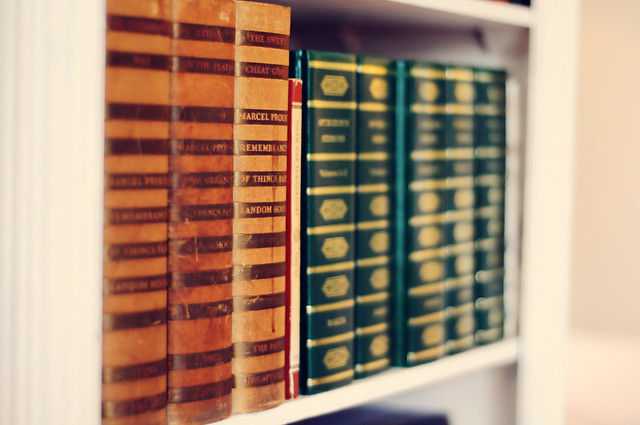
I like buying used books because I prefer buried treasure to the latest thing. I like drifting in the past more than jumping on the bandwagon. If books are windows, I prefer they open on a view I simply cannot find in yesterday’s blog post or this morning’s op-ed.
I also like a good deal.
I recently found the DK book of Forgotten Arts and Crafts by John Seymour at a local second-hand bookstore. I paid seven dollars. Seven dollars for a big coffee-table of a book. A book heavy enough to press maple leaves to perfect, dried crispness.
And inside?
Everything we once knew but have forgotten. This is the book to tell you how your ancestors … thatched a roof, built a canoe, made their tea, washed their clothes. [Big breath here.] Also, how they made nets, and brooms, and coffee. Not to mention, how they built a rock wall, where they stored the dishes, how they mopped the floors, how they blacked a stove. Would you like to learn about peat cutting, blacksmithing, or chair-making? I could go on. And on, and on, and on.
The many full-color illustrations, ink drawings, and photographs in this encyclopedia of forgotten skills make it a great choice for curious children (and their parents). I especially enjoy Seymour’s personal memories and commentary. He is no impartial recorder of forgotten lore. He remembers, he cares, and he believes that this modern world, a world in which very few people know how to make anything with their hands, is not sustainable.
Moreover the British are as inept at making coffee as the Americans are at making tea. So difficult and mysterious does this simple process seem to them that they resort to those horrible ersatz mixtures, either in powder or liquid form, which have no right to be called by the name of coffee. Perhaps there should be an exchange of missionaries between the two countries. – John Seymour
I found this next book at a local store with a good selection of books about the history and culture of “Plain” communities like those of the Amish and Mennonites. But Sue Bender’s Plain and Simple: A Woman’s Journey to the Amish is no straightforward history or tourist’s introduction. Bender is an artist. Hers is an artist’s meditation on living the good life. Is it possible, she wonders, to live the beauty and simplicity she sees in an Amish quilt? Or, must our modern, busy way of life only ever resemble a crazy-quilt?
Bender’s first encounter with traditional Amish quilt-making in the 1960s led her to the previously unthinkable. This wife, mother, and artist, a woman who had always despised all things domestic, spent months living with two different Amish families.
The result is this beautiful, little book. It is quiet, reflective, scattered with white space and ink drawings. It is a book of good questions and wisdom worth pondering.
Before I went to the Amish, I thought that the more choices I had, the luckier I’d be. But there is a big difference between having many choices and making a choice. Making a choice – declaring what is essential – creates a framework for a life that eliminates many choices but gives meaning to the things that remain. – Sue Bender
My favorite section of any used bookstore is usually called “Local Interest,” or some variation on that. This is where you’ll find the odd little books that would never be given a shelf in a big chain store. They are books rooted in a particular place.
Which means I am not exactly recommending this last book. I doubt it would interest many outside my own Chester County, Pennsylvania. Instead, I mention it for inspiration. This is the kind of odd-ball treasure you will only ever discover through a devotion to the dusty corners where old books lie in wait.
The book is Fine Food, Wine, and Pickled Pine: The Story of Coventry Forge Inn by Ann Kilborn Cole. I found it at a local used bookstore housed in a converted eighteenth-century barn. All I can say is of course this book would be found living in a converted eighteenth-century barn.
This is one woman’s memoir of working, with her sons, to turn their colonial-era Pennsylvania home into a fine-dining restaurant. Written in the 1950s, this is a quirky, eye-opening, unintentionally humorous book about one family’s dream and the good food that fueled it.
Did I mention there are recipes? I can’t imagine I’ll ever try one, but I spent a happy hour perusing the sample menus and imagining all those mad-men era businessmen and housewives enjoying a special Saturday night out. My very favorite moment came after several breathless paragraphs in which Cole describes a newly invented oven with the potential to transform the high-end restaurant kitchen. I’d never heard the name she used, but it slowly dawned on me that the modern marvel she was describing was most likely … the microwave oven.
Perhaps you imagine you have no time for such a useless book? You know your reading time is limited and there are so many “must-reads” out there? You are right. A book like this is the very opposite of “must-read.”
And that, my friends, is why I love it.
So, why don’t we finish this post with a quotation from yours truly?
Reading is not an item for the to-do list. Reading is a way of life, and life should never be contained within the confines of a bestseller list. – Christie Purifoy
