by Christie Purifoy | Nov 2, 2013 | Books, Poetry, Uncategorized
Autumn is a time for hoarding books. Like a squirrel and its acorns. Like my children and their Halloween candy.
Winter, the reader’s favorite season, will soon be here. And, yes, despite what we might say, winter is our favorite season. We can admire the beauty of fall, the fresh breezes of spring. We can enjoy mucking about in our gardens come summer. But, as readers, we are always at our happiest curled up with a book.
Short, dark days are welcome because they let us off the hook. What else is there to do but pull the blanket closer and go on reading our book?

Here are a few recommendations to help pad your winter reading list.
The first is welcome throughout the year, but I usually only remember it come fall. The Autumn Board Book , by Gerda Muller, is one of four wordless board books focused on the seasons.
I’m afraid I lost some of you when I wrote board book. But this is no ordinary board book.
As one of my favorite picture book characters would say, board books are the raisins and zeros of the book world. Condemned to be chewed upon. Containing only simplified, shortened versions of classic stories. I like to have a few lying around for the actual baby, but, otherwise, I give them a pass.
Except for these.
Muller’s four books are exquisite. I keep one nestled in with the candles and bowl of acorns on our kitchen table. It’s the kind of book you will want to pick up and enjoy for at least a few minutes every day.
These books make great first gifts for a new baby, but they are wonderful for older children, too. A good friend with grown children recently purchased all four. She told me she’s setting them aside for future grandchildren, but I’m quite sure she’s enjoying them in the meantime.
Autumn … the year’s last, loveliest smile. – William Cullen Bryant
One of my favorite things about this hinge season between summer and winter is the food. No more quick pestos or sauteed garden veggies. Now is the season for slow-simmered curries and meaty sauces and cranking the oven back to high.
Whether or not you care much for food or cooking, you will enjoy Ruth Reichl’s memoir, Tender at the Bone: Growing Up at the Table (Random House Reader’s Circle) . Reichl, a celebrated food writer and restaurant critic, is the exact right person for memoir. Not only is she a great writer, but she is curious. She collects stories and experiences like I collect books.
This memoir is full of fun and sweetness, but it tells some hard stories, too. I realized while reading it that quite a few of my favorite memoirs are written about girls growing up with mentally ill mothers. I have no idea why this is. I do know that Reichl’s book is an excellent addition to a list that includes memoirs by Mary Karr and Jeannette Walls.
The most powerful things about this book is the way it makes you care. First, for Ruth, and then for her family and friends and even the stray characters who cross her path. Reichl sees the world (and writes about it) through a lens of love. And I believe we only see the world, other people, and our own lives truly when we look with love.
My parents entertained a great deal, and before I was ten I had appointed myself guardian of the guests. My mission was to keep Mom from killing anybody who came to dinner. – Ruth Reichl
Luci Shaw is one of my favorite poets. I’ve mentioned her here before. She is a poet of faith and substance and beauty.
What the Light Was Like: Poems is a perfect collection for this season of shifting light. Reading poetry slows us down, something I always long to do this time of year, and Shaw’s work, especially, calls us to notice the natural world and to listen to its messages.
Light has a peculiar quality of transforming what it touches, like gold foil over wood. In Hebrew the word for glory has the sense of heaviness, as if light adds to the bulk of its significance. When I see the road that runs in front of my house and the bushes along the sidealk touched with sunlight, even the black tarmac and the faded winter leaves look glorious. – Luci Shaw
by Christie Purifoy | Oct 26, 2013 | Amish, Books, Pennsylvania, Uncategorized
Here is something you should know: my bookshelves are brimful with the very old and the very odd.
I bring them home by ones and twos. I bring them home by the bag. I bring them home from library sales and thrift stores. I find them in junk shops and antique emporiums. When I wake early on a Saturday morning to scour the deals at a children’s consignment fundraiser, I always rush past the piles of shoes and battery-operated toys to find, there are the back of the gymnasium, the table of cast-off books.
I am lucky enough to live nowhere near a big-box bookstore but in the neighborhood of 4 or 5 well-stocked used bookstores.
This is a post in praise of second-hand books.
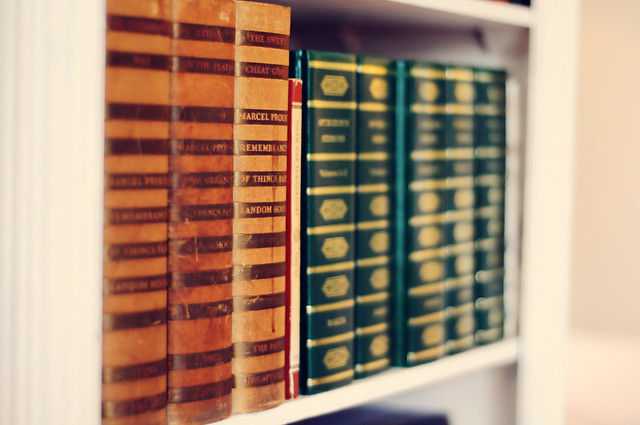
I like buying used books because I prefer buried treasure to the latest thing. I like drifting in the past more than jumping on the bandwagon. If books are windows, I prefer they open on a view I simply cannot find in yesterday’s blog post or this morning’s op-ed.
I also like a good deal.
I recently found the DK book of Forgotten Arts and Crafts by John Seymour at a local second-hand bookstore. I paid seven dollars. Seven dollars for a big coffee-table of a book. A book heavy enough to press maple leaves to perfect, dried crispness.
And inside?
Everything we once knew but have forgotten. This is the book to tell you how your ancestors … thatched a roof, built a canoe, made their tea, washed their clothes. [Big breath here.] Also, how they made nets, and brooms, and coffee. Not to mention, how they built a rock wall, where they stored the dishes, how they mopped the floors, how they blacked a stove. Would you like to learn about peat cutting, blacksmithing, or chair-making? I could go on. And on, and on, and on.
The many full-color illustrations, ink drawings, and photographs in this encyclopedia of forgotten skills make it a great choice for curious children (and their parents). I especially enjoy Seymour’s personal memories and commentary. He is no impartial recorder of forgotten lore. He remembers, he cares, and he believes that this modern world, a world in which very few people know how to make anything with their hands, is not sustainable.
Moreover the British are as inept at making coffee as the Americans are at making tea. So difficult and mysterious does this simple process seem to them that they resort to those horrible ersatz mixtures, either in powder or liquid form, which have no right to be called by the name of coffee. Perhaps there should be an exchange of missionaries between the two countries. – John Seymour
I found this next book at a local store with a good selection of books about the history and culture of “Plain” communities like those of the Amish and Mennonites. But Sue Bender’s Plain and Simple: A Woman’s Journey to the Amish is no straightforward history or tourist’s introduction. Bender is an artist. Hers is an artist’s meditation on living the good life. Is it possible, she wonders, to live the beauty and simplicity she sees in an Amish quilt? Or, must our modern, busy way of life only ever resemble a crazy-quilt?
Bender’s first encounter with traditional Amish quilt-making in the 1960s led her to the previously unthinkable. This wife, mother, and artist, a woman who had always despised all things domestic, spent months living with two different Amish families.
The result is this beautiful, little book. It is quiet, reflective, scattered with white space and ink drawings. It is a book of good questions and wisdom worth pondering.
Before I went to the Amish, I thought that the more choices I had, the luckier I’d be. But there is a big difference between having many choices and making a choice. Making a choice – declaring what is essential – creates a framework for a life that eliminates many choices but gives meaning to the things that remain. – Sue Bender
My favorite section of any used bookstore is usually called “Local Interest,” or some variation on that. This is where you’ll find the odd little books that would never be given a shelf in a big chain store. They are books rooted in a particular place.
Which means I am not exactly recommending this last book. I doubt it would interest many outside my own Chester County, Pennsylvania. Instead, I mention it for inspiration. This is the kind of odd-ball treasure you will only ever discover through a devotion to the dusty corners where old books lie in wait.
The book is Fine Food, Wine, and Pickled Pine: The Story of Coventry Forge Inn by Ann Kilborn Cole. I found it at a local used bookstore housed in a converted eighteenth-century barn. All I can say is of course this book would be found living in a converted eighteenth-century barn.
This is one woman’s memoir of working, with her sons, to turn their colonial-era Pennsylvania home into a fine-dining restaurant. Written in the 1950s, this is a quirky, eye-opening, unintentionally humorous book about one family’s dream and the good food that fueled it.
Did I mention there are recipes? I can’t imagine I’ll ever try one, but I spent a happy hour perusing the sample menus and imagining all those mad-men era businessmen and housewives enjoying a special Saturday night out. My very favorite moment came after several breathless paragraphs in which Cole describes a newly invented oven with the potential to transform the high-end restaurant kitchen. I’d never heard the name she used, but it slowly dawned on me that the modern marvel she was describing was most likely … the microwave oven.
Perhaps you imagine you have no time for such a useless book? You know your reading time is limited and there are so many “must-reads” out there? You are right. A book like this is the very opposite of “must-read.”
And that, my friends, is why I love it.
So, why don’t we finish this post with a quotation from yours truly?
Reading is not an item for the to-do list. Reading is a way of life, and life should never be contained within the confines of a bestseller list. – Christie Purifoy
by Christie Purifoy | Oct 22, 2013 | Dreams, Grateful, Jesus, Scripture, Uncategorized
I’ve mentioned this before.
I do think it’s worth repeating.
I believe the secret to the dreaming life is knowing when to let go of a dream.
***
Here is what I have neglected to mention: that dream never really goes away. There are days when you see it back there in the past and you thank God your dream was never realized. But there are other days and other dreams. You look back at them and you ache for the younger you who poured so much of herself into that dream. You wonder, what was the point of all that effort? Was it for nothing?
All this makes you a little less eager to embrace new dreams.
***
I shared my story this week. I wrote it out: how God spoke to me and the language was my desire. But there is more. There is always more to our story while we are living it.
Here is Part Two: My dream came true (the dream I never could have imagined on my own), and it is good. But the old dream, the dream I willingly released, still comes creeping back. Some days, I look over my shoulder. I remember how in that dream I was called professor (not stay-at-home mom). In that dream I wore heels (not muddy garden boots). In that dream I had an easy answer to the question what do you do? In that dream I was admired, respected, and I stood at the front of the room.
Like many dreams, it was a muddy swirl of selfishness and altruism. Of wisdom and foolishness. Most days, I am relieved that I no longer keep office hours. No longer grade essays. However, there are days when I look at the interview jacket in my closet and wonder, with something that might be an ache, if I’ll ever wear it again.
I’m not sure I want to wear it again.
I haven’t given it away, either.
Old dreams are never fully discarded. There is no donations drop-box for the dreams we outgrow.
***
Standing in the doorway of my closet, fingering the polished fabric of that interview suit, I fear I am Lot’s wife. Will I, too, be punished for looking back?
That is a story I struggle to comprehend. It reads to me like something from the Greeks. Mortal women transformed into swans and trees and the shape-shifting gods who chase them. Certainly, the Bible is a strange collection of legend and history, myth and poetry, wisdom and epistle, but I believe it is God-breathed. Where is God’s life-giving breath in the story of Lot’s wife turned into a pillar of salt?
But Jesus says remember her and so I do (Luke 17:32). I remember her, and I remember that with the next breath he says whoever tries to keep his life will lose it, and I remember that I have lived the truth of those words.
I remember how he lived them, too.
Maybe it isn’t a question of punishment but of choice. I can look back and cry my life away. I can squander these good days with endless longing and salty tears.
Or, I can listen. I can trust.
I can be grateful for memory. I can be grateful for the persistence of old dreams.
I can wake up every day eager to let it all go one more time, and one more time, because I know the only way to live is with empty arms.

***
by Christie Purifoy | Oct 21, 2013 | Dreams, Florida, Grateful, Home, Pennsylvania, Uncategorized
“The language of souls is their desire.” – Gregory the Great
Desire.
Like every good thing, it can be twisted. Exhibit A may be the wandering Israelites and their golden calf, but exhibits B through Z are not hard to find. No need even to name them.
Well aware of exhibits A through Z, desire begins to look dangerous. It begins to look like fire. Afraid of being burned, we push it aside, we cover it up, we warn our children about playing with fire, and we forget. We forget how much we need that life-giving warmth.

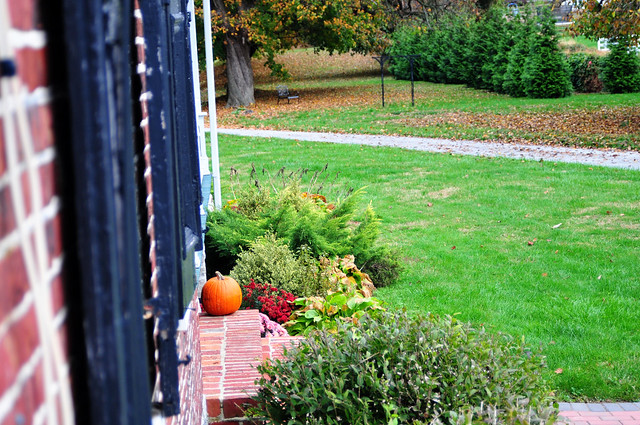
I can remember the day my Sunday New York Times magazine flipped open to a photograph of an old, rambling farmhouse. I sat in my Florida ranch home with its persistently green vegetation, and the desire I felt for that other house nearly knocked me out of my seat.
In the picture I could see trees turning orange, pumpkins on the porch, and a tower room that looked perfect for a writing desk. I imagined children (a bigger crowd than my own three) running across the lawn, while someone (couldn’t be me) watched from the windows. I pictured a henhouse and vegetable garden off to the side, and a woman writing stories in the tower room (of course, she wasn’t me; the only thing I’d ever written was a dissertation and that was an experience I was not eager to repeat).
In that image, I could see an entire life. It looked beautiful, but it could never be mine. I didn’t even consider it. That would have been like considering a trip to the moon.
I was a mother of three (there would be no more), I had recently applied for a tenure-track professorship at a small Florida liberal-arts school, and I was, however reluctantly, mapping out a future among the palm trees.
But those northern maples were blazing in my magazine, and I could feel their heat through the page.
Here is a long story made very short: God was speaking to me, and the medium of communication was desire.
It is a dangerous thing to listen to that voice. One day you are living reasonably, making reasonable plans, and fulfilling every obligation and expectation, and the next? You are on your knees warming your hands over a magazine picture until … you are consumed.
You have played with fire, and your life will never be the same.

Praise be to God.
by Christie Purifoy | Oct 19, 2013 | Books, children, Food, Stories, Uncategorized
There never is enough time for reading, is there?
I’ve heard the same thing from so many of you. Something like Oh no! More recommendations! I’ll never catch up! Of course, I know you’re winking. I know you’re dropping everything to read that novel though there are so many more important things to do.
And we wouldn’t want it any other way, would we?

When I’m honest with myself, I am never truly afraid that I won’t make it to the bottom of my must-read list. When I’m honest with myself, I know that my real fear is this: I am afraid I will run out of good books. I am afraid I’ll be caught waiting for a child somewhere and I won’t have a good book in my car. I’m afraid the baby will fall asleep at the exact same moment when the kids busy themselves with a game and I won’t have a good book on my desk.
I know. This is crazy talk. But let’s just make sure shall we? Let’s keep those bookshelves and nightstands and library order queues nice and full.
As always, I am here to help.
(P.S. This post includes affiliate links. You can find more info about those right here.)
Never trust anyone who has not brought a book with them. – Lemony Snicket
This was my recent stop-everything-must-read-to-the-very-last-page reading event: The Ocean at the End of the Lane: A Novel by Neil Gaimon.
I’ve mentioned before my weakness where fairytales for grownups are concerned. Gaimon’s newest book makes an excellent addition to this list. It is the book I want to write when I grow up.
This is a slim novel about a young boy living in an old house on a country lane in England. On the surface of the story, you’ll find a fairy ring, three generations of mysterious, ageless women, and an evil housekeeper/creature. Beneath the surface, you’ll find a boy growing into a man, a family breaking apart, and all the big questions about life and death and loss and the meaning of it all.
This is what I love about fairytales: something small and simple like the death of a beloved kitten is at the same time something big and meaningful and important. It is both. This is a novel exactly like the ocean at the end of the lane: it is so much bigger on the inside than it appears to be from the outside.
‘Grown-ups and monsters aren’t scared of things.’
‘Oh, monsters are scared,’ said Lettie. ‘That’s why they’re monsters. And as for grown-ups …’
– Neil Gaimon
My love for books about food (a category not to be confused with actual cookbooks) is well documented on this blog. A new-to-me classic of this genre is Laurie Colwin’s Home Cooking: A Writer in the Kitchen (Vintage Contemporaries) .
.
These essays are part memoir, part hilarious confession, part cookbook, and, well, I’m sure a few other secret ingredients have been added to the mix, but the result is delightful.
Colwin was a writer and a home cook. Her book is funny, informative, and mouth-watering. Most of all, it’s a book that makes me just that much happier in my kitchen and at my table. Good things happen at the table, whether we’ve cooked our meal on a hot plate or a community center’s professional oven. Colwin knows this and celebrates it. And I love her for it.
The ultimate nursery food is beef tea; I have not had it since I was a child, and although I could easily have brewed myself a batch, I never have yet. I am afraid that my childhood will overwhelm me with the first sip or that I will be compelled to sit down at once and write a novel in many volumes. – Laurie Colwin
Here’s a book I’m sure you don’t need me to tell you about, but maybe you have yet to pick it up? It’s Betsy-Tacy (Betsy-Tacy Books), the first in the series begun in 1940 by Maud Hart Lovelace.
I somehow missed this one as a child. My firstborn (recently turned ten) nearly missed it. But, thank heavens, we rectified that error in time. This may be a book well suited for little girls (ages four to eight, perhaps?), but, really, we are never too old to snuggle on the couch and read about childhood through the eyes of best friends Betsy and Tacy.
This is an old-fashioned book full of old-fashioned pleasures. Playing paperdolls. Building a backyard house out of a piano crate. Filling old bottles with rainbows of colored sand. It isn’t a life without hardship or sorrow, but it is a life made beautiful by friendship and imagination.
I’m not sure we’ll make it to the end of the series (Betsy’s Wedding? Maybe not). But this first book is a treasure.
Besides the little glass pitcher, she got colored cups and saucers, a small silk handkerchief embroidered with forget-me-nots, pencils and puzzles and balls. But the nicest present she received was not the usual kind of present. It was the present of a friend. It was Tacy.
