by Christie Purifoy | Sep 28, 2013 | Books, Gardening, Uncategorized, Writing
Friends, a confession: I read some books this summer.
The bad news is that I forgot to start dinner, I never noticed when the baby ate cat food, and I forced all four children to endure 90 minutes of daily “quiet time.”
The good news is that I have so many books to tell you about. Let’s talk books, again, shall we?
(If you’re new to this Saturday series you can browse my previous recommendations right here and read more about my use of affiliate links.)
Summer, for me, was over the top in every way. Heat, humidity, rain, noise, activity, zucchini. Just Over The Top. I survived by reading novels.
One of my favorites was Where’d You Go, Bernadette: A Novel by Maria Semple.
After reading the first few pages, my expectations were not high. The storytelling is unconventional. Rather than a seamless narrative, you’ll find fragments of communication: emails, texts, letters, newspaper clippings, etc. I worried the book would be some sort of postmodern experiment, more taken with its construction than the story it tells. I have nothing against experiments (Joyce’s Ulysses is one of my favorite books), but, this summer, I wanted something thoughtful and enjoyable.
If Semple’s book is an experiment, it succeeds beautifully. Yes, the form is unusual, but it turns out to be integral to a story that is deeply, warmly human. This is a fun, funny novel, but it makes a serious point: first impressions, even second impressions, might give us entirely flawed ideas about other people.
I loved the hope inherent in this story. I loved knowing that even villains might turn out to be lovable.
Hovering over me was the Chihuly chandelier. Chihulys are the pigeons of Seattle. They’re everywhere and even if they don’t get in your way, you can’t help but build up a kind of antipathy toward them. – Maria Semple
Over the summer, I spent more time gardening than reading, a first for me. Of course, when I wasn’t gardening I was often reading about gardening. I’d read this memoir years ago, but when I found it on the shelf of my local used bookstore, I was happy to read it again.
William Alexander’s The $64 Tomato: How One Man Nearly Lost His Sanity, Spent a Fortune, and Endured an Existential Crisis in the Quest for the Perfect Garden is funny, self-deprecating, and surprisingly informative. Reading about battles with garden pests and plagues should be discouraging, but Alexander’s honesty (and his recipes!) allow us to see just how rewarding life in the garden can be, whether we’re winning those battles or not.
With the kitchen garden established, I decided – in an act of horticultural hubris perhaps not seen since, well, since Yahweh designed the Garden of Eden – to Build a Meadow. – William Alexander
This new book by award-winning memoirist Beth Kephart was one of my great finds of the summer: Handling the Truth: On the Writing of Memoir . If you have even the tiniest dream to write memoir (or even a blog post based on personal experience) this book will be your Bible. It is inspiring, it is instructive, and it is beautifully written.
I think this book deserves a much wider audience than only writers and writers-in-the-making, however. First, Kephart offers lists of must-read memoirs. Some were familiar to me, but many were not. Her descriptions of what makes each memoir valuable would make this book worth its purchase price even if that’s all it offered. But it offers a great deal more.
This is a book to wake us up to our own lives. This is a book to reveal the treasure that is our own experience. This is a book to help us shape the stories that must be shared.
If all your memoir does is deliver story – no sediments, no tidewater, no ambiguity – readers have no reason to return. If you cannot embrace the messy tug of yourself, the inescapable contradictions, the ugly and the lovely, then you are not ready yet. If you can’t make room for us, then please don’t expect us to start making room for you. – Beth Kephart
And you? Read any good books this summer?
by Christie Purifoy | Feb 23, 2013 | allergies, Books, Family, Food, Uncategorized
Food is my love language.
Isn’t that one in the book? No? Well, I’m convinced food is my love language. I know my mother loved me because she sometimes surprised me during the after-dinner homework hour by sneaking into my bedroom with chocolate pudding. Yes, Mom, I still remember the chocolate pudding.
I show my kids love by feeding them.
Which has, on more than one occasion, resulted in a call to 911 and an epi-pen. Which just goes to show that love is complicated.
//
//
Making something that is healthy, non-allergenic, and liked by all is my holy grail of cooking. Actually, it’s my holy grail of motherhood. But, like any epic quest, mine is marked by failure, disappointment, and only occasional victory. Like the knights of old, I am not giving up.
Books like these inspire me to get up and give it another try. Books like these remind me that food and its enjoyment are among the very greatest gifts of our creator.
//
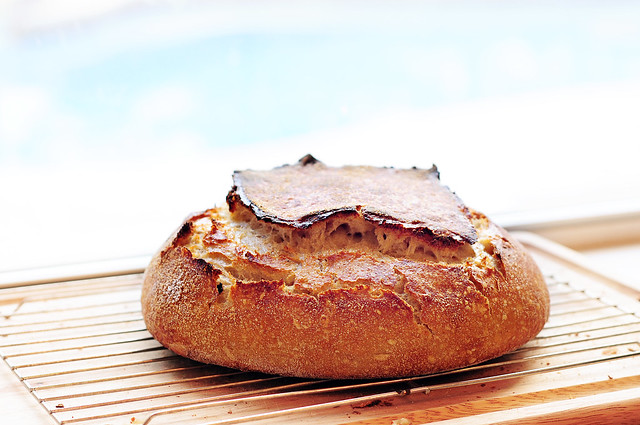
First, (for those whose taste buds have been set dancing by the photo above) is Tartine Bread by Chad Robertson. Yes, that photo shows actual bread baked by the actual me. In my actual home kitchen. And, it actually tastes even better than the picture looks.
In addition to the cookbook, you will need a digital scale and a cast-iron combo cooker (though I think a dutch oven would also work). Then, simply follow directions. Robertson takes us step-by-step from making our sourdough starter through his basic country loaf and on to variations that include everything from pizza dough to English muffins.
I am generally something of a disaster in the kitchen, but this book makes me look like I know what I’m doing.
//
Next, is a book I suspect many of you have read. It’s Animal, Vegetable, Miracle: A Year of Food Life by Barbara Kingsolver. If you haven’t yet read it, then I am thrilled to be the one to give you that final push. Because read it you must.
Do you like food? Do you like memoir? Then you will like this book. Kingsolver chronicles the year she and her family spent eating only locally grown foods, most of them foods they had grown or raised themselves. Kingsolver talks politics, global warming, and the state of American agriculture, but at the heart of this story is good food, family, and love.
This is a book about tomatoes. How we care for them. How we harvest them. How we spoon them out of jars in the middle of winter and remember warm, summer days. This is a book about bread. About what it does for our families when our homes smell of fresh-baked bread.
This is a book about celebration.
//
Finally, a new-to-me book I admit I’ve only just begun. Two chapters in, and I’m smitten. It’s An Everlasting Meal: Cooking with Economy and Grace by Tamar Adler. Generally, I won’t recommend a book I haven’t yet finished, but this is one of those books you start telling all your friends about before you’re even halfway through.
Adler is funny and wise. She begins with the simple act of boiling water, and I am now convinced that a big pot of bubbling, well-salted water is the start of all sorts of magic.
This is a book for those of us who love food but get bogged down in long, complicated recipes. It’s a book to make you believe that you, too, can create, not restaurant masterpieces, but the stuff of life. Good, nourishing food.
Which is, of course, the whole point.
by Christie Purifoy | Feb 16, 2013 | Books, Religion, Scripture, Stories, Uncategorized
I like to think of myself as an adventurous reader. A curious reader. A willing-to-give-it-a-go reader.
Truthfully, there are quite a few things that almost always trigger a “No, thanks,” from me. Almost always, that is. This Saturday, I bring you a few of those books I still don’t know why I read. But I’m so glad I did.
The descriptor ripped-from-the-headlines is a major stop sign for me. I can’t even watch Law and Order. I appreciate the headlines and the stories behind them (mostly via NPR). I love utterly fantastic, creative storytelling. I don’t like any mixing of the two.
In my view, the truth is generally more incredible than fantasy. Also, excellent fantasy is generally more truthful than reality.
Here’s the exception: Room: A Novel by Emma Donoghue. Actually, this book also defies another of my stop signs: never read a book in which terrible things happen to a child.
I wish I could remember why I ever picked up this book, but, heavens, am I glad I did. This is the story of a little boy who has never known anything but a single, small room. He is the child of a young woman who was kidnapped and is being held prisoner in a backyard shed.
I know I’ve already lost a few of you, but I hope you’ll stick with me. Truly, this is one of the most incredible novels I have ever read.
Because Donoghue tells her story from the little boy’s perspective, our overwhelming impression is one of wonder, never horror. The skill with which this child and his world are depicted simply boggles my mind. In fact, writing this, I am itching to read this one again. Just so I can figure out how she did it. Because what she has done is amazing.
This is a beautiful story. It will leave you in awe of the power of a mother’s love. It has an exciting, page-turning plot (will these two incredible people escape their imprisonment??). Finally, it has an emotionally satisfying ending.
Room breaks all my rules and does it beautifully.
Stories are a different kind of true. – Emma Donoghue in Room
Another of my rules? I don’t do literary adaptations. The sequal to Peter Pan? An update on Hamlet? Noooo! They can never equal the original, and they strike me as creatively lazy. Derivative. Come up with your own characters, why don’t you!
But, then I read The Flight of Gemma Hardy: A Novel (P.S.) by Margot Livesey. You could call this a retelling of Jane Eyre. Like me, you are probably thinking, “Why not just read Jane Eyre?” And, yes, if you haven’t, you should.
But thanks to Livesey, I think I now see the point of retellings, adaptations, and imaginative sequals and prequals. Art doesn’t exist in a vacuum. It creates echoes and other artists, in other places and other times, respond to those echoes. It is as if The Flight of Gemma Hardy is in conversation with Jane Eyre. It helps us to see the old classic with new eyes, and it is, in itself, a beautiful work of art.
Running, I soon realized, was the best way to stay ahead of fear. – Margot Livesey in The Flight of Gemma Hardy
One final no-go: gimmicks. I don’t like them. Also, anything that seems needlessly disrespectful towards the things I hold most dear. So, why I ever read The Year of Living Biblically: One Man’s Humble Quest to Follow the Bible as Literally as Possible by A. J. Jacobs is beyond me.
First, this book is hilarious and slightly gimmicky, but it is written with earnestness and humility. Jacobs really does want to understand the Bible and the many ways people profess to live it out, and he shares his growing wisdom with us.
In the end, this memoir is funny but it’s no joke. With curiosity and empathy, Jacobs encounters Biblical literalists from the Amish in Pennsylvania to Samaritans in Israel all while trying (and failing) to live the Bible as literally as possible. At the end of his experiment, Jacobs is humbler and wiser.
And so are we.
I’m still agnostic. But in the words of Elton Richards, I’m now a reverent agnostic. Which isn’t an oxymoron, I swear. I now believe that whether or not there’s a God, there is such a thing as sacredness. Life is sacred. The Sabbath can be a sacred day. Prayer can be a sacred ritual. There is something transcendent, beyond the everyday. It’s possible that humans created this sacredness ourselves, but that doesn’t take away from its power or importance. – A. J. Jacobs in The Year of Living Biblically
Find previous book recommendations here: week one, week two, week three, week four, week five, and week six.
by Christie Purifoy | Feb 9, 2013 | Books, Seasons, Uncategorized, Winter
Every winter I am surprised to remember that the return of the light is accompanied by the coldest weather. These days are snowier and chillier, but they are brighter, too.
Old, Pennsylvania farmhouses are known for their extra deep window sills. So, these days, instead of sitting in front of the fire, I am reading my book while perched on the sill of these floor-to-ceiling parlor windows. All the better to catch every ray of this golden, late-winter light.
Appropriately, I’ve been reading The Palace of the Snow Queen: Winter Travels in Lapland by Barbara Sjoholm. Part travel memoir, part history, this book is magical and intellectual.
Inspired by her childhood love of the Hans Christian Anderson fairytale, Sjohom helps us see the beauty of a world that is almost (but not quite) in total darkness. This book reminds us how special snow and ice can be. It also asks hard questions about the intersection of tourism and indigenous culture. We may share Sjoholm’s fascination with the Sami people, the reindeer herders of northern Norway, Sweden, and Finland, but we are not allowed to forget that they too live in the modern world. After all, some of them still herd reindeer, but they do it with helicopters and snowmobiles.
I was out of sight of the Icehotel now, far away on the snow-covered still-frozen river, sliding along on my simple kick sled, no desire to turn back yet, into the wide world, rejoicing. – The Palace of the Snow Queen
I like to think of myself as someone who collects seasonal children’s books. I imagine pulling out a basket of warm-weather themed books on midsummer’s eve and books about autumn and back-to-school in September. Truthfully, except for a few Easter titles, what I have actually accumulated is a collection of Christmas and winter books that is threatening to take over our house. (Winter! I love you, I hate you, and I am always and forever inspired by you. One of the saddest seasons of my life? The two years I spent reading Gingerbread Baby and It’s Snowing!
 in Florida.)
This December we added A Day On Skates by Hilda van Stockum, and I am in love. The kids are pretty happy, too.
First published in 1934, this is the (delightful! enchanting!) story of a Dutch ice-skating picnic.
I’m sorry, do I need to say more? Are you not already rushing out to buy this book? Because, truly, can you imagine anything more wonderful than spending your school-day skating frozen Dutch canals with your teacher and classmates while stopping occasionally for adventures and warm snacks?
Well, if you think you can, then I dare you to read this book. Van Stockum was a painter before she was a writer, and the full-color, full-page illustrations are … well, I don’t know what to say except this: I want to live in them! I want to wear wooden shoes, I want to join in a school-wide snowball fight, I want to see my twin brother rescued from beneath the ice, and I want, oh how I want, to eat Snow Pancakes.
In that small country called Holland, with its many canals and dykes, its low fields and quaint little villages, Father Frost went prowling round one January night, with his bag full of wonders. – A Day on Skates
Tell me there’s no need to go on?
Okay, I’ll say this one thing more: I may include amazon links for convenience, but this is where you should be discovering and buying children’s books. Yes, amazon is convenient. Yes, amazon will save you money. Yes, the big-box bookstores have a train table that keeps your three-year-old happy. However, they also have case after case of Disney-themed this and Wimpy Kid-that, and I can practically guarantee they do not carry works of art your children will always remember. No one ever wanted to live in a Captain Underpants book.
Since I’m already on this soapbox can I recommend one of the greatest short stories ever written (and, surely, it is the greatest short story featuring snow)?
The Dead by James Joyce (I own this edition: Dubliners: Text and Criticism; Revised Edition (Critical Library, Viking) ) concludes the stories collected as Dubliners. If you’ve tried to read Ulysses or Finnegan’s Wake and are afraid – don’t be. This is realist fiction at its finest: highly symbolic but readable. It is the story of a middle-class holiday party. It is the story of a marriage.
Like all of Joyce’s work, there are quite a few allusions to nineteenth-century Irish history and politics. Don’t worry about all that. Your job is to enjoy the party. Feel nervous with Gabriel as he prepares his toast. Indulge his self-important fantasies about a night away with his wife, and feel his shock and pain when he realizes how little he truly knows of life, and love, and death.
Most of all, your job is to read the final paragraphs aloud. Slowly. Quietly. Close the door, if you must, and listen to these words as they float, gently, on the air:
His soul swooned slowly as he heard the snow falling faintly through the universe and faintly falling, like the descent of their last end, upon all the living and the dead. – “The Dead”
Find earlier recommendations here: Week One, Week Two, Week Three, Week Four, and Week Five.
by Christie Purifoy | Jan 26, 2013 | Art, Books, Religion, Stories, Uncategorized
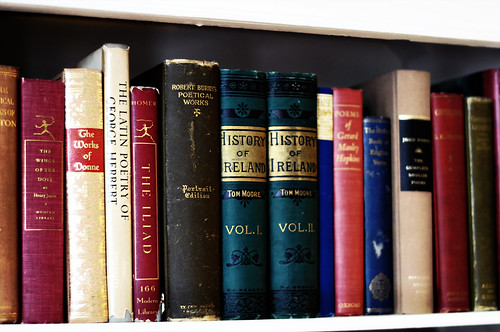
I began this Saturday series, this weekly glimpse of my over-stuffed bookshelves, because it seemed like fun. Just fun.
But now I’ve read House of Prayer No. 2: A Writer’s Journey Home by Mark Richard, and the word fun doesn’t come close. To share a book like this is something far beyond fun. It is serious. It is sacred. It almost feels like worship, and what can I possibly say to convince you to read this book? I don’t know what to say, but I feel desperate to say it.
This is a writer’s memoir. It is the story of a life, of a boy sinned against and sinning, and it is the story of God’s grace for this broken world. It is a work of art.
Unlike almost every other memoir you will read, Richard never uses the first person singular, never writes the word I. He refers to himself as you, and that choice draws his reader in and propels us through the pages.
It is as if a drowning man has lured us into the chaos of deep water. With him we are nearly overcome by the Southern Gothic horrors of his childhood, the wandering waste of his young adulthood, and, with him, we are saved. We are pulled from the water just as his father once pulled him from a swirling stream, and we see God.
By the end of this book we, like Richard, have long stopped believing in coincidence. Instead, through the words of an artist we are able to see the work of that Artist who takes the broken pieces of our lives, our bodies, our stories and fits them perfectly together. The result is something beautiful.
Richard’s memoir reminds me of the memoir trilogy by the poet Mary Karr, a series that began with The Liars’ Club: A Memoir . These are not easy books to read. Karr’s story takes Richard’s horrific Southern Gothic childhood and kicks it up a few notches. However, like Richard’s, this is memoir as poetry. Both books make me think that maybe the surest path to God is to run as hard and fast as you can in the opposite direction. Just maybe.
Next to memoirs by writers, I most enjoy memoirs by midwives. Baby Catcher: Chronicles of a Modern Midwife by Peggy Vincent is the best I’ve found. Each birth story she shares could stand alone, but there’s an overarching narrative that will make you catch your breath. Organized with brief quotations from The Book of Common Prayer, Vincent’s story prompts me to believe there may be no work more holy than that of a midwife.
I only wish we had a memoir from those heroic Hebrew midwives Shiphrah and Puah, women brave enough to deliver babies and tell tales to Pharaoh himself.
If books get written in heaven (and why not?), then no doubt we’ll read their stories someday. I, for one, can’t wait.
Find earlier book recommendations here, here, and here.
