by Christie Purifoy | Apr 4, 2012 | Family, Home, Lent, motherhood, Seasons, Uncategorized

(photos by yours truly)
It’s Holy Week. It’s also – in our house – Spring Break.
Which means there are fewer quiet prayers and meditations, more picnics at the park and kids screaming in the car. In other words, the holy is not hard to find. It’s in my face, and it’s ringing in my ears (quite literally).
My Bible has stayed mostly closed, and I’m not sure if Friday’s Tenebrae service is appropriate for my eight-year-old, but this may all be for the best.
There has been time, after all, to cross one item off of my most important
to-do list.
Flowers for the Doll Family.

(the dollhouse dining room prepared for Easter brunch)
by Christie Purifoy | Mar 8, 2012 | Blog, God's promises, Lent, Seasons, Waiting
Things have been a little quiet around here. A little empty. On the blog and in my heart. This Lent I find myself in a waiting, resting mode. Waiting for my lungs to heal. Waiting for a little boy’s fever to break. Waiting for God to reveal something of what’s next.
I’m waiting on big things and small and holding on to the hope that there will be much to share and much to say on this blog in the months ahead.
Last night, awake at 3 am and waiting for sleep to return, I noticed the moonglow in my bedroom. There’s a full moon tonight, but I have been thinking of new moons. This blog began with my thoughts on a new moon. I’m posting them again in case any of you are finding Lent to be a dark season.
Just remember … darkness is never the end of the story. To paraphrase the writer Anne Lamott, we may be living in a Good Friday world, but we are an Easter people.
Do you know what a new moon looks like? Of course, I do, you’re probably thinking. Until two days ago, I would have thought exactly the same, but I wouldn’t really have been seeing a new moon in my head.
Because I have been in the middle of one book (or six) pretty much ever since I picked up my first kindergarten reader, many of the ideas floating around in my head are attached to letters but not pictures. For example, having read a towering stack of nineteenth-century British novels, I have the word rookery firmly planted in my head. However, I have no solid picture to go along with it. Instead, when I happen upon this word, maybe in Jane Eyre, I see the letters r-o-o-k-e-r-y with a vague image of big black birds sitting on rocks. Which is funny, really, because a rookery shares nothing with rocks but “r,” “o,” and “k.” Though, I had to look it up in wikipedia to be sure even of that.
So, new moon. Two days ago, I googled the phases of the moon. If you’re following a train of thought and sitting in front of a computer (or smartphone, I suppose) it’s amazing how far you can follow said train. My thought began with a complaint and a worry.
I have a two-year-old, and he is a terrible sleeper. Always has been. Which means that my husband and I haven’t slept well in more than two years (because those last few months of pregnancy are never great for sleep, either). Lately, this boy has taken to creeping into our bedroom several times each night and trying to sleep on the floor beside our bed. It’s a little sad and a little cute, but, mostly, it’s exhausting because the two-year-old can’t actually fall back to sleep on our floor, and we can’t fall back to sleep with the loud sucking sounds of his pacifier. Also, I’ve been worried that I’ll get up in the night, not realize he’s there, and step on him. Did I mention that our bedroom has been very, very dark lately? We have transom windows that let in a lot of moonlight, but recently there’s been no light at all and why has there been no light? . . . well, I started googling. The first page that popped up had a huge image of Wednesday night’s moon. A new moon.
This is what a new moon looks like: black, empty, nothing. Somewhere in my head I suppose I knew that. However, it’s the word new that throws me off. New suggests promise, possibility, beginnings. New things should be light, bright, and shimmery. Shouldn’t they? Yet a new moon looks like a black hole. The opposite of promising. The opposite of fresh. The opposite of, well, new.
Staring at that shadowy, black circle where a moon should be, I felt both surprised and encouraged. I’ve been waiting and watching and longing for new things. Months ago, I read these words and felt a promise for my own life: “See, I am doing a new thing! Now it springs up; do you not perceive it?” (Isaiah 43: 19). Some days, I did perceive it. Lately, not so much. I read David’s confession that God lifted him “out of the mud and mire” and “put a new song” in his mouth. I too want a “new song,” but I’ve seen so few signs of it. The landscape of my life looks a little dark. Mostly empty.
Seeing rightly what a new moon is, I recall what I do know: new things start out small. New things begin growing in darkness. In their earliest days, new things look a lot like nothing.
Today, I am choosing to believe that what looks like emptiness and nothingness to me is actually the most promising sign of something new. It is fertile ground for the new thing I choose to believe that God is doing.
I’m afraid I’m mixing metaphors here (from sky to earth), but the new moon reminds me of nothing more than a bed of fertile soil. It looks like absolutely nothing. It looks like darkness and emptiness. It isn’t.
“Those who sow in tears will reap with songs of joy. He who goes out weeping, carrying seed to sow, will return with songs of joy, carrying sheaves with him” (Psalm 126: 5,6).

by Christie Purifoy | Feb 28, 2012 | Florida, God's Love, Lent, Seasons, Waiting
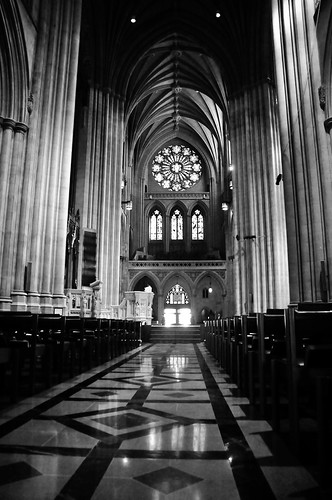
I live in Florida, but my inner calendar has been tuned by the north. In other words, no matter what I see outside my window, January means cold and snow and spring never shows up until after Easter. I suppose ten years living in Chicago did this, although I think it may go back even farther.
Growing up in Texas, I felt cheated by February heatwaves. I have always had an idealized version of the seasons; one more rooted in classic literature for children than in lived experience. Late winter meant sugar snow because I read Little House in the Big Woods no matter that late winter in Texas looks like fields full of bluebonnets.
In Chicago, Lent was appropriately dark, cold, and gray. A fitting backdrop for contemplating dust to dust. The right atmosphere for remembering the cross.
Last year, Lent in Florida surprised me with its very different rightness. The hot pink azaleas and vivid blue skies could not be reconciled with the grey smudges on our foreheads. They simply could not. But I decided that this was best. To practice Lent in such a place is to say, “I will not be distracted by youth or beauty. I will remember that death is ever present. I will not be seduced by sunshine and forget to pick up my cross.” How can we truly celebrate the resurrection power of God’s kingdom if we’ve forgotten how and why Jesus suffered?
Last year, I determined always to make an effort for Lent. It was necessary whether the fruit trees were blooming or not.
This year, I didn’t even make it to my church’s Ash Wednesday service. I was too tired. Too sick. Which says it all, I’m afraid, about the past few months of my life.
I thought about making an effort in some other way. What would I give up? Could I read through a special book of devotions? Make some goal for prayer or good works?
If only I weren’t so tired. If only my asthma would go away. If only I didn’t already feel crushed and weak. If only I didn’t already feel like dust, I might be able to make some effort to remember that I am dust.
Of course, If I had phrased it to myself just like that I might have realized sooner how foolish, how hopelessly circular my thinking had become.
Now I know that if Lent is about making some effort then the end result must always be gratitude that I need never make that effort.
With no effort on my part, I am loved.
With no effort on my part, I am redeemed.
Having made no choice, I might be led through a wintery, Lenten wilderness. Whether my calendar says it’s time for that or not.
Having done little but wait and rest, I will be led out again.
That in itself, I’ve learned, is a kind of discipline. God did tell his children, “It is a day of Sabbath rest for you, and you must deny yourselves” (Leviticus 23:32). Would he have put it like that if rest came easily and naturally?
What, then, is my Lenten discipline for 2012? Merely to rest in the shadow of the cross. And wait.
