by Christie Purifoy | Nov 8, 2011 | Books, Home

I recently bought a chair.
To be more precise, I bought an arm-chair.
This is no hard-backed dining chair. This is a reading chair, a tuck-in-by-the-window-with-a-stack-of-books-and-a-cup-of-tea-chair.
Full confession: I already had a good reading chair. With its faded green-velvet slipcover, it is soft and welcoming. It even has a small hole on the right arm, an x-marks-the-spot for the exact right place to rest my book. In our Chicago apartment, this chair sat between our third-floor window and a built-in bookcase. The ideal spot for reading; the ideal spot for thinking.
This chair still sits in the living room, but in our Florida house it has no window (the window, in this case, consisting of a sliding-glass door to the screened-in patio). A reading chair with no window is simply no good, in my opinion.
And so, I’ve been on the lookout for a new reading chair.
I’ve long kept its intended spot in mind. Because our Florida home is younger than our Chicago home (oh, by eighty years or so), the only consistently quiet spot in this house is in my bedroom (darn these contemporary “open” floor plans). If the quiet weren’t enough, the windows in this room would confirm it as the ideal place for reading: they are a tall, three-sided embrace for my writing desk with just enough room left over for an arm-chair.
And the view, you ask? Fruit trees, a spreading oak, water, and all kinds of birds.
Of course, as with any big purchase, there was no small amount of hand-wringing and budget-worrying. I want to live simply, but I recognize that my usual standards of comparison have become a bit skewed in a place where every other person appears to own a boat.
I might justify my purchase by saying, “Well, it isn’t as if I’m buying a boat.” And yet, I’ve learned that these two objects may not be all that different.
I know this because I sat next to a boat-owning businessman on my recent flight to Chicago. When he started talking to me about how much he loved living in Florida, I just smiled and nodded. I’ve learned that around here conversations tend to shut down once you admit to being more of a “cold-weather person.” It’s not hostility. Just bewilderment.
As I listened to him describe his weekends on the boat, the slow putt-putting to just the right quiet cove, I realized, with surprise, just how much we actually had in common. I understood that for some boat-lovers at least (and I’m afraid I must entirely exclude jet-ski lovers from this observation) a boat is like an arm-chair you can enjoy out on the water. It’s a place to sit, to hold a nice drink, to observe the glory of our world.
The biggest difference, as far as I can tell, is the cost of maintenance (in time and money). So, I am more than content to be an arm-chair kind of girl.
Still, it’s nice to know that I’m not quite the Florida-coast oddball I thought I was. I may not be a hot-weather person. I may not be a beach-person. I may not be a boat-person, but I know what it is to long for one inspiring, beautiful place.
I know what it is to sit in that place, quietly grateful.
by Christie Purifoy | Oct 25, 2011 | Chicago, Community, Seasons

Taken by Yours Truly at Chicago's Art Institute. This painting, with its people like stone columns, always reminds me that living in a crowd is not the same thing as living in community.
Our airplane tilts away over city rooftops, and I feel as if I am leaving home in order to return to a house. It is not an altogether blue feeling (it is a house inhabited by my favorite people, after all), but it is disorienting. An emotional confusion to match a physical one; as the plane banks, I can no longer tell if I am pointed toward ground or sky.
I’ve spent four days trying to understand what I left behind when I moved away from Chicago. It seems important to do this, because I do not yet know if my life is a straight line heading always away from it or a curve that will one day return. I think the only word for what has been lost is community, but that word seems beyond inadequate.
In Florida, when my husband leaves for a business trip, I lie awake wondering who I would call if one of the children had an accident or became suddenly ill. I know that there are people in our neighborhood and people in our church who would graciously, even eagerly, help out, but it would involve some tracking down of phone numbers and many apologies for having “bothered” them in the middle of the night.
Living in community meant that there were no apologies.
We frequently woke to midnight phone calls, whispered midnight prayers for friends in crisis, made beds on the floor for small children whose parents were racing to hospitals. I have rushed behind a curtain in the emergency room to find a friend sitting at my son’s bedside: the friend who held him down for the epi-pen, the friend who drove him to the hospital.
But community is so much more than a safety net.
It is a web of interdependence that is often uncomfortable, even painful. It is the downstairs neighbor who calls (again) because my children are pounding on her ceiling (again). It is the woman pushing the stroller down my street who asks me (again) for bus money. Walking near my old building this week, I saw her, remembered her, and was not at all surprised when she stopped me to ask for money. I passed her again on my last evening in Chicago, and she asked (again) for money. I hand over my bus pass knowing that she will always need, and I hope, for Jesus’ sake, that someone will always be there to give.
Community is trying to keep the kids quiet in the kitchen in order that the group of church ministry leaders meeting in the living room won’t be disturbed. Community is making the bed in the spare room for friends of friends. Community is waking up early to make them breakfast, too.
Community is being inconvenienced.
It is straightening up the living room in order to host a weekly gathering for a church small group when all you want to do is climb into bed. Community is when the unmarried, male graduate student from that same small group surprises you with home-cooked Indian food two weeks after your baby is born.
Community is life in abundance.
This is the gift of the one who made us (the one who said it is not good to be alone): to be poured out again and again in order to be filled again and again. Of course, I am not talking about martyring oneself so that bitterness and resentment destroy all hope of relationship. But I have seen that when I open my hands to give until it hurts I receive … oh, I receive so much in return.
On Sunday, I sat once again in my former church. I was joined by a friend, and we both had tears in our eyes just for the joy of sitting next to one another. She turned to me and whispered, “This is our life,” and I knew just what she meant.
This is our life: it is real, it is now, it is beautiful and difficult, and, above all else, it is shared.
by Christie Purifoy | Oct 19, 2011 | Family, Grace, Vacation, Waiting
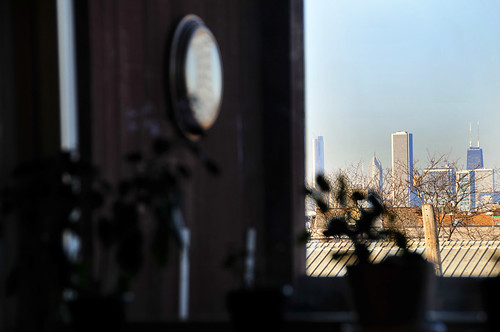
The firstborn and I will be back in Chicago soon. Four days with the people and places we both love best.
I feel an urge to write that we are going home, except that we aren’t.
It isn’t only that we sold our Chicago apartment 18 months ago. It isn’t because we have no family there. We do have many friends, and they were our family for ten good years. Rather, it is that I was once planted in Chicago. I’m not planted there any longer, though I haven’t yet laid down roots in any other place. I feel as if (actually, I hope as if) we are in between homes. (Florida, you are lovely, but I do not think you will ever be home.)
Perhaps I can write of Chicago from my daughter’s point of view. She was born there, after all, and has more of a claim to the place than I do. Here is the hospital where she took her first breath. A few blocks away is the converted hotel (with a tunnel where Al Capone once smuggled gin). It was her first home. Here is the museum that became her own private wonderland; fairy castle, baby chicks, and all. And there is pebble beach, our pebble beach, where we swam in summer and climbed ice dams in winter. Even now when I stand at some water’s edge and look to my left, I half expect to see the glittering wall of a downtown skyline. Perhaps she does, too.
In this life, home is always temporary. In Chicago, I learned that it is possible to feel at home in a temporary place. It is possible to breathe deeply and live thoroughly in a home that won’t always be home.
Possible, yes, but never a given. Or, perhaps I should say that it is exactly that: a given thing. A grace thing.
When God tells his exiled people in Jeremiah that he will bring them home one day, he also says: “Build houses and settle down; plant gardens and eat what they produce. Marry and have sons and daughters; find wives for your sons and give your daughters in marriage …” (Jeremiah 29:5-6). His gift to them is a home in exile. Permission to live, even as they wait.
“For the Lord your God is bringing you into a good land – a land with streams and pools of water, with springs flowing in the valleys and hills.”
(Deuteronomy 8:7)
by Christie Purifoy | Sep 30, 2011 | book of quotations, Poetry

I keep a book of quotations. It looks exactly like any other journal, but it’s for a different kind of journaling. Journaling with the words of other writers, if you will. Here I scribble down quotations from all kinds of books: poetry, theology, memoir, literary theory, fiction, you name it. I write down anything I want to remember.
Sometimes I use these quotations later, in my own writing or maybe just in conversation. But, it isn’t really about utility. It’s about beauty. Language can be so beautiful it stuns. However, I am generally reading so much, so quickly that I need a way to hold on to those beautiful bits that I just can’t bear to let wash down the stream of words, words, words.
In The Poetics of Space the French philosopher* Gaston Bachelard tells us that “the house shelters day-dreaming, the house protects the dreamer, the house allows one to dream in peace.”
That is pure poetry and reminds me, once again, that I will always find more truth in poetry (and myth, and story, and art) than in the dictionary.
Like many introverts, I imagine, I am happiest when in my own home. I also love the purely abstract idea of houses. As a middle-schooler, I wanted to be an interior designer. As an almost-college student, I considered architecture. Ultimately, my desire for fame and fortune led me to study literature. (For those perhaps unfamiliar with the current job market in the humanities, I should explain: that was a joke.)
After ten years of English lit. and babies, I finally did finish with school, and we left Chicago. I have missed my Chicago home for one year and six months. When I picture what it is that I miss, I see what Bachelard prompts me to call my “dreaming spot.” A soft green chair is huddled up against a corner window. A tall built-in bookshelf is just on the other side of the window, and through the glass there are rooftops with one-hundred year old chimneys and treetops that shift from bare, to bright green, to rich green, to shades of fire, and back again.
When I leave this Florida house, I am sure that I will miss the big bay window that shelters my writing desk. I still have the soft, green chair, but I no longer spend much time there. I prefer the hard-backed desk chair, here by the window, where I can see vegetable beds, ripening citrus, water, and (when I’m lucky) river otters. Right now, this is my spot for dreaming.
For me, one of the saddest and most troubling verses in the Bible is Matthew 8:20 where Jesus tells us, “‘Foxes have holes and birds of the air have nests, but the Son of Man has no place to lay his head.’” To follow Jesus, is to say, “Lord, I will make my home in you.”
But we have also been given a promise. In John 14:2 Jesus says, “’In my Father’s house are many rooms . . . I am going there to prepare a place for you.’”
I love houses, mine (wherever it happens to be) most of all. I simply cannot imagine having no place (let alone a cozy, book-filled place) to lay my head. And so I stumble upon yet one more difficult, beautiful paradox: my desire for Home is God-given and good, but this fact gives me no right to hold my house in a possessive, white-knuckled grip.
“Then Jesus said to his disciples, ‘If anyone would come after me, he must deny himself and take up his cross and follow me. For whoever wants to save his life will lose it, but whoever loses his life for me will find it.’”
(Matthew 16: 24-25)
*Lest anyone formulate an unduly high regard for my intellectual habits, I must admit that I do not actually spend my days reading French philosophy. I encountered this quotation in the travel section of my Sunday New York Times. Poetry can find us in the most surprising places.
by Christie Purifoy | Jun 1, 2011 | Florida, God's promises

I am blinking and shielding my eyes as I look toward another hot and humid Florida summer, and I am thinking about winter.
One of my favorite poets, Louise Gluck, invokes winter in “Snowdrops”: “You know what despair is; then winter should have meaning for you,” she writes.
I lived in Chicago for ten years, and winter has meaning for me. But I also know what despair is, so I think I would understand winter even if I had never felt the icy wind that blows off Lake Michigan.
Toward the end of a long winter, it is possible, even easy, to stop believing in spring. It is possible to doubt that you will ever again feel warm sunshine on your bare arm.
This kind of doubt seems ridiculous. Haven’t I witnessed the earth turning year after year for decades? Don’t I know that spring always returns?
I know this, that spring always comes, and I know something else: it is better after waiting. Waiting out a long winter, whether literal or metaphorical, is incredibly, sometimes unbelievably, difficult. Even when I hold tight to my belief in spring’s return, I can tip over into despair, like a teeter-totter shifting between faith and fear.
Having walked through a decade of winters, winters that were often seasons of my soul as much as seasons on the calendar, I know that the sunshine and warm air feel better, richer, more precious after waiting. Even now, knowing what I know, I can still waste too much effort wishing away the waiting, trying to speed up time.
Today, looking toward several months of heat and humidity (though the near-constant coastal breezes do offer some relief), I want to wish it away, as if I could push some sort of cosmic fast-forward button. It’s the weather, yes, (I may have grown up in Texas, but I have never been a hot-weather person), but it’s also a whole season of waiting.
Here, in Florida, we are in-between. Our careers and the long miles between us and family suggest that we will not stay here long, but we don’t know where we’ll go next or when that might happen. We are waiting, yet trying to find within the temporary some sense of at-home-ness. At times, I despair. I begin to believe that I’ll always be frozen in this place, with this weather.
“Yet the Lord longs to be gracious to you; he rises to show you compassion.
For the Lord is a God of justice. Blessed are all who wait for him!”
– Isaiah 30:18
