by Christie Purifoy | Nov 5, 2012 | Art, Books, Faith, Pennsylvania, Poetry, Uncategorized
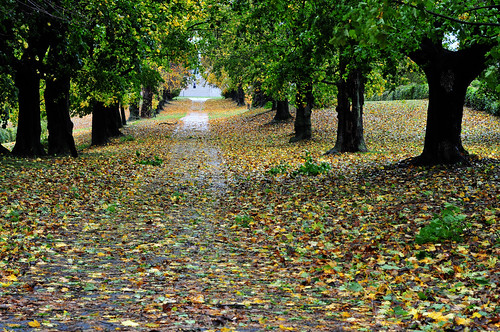
I watched these old, old maples bend in the wind of that hurricane. Because they yielded, they are still standing.
That is how I want to live. I am more and more sure that art and beauty and love grow best not by raging against the wind (or the storm, the dark day, the hard, unasked-for circumstance). They come through yielding.
To yield is not to give up. It is not throwing up my hands in defeat. This yielding is more like being carried. It is moving with what moves and watching – always watching – for the One who does the moving.
And then singing of what I see.
Vow
The need to work this land to fit my wants
I yield. I vow no more to walk with plans
like gossip falling from my mouth. I choose
to go in silence, learning, in my sure
refusal, the truth that yields to yielding.
At Equinox, before the flood of light
sets water loose, I covenant to give
the downward rush beneath the grass its head.
I’ll dam no stream. I’ll dig no pond. Nor will
I plant willows to suck the wet spots dry.
My work shall be to say the nature
of Creation’s slow unfolding, to name what
becoming new has always been, to praise
what lives without my praise unto itself.
– John Leax
by Christie Purifoy | Apr 27, 2012 | Family, God's promises, healing, motherhood, prayer, Uncategorized
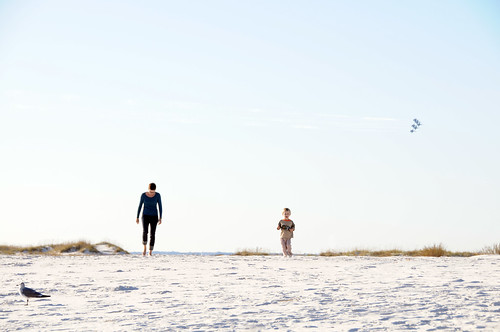
A birthday letter for one’s child should be a marker of all that a mother knows. For instance, on the day you turned three you had a scratch on your cheek and a bruise on your forehead. Your legs and arms were somehow both surprisingly long and impossibly tiny. You loved your balloon. You whined for more chocolate cake. You pronounced it so carefully: “choc-oh-lut.”
But you are almost entirely unknown. This doesn’t bother me or frighten me. At least once a day your father or I will laugh at you and say, “Who are you? Where did you come from?”
Your blonde hair sets you apart in our family. But it is more than appearance. Perhaps it is comparison. With two older siblings whose personalitites and interests have seemed long settled, you are less familiar. We are still getting acquainted. You are still getting acquainted with the world.
Or, perhaps it is a holdover. You were unknown for nine months before your birth. Boy or girl? We chose not to know. You were the little stranger born into the thoroughly familiar, the utterly known: our own bed, in our own apartment, in a city that felt like home.
There has been only one moment when I saw more. One moment when I seemed to glimpse the you that is still buried in your bones.
You were six months old. It was late at night. Your cough was so like a barking seal that we had no need to google symptoms. We could name it. By naming it we felt we had tamed it.
We had done no such thing. In the space between those known, nameable coughs your breath became jagged. Desperate. Each breath seemed just on the verge of not coming at all.
Your father spoke with the nurse on call, and I held you on the floor of the bathroom, your face hardly visible through the steam. I prayed for you.
So often prayer is just a desperate word or two. It hardly seems capable of traveling whatever distance lies between my mouth and God’s ear. But sometimes prayer takes over and I know that it does not come from me at all. It is more like a river, and I’ve just fallen in.
Sitting there, holding you, I was in that river and I saw something. It was as if that rushing river of prayer drew back the veil between known and unknown, seen and unseen. I saw You, the you that is never just a baby or a three-year-old, but the You that is every age, and I recognized how far away from me you would travel. I could see you bringing light into dark places where I would never go. It seemed to me, as I prayed, that there was a great struggle taking place in this ordinary, steamy bathroom.
Later, I recognized that this river of prayer was not my communication with God. It wasn’t my puny request for healing. A simple question to be answered “yes” or “no.” The prayer was God’s own roaring response to the darkness, the utter evil, that would end your life before you could do all that you were made to do. Or, more importantly, before you could become who you were made to be.
God wouldn’t allow it. Yes, the darkness was there with us, grasping at you as you grasped for breath, but God was shoving it aside. Saving you because we needed you. A “we” that includes so many more than just your father and I.
I don’t know exactly who you are or how far you will go. I do know your life will be beautiful, more beautiful even than these first three years. Your life will matter, more than it already has to your family. And I know you are one step closer today to the promise I glimpsed in that prayer.
You are three.
by Christie Purifoy | Apr 20, 2012 | allergies, healing, Jesus, Music, Seasons, Uncategorized, Waiting

Unless this is your first visit to my blog, you know that I’ve been in waiting mode almost since the day, two years ago, when we arrived in Florida. One of the very first posts I wrote was called On Waiting.
Two years ago, I didn’t know what I was waiting for. And, sometimes, waiting is like that. It is a heavy weight. An ache. A question: what now?
But God was present in the waiting. Every day there was water seeping from desert rocks. Food dropped, fully-prepared, on the desert floor.
Occasionally, I even spotted the cloud by day and the fire by night. Spring wildfire season in Florida meant that once we followed a narrow column of smoke the whole twenty-minute drive from our church to our house. Another evening, we followed a full moon made blood-red by reflected fire. That fiery moon hovered in the center of our ash-covered windshield for the long, long drive from a downtown theater to our home. Whoever said that metaphors aren’t as solidly real as flesh, blood, and bread? Those old Bible stories are still alive, you know.
God has been water and bread, fire and cloud for us. And, slowly, so slowly, he filled in the emptiness of waiting with vision. I still waited, but I could see something of what it was that I waited for. This waiting was less desperate but more impatient.
Even hopeful, expectant waiting is difficult. I have wearied of the waiting. I wearied of it long before I knew how heavy it would become.
This winter I got sick. Florida’s pollen season came early and fiercely, and my lungs failed. I spent weeks lying still beside my bedroom air-purifier focusing on each breath. On the worst day, the day that found me back on the doctor’s examining table desperate for new asthma drugs, I found out that I was pregnant. Such surprising, beautiful news, but it was hard to hold on to my belief in an unseen baby while my body tumbled down into an even darker hole. Now nausea and exhaustion kept me pressed into my pillow more tightly than even the asthma.
And I waited. For hope. For healing. For breath.
I waited for God to show up, and I expected fireworks. I imagined an end to my waiting something like a switch clicking from dark to light. When will he come, I wondered. Tomorrow? The next day? How long, Lord, how long?
This morning I sat in the lovely light of a college chapel for a presentation on lament. Lament like that of Psalm 13: “How long must I wrestle with my thoughts and day after day have sorrow in my heart?”
I’m in Michigan for a writer’s conference, and it feels strange and beautiful to be enjoying again the midwestern spring. Daffodils and tulips. Redbuds and soft, green grass. Unfortunately, the beauty also means that Florida’s pollen has followed me northward. In the busyness of travel I forgot to take my little, pink asthma pill. During my first day at the conference I could never quite escape the pain in my chest and the breathless anxiety that is like a sharp, metallic taste in my mouth. I remembered the pill this second day, and I could enjoy, a little more easily, the cool, wet wind and the rainy sidewalks plastered with petals.
One of the presenters in this session on lament, a songwriter, asked his audience of writers to sing. And, so, I found myself breathing out these words, my own tune-less voice supported by all the voices around me: “The One who gives me breath. He is my Shepherd. I shall never be in want. I shall never be in want.”
The One who gives me breath.
He is my Shepherd.
While I waited for fireworks, for the coming of God like thunder and lightning, my Shepherd slowly, almost imperceptibly, brought me from a sickbed to a chapel filled with the light of a midwestern spring. He did this so that I could know: He is the one who gives me breath. I shall never be in want.
Perhaps my waiting isn’t over, but I know that it is ending. One seed planted in darkness and emptiness is now a fully-formed child, prodding me from within. And I believe that this new life is not the only seed that God has planted in these waiting years.
The true end of my waiting will be, I think, like the coming of spring itself. Subtle. Slow. Until I find myself singing a God-given song and wonder, “When did this happen? How did I get here?”
“How long, Lord? … How long will you hide your face from me? … But I trust in your unfailing love; my heart rejoices in your salvation. I will sing the Lord’s praise, for he has been good to me.”
(Psalm 13)
by Christie Purifoy | Mar 27, 2012 | Jesus, poverty, Stories, Uncategorized
A good friend of mine just returned from a trip to India, and she came by recently to share her stories. Stories of hopelessness. Stories of darkness. Stories of Jesus in the midst of it all.
In addition to her stories, she gave me another gift: a gorgeous, hand-sewn bag covered in the faded colors of vintage sari fabric. The label inside says it was sewn by Shamoli.
My friend told me about visiting Shamoli and her coworkers at SariBari in Kolkata, India. She described the laughter and happy conversation that fills the space where they sew blankets, pillows, bags of all sizes, and (this I’m really excited about!) baby blankets, changing pads, and diaper bags.
These women have been rescued from slavery. Their happiness testifies to the truth of another label tucked into my bag. This one says: “making life new.” And yet, for every woman given hope and a new livelihood, so many women and girls continue to be trafficked into the darkest forms of suffering. We wonder together, my friend and I, if it’s enough. What is a little happiness when set against so much ongoing evil?
Is Jesus enough? Is Jesus enough, even when the darkness remains dark and happiness is unimaginable? I think we should all be asking this question.
For me, it took being bedridden by asthma, pregnancy, and various nasty cold bugs (not to equate these three but, physically at least, none is a walk in the park) to acknowledge that I haven’t been happy in a long time.
Happiness. Maybe you prefer a different word, but I’m talking about that it-just-feels-good-to-be-alive rush. I’m talking about those days when we wake up singing “This is the day that the Lord has made. Let us rejoice and be glad in it.” I’m talking about the days when we’re still singing that song as the sun goes down.
The truth is, I haven’t been really, truly, all-day-long happy since we moved to Florida two years ago.
My confession isn’t a complaint however. My Florida life is packed with blessings: a few friends, a good church, a comfortable home. But I’ve been living this verse: “Just as I watched over them to uproot and tear down … so I will watch over them to build and to plant” (Jeremiah 31:28). Well, I’ve been living the first half, at least.
For two years God has held me in his hand while uprooting old dreams and plans, while tearing down old joys and comforts. In two years I’ve gone from pursuing an academic career to staying home with my kids and stealing hours to write a book that may never see the light of day. I’m content with that trade, but it hasn’t been easy either.
For two years I’ve lived without almost every single thing that used to make me happy: my city neighborhood, my university, my large circle of friends, the apartment in which I hosted dinners and parties nearly every week.
I’ve missed winter, the city skyline, bumping into friends on every sidewalk. I’ve missed apple picking, drives through rolling corn fields, and long summer evenings when it seems that every neighbor you’ve ever known has come down to walk by the lake.
I know that happiness is possible, but I’m not sure that it’s a promise. Or, even, that it’s always in our best interest. Which is why it took a few months of being imprisoned near my bedroom air-purifier to tell God how much I wanted to be happy again.
I accept that the uprooting and the tearing down have been good things, but, oh Lord, am I ready for the building and the planting.
A few hours after my friend’s visit, I carried my new bag to the library. I had one book to pick up and the big bag was overkill, but I was eager to carry it around. Standing at the librarian’s desk, I saw her struggling my way under a tower of books. I expected one book, but it seemed that every book I’d ordered in a month had arrived this day.
I filled my beautiful bag with these long-anticipated library books until the bag overflowed. I stood, considering my bounty, and was suddenly bathed in warm, delicious light. I was standing beneath a skylight, and, I don’t know, maybe a cloud had just blown away from the sun, but it felt like a shower of grace.
In an instant, my heart was filled and overflowing with happiness. My bag – my cup! – overflowed. And then, I remembered the words that come just a little higher on the page: “Even though I walk through the darkest valley, I will fear no evil, for you are with me” (Psalm 23:4).
I knew then that Jesus is enough.
I don’t have the authority to speak that truth on my own. Honestly, I haven’t suffered enough. My own troubles are small.
I speak it because others who have suffered say it is so. They have shared their stories. The shepherd David. The Indian seamstress Shamoli.
Before giving me the bag, my friend told me story after story of Jesus’s presence in the darkest places. In my friend’s own words, this Jesus is enough because he “steps into our suffering and brings love, joy and peace where it just doesn’t make sense to have it.”
It’s true in the valley of the shadow of death. And, to my surprise, it is even true in the library.
We all know babies in need of welcome gifts, mothers in need of mother’s day presents, and nesters who would love a pretty pillow. The equation here is actually quite simple. The more items sold by Sari Bari, the more women will gain their freedom from either the reality or the threat of human trafficking and forced prostitution in Kolkata, India. Our dollars are one way we get to be the hands and feet of Jesus in a suffering world.
You can find more beautiful products made by women freed from Kolkata’s sex trade at Freeset and at Love Calcutta Arts (I can personally attest to the beauty of their handmade paper journals).
by Christie Purifoy | Mar 8, 2012 | Blog, God's promises, Lent, Seasons, Waiting
Things have been a little quiet around here. A little empty. On the blog and in my heart. This Lent I find myself in a waiting, resting mode. Waiting for my lungs to heal. Waiting for a little boy’s fever to break. Waiting for God to reveal something of what’s next.
I’m waiting on big things and small and holding on to the hope that there will be much to share and much to say on this blog in the months ahead.
Last night, awake at 3 am and waiting for sleep to return, I noticed the moonglow in my bedroom. There’s a full moon tonight, but I have been thinking of new moons. This blog began with my thoughts on a new moon. I’m posting them again in case any of you are finding Lent to be a dark season.
Just remember … darkness is never the end of the story. To paraphrase the writer Anne Lamott, we may be living in a Good Friday world, but we are an Easter people.
Do you know what a new moon looks like? Of course, I do, you’re probably thinking. Until two days ago, I would have thought exactly the same, but I wouldn’t really have been seeing a new moon in my head.
Because I have been in the middle of one book (or six) pretty much ever since I picked up my first kindergarten reader, many of the ideas floating around in my head are attached to letters but not pictures. For example, having read a towering stack of nineteenth-century British novels, I have the word rookery firmly planted in my head. However, I have no solid picture to go along with it. Instead, when I happen upon this word, maybe in Jane Eyre, I see the letters r-o-o-k-e-r-y with a vague image of big black birds sitting on rocks. Which is funny, really, because a rookery shares nothing with rocks but “r,” “o,” and “k.” Though, I had to look it up in wikipedia to be sure even of that.
So, new moon. Two days ago, I googled the phases of the moon. If you’re following a train of thought and sitting in front of a computer (or smartphone, I suppose) it’s amazing how far you can follow said train. My thought began with a complaint and a worry.
I have a two-year-old, and he is a terrible sleeper. Always has been. Which means that my husband and I haven’t slept well in more than two years (because those last few months of pregnancy are never great for sleep, either). Lately, this boy has taken to creeping into our bedroom several times each night and trying to sleep on the floor beside our bed. It’s a little sad and a little cute, but, mostly, it’s exhausting because the two-year-old can’t actually fall back to sleep on our floor, and we can’t fall back to sleep with the loud sucking sounds of his pacifier. Also, I’ve been worried that I’ll get up in the night, not realize he’s there, and step on him. Did I mention that our bedroom has been very, very dark lately? We have transom windows that let in a lot of moonlight, but recently there’s been no light at all and why has there been no light? . . . well, I started googling. The first page that popped up had a huge image of Wednesday night’s moon. A new moon.
This is what a new moon looks like: black, empty, nothing. Somewhere in my head I suppose I knew that. However, it’s the word new that throws me off. New suggests promise, possibility, beginnings. New things should be light, bright, and shimmery. Shouldn’t they? Yet a new moon looks like a black hole. The opposite of promising. The opposite of fresh. The opposite of, well, new.
Staring at that shadowy, black circle where a moon should be, I felt both surprised and encouraged. I’ve been waiting and watching and longing for new things. Months ago, I read these words and felt a promise for my own life: “See, I am doing a new thing! Now it springs up; do you not perceive it?” (Isaiah 43: 19). Some days, I did perceive it. Lately, not so much. I read David’s confession that God lifted him “out of the mud and mire” and “put a new song” in his mouth. I too want a “new song,” but I’ve seen so few signs of it. The landscape of my life looks a little dark. Mostly empty.
Seeing rightly what a new moon is, I recall what I do know: new things start out small. New things begin growing in darkness. In their earliest days, new things look a lot like nothing.
Today, I am choosing to believe that what looks like emptiness and nothingness to me is actually the most promising sign of something new. It is fertile ground for the new thing I choose to believe that God is doing.
I’m afraid I’m mixing metaphors here (from sky to earth), but the new moon reminds me of nothing more than a bed of fertile soil. It looks like absolutely nothing. It looks like darkness and emptiness. It isn’t.
“Those who sow in tears will reap with songs of joy. He who goes out weeping, carrying seed to sow, will return with songs of joy, carrying sheaves with him” (Psalm 126: 5,6).

