
by Christie Purifoy | Apr 9, 2016 | Books, Grace Table, Roots and Sky, These Farmhouse Bookshelves, Uncategorized

It has been too windy and cold since Easter for much gardening. Asparagus crowns, strawberry plants, and a net sack of seed potatoes are all waiting, more patiently than I am, to be planted out. If April showers bring May flowers, then I am hoping April hail and snow really do the trick.
While the storms rage, I read up a storm indoors.


You Are What You Love: The Spiritual Power of Habit is a new release by James K. A. Smith. I don’t tend to pick up books on Christian discipleship and spiritual formation, or, if I do, my attention wanders well before I’ve turned the final page. Though I haven’t quite finished this one, I’ve begun deliberately slowing my pace. I’m already certain I’ll be reading this a second time and passing it on.
Smith’s argument is at once self-evident and astonishing. It brings into sharp focus so many of the dynamics of my own spiritual journey.
Descartes said, “I think, therefore I am,” but most of us know, intuitively, that isn’t so. What we think touches only a small, small part of our lives. Love, desire, and worship are much more powerful forces in our lives, and we will never be transformed if we limit Christian discipleship to what we think about doctrine or articles of faith.
The difficult but ultimately beautiful truth explored in this book is that we do not always love who and what we think we love.


I read the first installment in the Duncan Kinkaid/ Gemma James mystery series, A Share in Death, a long time ago and promptly forgot about it. I enjoyed the story, but I forgot that what I appreciate most in a mystery series is the slow and subtle revelation of the central characters. This means that if I think a series has potential, I should read them in order and read at least the first two or three. I am so glad I recently picked up book two All Shall Be Well.
I don’t like the look of mass market paperbacks (perhaps because they all look the same to me?), but, despite appearances, this is a great series for fans of Louise Penny. Scotland Yard detective Duncan Kinkaid interviews suspects in a London of stewed tea and curry takeaways while Inspector Gamache enjoys tender baguettes in a quaint Quebec village, but I think they have a lot in common. These books are a great way to pass the time until Penny’s newest book comes out in August.
Next week I’ll be participating in the Festival of Faith and Writing at Calvin College in Michigan. I’ll be speaking on a panel with Preston Yancey (I’ve heard his latest book Out of the House of Bread is wonderful, and I’ll be reading it myself soon), Addie Zierman (I told you how much I enjoyed her latest memoir, Night Driving), and another wonderful writer Sarah Bessey (her latest is Out of Sorts: Making Peace With An Evolving Faith).
I’m looking forward to hearing from some of my favorite writers, including Christian Wiman, Leslie Leyland Fields, Luci Shaw, and George Saunders.
I met blogger Anne Bogel at the last Festival of Faith and Writing. If you are looking for a new book to read, I highly recommend her podcast What Should I Read Next? In each episode, Anne talks with a thoughtful reader about three books they love and one book they hate. Based on those titles, she recommends three books to try. I almost always learn about some new-to-me title, and it was a conversation on this podcast that reminded me I’d abandoned the Duncan Kinkaid/Gemma James series too quickly.
After a brief hiatus, the Roots and Sky book club is back. Laura Brown asks such thoughtful questions. I hope you’ll check it out, either by offering your own comment or “listening” in. As a bonus, you’ll find several audio recordings of me reading from the book.
I recently shared a Roots and Sky-themed installment of “These Farmhouse Bookshelves” on writer Rachel McMillan’s website.
I have a new piece called “Comfort Food For Those Who Mourn” at Grace Table. It includes a recipe for my family’s favorite dessert.
Do you have a favorite comfort food?
by Christie Purifoy | Dec 5, 2015 | Advent, Books, children, Family, Grace Table, Stories, Uncategorized, Winter
The weather here in our corner of Pennsylvania is soggy rather than snowy, but our stack of Christmas books is helping to set the mood.
If you’re looking to start your own collection, or maybe writing a list for the library, here are a few of our favorites.
(this post contains affiliate links)
Christmas Day in the Morning by Pearl Buck is a beautiful picture-book edition of a classic.
Buck, who won both the Nobel and the Pulitzer, originally published this story in 1955. It’s a very simple story of an adolescent boy’s gift to his hardworking, farmer father on Christmas Day. Even my young children are inspired by this story, but it’s a tale that gets better and means more the older you are.
Little One, We Knew You’d Come by Sally Lloyd-Jones appears to be out of print, but it is really worth seeking out. This one may be my favorite Christmas book.
The illustrations tell a straightforward story about the birth of Christ (though their beauty is anything but typical or generic), but it’s the sweetness and lyricism of the text that makes this story something bigger and more beautiful than it first appears to be.
Little one, we knew you’d come. We hoped. We dreamed. We watched for you.
It can be hard for us to fully grasp the longing of creation for Christ or even to understand what it means to long for our King’s return during this Advent season, but many of us know what it is to long for a baby. The words of this book tell that story so many of us know intimately, that story of “our miracle child, our dreams come true.”
This book makes the perfect gift for new moms, or anyone familiar with the special love we have for a long-anticipated child, no matter the time of year.
This Advent the kids and I are reading a new book at bedtime. It’s The Christmas Mystery by Jostein Gaarder, the philosopher and writer of Sophie’s World (a novel I remember loving in college).
Translated from the Norwegian, this is a strange but wonderful tale within a tale about a magic Advent calendar and an odd pilgrimage back through history to the Bethlehem of Christ’s birth. The story is divided up according to the twenty-four windows of an Advent calendar so it’s ideal for nightly reading.
My paperback copy is high quality and lovely to look at, but there are quite a few typos and a handful of places where the translation seems a little awkward. Still, as a read-aloud capable of keeping the attention of a six, nine, and twelve-year-old at Christmastime, it seems just about perfect.
It isn’t a devotional book, and yet Gaarder’s philosophical observations (quite a few spoken by the “wise man” Caspar) have given even me a few mysteries to ponder. We haven’t finished it yet, so I can’t vouch for where the whole narrative is heading, but I do know we are headed to Bethlehem. I’m eager to discover what Gaarder has in store for us there.
If you only have time for a short Advent read this morning, may I suggest my latest post at Grace Table? Titled “The Irrational Hospitality of Advent,” you can find it right here.
Peace be with you, friends.
by Christie Purifoy | Oct 3, 2015 | Uncategorized
It has turned suddenly cold and windy. Cold enough that we considered firing up the woodstove in our kitchen this morning.
It has also turned dark. Thanks to a nor’easter, we’ve had rain and clouds for days. The sun rises noticeably later. It sets before any of us are at all ready.
It feels like October. Which is right on schedule, I suppose. Isn’t it comforting when nature’s patterns prove reliable?
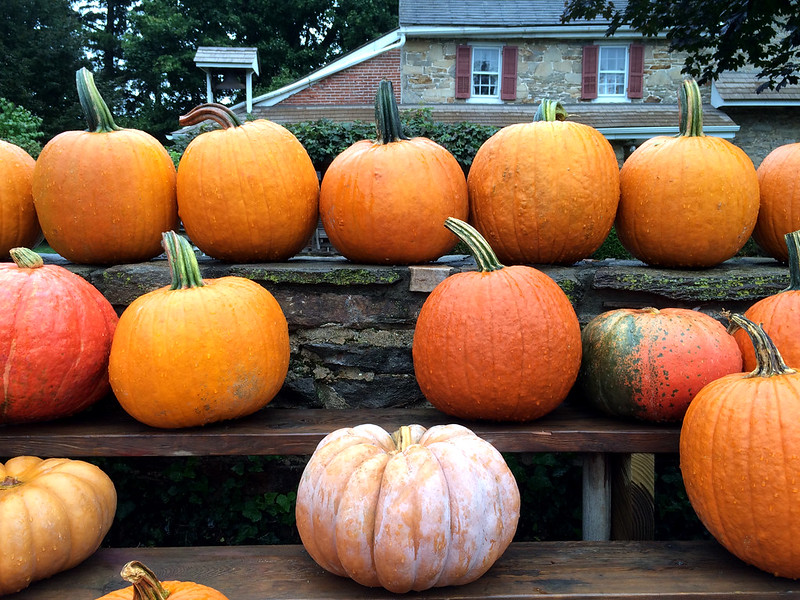
This week I went to one of our local farm markets and filled my cart with pie pumpkins, butternut squash, acorn squash, and Concord grapes. Now what I really need to do is stock up my nightstand with fresh books for autumn. Dark nights were made for books.
If you’d like to do the same, here are a few I’ve picked up recently.
Earth Works: Selected Essays by Scott Russell Sanders is an excellent collection of thoughtful essays by one of the best writers working in that genre. For the price of one book, these thirty essays could keep you company all winter. Like most of the best things in life, they should be appreciated slowly (however, I’m sure you will be tempted to gulp them down. But don’t! They are too wise, too lovely for that).
Sanders writes about houses and marriages. About the stars and beauty. He writes to discover, and the thing he wants to find, the question he seems most compelled to ask, is some variation on what it means to live well. How can we live in harmony with ourselves, with one another, and with this beautiful, astonishing planet that is our home?
All of us ponder our lives. … Essayists choose to do such reflecting, remembering, and imagining in public, on the page. – Scott Russell Sanders
Here is my new favorite book for little people: A Party for Pepper: A Hazelwood Forest Counting Book by Sarah Hartsig.
I discovered Hartsig, the artist behind the world of Hazelwood Forest, on Instagram, and I love her subject and style. If you enjoy Tasha Tudor and Beatrix Potter, you will love Hazelwood Forest, too.
I think we adults should buy picture books (and support talented artists) for ourselves, but I am fortunate to still have a small book-loving person in my life, so the choice, for me, was easy. I gave A Party for Pepper to Elsa on her third birthday in September, and I can honestly tell you it was one of her favorite gifts. Numbers are her thing right now, so while I enjoyed the depictions of sweet animals taking tea, Elsa counted and counted the gorgeous watercolor numbers.
I am already eager to see what Hartsig creates next.
Amish Peace: Simple Wisdom for a Complicated World by Suzanne Woods Fisher was sent to me by a friend who read my recent blog posts on simplicity. She thought I’d like this book, and she was right. I haven’t finished it yet (this, too, is a book best absorbed slowly), but I can already recommend it.
Here are stories from Amish lives and reflections on Amish belief and practice for the rest of us. The tone is respectful but not fawning, and the author, though not Amish herself, has family roots and ongoing relationships within a plain community. In other words, she is not a voyeur, nor does she think we should all be Amish. Rather, she knows these communities well, her own life has been enriched by their wisdom, and she is interested in sharing that wisdom with us.
The book is organized for small group discussions. At first, I skimmed the discussion questions that come at the end of each brief chapter, but it finally dawned on me how much I would love to read this book with a group. I know there are some aspects of my complicated life and world I take entirely for granted or view as entirely fixed.
Reading this with a group, I wonder if we might discover just how much we are not required to live the lives of overly busy consumers that our world demands?
We non-Amish types might object to having a church choose our house paint. The Ordnung seems confining and restrictive, invasive, even. It’s true that the Amish are not free to do some things. However, they are free from many others. – Suzanne Woods Fisher
On this same theme, I shared a story at the Art of Simple this week about slowing down to the pace of a horse-drawn buggy. It’s a story about slow travel and sacred places. It’s a story about placemaking. It surprised me as I wrote, and I am still pondering the ideas that emerged. I hope you’ll read it and ponder with me.
Happy Saturday, friends.
by Christie Purifoy | Jul 25, 2015 | Amish, Books, Simplicity, Uncategorized
I’ve been writing about simplicity. This means, of course, that I’ve been reading about it, too.
So here is one more peak at the bookshelves in this old farmhouse. Though, to be honest, most of these books haven’t yet found their place on a shelf. Too new, too needed, they are piled on that one chair in our tiny sunroom or the little bureau I use as a bedside table. I’m fairly sure my almost-three-year-old has already taken a ballpoint pen to one or two of them.
This list is not meant to be exhaustive. Not even comprehensive. Perhaps it isn’t even a good place to begin if you are new to the topic. But these are the books I’ve been reading. These are the books I would pass on to you if you came to visit us at Maplehurst.
These are merely a few books that have found their way to me. And I am trying my best to listen.
(contains affiliate links)
I’ll give you the best right up front. It’s called In Celebration of Simplicity: The Joy of Living Lightly by Penelope Wilcock. Recommended by an internet friend (she and her words are wise and beautiful; I recommend especially this recent post on dimming the lights), I think of this book as a lovely little dagger.
It is a pretty thing, like a gift book. The edges of every single page are devoted to Scripture and inspirational quotations. But don’t be fooled. There is nothing sweet about Wilcock’s message.
This is a book about discipleship. About following Jesus in every part of our lives – our eating, our shopping, our words, our clothing, our hospitality, our entertainment, our work, our everything.
The Way of Christ, The Way of simplicity is narrow. Reading Wilcock I see it. I believe it. I am afraid of it. Yet somehow, reading this book, I want to run in that direction. And never come back.
The discipline of simplicity is the magnifying glass that focuses the sun, so that the concentrated force of the Holy Spirit can be trained upon the insignificant bits and pieces of the common way in which we tread, effecting amid all the dross and distractions the living fire of a kindled life. – Penelope Wilcock
Another book suggested by an internet friend (on my facebook page, are we connected there?), is The Plain Reader: Essays on Making a Simple Life edited by Scott Savage.
I am only halfway through this anthology, but I already know it’s one I want to pass on.
You’ll find at least one well known name (Wendell Berry and his essay on health is excellent) but most of these voices are not often heard outside their small circles. Most are Amish (by choice, not birth), Quaker, or members of other “Plain” communities.
The choices and viewpoints reflected in this book can only rightly be described as extreme. The temptation for many readers, myself included, is to put up defenses, to feel judged, to argue, and so to hold tightly to our usual ways of thinking and living.
But that is a waste.
If we can read this book with openness and curiosity, there is so much to gain. First, there is the benefit of seeing how radically different some live their lives all in the name of Christ. Second, though we may not adopt all, or even very many, of the practices of these writers, their radical choices can help us realize how much of our lives we actually can choose. So much of how we live, work, play, and worship seems already determined. But the essays in this book reveal how very possible it is to change everything about the ways in which we live.
And I find that incredibly inspiring.
In an odd sense, when every taboo has fallen, then the only way to be subversive is to have more fun than other people – to fill your heart and your home with more joy and warmth and pleasure than the frantic, slightly pathetic, ersatz happiness offered by Disney and the mall and the chat room. This is a book, finally, about joy. – Bill McKibben
A book I’ve mentioned before is Plain and Simple: A Woman’s Journey to the Amish by Sue Bender. Bender’s book, part-memoir, part artistic vision, asks whether it is possible for a thoroughly modern woman to live life as beautifully and simply as the handmade Amish quilts she admires.
Must our lives be the crazy quilts we often feel them to be?
The feeling went beyond everyday cleanliness and order. The air felt alive, almost vibrating. Can a room have a heartbeat? Can space be serene and exciting at the same time? I’d never been in a room that felt like that. – Sue Bender
One reason I am feeling beckoned towards this thing we call the simple life, is that I want space in my life for the things that matter.
I want space to breath (to cut flowers every morning, to sit in stillness with a child in my lap). I want space for paying attention (there is trouble and injustice in our world, but if my life is too crowded I cannot notice, and I cannot do anything). And I want space for the absolutely essential non-essentials.
Like poetry.
I don’t want to live a life that has no room for a book like A Timbered Choir: The Sabbath Poems 1979-1997 by Wendell Berry.
I recommend it. Both the space-making and the poetry-reading.
***
by Christie Purifoy | Mar 7, 2015 | Books, Gardening, Uncategorized, Winter
No doubt most of you are not sitting under a foot of snow as we are here at Maplehurst, but early March days are still ideal reading days.
I’m reading mostly gardening books, which, I suppose, must mean that I am a very hopeful person. Or else that I am practiced in denial.
I have a stack of gardening books currently checked out from my library, including the coffee-table treasury Visions of Paradise by photographer Marina Schinz. It begins with these words:
To create a garden is to search for a better world. In our effort to improve on nature, we are guided by a vision of paradise. … This hope for the future is at the heart of all gardening.
I think this is true of gardening, but my late-winter prayer is that these words would be true in every area of my life. That my reading, my loving, my working – everything – be motivated by hope for the future.
The following post contains affiliate links. You can find all my book recommendations here.

My favorite book in that stack of gardening books is The Essential Earthman: Henry Mitchell on Gardening .
.
Henry Mitchell was a columnist for the Washington Post. This posthumous collection has been called “one of the great American gardening books,” and I absolutely agree. This is wonderful reading: informative, practical, hilarious, witty. In its own subtle way, it is brilliant.
Its appeal for gardeners is obvious, but as I read I decided the book was worthy of an even broader audience. Almost all of the pieces are wonderful examples of what newspaper opinion writing can be.
We can all learn something from Henry Mitchell. We might learn about planting peonies or which varieties of daffodil are the most glorious. Or, we might learn the subtle art of communicating one’s own strong opinions in the most disarming and entertaining way.
*
Dept. of Speculation (Vintage Contemporaries) by Jenny Offill is not like any other novel you have read. I am sure of that. It is more like one of those works of art that looks, from a distance, like a hyper-realist portrait but is, upon closer examination, found to be made up entirely of buttons or bottle caps.
From a distance, this is the story of a marriage that is falling apart. Now, I know that sounds entirely too depressing for late-winter, but the full arc of the story is hopeful and beautiful.
But close up? This is a strange collection of thoughts and facts and memories. I tend not to like experiments in fiction, James Joyce excepted, of course. But when an experiment works, it really, really works. And this one works.
There is nothing self-indulgent about Offill’s writing. Instead, she has found a new way to tell a familiar story, and the result is astonishing.
*
I sometimes postpone writing these book recommendation posts because I worry that I haven’t read enough new, great books. I forget that the premise, when I began, was simply to tell you about the books on my shelves. Or, more accurately, the books taken off the shelves and left lying near beds and armchairs.
We’ve loved Mary Ann Hoberman’s picture book The Seven Silly Eaters for years, but this book has recently come off the shelf for round after round of reading. Elsa loves it, but my nearly-six and nearly-nine-year-old boys come like moths to a flame when they hear me reading it.
We are big fans of other Hoberman books, especially A House Is a House for Me and The Llama Who Had No Pajama: 100 Favorite Poems
 , but The Seven Silly Eaters is special. It’s the rhyming story of a tired mother with seven picky-eaters for children, but, like all great picture books, it offers so much more. Every illustration tells a story of its own, and, I think, every family will find something of themselves in its pages.
Do you think your child is too old for picture books? Do you think you are too old for picture books? Then I recommend The Seven Silly Eaters as a very necessary corrective.
Happy reading, friends.
*


