
Advent (Day 4): O These Many Holy Nights
“… the weary world rejoices …”
We are baking together, the little boy and I, but I am also listening to the radio.
It is 75 years since the kindertransport brought German Jewish refugee children to England. An elderly man is speaking. He was only seven when he boarded that train. Only seven when his mother and father made a promise they would not be able to keep. They promised they would join him.
He still has the small hairbrush his mother tucked into his case.
I am listening to the refined voice of this now elderly man, but I am seeing the face of my own seven-year-old son. I do not think I can bear it.
What are Christmas candies and frosted cookies to a world with so much pain?
“Fall on your knees! O hear the angel voices! ”
Some of the old maple trees that gave this home its name are waving pink, plastic ribbons. They are marked for removal. This week the tree man will come with heavy machinery and sharp blades, and we will say goodbye.
I will find it easy to say goodbye to the headless trunk covered in poison ivy vines. I will not find it so easy to witness the fall of the other tree. This tree is crowned with green leaves in summer, yellow leaves in fall, but it is hollow. Standing in front of it, I can see blue sky through a hole that is shaped just like a child’s drawing of a heart.
I feel a kinship with this tree. I know this is what love does. It rips you right open.
We are discussing Christmas gift ideas when my friend suddenly confesses that she can’t stop imagining the loss of her two-year-old daughter, her much-loved only daughter. I tell her I understand. This pain is love’s shadow.
It sends us to our knees.
I am blessed with four children. Which means I have been on my knees for a very long time. It isn’t such a bad place. There are angel voices here.

“Behold your King! Before Him lowly bend!”
The shrieking radio, that bearer of bad news, is on again, and my daughter says, “More war? Why is there always more war?”
She places her frosted angel back on the table. I lay my own sugared bell beside it.
I think about that interview. How the little boy grew up. How he visited a Holocaust museum in Israel. There, on the wall, he found a photograph of prisoners in a concentration camp. Among those gaunt, wounded faces he discovered the face of his own father. A man he had not seen since that day when promises were made.
It occurs to me only now that my Father is also among the wounded. I can’t seem to articulate to my daughter why it matters. Why it makes such a difference.
I only know that it does.
Ours is a world of violence and loss. It is also a world of small hairbrushes packed with love. A world of Christmas cookies baked with love.
A world being healed by the wounds of a king.
“And in his name all oppression shall cease.”
Advent (Day 3)
On Thursday, we said thank you around the table.
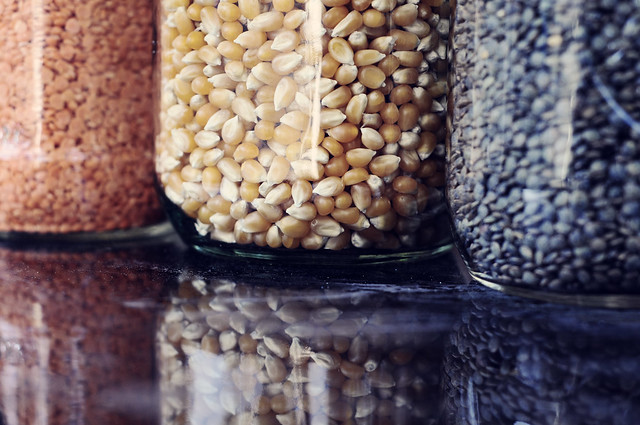
We passed the big bowl with potatoes like mountain peaks. We passed the medium-sized bowl with its cranberry jewels. We passed the tiny, wooden bowl. Three times we passed that particular bowl, and three times we tipped in our little kernels of corn. With each kernel came a thank you.
I said thank you for friends, and books, and old maple trees. The little boy said thank you for toys. The bigger boy said thank you for Jesus.
And so we entered Advent on a tidal wave of gratitude, every thank you deeply meant.
But now it is so dark, and gratitude has slipped through my fingers.
Every good gift from this past year seems to have its tarnished edge, and I am weary. Weary of sifting good from bad, blessing from burden.
This old farmhouse is a promise fulfilled. We wandered, but He brought us home. But … the pipes leak, too many old maples were lost in a storm, and this is farming country – some days I can’t breathe for the manure in the air.
The baby is a good and perfect gift. Beautiful. Much loved. With her came depression. Two months of panic and tears. Now I tremble remembering those days and pray God, don’t let that darkness ever come back. And my heart is broken for all who live within that fog for years.
So many dreams are coming true, but they are being realized in dust and dirt and darkness. And some part of me knows the bigger story. It begins in a stable but ends with streets of gold.
There are no streets of gold in my neighborhood. There’s a diaper pail. A filthy chicken coop. Kitchen scraps left to rot.
But I am done with sifting.
Done trying to untangle the knots of good and bad, done naming one thing a gift, another a curse.
I am dust myself, but I breathe with God’s own breath, and I am using that breath to say thank you.
Thank you for all of it.
The mess. The smell. The compost under my nails, and the dishes in the sink.
I say thank you because our God has never despised the dirt, and he once wrapped himself in dust.
He is our God with dirt under his nails, and he is near.
God with us.
Advent (Day 2)
A poem for this, the first Monday of Advent.
Henry Vaughan’s sonnet is an echo of Song of Solomon 2:11-12: “For behold, the winter is past; the rain is over and gone. The flowers appear on the earth, the time of singing has come, and the voice of the turtledove is heard in our land.” These verses hold special meaning for me and my family. They remind me of my own baby’s birth, but they speak of Mary’s child, too.
Advent is a season of contradiction. A high King and a lowly manger. A victorious Savior and a vulnerable infant. The brilliance of stars and the stench of a stable. Here, in Vaughan’s words, is another: “… here in dust and dirt, O here / The lilies of his love appear!”
We are creatures of dust, and we live out our lives on a crust of dirt. But would we wish it otherwise? For Love came down, and this dirt-filled world has never been the same.
So, plant your feet on solid earth. Feel the tremors of what has been and all that is to come.
Can you feel them?
The time for singing has come.
The Revival
Unfold, unfold! Take in his light,
Who makes thy cares more short than night.
The joys, which with his day-star rise,
He deals to all but drowsy eyes:
And what the men of this world miss,
Some drops and dews of future bliss.
Hark how his winds have changed their note,
And with warm whispers call thee out.
The frosts are past, the storms are gone,
And backward life at last comes on.
The lofty groves in express joys
Reply unto the turtle’s voice,
And here in dust and dirt, O here
The lilies of his love appear!
– Henry Vaughan (1622-95)