On Boredom (Or, What I Did on My Summer Vacation)
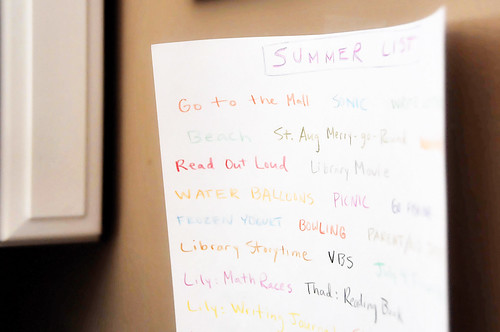
Our Summer List is nearly illegible. Most of the items are crossed through. I might have drawn a neat pencil line through each activity (trying to check it off but not erase it). My young daughter, who has not yet learned to grasp desperately at passing time, obliterated most of the list with a thick, black marker.
On the record, I’d say that our list helped shape an enjoyable summer. Though, the perfectionist zeal of my first-born did lead to a difficult argument on one of the final days of summer vacation. No, I had to tell her, we cannot visit the carousel, go on a picnic, keep a writing journal, and make playdough all in a single day just because they are still on the list. The compromise was a half-hour drive to the carousel. And a few more memories for our piggy banks.
The Summer List did not completely silence the eternal summer cries of “Mom, I’m bored!” Nor should it have.
I tend to think that boredom is good for children, like green beans and sharing a bedroom. I tell them as much, though they remain unconvinced.
I thought I believed my own preaching, but I began to doubt that over the summer. I too have been bored. Very bored. I discovered that, for me at least, green beans and sharing a bedroom are much, much better than being bored.
Of course, boredom is a privilege. If I had to walk miles in fear to collect water for my family, I would not be bored.
I wonder, is boredom merely a lesser evil, or might it have some good to offer?
I know that I don’t like it, I know that I don’t want it, and yet I write out here a few of the gifts boredom has recently given me:
To be bored is to be unhurried.
When my toddler throws a screaming fit, I let him scream. But, I also sit down close by because nothing else is screaming for my attention. When he’s ready to climb into my lap, I’m right there.
To be bored is to be waiting.
I have been thinking (and, let’s face it, hoping) that boredom might be one of the final stages of resting. When we first rest from work, we are content to simply be. After a while, our minds, our hearts, our bodies are ready, once again, to do.
To be bored is to be listening.
God is always talking. Sometimes He has a lot to say, and He says it in some big way, but, more often, He is whispering. When I am bored out of my mind, my ears are searching for any sound from Him, so eager am I to hear the extraordinary break into my ordinary.
Book of Quotations: Love Stoops

I keep a book of quotations. It looks exactly like any other journal, but it’s for a different kind of journaling. Journaling with the words of other writers, if you will. Here I scribble down quotations from all kinds of books: poetry, theology, memoir, literary theory, fiction, you name it. I write down anything I want to remember.
Sometimes I use these quotations later, in my own writing or maybe just in conversation. But, it isn’t really about utility. It’s about beauty. Language can be so beautiful it stuns. However, I am generally reading so much, so quickly that I need a way to hold on to those beautiful bits that I just can’t bear to let wash down the stream of words, words, words.
During our recent vacation, I read Ian Morgan Cron’s Jesus, My Father, the CIA, and Me: A Memoir of Sorts.
It fully lives up to its title. Which means that the story it tells is crazy and beautiful, wise and, frequently, very, very funny.
Toward the end of his story, Cron describes the life-changing moment when he hears (or thinks he hears) the voice of Jesus asking him, Cron, for forgiveness. These words heal an ugly wound in Cron’s heart, but they puzzle him too.
He knows in his head that Jesus is perfect. Knows that there can never be any reason why He would need to ask for forgiveness.
When asked, theologians, pastors, and priests consistently fail to unravel this apparent contradiction. Finally, a woman named Miss Annie, a woman with no seminary training, does exactly that. She tells Cron, “Why wouldn’t Jesus humble himself and tell a boy he was sorry for letting him down if he knew it would heal his heart?” Cron interrupts with what he knows: “But if Jesus is perfect?”
“Miss Annie ambled the five or six feet that separated us and took my hand. ‘Son,’ she said, rubbing my knuckles with her thumb, ‘love always stoops.’”
Since finishing the book, I’ve been considering the truth of Miss Annie’s words. I can remember years where the things I knew about God seemed to stand like a wall between me and His love. Learn just a little bit about God’s power, his glory, his holiness . . . do that, and it can be hard to fit your own miserable, tiny little self into the picture.
Maybe there are those who can hear a Sunday School lesson on God’s love and then feel it in their bones. All I really know is that it didn’t work that way for me. Perhaps my head and my heart are farther apart than they should be.
I will always be grateful that Love stooped down and came looking for me. Like Miss Annie said, Love humbles itself, Love stoops, and what this means to me is that Love pursues. Love chases. Love makes itself small enough for even our short-sighted, human eyeballs.
Love searches desperately for one lost sheep, and love keeps on searching until that sheep is safe, until that sheep knows and feels that she is loved.
Why I Love the “Jesus of Prostitutes”

I’ve been listening to Mat Kearney’s new album. These words from the song “Hawthorne” keep running through my head: “the Jesus of prostitutes is chasing my soul.”
Those words seem so wonderful and comforting, but it takes me a few days before I stop to consider why. Why does it feel right and good to sing about “the Jesus of prostitutes”? Wouldn’t I rather sing about the Jesus of overly-educated-suburban-mothers-of-young-children? You know, the Jesus-of-me?
No, I really wouldn’t.
I am not actually a follower of the Jesus-of-me (though, some days, I act as if I am). I am a follower of the Jesus who loves the least, the powerless, the set aside, the unseen. I am a follower of the One Who Sees (Genesis 16:13).
Pain. Injustice. Small, seemingly insignificant people. We may look away or keep our eyes closed, but He never does.
You would think that prostitutes would no longer be among the unseen. Not in our hyper-sexed, anything-goes culture, right? But, of course, they are.
I am reminded of this when my friend tells me about a group of locals organizing together to show love in practical ways to the prostitutes who work a particular street. I hadn’t realized there were prostitutes on that street.
Unseen.
Ironically, God shows us throughout his Word that one reason he loves prostitutes – one reason he is their God – is because they see.
Pushed to the edges of her community, Rahab saw the truth. She knew whose side she wanted to be on. The woman with the expensive perfume? She was the only one who truly saw the Beauty-Deserving-of-Worship in that room.

I strive to have the clarity of vision those women had. I accept that one reason they had it was because they were not among their community’s successful, powerful elite.
Blessed are the poor in spirit, for theirs is the kingdom of heaven.
Blessed are those who mourn, for they will be comforted.
Blessed are the meek, for they will inherit the earth.
This is Kingdom-of-God logic, and it turns the Kingdom-of-the-world logic on its head.
It isn’t telling us to close our eyes, to accept injustice. Rather, it says to us: “Take heart! The Kingdom of God has come. And all around you, and even through you, the tables of this world are being turned. The moneychangers are kicked to the curb, and all is being set right.”
The One who Sees, the One Who is Making All Right: He is a lion, He is a lamb. He is the Jesus of prostitutes.