by Christie Purifoy | Sep 26, 2011 | Family, grief, motherhood, Poetry, Seasons
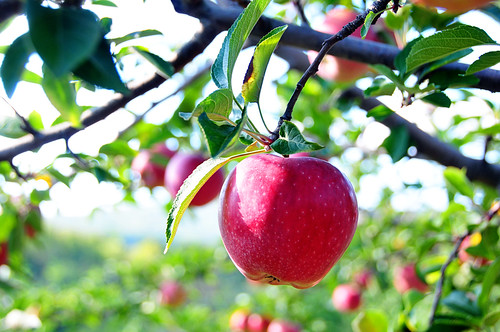
This comes from one of my favorite poets, the Irish writer Eavan Boland.
Reading it again this morning, I remember that myths are some of the truest stories we tell. The myth of Persephone is not merely a way of explaining the change of seasons before our age of scientific discovery. More than this, it is a story of loss and restoration. This poem reminds me that I have been Persephone. It also reminds me that my oldest child is swiftly becoming Persephone. I say, with Boland, that I will not deny her her own unique life story, though no good story is without pain.
The Pomegranate
The only legend I have ever loved is
The story of a daughter lost in hell.
And found and rescued there.
Love and blackmail are the gist of it.
Ceres and Persephone the names.
And the best thing about the legend is
I can enter it anywhere. And have.
As a child in exile in
A city of fogs and strange consonants,
I read it first and at first I was
An exiled child in the crackling dusk of
The underworld, the stars blighted. Later
I walked out in a summer twilight
Searching for my daughter at bedtime.
When she came running I was ready
To make any bargain to keep her.
I carried her back past whitebeams.
And wasps and honey-scented buddleias.
But I was Ceres then and I knew
Winter was in store for every leaf
On every tree on that road.
Was inescapable for each one we passed.
And for me.
It is winter
And the stars are hidden.
I climb the stairs and stand where I can see
My child asleep beside her teen magazines,
Her can of Coke, her plate of uncut fruit.
The pomegranate! How did I forget it?
She could have come home and been safe
And ended the story and all
Our heartbroken searching but she reached
Out a hand and plucked a pomegranate.
She put out her hand and pulled down
The French sound for apple and
The noise of stone and the proof
That even in the place of death,
At the heart of legend, in the midst
Of rocks full of unshed tears
Ready to be diamonds by the time
The story was told, a child can be
Hungry. I could warn her. There is still a chance.
The rain is cold. The road is flint-coloured.
The suburb has cars and cable television.
The veiled stars are above ground.
It is another world. But what else
Can a mother give her daughter but such
Beautiful rifts in time?
If I defer the grief I will diminish the gift.
The legend must be hers as well as mine.
She will enter it. As I have.
She will wake up. She will hold
The papery, flushed skin in her hand.
And to her lips. I will say nothing.
– Eavan Boland
by Christie Purifoy | Sep 13, 2011 | Faith, grief, Scripture

I slumped down at my writing desk one recent morning, and this phrase floated up to the top of my mind: “there is nothing new under the sun” (Ecclesiastes 1:9).
I was feeling a little depressed, a little overwhelmed, and Solomon’s words came unbidden to justify my dark mood.
For me, it was nothing more serious than hot weather, kids fighting (again), and dirt tracked all over my just-mopped floors. Some days it only takes that little bit and we are carrying the burdens of the world: in an instant my eyes roam from the dirt, sweat, and tears in my own house to the global orphan crisis, drought in Texas, famine in Africa (again!).
Why is my life such a mess? Why is the world such a mess?
Supposedly, we Christ-followers are the bearers of “Good News” (just search the Bible for the phrase “good news”: it comes up a lot). But what can we possibly have to say to those suffering amidst the ever-present darkness of this world?
As a child, growing up in the church, I heard a lot about good news. Maybe the message was simplistic or maybe I was only able to understand a simple message, but I believed then that the good news was all about heaven. The good news, then, was that Jesus made a way for us to go to heaven when we die. That seemed like pretty good news to me, which is strange because I was a lot farther from death than I am now. Today, thirty years closer to my own end, that news doesn’t seem nearly good enough.
You and I and our neighbors on this planet? We need good news now. We need good news for today.
Solomon’s words take me there. He writes, “Is there anything of which one can say, ‘Look! This is something new’?” (Ecclesiastes 1:10). I’m not sure, I can’t really answer his question, but then I remember these words in Isaiah: “I am doing a new thing! Now it springs up; do you not perceive it?” (Isaiah 43: 19).
God is doing something new. In fact, He’s been working at it for thousands of years. The Old Testament whispers it, and Jesus embodies it. New life. New creation. New covenant. New heaven. New earth.
God is making all things new (Revelation 21: 5).
I don’t know exactly what that means. But I feel something good deep down in my bones when I hear the word new. New, new, new. All is being made new.
Was there ever a more hopeful, beautiful word than “new”?
In me, in you, and in this gorgeous, broken-down world, God is doing a new thing. Look closely. Do you not perceive it?
by Christie Purifoy | Sep 9, 2011 | grief, prayer, Vacation

The two of us. Pre-digital camera. Pre-parenthood. (Just barely) pre-9/11.
I still have the airfare ticket stub marked September 11, 2001. Ten years ago, we didn’t use e-tickets.
Also, there were no smartphones. This partially explains why it isn’t the images of destruction that have stuck with me (images we didn’t get a good look at for nearly a week). It’s the voice of our pilot.
We had just begun our flight from Shannon airport in the west of Ireland home to Chicago, when a deadly-serious voice sounded over the speakers: “Something terrible has happened,” it said. “The FAA has closed all airspace, and we will not be continuing this flight.”
Our plane was grounded in Dublin, a city we hadn’t planned to visit during this, our first, trip to Ireland. Jonathan and I didn’t say anything while we sat on that plane waiting to disembark and collect our luggage packed with dirty laundry. We only looked at each other. Later, we discovered that the image in our minds had been the same: mushroom cloud.
Somehow the actual story was harder to believe. An Irishman with a working cellphone began hearing stories, and they spread quickly from row to row. Attacks? On New York City? Washington D.C.? We shook our heads, said we didn’t believe it.
A few hours later, the airport employee helping me find accommodations in Dublin said it was like something out of a disaster movie. That’s when I understood.
Jonathan left me with the luggage and went searching for a television. He found one at the airport pub. Walking back in my direction, he looked stunned.
I could only pray, “Lord, have mercy.”
For a week, we wandered around the city, feeling as if we might never get home. We guarded our torn ticket stubs as if they were a king’s ransom. We saw confused looks every time we handed them over to another ticketing agent. It was hard for them to understand that when the towers fell we’d been caught in mid-air.
Some small, rational part of our brains kept repeating that if only we knew when we’d be going home we could enjoy this unexpected vacation in Dublin. But we were counting pennies, dodging raindrops, and washing a suitcase full of clothes at the laundromat. It didn’t feel like vacation.
While on vacation we had spent our carefully saved dollars on bed and breakfasts that served Irish porridge with just-picked blackberries. In Dublin, we had a small lumpy bed and were served canned beans on toast. Want to make an American feel wretchedly homesick? Just serve her instant coffee and canned beans on toast.
The world had shifted on its axis, we understood that unimaginable evil could rear its head at any time and in any place, but we couldn’t comfort ourselves with the well-loved and familiar. The flags at half-staff were Irish ones.
After several days in Dublin, we were promised a flight home, but we would need to get back to Shannon airport. We said goodbye to the lumpy bed and took an all-day bus that brought us back across the country, to the place where we had started.
When international airspace reopened, we were there, again, at Shannon airport. They had no record of our names, and we had only our tattered ticket stubs.
We spent one night in the home of a family preparing for their daughter’s wedding. Two stranded German tourists were across the hall from us. The wife said not to worry, we were no bother at all, and she cooked us a big fried breakfast. The husband drove us back to the airport for another try.
At the airport again, we sat on the floor and listened as Aer Lingus employees filled up a plane to Chicago with names called out one by one. When there was exactly one seat left, they called my name. I said that I wouldn’t get on any plane without my husband.
We were wondering whether we could interrupt the wedding weekend with one more night’s stay, when a woman in an official green uniform came running up and shouting, “Does anyone want to go to Baltimore?” We raised our hands. Then, following our guide, we ran.
We also prayed, “God let the doors still be open.”
We weren’t headed home, but it was close enough.
We remembered a friend who lived near D.C. Jonathan, miraculously, remembered his phone number. He picked us up, drove us to his own home, gave us a beautiful, not-at-all lumpy bed.
We managed to find a tiny, out-of-the-way rental car business with one car still on its lot. We took it. Twelve hours later, and one week after 9/11, we slept in our own bed.
“God is our refuge and strength,
an ever-present help in trouble.
Therefore we will not fear, though the earth give way
and the mountains fall into the heart of the sea,
though its waters roar and foam
and the mountains quake with their surging.
There is a river whose streams make glad the city of God,
The holy place where the most High dwells.”
(Psalm 46: 1-4)
by Christie Purifoy | Aug 15, 2011 | Family, grief
We’ve been putting it off, but at dinner yesterday we finally told the kids that their dog is dead. We were able to put it off because Casey lived, not with us, but with faraway grandparents. Still, they had always considered him their dog.
Because the miles are long, and we cross them so seldom, I imagined frowns. Concerned questions. I didn’t imagine tears, let alone heartbroken sobs.
There are some phrases that seem to show up only in books. They are clichéd, like “sat bolt upright” and “burst into tears.” And yet, considering it now, “burst into tears” really does seem to get it right.
Her face crumpled, like a bubble burst, and there was a fierce and terrible sadness pouring out of her.
I was amazed. Who taught her to feel so deeply? It wasn’t me. I have never poured sadness over anyone. I keep it balled up tight like a painful tumor in my throat.
I am grateful that my daughter knows how to hurt. Grateful that she will not or cannot keep it all inside (though I wish she had no need for tears; I wish she never would).
Today, I think of someone else. I wasn’t with her, but I wonder if she looked like my daughter when she understood the news. When she knew what had been lost.
Once, so many years ago, I sat in a church pew directly behind her. I can still see her two long braids, perfectly combed and parted. She shook with sobs.
We were at the funeral for one who loved us both, for one we’ve missed every single day since. Back then, I wished I could cry like that.
Remembering that day is difficult, but it also gives me hope. I hope that she will, once again, have the strength, the child’s wisdom, to grieve.
Our culture rarely talks about grief. We talk about recovery. We focus on getting over, moving on. Surely, those of us who believe in the restoration of all things have no reason to smooth out the emotional peaks and valleys of our lives? Jesus wept. Shouldn’t we?
“Now, O women, hear the word of the Lord; open your ears to the words of his mouth. Teach your daughters how to wail; teach one another a lament.”
(Jeremiah 9:20)

(photo by yours truly)

