by Christie Purifoy | Dec 22, 2014 | Advent, Christmas, guest post, Music, Uncategorized
Four candles lit. Can you believe it?
The season of Advent will soon be fulfilled. Christmas is near. And I am so pleased to share these words from my friend Allison. A fellow writer and gardener, Alison and I met at church. When I say thank you for the many good gifts I have received since moving to Pennsylvania, Allison is always near the tippy-top of that long list. I love being able to introduce you to her today.
*
*
Why Christmas is Not About Giving
Sometimes I really hate getting gifts.
It’s not the gifts themselves I hate. It’s the getting part.
You know the feeling. Your co-worker unexpectedly gets you a Christmas gift, and you can’t hide the fact that you never intended to get one for her. Or your friend buys you an expensive present that you love, and you wonder if you spent enough money and effort to get him a comparable gift.
Sometimes I love giving gifts more than getting them. I get excited about brainstorming creative gift ideas for family and friends—homemade food items or crafts, books I know they’ll like, fair trade gifts, something fancy they couldn’t justify buying for themselves, or something they didn’t know they wanted. I can’t wait to see their faces when they unwrap what I got them and see just how well my gifts fit who they are. I even get a little jealous if they gush over something that someone else got them.
As much joy as I get from giving, it can be a distraction. It can even be selfish. “[E]veryone, even the nominally religious, loves Christmas. Christmas is a season to celebrate our alleged generosity,” writes William Willimon in “Watch for the Light: Readings for Advent and Christmas.”
Giving involves power. I love to be the strong one who tips well, who feels good about writing the big check for the soup kitchen, who tries to do more than my fair share of listening to and helping my friends, who doesn’t mind spending a little extravagantly to get my family what they really want. I want them to be indebted to me, maybe even dependent on me. They usually appreciate my gifts, but even if they don’t, I get to feel useful and generous.
For me, Christmas is too often an opportunity to secure a little more power in my relationships through giving. But Christmas isn’t about using gifts to gain power. It isn’t even about using gifts to express love for people.
Willimon puts it bluntly: “We prefer to think of ourselves as givers—powerful, competent, self-sufficient, capable people whose goodness motivates us to employ some of our power, competence and gifts to benefit the less fortunate. Which is a direct contradiction of the biblical account of the first Christmas. There we are portrayed not as the givers we wish we were but as the receivers we are.”
Christmas is about receiving the gift of God Himself. In this relationship, we have no power at all. We are embarrassingly needy, dependent on the generosity of another. We are forever in His debt with no hope of reciprocating. We now have the costliest, most precious gift imaginable—God’s gift of His very self. A gift we despised and rejected, because we were too proud to admit we needed it.
This lesser-known Christmas carol reminds us of just how much Christ gave—and gave up—for us:
Thou who wast rich beyond all splendour,
All for love’s sake becamest poor;
Thrones for a manger didst surrender,
Sapphire-paved courts for stable floor.
Thou who wast rich beyond all splendour,
All for love’s sake becamest poor.
Thou who art God beyond all praising,
All for love’s sake becamest man;
Stooping so low, but sinners raising
Heavenwards by thine eternal plan.
Thou who art God beyond all praising,
All for love’s sake becamest man.
Thou who art love beyond all telling,
Saviour and King, we worship thee.
Emmanuel, within us dwelling,
Make us what thou wouldst have us be.
Thou who art love beyond all telling,
Saviour and King, we worship thee.
He impoverished Himself, left the glories of heaven, came down to our level, spent all He had on us so that we, through His poverty, might become rich.
So in the remaining days before Christmas, set aside those glittering gifts. Open your hands. See how empty they are. As empty as a virgin’s womb. Now stretch out your hands toward the manger. Receive the Christ child, and the wealth of His love, into your arms.
“It is more blessed to give than to receive.” Yes. And this is why God’s Name is blessed above every other name, for He is the all-powerful Giver. “Hallelujah! Blessing and honor, glory and power be unto Him that sitteth upon the throne, and to the Lamb.”
*
Allison Sheeler Duncan is a writer and theology nerd who is learning (slowly) to love receiving gifts as much as she loves giving them. She works as a communications specialist at a university in southeast Pennsylvania, and she enjoys writing in calligraphy, growing heirloom tomatoes, and singing at least some of the right notes in the alto section of her church choir. She blogs at www.shiningfromshookfoil.com.


by Christie Purifoy | Dec 19, 2014 | Advent, Christmas, Jesus, Pennsylvania, Uncategorized
I am incredibly grateful for the community of writers I’ve come to know through the internet.
But there is nothing like sitting face to face. Nothing like talking over cups of coffee while children run through our legs (or beg for another push on the swing). Campbell has been that friend to me, and I am grateful beyond words.
Campbell is also a smart and talented writer, and she’s written the Advent reflection I desperately needed as Christmas Day approaches.
Every year, I am surprised when the world doesn’t seem to grow brighter, lighter as Christmas nears. Every year, at about this point, I wonder what is the point? The news goes from bad to horrific, and, like Campbell, I fear Christmas joy will never be found. Peace is impossible.
But here is hope. Here is the light that shines in darkness. That has not, nor ever will be, overcome.
***

***
Looking for Christmas
I’m looking hard for Christmas this year. I feel my broken edges, sharp and pointy, and I’m tired and weary from the world. I’m needing something holy. I’m trying to find Jesus, trying hard to see the babe in swaddling clothes, the one who brings light and love and makes things right again.
Maybe Christmas looks like twinkly lights, strung along roof lines and spun around bushes. Is this holiness – these tiny dots of light, twisted and tied into a brighter picture? One small LED bulb isn’t much on its own, but step back a bit and I can see the shape of a reindeer, or the letters that spell out “peace.”
My small light isn’t much on its own, either. Sometimes, even, a bulb or two are missing or out. Maybe if I string my little light offerings with your little sparks we can step back and see His burst of glory, the grand story spelled out in twinkles. Peace for each other, one small light at a time.
Maybe Christmas is like this: – maybe it’s the late night rock concert, where I’m sitting with folks who I know and folks I don’t and it smells like sweat and beer. It seems about as holy as donkey poop and hay. The darkness inside the theater is not unlike the winter dark.
The show has built with percussive intensity and it’s nearing the end. I’ve scooted my way to the edge of my seat. My body is prickly with emotional electricity, as if I could start a forest fire, standing too close to tinder and kindling. She stands at the edge of the stage, surrounded by her bandmates, lit up like a Christmas tree, and after one big breath in she lets it all out: “Rivers and roads” she belts out with emotional intensity, “Rivers and roads, rivers till I reach you.” Boom. The strength of her voice is punctuated by a sharp drumbeat and with it the lights die out. The theater is absolutely dark, utterly quiet. Maybe like Bethlehem?
She breathes deep, maybe we all do, and she sings it again “Rivers and roads, rivers till I reach you.” Boom. We are in darkness again.
This year has been nothing but tinder and kindling, and I’m in flames.
I think Christmas is like this: the pitch darkness, the creeping loneliness, the cold intensity of a world too big, too hard, too closed in. And when the light bursts back, it’s with this same message: till I reach you. To reach me. Rivers, roads, fields, trees, stars, stables, donkeys. It is all the message, and all the means, and it is Jesus here, in this darkness, in this theater, in my heart, reaching. Reaching. Boom. The show lights are back on.
We buried our grandfather, generous patriarch of this wide family, this week. He lived a glorious life, but there is heartache and sadness as we think of a tomorrow with no Grandpop in it. Can the babe in swaddling clothes be here, too, graveside with our grieving family, listening to Taps on the bugle behind us?
It’s through this veil of tears that somehow I see that He is here. He’s reaching us, rivers and roads, to hold hands and wrap His arms of love around me, around you. Not like my imaginary friend Jenny, who I used to see in the mirrors in the produce section at the grocery store, a fancy image of what I wanted to see. But instead Jesus is God himself, with me. He became human, cried human tears, laughed human laughs. Maybe He had heart burn and runny noses. He got tired and hungry and angry and hurt. And He loved. He gave love, He showed love, He is love.
It doesn’t seem to matter that I don’t know where to look for Jesus, or how to find Christmas this year. What I’m finding is that it can all be holy, because in God becoming human He sanctified it all. His holiness is everywhere. And through sadness and weariness, He’s reaching me with twinkle lights and rock concerts.
***
Campbell C. Hoffman can be found with her carpenter-husband on a trail in Southeast Pennsylvania, encouraging (read: begging) her three kids to keep hiking. When she is not hiking, she is on another adventure not altogether different: motherhood. She writes about it on her blog and can be found on Twitter @tumbledweeds. Campbell’s work has also appeared at Brain, Child Magazine, Hippocampus Magazine, and Mamalode.

by Christie Purifoy | Dec 15, 2014 | Advent, Christmas, guest post, Uncategorized
I met Cara last spring at The Festival of Faith and Writing at Calvin College. Already, I consider her a dear friend.
She is honest and eloquent. She writes about hard things, yet she always writes with hope and with joy.
She is sharing just such hard, honest words with us today, but she is, as always, sharing them with wisdom and with love. Reading Cara’s words, I feel that something precious is given to me. It is a gift like an easy yoke, a gift like a light burden.

The Lonely Season
It seems like a lesser pain somehow.
I am not sick, or truly bereaved. I have not loved and lost slowly, day by day. I am not hungry or in want of warmth or occupation. It is easy to think that my pain is less real. But it is with me, more days than not, following after me like a shadow.
I am lonely.
But there is something about Advent that helps me feel that I am not alone in my loneliness. Suddenly I am walking alongside a very young unmarried mother, pregnant and wrapped in mystery. I am keeping company with a woman who watched everyone around her raise children, while she remained barren.
Here in Advent, the lonely find each other, just like Mary and Elizabeth did.
I wonder, sometimes, if they knew each other well, or if their time together started out awkward and halting, like a song half forgotten. I wonder if each person wasn’t just a little jealous of the other: Mary of Elizabeth’s intact reputation, Elizabeth of Mary’s youth and ease of becoming pregnant.
What must people have thought about these two women in the same “stage in life” (as so many of my contemporaries like to say) but in such different life seasons?
I’ll bet they were lonely.
The circumstances leading up to Jesus and John’s births were not easy or smooth. I can imagine that Zechariah discovered the difficulty of moving through a world without speech, and Joseph lost friends and respect after failing to divorce Mary.
I like to take some time to think about the women in Jesus’ lineage during this season. I think about Ruth, who journeyed to a country that wasn’t hers with her mother-in-law, the only person she knew there. I think about Rahab, a prostitute by trade, in Jericho. Tamar, who endured the death of one husband and that of his brother, with no children to show for it, forced to take things into her own hands. I think of Bathsheba, who obeyed the words of the king and stood by as he sent her husband into battle and certain death, her unborn baby following quickly after.
These were women who were acquainted with grief and sorrow. I can only imagine that they knew loneliness, as well.
In fact, once I start looking, I find it hard to stop seeing them, women and men in scripture who were alone, or felt alone. Elijah in the wilderness telling God that he was the only one left. Hannah, crying out to God for a child. Jeremiah in the cistern. Hosea entering into a relationship with a wandering woman again and again.
I resonate with these stories, though mine is not so extreme. But like most people who make up the Advent narrative, I am hoping for what I can’t see. I am feeling around in the darkness, unsure of whether I will truly see light (not even sure I know what light looks like).
I am learning that Advent is a perfect fit for my lonely heart. Here, I can wail and lament. I can ask God why I’m still single, though I’ve prayed faithfully over a relationship since I was seven. I call out and ask Him why finding and maintaining friendships and community feel like trying to lift a sleeping whale. I can set my hope in His hands for a while, because I can’t bear the weight any longer.
I fall into step beside Mary, Elizabeth, Zechariah, and Joseph. Somehow, I feel less alone.
*
Cara Strickland is a writer, editor, and food critic in Spokane, Washington. She writes about singleness, food, feminism, and the way faith intersects life (among other things) on her blog Little Did She Know. Come say hi to her on Twitter. She likes making new friends.

by Christie Purifoy | Dec 4, 2014 | Advent, Christmas, Deeper Story, Seasons, Uncategorized
There is no one right way to do this season. Whether you observe a strict Advent, Christmas only, or some mish-mash of the two, we all celebrate in our own ways.
We do it just the way our own parents did, or we do it just the opposite. We did it one way before our marriage and something else again now. We do it differently every year depending on someone’s health or who might be just the age for grabbing ornaments off the tree.
There are so many ways to celebrate well.
There are so many ways to live well.
*
*
I have always loved anticipation. I have always been the quiet, watchful sort. Though I wasn’t raised with Advent, my years of Advent observance now seem inevitable. The season fits me like a glove.
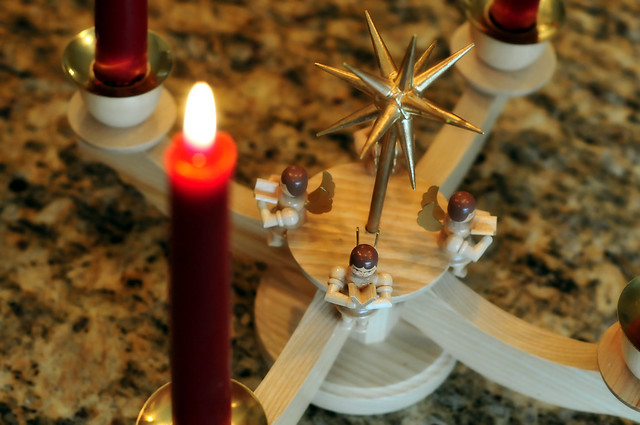
In some ways it also fits the life of my family like a glove. Our church is liturgical. On the Sunday after Thanksgiving, the first Sunday of Advent this year, our church had no poinsettias. No Christmas trees or twinkly lights. It had a deep purple altar cloth. It had an Advent wreath. These are almost the same decorations we have right now in our home, though we trade the altar cloth for white twinkly lights on our banister.
There is an ease between church and home which may explain why my children have not yet asked for a tree or for stockings on the mantel. But, in other ways, there is no ease during Advent. There is no fit like a glove.
Advent is irrational, as Madeleine L’Engle described it so well. A comfortable society, a society focused on buying and selling and consuming, doesn’t know what to make of Advent. Jingle Bells and buying gifts, sure. But Mary’s song? She sang of the rich being turned away empty, of the proud being scattered.
During Advent, we remember Mary’s prophetic words, and we remember that it is the humble and the hungry who receive.
*
Each month I contribute a story over at A Deeper Story. I don’t normally link to those posts here, though I do always share them on facebook and twitter. But my story this month is about Advent, this disjointed season. It is about remembering how wide is the gap, how ill the fit between us and the world.
I hope you’ll click over to read my story there. I’d love to hear your thoughts.
by Christie Purifoy | Dec 25, 2013 | Advent, Christmas, Family, Uncategorized
***
“Glory to God in the highest,
and on earth peace to men on whom his favor rests.”
Luke 2:14
***

***
by Christie Purifoy | Dec 24, 2013 | Advent, Christmas, Food, Uncategorized
When I picture in my mind this turn from Advent to Christmas, it looks like a stream of water becoming larger and faster until it pours itself out into a big, beautiful sea.
And, I do think it is like that. But, it is also like sitting next to a friend at the Christmas Eve church service. It is getting up and making the traditional Christmas morning cinnamon rolls. It is heading to the kitchen to prepare the turkey or ham or (in our case) the Beef Bourguignon soup. It is cleaning up the mess of wrapping paper. It is a big sandwich made with leftover everything and eaten in front of the fire.
In other words, Christmas is both extraordinary (like frosty starlight and Beethoven’s “Ode to Joy”) and beautifully ordinary (meals cooked and shared, phone calls made and received).
We all know this. We have all lived this. We have seen Christmas come and go, again and again. But I mention it because it is so easy, with the waiting and the longing, to forget that what we have been waiting for is mostly already with us. Not entirely, no, but more and more every year Christ is with us and his kingdom is more fully realized.
Perhaps, what we have been waiting for is not more of Jesus, necessarily, but eyes that are open more widely to the fact that he is always and already with us – in so many seemingly ordinary ways.
And so I wish you an ordinary Christmas. A Christmas of friendship and special food and thoughtful gifts. A Christmas of candlelight and carols and maybe a hand to hold or, if not that, a very good book.
I wish you a Merry Christmas.