by Christie Purifoy | Mar 8, 2012 | Blog, God's promises, Lent, Seasons, Waiting
Things have been a little quiet around here. A little empty. On the blog and in my heart. This Lent I find myself in a waiting, resting mode. Waiting for my lungs to heal. Waiting for a little boy’s fever to break. Waiting for God to reveal something of what’s next.
I’m waiting on big things and small and holding on to the hope that there will be much to share and much to say on this blog in the months ahead.
Last night, awake at 3 am and waiting for sleep to return, I noticed the moonglow in my bedroom. There’s a full moon tonight, but I have been thinking of new moons. This blog began with my thoughts on a new moon. I’m posting them again in case any of you are finding Lent to be a dark season.
Just remember … darkness is never the end of the story. To paraphrase the writer Anne Lamott, we may be living in a Good Friday world, but we are an Easter people.
Do you know what a new moon looks like? Of course, I do, you’re probably thinking. Until two days ago, I would have thought exactly the same, but I wouldn’t really have been seeing a new moon in my head.
Because I have been in the middle of one book (or six) pretty much ever since I picked up my first kindergarten reader, many of the ideas floating around in my head are attached to letters but not pictures. For example, having read a towering stack of nineteenth-century British novels, I have the word rookery firmly planted in my head. However, I have no solid picture to go along with it. Instead, when I happen upon this word, maybe in Jane Eyre, I see the letters r-o-o-k-e-r-y with a vague image of big black birds sitting on rocks. Which is funny, really, because a rookery shares nothing with rocks but “r,” “o,” and “k.” Though, I had to look it up in wikipedia to be sure even of that.
So, new moon. Two days ago, I googled the phases of the moon. If you’re following a train of thought and sitting in front of a computer (or smartphone, I suppose) it’s amazing how far you can follow said train. My thought began with a complaint and a worry.
I have a two-year-old, and he is a terrible sleeper. Always has been. Which means that my husband and I haven’t slept well in more than two years (because those last few months of pregnancy are never great for sleep, either). Lately, this boy has taken to creeping into our bedroom several times each night and trying to sleep on the floor beside our bed. It’s a little sad and a little cute, but, mostly, it’s exhausting because the two-year-old can’t actually fall back to sleep on our floor, and we can’t fall back to sleep with the loud sucking sounds of his pacifier. Also, I’ve been worried that I’ll get up in the night, not realize he’s there, and step on him. Did I mention that our bedroom has been very, very dark lately? We have transom windows that let in a lot of moonlight, but recently there’s been no light at all and why has there been no light? . . . well, I started googling. The first page that popped up had a huge image of Wednesday night’s moon. A new moon.
This is what a new moon looks like: black, empty, nothing. Somewhere in my head I suppose I knew that. However, it’s the word new that throws me off. New suggests promise, possibility, beginnings. New things should be light, bright, and shimmery. Shouldn’t they? Yet a new moon looks like a black hole. The opposite of promising. The opposite of fresh. The opposite of, well, new.
Staring at that shadowy, black circle where a moon should be, I felt both surprised and encouraged. I’ve been waiting and watching and longing for new things. Months ago, I read these words and felt a promise for my own life: “See, I am doing a new thing! Now it springs up; do you not perceive it?” (Isaiah 43: 19). Some days, I did perceive it. Lately, not so much. I read David’s confession that God lifted him “out of the mud and mire” and “put a new song” in his mouth. I too want a “new song,” but I’ve seen so few signs of it. The landscape of my life looks a little dark. Mostly empty.
Seeing rightly what a new moon is, I recall what I do know: new things start out small. New things begin growing in darkness. In their earliest days, new things look a lot like nothing.
Today, I am choosing to believe that what looks like emptiness and nothingness to me is actually the most promising sign of something new. It is fertile ground for the new thing I choose to believe that God is doing.
I’m afraid I’m mixing metaphors here (from sky to earth), but the new moon reminds me of nothing more than a bed of fertile soil. It looks like absolutely nothing. It looks like darkness and emptiness. It isn’t.
“Those who sow in tears will reap with songs of joy. He who goes out weeping, carrying seed to sow, will return with songs of joy, carrying sheaves with him” (Psalm 126: 5,6).

by Christie Purifoy | Feb 28, 2012 | Florida, God's Love, Lent, Seasons, Waiting
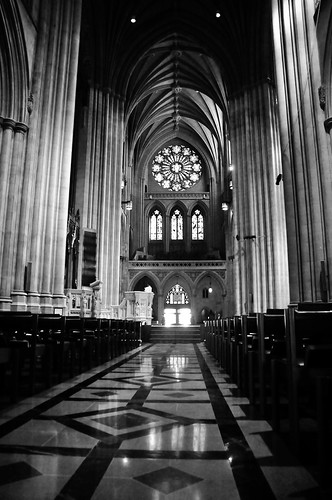
I live in Florida, but my inner calendar has been tuned by the north. In other words, no matter what I see outside my window, January means cold and snow and spring never shows up until after Easter. I suppose ten years living in Chicago did this, although I think it may go back even farther.
Growing up in Texas, I felt cheated by February heatwaves. I have always had an idealized version of the seasons; one more rooted in classic literature for children than in lived experience. Late winter meant sugar snow because I read Little House in the Big Woods no matter that late winter in Texas looks like fields full of bluebonnets.
In Chicago, Lent was appropriately dark, cold, and gray. A fitting backdrop for contemplating dust to dust. The right atmosphere for remembering the cross.
Last year, Lent in Florida surprised me with its very different rightness. The hot pink azaleas and vivid blue skies could not be reconciled with the grey smudges on our foreheads. They simply could not. But I decided that this was best. To practice Lent in such a place is to say, “I will not be distracted by youth or beauty. I will remember that death is ever present. I will not be seduced by sunshine and forget to pick up my cross.” How can we truly celebrate the resurrection power of God’s kingdom if we’ve forgotten how and why Jesus suffered?
Last year, I determined always to make an effort for Lent. It was necessary whether the fruit trees were blooming or not.
This year, I didn’t even make it to my church’s Ash Wednesday service. I was too tired. Too sick. Which says it all, I’m afraid, about the past few months of my life.
I thought about making an effort in some other way. What would I give up? Could I read through a special book of devotions? Make some goal for prayer or good works?
If only I weren’t so tired. If only my asthma would go away. If only I didn’t already feel crushed and weak. If only I didn’t already feel like dust, I might be able to make some effort to remember that I am dust.
Of course, If I had phrased it to myself just like that I might have realized sooner how foolish, how hopelessly circular my thinking had become.
Now I know that if Lent is about making some effort then the end result must always be gratitude that I need never make that effort.
With no effort on my part, I am loved.
With no effort on my part, I am redeemed.
Having made no choice, I might be led through a wintery, Lenten wilderness. Whether my calendar says it’s time for that or not.
Having done little but wait and rest, I will be led out again.
That in itself, I’ve learned, is a kind of discipline. God did tell his children, “It is a day of Sabbath rest for you, and you must deny yourselves” (Leviticus 23:32). Would he have put it like that if rest came easily and naturally?
What, then, is my Lenten discipline for 2012? Merely to rest in the shadow of the cross. And wait.
by Christie Purifoy | Feb 21, 2012 | allergies, Art, Food, God's Love

I’ve been sick and in bed a lot (Florida’s motto should be The Pollen State) and dreaming of everything I want to do when I’m feeling better. You know, practical, productive activities like cleaning my house, making dinner for my kids, and organizing my desk.
I kid! I’ve actually been dreaming of the wonderful and utterly nonessential. Things like making my own sourdough bread and picking a bouquet of teensy flowers for my daughter’s dollhouse. Oh, and writing out my favorite recipes to fill an antique recipe box. Why? Because it’s prettier than my binder full of recipe clippings, that’s why.
Illness has stripped away my ability to be energetic and efficient, but I am not daydreaming about regaining my productivity. I am daydreaming about Folly.
The capital F is important. Do you know about Follies? Those small architectural oddities which dotted the landscapes of eighteenth-century British aristocrats? If you’ve seen the latest film version of Pride and Prejudice you know what I’m referring to. Elizabeth and Darcy exchange words when they take shelter from the rain in a miniature reproduction of a Greek temple. That is a Folly with a capital F.
It serves no purpose. It has no point. It is as if those who built them said, “I am going to create something beautiful. And, then, I am going to look at it.” That is all.
We can easily criticize the Folly (and the one who built it) for its ridiculousness. Its wasteful extravagance. What is the point? What does it do? Aren’t there better uses for your time? Your money? Your life?
I have no desire to defend those eighteenth-century aristocrats. Is it a coincidence that this century ended in revolution or the threat of it all around the globe? Probably not.
Lying in my sickbed, however, I find a lot to like about the idea of Folly with a capital F. Folly, as it appeals to me, has more to do with beauty than foolishness. It means acknowledging that life is not Life if it is all efficiency, productivity, and utility. It must also make room for beauty, creativity, whimsy, and delight.
For homemade sourdough bread. For handwritten recipe cards. For tiny tabletop bouquets bestowed on a family of dolls.
For art.
For music.
For dance.
For embracing the Creator in whose image we are made.
“How priceless is your unfailing love, O God!
People take refuge in the shadow of your wings.
They feast on the abundance of your house;
you give them drink from your river of delights.
For with you is the fountain of life;
in your light we see light.”
(Psalm 36:7-9)
I’d love to know: what is bringing you delight during these late winter days?
by Christie Purifoy | Feb 14, 2012 | God's Love, God's promises, grief, Jesus, Waiting
Alone in darkness.
Someone typed those words into their search engine, and it led them to my blog. It breaks my heart to know this. I wonder if they found what they were looking for. I wonder if they found something else, something good that they didn’t even know they were searching for. Somehow, I do not think they did.
For those of you unfamiliar with the writing of blogs (which group included myself only a few months ago), it is possible for the blog’s author to check his “stats.” One of these stats includes word searches that have led someone to click on that particular website.
These searches usually make sense. Someone searching for a particular poem or literary quotation is often led here. A surprising number of people want to know about southernisms like “bless her heart.” I wrote about that once. And every single day someone types in some variation on “Jesus” and “prostitutes,” which leads them here. That makes me very happy.
Sometimes the words searched are so bizarre I cannot fathom how the google gods led them to my site. I laugh, imagining how disappointed or confused that searcher must have been as my site filled their screen. Yesterday, I didn’t laugh. Instead, I decided that if anyone ever again typed alone in darkness they would find my response here.
Do you feel alone? Has the world gone dark? Then I have something for you.
It isn’t advice. I don’t believe in advice. But, I do have my story, and I know what it is to feel unseen. Unheard. Alone in darkness.
You are not alone. You are not. Yet, I know that it feels that way. I know the weight of it is crushing. There are few things so painful as feeling unseen and unknown.
There is Someone with you. He has always been with you, and he has not abandoned you. He goes by so many names, but the name I know best is Jesus. He made you. He knows you. And he promised that he would always be with you (Matthew 28:20).
Here’s something else I know: when we’re in the darkness we only sometimes feel his presence. Usually, we don’t. We feel alone. It is only later when some grace has drawn us slowly back into the light that we are able to turn around and see rightly. That is when I have known, without a doubt, that I was never on my own. That I was never forgotten. Never unseen.
Why does he sometimes leave us in the darkness? Why doesn’t he swoop in to rescue us? I don’t really have the answers to those questions. “Why” questions are mostly impenetrable. I do have some “whats”, however. I don’t know why, but I do not what has happened to me. Having walked through darkness into light I know that morning always returns. The night never lasts forever. I know that I am loved and that I do not walk alone through the valley of the shadow of death. I know that sometimes I needed to change in ways that only darkness could accomplish. I know that I have never searched for God or prayed to God like I have in the darkness. I am glad to know that I am capable of that. I am forever grateful to know that he always responds, he always hears, even if it isn’t on my timetable.
I will not tell you that darkness is good. I certainly will not say that it is good for you. I do admit that I have been amazed to see how bright the light shines after darkness.
That light is waiting for you. I know you cannot see it yet. Try to hold on. Wait. Pray. Hurl your loneliness and fear at the sky.
He’s listening. He sees.
“I have heard your prayer and seen your tears.” (Isaiah 38:5).

by Christie Purifoy | Feb 9, 2012 | Books, Food

I write a great deal about books on this blog. You know that I love Irish poetry and the novels of Virginia Woolf. You know that I love Harry Potter and the Hunger Games. You may not know that I love well-written detective novels like those by Margery Allingham (past) and Kate Atkinson (present).
A significant sub-genre in the large category of Books I Have Loved is Food Books. This includes my childhood favorite Little Farmer Boy, by Laura Ingalls Wilder. Even today, I could happily read those descriptions of nineteenth-century farm meals over and over and over. Wilder can make me drool even for headcheese.
It also includes Food Memoir. This seems to be a very popular genre today. I haven’t actually read many of these books, but I have noticed whole stacks of memoirs with words like cupcake, lemon, chocolate, etc. in their titles. My own favorite food memoir may be Down the Kitchen Sink, by Beverley Nichols. His gardening books are the best, but I love Nichols no matter his subject. He’s sentimental, nostalgic, and rather snobbish (well aware of his own foibles, he would no doubt prefer the term “romantic”), but he’s witty, supremely British, fond of name-dropping and more comforting than the most comforting comfort food.
Lastly, there are cookbooks. I read them like novels and am drawn both to the glossy and new (Ina Garten! Babycakes!) and the vintage and worn (The Kitchen Garden Cookbook with watercolor illustrations by Tasha Tudor!). One of my all-time favorites for reading pleasure is Apples for Jam. The recipes are organized by color (pink! green! white!) rather than food type or meal. It’s totally impractical and wonderfully inspiring.
Last spring, I inherited (via estate sale) a whole stack of vintage cookbook treasures. When I paid for them, the daughter of their previous owner sighed and told me that her mother used to read cookbooks like novels. I told her I’d be keeping them on my bedside table for just that reason.
My favorite of her books is The Margaret Rudkin Pepperidge Farm Cookbook. The title may sound corporate and rather soul-less, but if you could hold it in your hands you would know right away how wrong that first impression is. This is a hefty, hardback covered inside and out with delicate ink drawings, many of them in full technicolor glory. Originally published in 1963, mine is the 1965 edition.
It is part cookbook, part memoir (as the best cookbooks usually are), and describes the life, times, and food of Margaret Rudkin. Apparently, Mrs. Rudkin was inspired to begin baking and selling Pepperidge Farm bread because of her child’s food allergies. Thus, she is dear to this mama’s heart.
Part One of this book describes Mrs. Rudkin’s childhood in a New York City brownstone. It seems they ate a lot of soup and fish. I might try the recipe for Strawberry Soup. Likely, I will skip the Pickled Lambs’ Tongues.
Of course, I also enjoy actually cooking. And certainly, I love to eat. Still, one can only cook or eat so much. But reading … ah, reading. With books I am never sated.
Do any of you share my love for cookbooks and books about food? Any recommendations? I’m always hungry for more.
