by Christie Purifoy | Sep 26, 2011 | Family, grief, motherhood, Poetry, Seasons
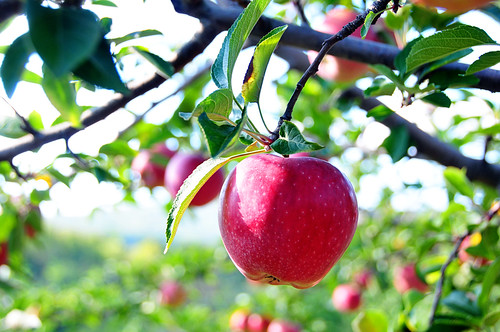
This comes from one of my favorite poets, the Irish writer Eavan Boland.
Reading it again this morning, I remember that myths are some of the truest stories we tell. The myth of Persephone is not merely a way of explaining the change of seasons before our age of scientific discovery. More than this, it is a story of loss and restoration. This poem reminds me that I have been Persephone. It also reminds me that my oldest child is swiftly becoming Persephone. I say, with Boland, that I will not deny her her own unique life story, though no good story is without pain.
The Pomegranate
The only legend I have ever loved is
The story of a daughter lost in hell.
And found and rescued there.
Love and blackmail are the gist of it.
Ceres and Persephone the names.
And the best thing about the legend is
I can enter it anywhere. And have.
As a child in exile in
A city of fogs and strange consonants,
I read it first and at first I was
An exiled child in the crackling dusk of
The underworld, the stars blighted. Later
I walked out in a summer twilight
Searching for my daughter at bedtime.
When she came running I was ready
To make any bargain to keep her.
I carried her back past whitebeams.
And wasps and honey-scented buddleias.
But I was Ceres then and I knew
Winter was in store for every leaf
On every tree on that road.
Was inescapable for each one we passed.
And for me.
It is winter
And the stars are hidden.
I climb the stairs and stand where I can see
My child asleep beside her teen magazines,
Her can of Coke, her plate of uncut fruit.
The pomegranate! How did I forget it?
She could have come home and been safe
And ended the story and all
Our heartbroken searching but she reached
Out a hand and plucked a pomegranate.
She put out her hand and pulled down
The French sound for apple and
The noise of stone and the proof
That even in the place of death,
At the heart of legend, in the midst
Of rocks full of unshed tears
Ready to be diamonds by the time
The story was told, a child can be
Hungry. I could warn her. There is still a chance.
The rain is cold. The road is flint-coloured.
The suburb has cars and cable television.
The veiled stars are above ground.
It is another world. But what else
Can a mother give her daughter but such
Beautiful rifts in time?
If I defer the grief I will diminish the gift.
The legend must be hers as well as mine.
She will enter it. As I have.
She will wake up. She will hold
The papery, flushed skin in her hand.
And to her lips. I will say nothing.
– Eavan Boland
by Christie Purifoy | Sep 23, 2011 | Family, motherhood

She leaned forward, looked right into my eyes, and said, “You’re a good mother, aren’t you?”
Yes, she really did. My jaw dropped a little, and I said nothing but “Ummm.” Then I watched those inarticulate sounds hang there in the air between us.
Fortunately, she was a talker, and she barreled right ahead, “Well, of course you are, but my own mother now . . .” and she was off, telling me her life story. We were strangers making small talk in a Starbucks, though our talk (or hers, at least) quickly ballooned.
At least a decade older than me, she was beautiful. Like a model for hip, expensive yoga-wear. She was also honest. I heard all about her many failed relationships, failures for which she was quick to accept responsibility (though not without some wickedly funny anecdotes about her exes). And when it came to her children, she was confident. She had always, she was sure, been an excellent mother. Nothing like the alcoholic who had raised her.
Our conversation took place more than a year ago, but I still marvel at the certainty with which she announced: “I am a good mother.” Not “good enough” (to use the psychoanalytic catchphrase I learned in graduate school) but truly, thoroughly good.
In the radiance cast by her lovely, shiny blonde hair, my own self-doubt emerged as if spotlighted. For that’s exactly what her bold question had done: shined a light on my weakness.
I don’t think that I will ever say with confidence or certainty that I am a good mother. I love my kids. I love being a mother (though I don’t always like it). And I’ll even admit that if you lined up a cross section of the world’s mothers, I might show up somewhere near the top, at least according to superficial, measurable factors (I kiss them, I say “I love you,” I feed them organic as much as possible, I make them brush their teeth).
For whatever reason, I tend not to focus on the things I do well. Instead, I see the failures: from lost tempers and angry threats to my consistent refusal to play Legos with my son (I’m just not good at that. Why don’t you wait till Daddy’s home?).
Over the years (well, eight years, to be exact), I’ve made peace with my weakness. I cannot stand up boldly to claim the title “good mother,” but today I’m okay with that.
Mothering is now so much less about me and so much more about Grace. The more impossible I find this role, the more room there is for God (and for His presence, His love, His power, His many good gifts).
As my friend Courtenay recently told me, all that hard, cannot-possibly-get-it-done, certainly cannot-do-it-well stuff on your horizon? Well, that’s what grace is for.
“Three times I pleaded with the Lord to take it away from me. But he said to me, ‘My grace is sufficient for you, for my power is made perfect in weakness.’ Therefore I will boast all the more gladly about my weaknesses, so that Christ’s power may rest on me. That is why, for Christ’s sake, I delight in weaknesses, in insults, in hardships, in persecutions, in difficulties. For when I am weak, then I am strong.”
(2 Corinthians 12:8-10)
by Christie Purifoy | Aug 3, 2011 | Family, God's Love

The middle child, the oldest boy, starts kindergarten in just a few weeks. Not only that, but he will ride the bus (which is, possibly, a bigger deal for both of us even than kindergarten itself).
I’ve been a mother long enough to know that the days are long but the years are short. These summer days drag (how to fill the time between dinner and bed?), but I will wake up tomorrow and watch my son graduate from high school. I know this, and it has prompted me to wonder: what do I want this boy to grow up to do? To know? To be?
Like most parents in these enlightened days, I say, “I only want him to be happy. Whatever makes him happy. If that means becoming a doctor, great. If it’s an auto mechanic, fine by me.” Unlike most parents, I suspect, I really do mean it.
I’ve spent enough time around highly-educated Ivy-leaguers to know that the things which spell success in our culture (straight A’s! a University of Chicago degree!) are not necessarily markers of either success or happiness.
Not only that, but I know that there is some kind of Murphy’s law of parenting: whatever I plan for my child, the opposite will happen. My father gave me only this bit of advice as I prepared for college: “Study anything you want, but be practical. Don’t major in English or History.” I was never a rebellious child, but Murphy’s law kicked in and, by the end of college, I was graduating with a double major in English and History.
What then do I want for my boy? For his big sister? His little brother?
Only this: to know deep down in their heart of hearts that God loves them. Truly, that is all.
Unfortunately, there is such a big chasm between head knowledge and heart knowledge, between assenting to an idea or concept and feeling the truth of it deep inside. I tell them over and over: you are loved. By me. By others. But, most importantly, you are loved by the Love who created everything beautiful and that Love is vaster and more intimate than you may ever know.
I heard that too as a child. I sang these words in so many Sunday school classes: “Jesus loves me, this I know.” But I didn’t know. I nodded my head and agreed, but I didn’t really know.
Praying that my children know God’s love is sometimes difficult. It is as if I am praying that they suffer. Maybe I’m wrong. Maybe there is some other way in which this knowledge can travel from head to heart, but the enormity of God’s personal love was only revealed to me in some very dark places.
Looked at another way, I am not praying that they suffer. I am praying that they be comforted.
And this is what I want for my babies? Yes, this is what I want for them: that, like Hagar, they will one day say, “I have now seen the One who sees me.”
This is my prayer:
“I pray that you, being rooted and established in love, may have power, together with all the saints, to grasp how wide and long and high and deep is the love of Christ, and to know this love that surpasses knowledge – that you may be filled to the measure of all the fullness of God” (Ephesians 3:17-19).
I’m afraid that it will hurt, but I promise you: it is worth every tear.
“My ears had heard of you but now my eyes have seen you.” (Job 42: 5)
