
These Farmhouse Bookshelves
It has turned suddenly cold and windy. Cold enough that we considered firing up the woodstove in our kitchen this morning.
It has also turned dark. Thanks to a nor’easter, we’ve had rain and clouds for days. The sun rises noticeably later. It sets before any of us are at all ready.
It feels like October. Which is right on schedule, I suppose. Isn’t it comforting when nature’s patterns prove reliable?
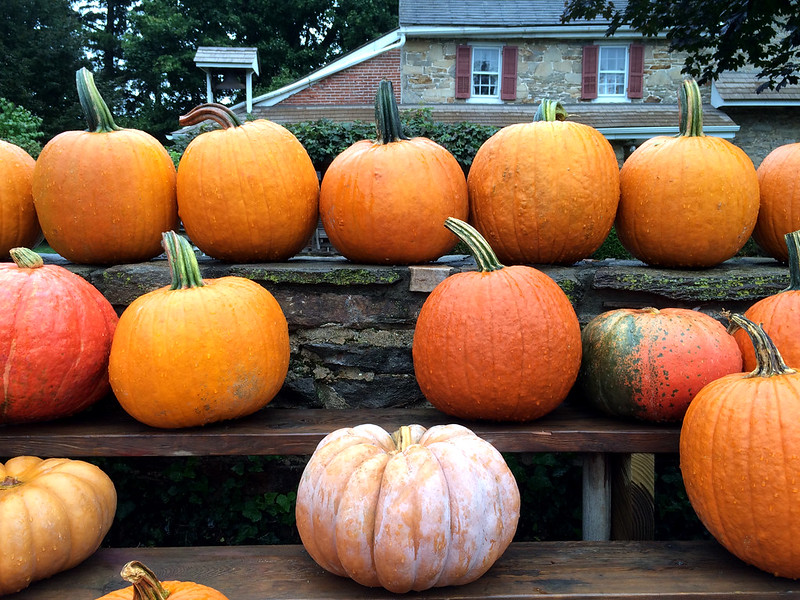
This week I went to one of our local farm markets and filled my cart with pie pumpkins, butternut squash, acorn squash, and Concord grapes. Now what I really need to do is stock up my nightstand with fresh books for autumn. Dark nights were made for books.
If you’d like to do the same, here are a few I’ve picked up recently.
Earth Works: Selected Essays
Sanders writes about houses and marriages. About the stars and beauty. He writes to discover, and the thing he wants to find, the question he seems most compelled to ask, is some variation on what it means to live well. How can we live in harmony with ourselves, with one another, and with this beautiful, astonishing planet that is our home?
All of us ponder our lives. … Essayists choose to do such reflecting, remembering, and imagining in public, on the page. – Scott Russell Sanders
Here is my new favorite book for little people: A Party for Pepper: A Hazelwood Forest Counting Book
I discovered Hartsig, the artist behind the world of Hazelwood Forest, on Instagram, and I love her subject and style. If you enjoy Tasha Tudor and Beatrix Potter, you will love Hazelwood Forest, too.
I think we adults should buy picture books (and support talented artists) for ourselves, but I am fortunate to still have a small book-loving person in my life, so the choice, for me, was easy. I gave A Party for Pepper to Elsa on her third birthday in September, and I can honestly tell you it was one of her favorite gifts. Numbers are her thing right now, so while I enjoyed the depictions of sweet animals taking tea, Elsa counted and counted the gorgeous watercolor numbers.
I am already eager to see what Hartsig creates next.
Amish Peace: Simple Wisdom for a Complicated World
Here are stories from Amish lives and reflections on Amish belief and practice for the rest of us. The tone is respectful but not fawning, and the author, though not Amish herself, has family roots and ongoing relationships within a plain community. In other words, she is not a voyeur, nor does she think we should all be Amish. Rather, she knows these communities well, her own life has been enriched by their wisdom, and she is interested in sharing that wisdom with us.
The book is organized for small group discussions. At first, I skimmed the discussion questions that come at the end of each brief chapter, but it finally dawned on me how much I would love to read this book with a group. I know there are some aspects of my complicated life and world I take entirely for granted or view as entirely fixed.
Reading this with a group, I wonder if we might discover just how much we are not required to live the lives of overly busy consumers that our world demands?
We non-Amish types might object to having a church choose our house paint. The Ordnung seems confining and restrictive, invasive, even. It’s true that the Amish are not free to do some things. However, they are free from many others. – Suzanne Woods Fisher
On this same theme, I shared a story at the Art of Simple this week about slowing down to the pace of a horse-drawn buggy. It’s a story about slow travel and sacred places. It’s a story about placemaking. It surprised me as I wrote, and I am still pondering the ideas that emerged. I hope you’ll read it and ponder with me.
Happy Saturday, friends.
Life Right Now
(this post contains affiliate links)
Is green edged with gold.
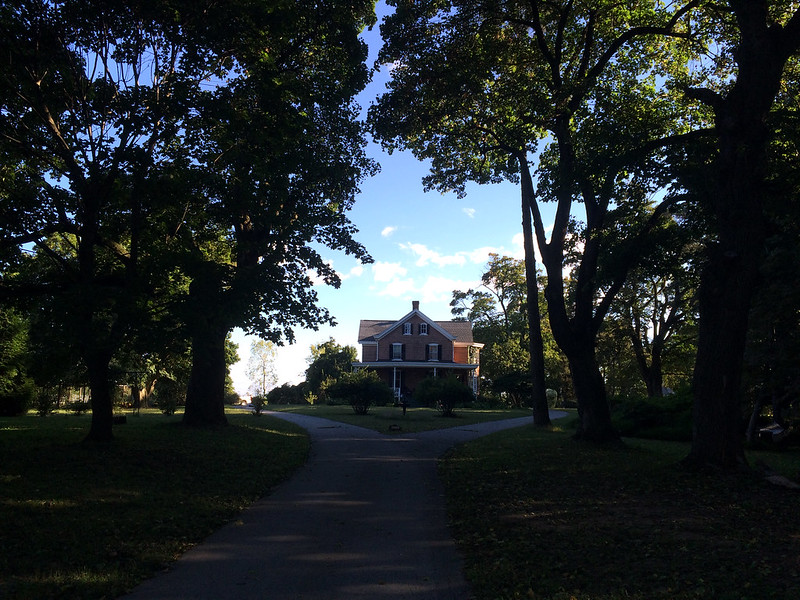
It is the first official day of autumn, but we have been observing its approach for weeks. The lingering heat and humidity made us doubt our eyes. Now that the air has shifted, now that we have retrieved our jackets from the back of the wardrobe, we cannot tell ourselves that the cherry trees with their yellow leaves are overeager.
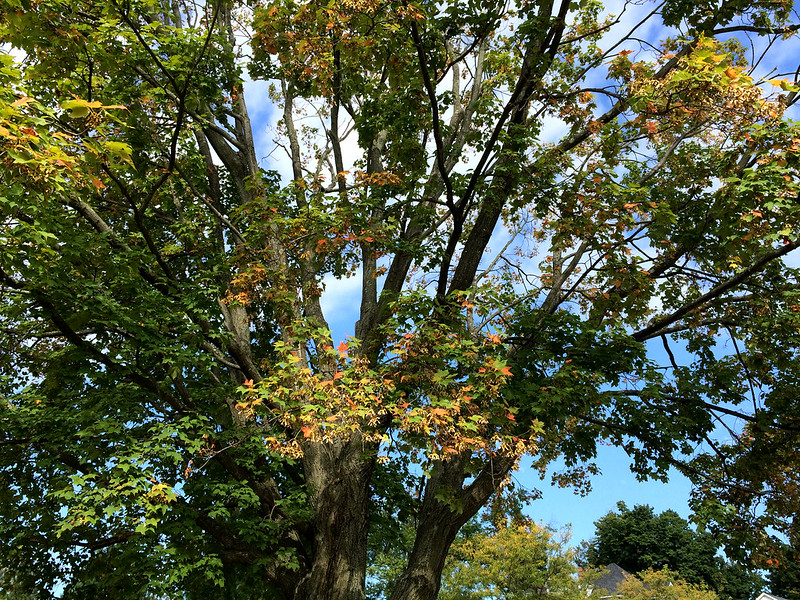
The maples are shaded with color now. The pumpkins lined up outside the grocery store no longer seem presumptuous.
/
/
Last weekend, Jonathan and I buried two hundred daffodil bulbs on the slope above the driveway.
Every year when I trip over a just-delivered box of bulbs on the porch near our back door, I feel beleaguered. Who has time for bulbs when the younger two won’t stop poking one another then screeching and the older two are whining about after-school snacks and someone refuses to meet my eye when asked about his school reading log?
But every year when spring finally breaks through, I wish I had planted more. I always wish for more.
I am trying to remember that winter-weariness. Trying to remember what those bulbs will mean come April.
Two hundred daffodils are only the beginning. I’ll plant at least as many more when another box shows up some time in October. More daffodils, but also alliums for the new flower garden and tulips for the raised beds in the vegetable garden.
If I plant tulips anywhere else they’ll only be eaten by deer, so I fill a bed or two inside the picket fence. When the tulips are finished in May, I can fill those spots with tomatoes or peppers or beans.
/
I am reading Terry Tempest Williams’ beautiful book Refuge: An Unnatural History of Family and Place
When I came across that line, I put down my book and went in search of a pen. Her words describe something I have been living for years now, but only dimly perceived. The poetry of her sentence, with its alliterative P, has made something invisible in my experience visible to me.
The earth is full of patterns and rhythms. Some we merely observe but others invite collaboration. Like the planting of bulbs in autumn and the picking of flowers in spring.
These back-to-school days have been anxious days for me, but feeling again the net bag of bulbs stretched tight against the palm of my hand is like feeling my head surface above deep water.
I can breathe again. The peace of a larger, more meaningful perspective fills my lungs.
Homework may go unfinished, my children may go on poking and screeching, but wasn’t it only yesterday I was digging in bulbs with a baby strapped to my back? And isn’t it only tomorrow when those bulbs will bloom again?
The earth spins so fast. There is so much to remember (not homework but the feel of a baby on my back). There is so much to anticipate.
The present moment is always what matters most. But it matters most when it is rooted in memory even as it reaches toward that which is still to come.
/
These Farmhouse Bookshelves (+ A Giveaway!)
Alaska is far away.
Maybe you think you know this, but however far away you imagine Alaska to be, double that. Because Alaska is really, really far away.
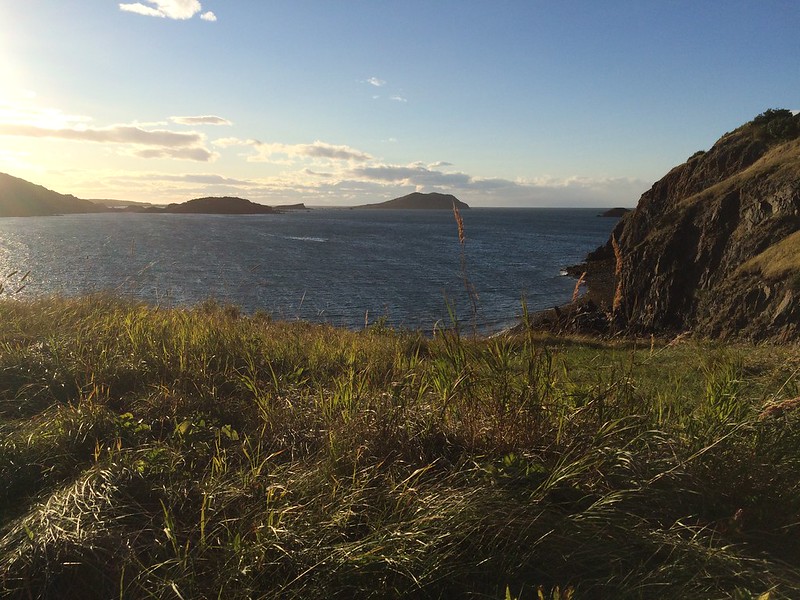
I am so grateful to have had the opportunity to spend a week with other writers on a remote Alaskan island. I wish that each of you could have the chance to be dazzled by the Alaskan sun and scoured by the Alaskan wind. I wish that you could taste King salmon only just pulled from the water.
If a two-day journey isn’t an option for you, what about a book instead?
(the following includes affiliate links)
Here is a memoir of that same remote island. It is also one of the best memoirs I have ever read.
Surviving the Island of Grace: Life on the Wild Edge of America
This is a memoir of marriage, motherhood, spirituality, and poetry. It is also a memoir of wilderness and the dangerous and exhausting work of commercial salmon fishing.
Even if you can’t imagine enjoying a book about fishing (much less actual fishing!) I highly recommend this book. The writing is stellar, the story captivating, and the whole thing is edged with lyricism.
This is the most particular and most universal of stories. Now, I too, am asking the question at the heart of this book: how do we bear the terrible, beautiful grace that sustains our lives?
This was where we unraveled the rest of our lives, it seemed, even as we sewed up the holes in the nets. There was something about this space, about standing out there on the beach under the open sky – the clouds or sun, mountains on every horizon, though it was ocean all the way to the edge. The walls were gone, how could there be a larger space to stand in, and yet, it became a sort of confessional. – Leslie Leyland Fields
I picked up another Alaska memoir in the bookstore at the Anchorage airport: Take Good Care of the Garden and the Dogs: A True Story of Bad Breaks and Small Miracles
Lende organizes her chapters around the Bible and the Book of Common Prayer, but she incorporates other traditions as well, such as Buddhism or Native American spirituality.
I kept this one tucked in the seatback pocket on the long flight from Anchorage to Seattle. At one point, my seatmate asked if she could read it, and I passed it over. She laughed out loud for the rest of the flight.
It’s a good book.
I wonder if to be human is to know that we can’t ever banish pain and ugliness from the world, only learn from it and create something beautiful and good out of it – like the newest totem pole in Sitka, the one called ‘You Are Going to Get Well.’ If you ever see it, you will believe that’s possible. – Heather Lende
One of the guest writers at the Alaska workshop was the novelist Bret Lott. You can’t go wrong picking up any of his fiction (I adore the strange, hilarious, heartbreaking first story in his collection The Difference Between Women and Men: Stories), and his novel Jewel
I especially recommend his latest, a collection of essays called Letters and Life: On Being a Writer, On Being a Christian
For writers, his essay “On Precision” is outstanding. For everyone, the final long essay on the death of his father is beautifully crafted. I aspire to write personal essays like this one.
As a writer you must always be striving for that which you cannot yet achieve and for that which you cannot yet know. – Bret Lott
I have two bonus recommendations for you today. The first is Girl Meets Change: Truths to Carry You through Life’s Transitions
The second is the most recent book from Emily P. Freeman: Simply Tuesday: Small-Moment Living in a Fast-Moving World. I don’t think anyone writes Christian formation quite like Emily. Her writing is accessible but also lovely, straightforward but rich and wise.
In my eagerness to read it, I mistakenly ordered two copies. Leave a comment here, and I will enter your name in a drawing to win one of those copies. A winner will be notified by email.
Tell me, friends. Read any good books lately?
***