
On Living Without
I believe in stories more than advice. In other words, I believe that a light is shined on our way forward, not when we finally hear the exact, right piece of advice, but when someone shares their story with us.
True stories contain all of the messy, untranslateable details of a life. Somehow, they also point us toward the maker of life.
I wish I could tell you how to live without the kind of community I described earlier this week. I wish I could tell you how to get it back. I even wish I could tell you that developing that kind of community in your own setting is the most important use of your time. But I can’t tell you these things.
If this whole Jesus-following-way-of-life is truly a relationship (as I’ve been hearing all my life) then we need to stop comparing our circumstances with everyone else’s. My marriage to Jonathan is fifteen-years-old (or fifteen-years-good), and it makes no sense for me to look at those still-awkward newlyweds and wonder why our lives are so different. Other than the fruits of the spirit, I’m not sure there are many things we can point to in order to say “that is a good Christian life” and “that is not.” At times Jesus walks us through joy and other times he walks us through trouble, but we can be confident in both that he has not and will not abandon us.
I lived in community for ten years, and it was good and it was painful, and I hope I haven’t said goodbye to that way of life forever. I could beat my head against my Bible wondering why my life no longer looks like that and how to get it back, or I can accept that when God empties our lives he also fills them up again. Not with the things we are missing, necessarily, but with himself.
In this world, we are wanderers. And that is not always a bad thing, not always a sin thing. We can wander quite a distance pursuing the good things of God’s kingdom on earth. Still, there’s little rest in wandering, and God knows we need rest. But where to find it?
God’s people “wandered over mountain and hill and forgot their own resting place” (Jeremiah 50:6).
Sometimes we need silence and emptiness, loneliness and barrenness in order to remember. We need winter.
The four walls of my suburban existence can feel like a prison, but they have been just the thing for feeling the heavy, holy pressure of God’s hand on me.
“You hem me in – behind and before; you have laid your hand upon me. Such knowledge is too wonderful for me, too lofty for me to attain.”
Psalm 139: 5-6
Why Life Shared is Life Abundant

Taken by Yours Truly at Chicago's Art Institute. This painting, with its people like stone columns, always reminds me that living in a crowd is not the same thing as living in community.
Our airplane tilts away over city rooftops, and I feel as if I am leaving home in order to return to a house. It is not an altogether blue feeling (it is a house inhabited by my favorite people, after all), but it is disorienting. An emotional confusion to match a physical one; as the plane banks, I can no longer tell if I am pointed toward ground or sky.
I’ve spent four days trying to understand what I left behind when I moved away from Chicago. It seems important to do this, because I do not yet know if my life is a straight line heading always away from it or a curve that will one day return. I think the only word for what has been lost is community, but that word seems beyond inadequate.
In Florida, when my husband leaves for a business trip, I lie awake wondering who I would call if one of the children had an accident or became suddenly ill. I know that there are people in our neighborhood and people in our church who would graciously, even eagerly, help out, but it would involve some tracking down of phone numbers and many apologies for having “bothered” them in the middle of the night.
Living in community meant that there were no apologies.
We frequently woke to midnight phone calls, whispered midnight prayers for friends in crisis, made beds on the floor for small children whose parents were racing to hospitals. I have rushed behind a curtain in the emergency room to find a friend sitting at my son’s bedside: the friend who held him down for the epi-pen, the friend who drove him to the hospital.
But community is so much more than a safety net.
It is a web of interdependence that is often uncomfortable, even painful. It is the downstairs neighbor who calls (again) because my children are pounding on her ceiling (again). It is the woman pushing the stroller down my street who asks me (again) for bus money. Walking near my old building this week, I saw her, remembered her, and was not at all surprised when she stopped me to ask for money. I passed her again on my last evening in Chicago, and she asked (again) for money. I hand over my bus pass knowing that she will always need, and I hope, for Jesus’ sake, that someone will always be there to give.
Community is trying to keep the kids quiet in the kitchen in order that the group of church ministry leaders meeting in the living room won’t be disturbed. Community is making the bed in the spare room for friends of friends. Community is waking up early to make them breakfast, too.
Community is being inconvenienced.
It is straightening up the living room in order to host a weekly gathering for a church small group when all you want to do is climb into bed. Community is when the unmarried, male graduate student from that same small group surprises you with home-cooked Indian food two weeks after your baby is born.
Community is life in abundance.
This is the gift of the one who made us (the one who said it is not good to be alone): to be poured out again and again in order to be filled again and again. Of course, I am not talking about martyring oneself so that bitterness and resentment destroy all hope of relationship. But I have seen that when I open my hands to give until it hurts I receive … oh, I receive so much in return.
On Sunday, I sat once again in my former church. I was joined by a friend, and we both had tears in our eyes just for the joy of sitting next to one another. She turned to me and whispered, “This is our life,” and I knew just what she meant.
This is our life: it is real, it is now, it is beautiful and difficult, and, above all else, it is shared.
A Poem (and a Memory) for Your Monday
For the past few days, I’ve been back in Chicago, remembering with my feet as I walk the familiar slate sidewalks.
If poems had mailing addresses, this one would surely be marked Chicago, the Southside.
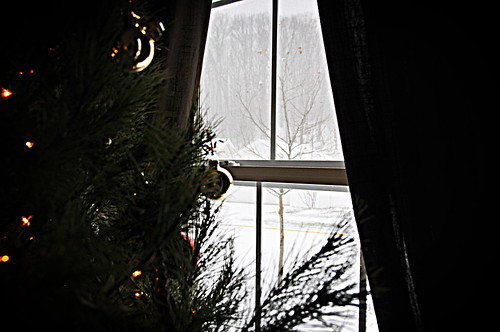
Winter hasn’t yet arrived, even in Chicago, but I’ve been reliving one particular winter memory. It was my first winter here, and the heavy skies were unburdening themselves of a record amount of snow. In early December, I sat at my writing desk trying to complete my first graduate seminar paper. Hunched close to my window, my Texas-bred eyes couldn’t stop wandering toward the snow-globe view.
Everything outside had been erased by the whiteness, even the people and the cars had disappeared. But then I saw a black parade slowly winding its way in front of my building. A hearse, a limousine, followed by a patient tail of black-flagged vehicles: I knew, without being told, that this was for Gwendolyn Brooks. Her death, on December 3, had been in all the papers and on every channel.
I can’t remember if the memorial was open to the public. I don’t think I would have made it to the university’s gothic chapel anyway, not through all that snow, not with a paper keeping me at my desk.
The chapel is beautiful, but it isn’t a poem. The slow slash of black in a washed-white world: that was a poem. I’m sure I could never fully capture what I saw in words, but there’s really no need. Gwendolyn Brooks had already done it.
Cynthia in the Snow
It SHUSHES
It hushes
The loudness in the road.
It flitter-twitters,
And laughs away from me.
It laughs a lovely whiteness,
And whitely whirls away,
To be
Some otherwhere
Still white as milk or shirts,
So beautiful it hurts.
– Gwendolyn Brooks