by Christie Purifoy | Sep 13, 2011 | Faith, grief, Scripture

I slumped down at my writing desk one recent morning, and this phrase floated up to the top of my mind: “there is nothing new under the sun” (Ecclesiastes 1:9).
I was feeling a little depressed, a little overwhelmed, and Solomon’s words came unbidden to justify my dark mood.
For me, it was nothing more serious than hot weather, kids fighting (again), and dirt tracked all over my just-mopped floors. Some days it only takes that little bit and we are carrying the burdens of the world: in an instant my eyes roam from the dirt, sweat, and tears in my own house to the global orphan crisis, drought in Texas, famine in Africa (again!).
Why is my life such a mess? Why is the world such a mess?
Supposedly, we Christ-followers are the bearers of “Good News” (just search the Bible for the phrase “good news”: it comes up a lot). But what can we possibly have to say to those suffering amidst the ever-present darkness of this world?
As a child, growing up in the church, I heard a lot about good news. Maybe the message was simplistic or maybe I was only able to understand a simple message, but I believed then that the good news was all about heaven. The good news, then, was that Jesus made a way for us to go to heaven when we die. That seemed like pretty good news to me, which is strange because I was a lot farther from death than I am now. Today, thirty years closer to my own end, that news doesn’t seem nearly good enough.
You and I and our neighbors on this planet? We need good news now. We need good news for today.
Solomon’s words take me there. He writes, “Is there anything of which one can say, ‘Look! This is something new’?” (Ecclesiastes 1:10). I’m not sure, I can’t really answer his question, but then I remember these words in Isaiah: “I am doing a new thing! Now it springs up; do you not perceive it?” (Isaiah 43: 19).
God is doing something new. In fact, He’s been working at it for thousands of years. The Old Testament whispers it, and Jesus embodies it. New life. New creation. New covenant. New heaven. New earth.
God is making all things new (Revelation 21: 5).
I don’t know exactly what that means. But I feel something good deep down in my bones when I hear the word new. New, new, new. All is being made new.
Was there ever a more hopeful, beautiful word than “new”?
In me, in you, and in this gorgeous, broken-down world, God is doing a new thing. Look closely. Do you not perceive it?
by Christie Purifoy | Aug 25, 2011 | God's Love, Religion, Scripture

I’ve been listening to Mat Kearney’s new album. These words from the song “Hawthorne” keep running through my head: “the Jesus of prostitutes is chasing my soul.”
Those words seem so wonderful and comforting, but it takes me a few days before I stop to consider why. Why does it feel right and good to sing about “the Jesus of prostitutes”? Wouldn’t I rather sing about the Jesus of overly-educated-suburban-mothers-of-young-children? You know, the Jesus-of-me?
No, I really wouldn’t.
I am not actually a follower of the Jesus-of-me (though, some days, I act as if I am). I am a follower of the Jesus who loves the least, the powerless, the set aside, the unseen. I am a follower of the One Who Sees (Genesis 16:13).
Pain. Injustice. Small, seemingly insignificant people. We may look away or keep our eyes closed, but He never does.
You would think that prostitutes would no longer be among the unseen. Not in our hyper-sexed, anything-goes culture, right? But, of course, they are.
I am reminded of this when my friend tells me about a group of locals organizing together to show love in practical ways to the prostitutes who work a particular street. I hadn’t realized there were prostitutes on that street.
Unseen.
Ironically, God shows us throughout his Word that one reason he loves prostitutes – one reason he is their God – is because they see.
Pushed to the edges of her community, Rahab saw the truth. She knew whose side she wanted to be on. The woman with the expensive perfume? She was the only one who truly saw the Beauty-Deserving-of-Worship in that room.

I strive to have the clarity of vision those women had. I accept that one reason they had it was because they were not among their community’s successful, powerful elite.
Blessed are the poor in spirit, for theirs is the kingdom of heaven.
Blessed are those who mourn, for they will be comforted.
Blessed are the meek, for they will inherit the earth.
This is Kingdom-of-God logic, and it turns the Kingdom-of-the-world logic on its head.
It isn’t telling us to close our eyes, to accept injustice. Rather, it says to us: “Take heart! The Kingdom of God has come. And all around you, and even through you, the tables of this world are being turned. The moneychangers are kicked to the curb, and all is being set right.”
The One who Sees, the One Who is Making All Right: He is a lion, He is a lamb. He is the Jesus of prostitutes.

by Christie Purifoy | Jul 22, 2011 | Books, Religion, Scripture
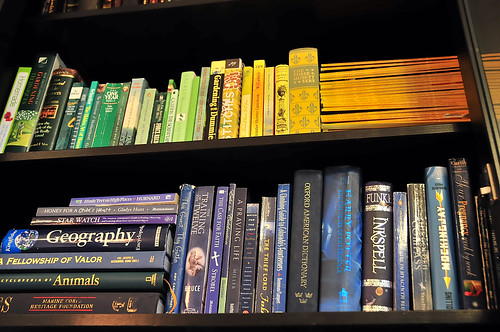
I recently came across news of another Gallop poll that attempts to sort and label people according to their beliefs about the Bible. You know the polls I'm talking about. Inevitably, they use catchwords like "literal" and "inspired" to tidy diverse opinions into neat categories.
I think I understand and sympathize with what is meant by statements like "I believe that the Bible should be read literally." However, I always bristle at that word literal. In my mind it makes Scripture sound too much like a set of instructions for assembling IKEA furniture.
Now, before I step on anyone's toes (oh dear, is it too late?), I should say that I do understand that theologians who use the word literal use it to mean something like the word straightforward. In their view, to read literally is to read straightforwardly, without twisting the meaning of the text to suit our own purposes.
They understand that the Bible is made up of diverse genres. They know that poetry must be read as poetry. History as history.
And yet, while I don't exactly disagree with this approach, I wonder if it doesn't compress the Word into a more human-sized package.
History is history, yes, but what if history is also more than history? What if it happened and is happening? The story of a people long ago and the story of you today?
It may be the poetry lover in me, but I find that only metaphor gives me a sense of the Bible that seems more God-sized, less me-sized. The Word is the Son of God, the Word is a lamp, the Word is a sword, the Word is food, the word is life.
This might not seem like very good news. Too often, I would rather have an instruction manual (especially where work and motherhood are concerned) than a person. I would rather go hungry if it meant that I could have every choice made for me. Every question answered. Every complex issue explained and categorized.
But we are so much more than IKEA furniture. Instead of a lifeless history lesson, we’ve been given a history that lives. Instead of diagrams, we’ve been given poetry. Instead of to-do lists, we’ve been given wisdom.
Hold the Bible tightly but your interpretation lightly. I read that somewhere recently. I can understand why it makes some believers nervous. We’re meant to be building our houses on rock, not shifting sand, right?
Yes! God’s word is solid and true, but, too often, our interpretations, those ideas we like to keep in neat little packages lined up on mental shelves . . . well, they are less so.
The risk of holding too tightly to our own understanding is that we can no longer be unsettled by the word of God. If we cannot see its somewhat wild, messy beauty, we risk assuming that we have God all figured out. We may assume that our lives look just as they should.
In The Cloister Walk, the poet and Christian Kathleen Norris describes her lifelong determination to “focus on the fuzzy boundaries, where definitions give way to metaphor.” It was a determination born in her one day in fourth grade math class. Her teacher, exasperated that Kathleen had once again failed to give the right answer, said sarcastically, “You see, it’s simple, as simple as two plus two is always four.”
At that moment, Kathleen had an epiphany and, without thinking, spoke up: “That can’t be.” She writes: “Suddenly, I was sure that two plus two could not possibly always be four. And, of course, it isn’t. In Boolean algebra, two plus two can be zero, in base three, two plus two is eleven. I had stumbled onto set theory, a truth about numbers that I had no language for. As this was the early 1950s, my teacher had no language for it either, and she and the class had a good laugh over my ridiculous remark.”
The Bible contains truth solid enough to stand on. To build our lives on. But it’s far from simple. It’s alive.
by Christie Purifoy | Jul 13, 2011 | Music, Religion, Scripture, Writing

(That's my brother-in-law and two of my nieces perched at the top. Not pictured: my own children who had just fallen into the water and sat, crying, in a wretched, soggy pile at the water's edge.)
The name of this blog ("There is a River") comes from Psalm 46:4: "There is a river whose streams make glad the city of God, the holy place where the Most High dwells."
I didn't know what this blog would look like when I began writing it in May. I think I sensed that it would not be topic-driven, and this still seems accurate to me today. Instead, I would say that this blog is focused on a particular perspective rather than a particular subject.
This blog explores the perspective of a Jesus-following writer, reader, wife, and mother who is looking for hope and beauty wherever it can be found.
I like to think that my spiritual perspective is not an example of Christian pie-in-the-sky thinking but, rather, more like pie-right-here-and-now with the promise of so much more to come.
But, really, my perspective has little to do with pie and everything to do with water.
"There is a river" points us to a place, the place where God's glory dwells, but, even more importantly, it testifies to a presence that is not contained by the flood-gates of heaven. This river washes us, it transforms us, and it quenches our thirst forever. It is here and now as well as there and then.
It is "the fountain of life" (Psalm 36:9). It is the man of sorrows who promises that whoever "believes in me will never be thirsty" (John 6:35).
I've been listening to the new album by Josh Garrels. It is beautiful and wise (and free! Download your own copy here). In the song "Farther Along," he sings, "go down into the river" and "let the flood wash me."
My hope is that "There is a River" (the blog) reads a lot like this song sounds. Click through below to track # 3 and enjoy.
by Christie Purifoy | Jul 4, 2011 | Family, Religion, Scripture

We've spent a lot of time in the pool this holiday weekend. Even the two-year-old has joined in the fun, thanks to an outgrown flotation vest passed on to us by our neighbor.
For some reason, I've always avoided things like vests and water wings. I imagined that those devices prevented children from learning to swim on their own, and I took it in stride every time I had to fish my toddler out of deep water. Watching my littlest boy in the pool this weekend, I'm grateful to be proved wrong. Wearing his vest, he loves to maneuver across the pool, looking for all the world like a tiny member of a retirees' aqua-jogging class. He pumps his arms and legs and shrieks with utter happiness: "I'm running! I'm running!"
This is also his cry when actually running. I'm afraid it's a sad commentary on the highly circumscribed nature of childhood in our society today, but whenever the two-year-old is set free – whether in our small backyard or the grassy lawn of our neighborhood playground – he streaks around yelling, "I'm running, I'm running!"
My own attitude toward running has always been very different. Watching someone else run is enough to give me an asthmatic wheeze and a stitch in my side.
Even running as metaphor makes me tired. "Let us run with perseverance the race marked out for us." Just reading those words in Hebrews is enough to send me to the sofa with a good novel and a cup of tea. To write that this verse has always been uninspiring for me is to put it very mildly.
Recently, I heard a similar Scripture read aloud in church, but it sounded entirely new: "Forgetting what is behind and straining toward what is ahead, I press on toward the goal to win the prize for which God has called me heavenward in Christ Jesus" (Philippians 3: 13, 14).
Forgetting what is behind. Straining toward what is ahead. For the first time, those words didn't strike me as another unpleasant item for my spiritual chore list. Rather than a charge to be disciplined, to work hard and push through the pain (ideas that motivate me not at all), I realized the hope contained within these words.
Forget yesterday. Run! There is good stuff ahead. Go and claim it!
The idea of running away from one's problems is rightly suspect. If I've wounded someone, I should go to them. Many of us have also learned that we do ourselves no favors when we run away from grief. However, I'm not talking about running away. I'm talking about running, as quick as we can, right on through.
There are days when I know that this may be my only hope. There are enough mistakes and disappointments in my past to keep me mired in a slimy pit for the rest of my life. I can't clean up the mess, whether or not I made it. Fortunately, I hear Philippians telling me that I don't have to: "Forget about it! Just run! Run for your life and every day you're moving closer to light, to joy, to rest."
Suddenly, running sounds very, very good. I can imagine running with the same joy and exhilaration as my young son: "Lord, I'm running! I'm running!"
Our lives might demand that we keep running the same tedious laps around the schoolyard, but God calls us to "run heavenward," a race that sounds, even to me, like sheer joy. Like freedom.
